


Accountant’s Error Saves Assessee from Penalty: Tribunal Upholds CIT(A) Decision


Full News

Accountant’s Error Saves Assessee from Penalty: Tribunal Upholds CIT(A) Decision
Accountant’s Error Saves Assessee from Penalty: Tribunal Upholds CIT(A) Decision
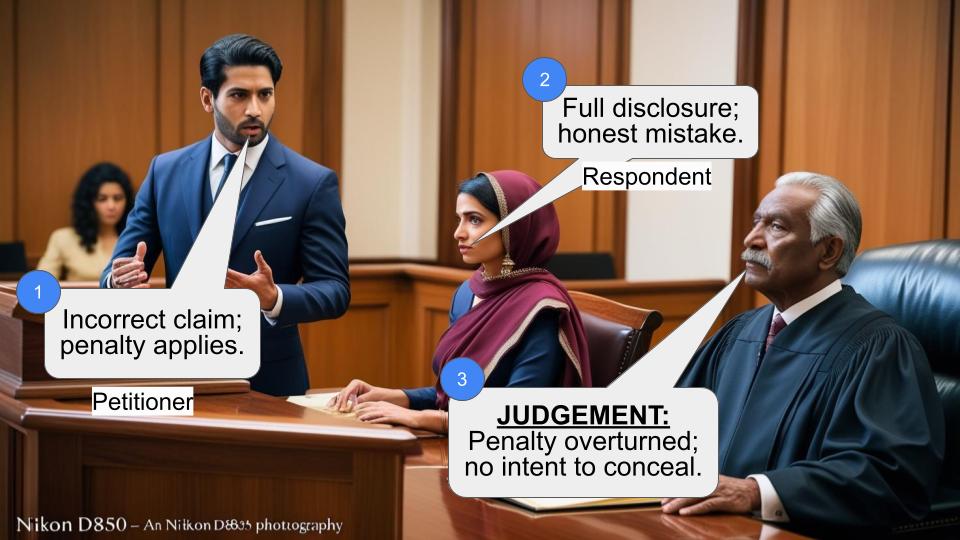
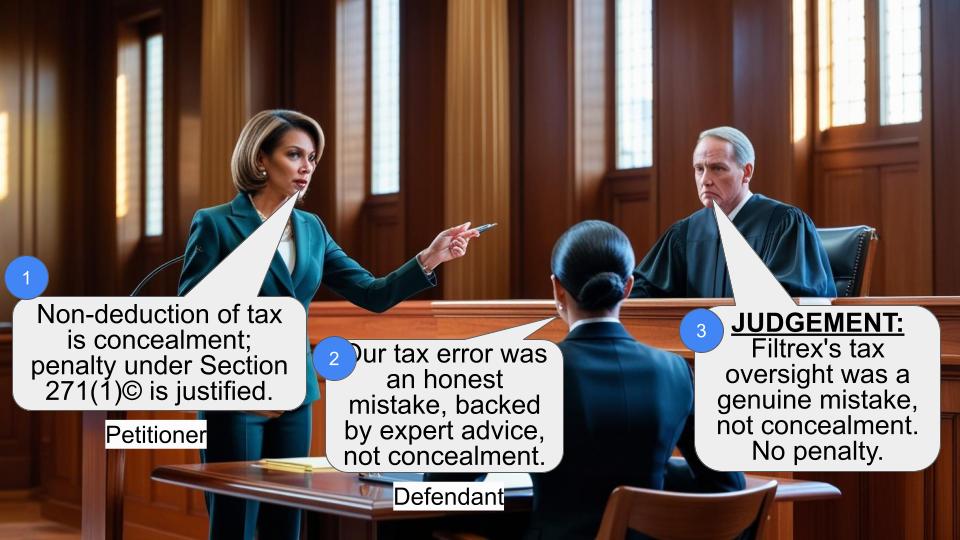
In this case, the Income Tax Department appealed against a decision by the Income Tax Appellate Tribunal, which upheld the Commissioner of Income Tax (Appeals) [CIT(A)]'s decision to delete a penalty imposed on H. V. Williams & Company. The penalty was initially levied due to an error made by the company’s accountant, which was not found to be mala fide. The High Court dismissed the Department’s appeal, agreeing with the Tribunal’s decision.
Get the full picture - access the original judgement of the court order here
Case Name
Principal Commissioner of Income Tax vs. H. V. Williams & Company (High Court of Calcutta)
ITAT 104 of 2015
Date: 2nd December 2015
Key Takeaways
- The court emphasized that a genuine mistake by an accountant, if not mala fide, does not justify a penalty under Section 271(1) (of Income Tax Act, 1961)© of the Income Tax Act.
- The decision reinforces the principle that penalties should not be imposed for honest errors that are promptly disclosed and corrected.
- The case highlights the importance of intent in determining the imposition of penalties for tax-related errors.
Issue
Was the Assessing Officer justified in imposing a penalty under Section 271(1) (of Income Tax Act, 1961)© of the Income Tax Act for an error made by the assessee’s accountant, which was not mala fide?
Facts
- H. V. Williams & Company, a firm engaged in the profession of attorneys, filed its income tax return for the assessment year 2007-08.
- The return included a misclassification of professional income as income from mutual funds, due to an accountant’s error.
- The Assessing Officer (AO) imposed a penalty under Section 271(1) (of Income Tax Act, 1961)© for this misclassification and for disallowance of partners’ remuneration.
- The assessee explained that the error was not intentional and was due to the accountant’s mistake.
Arguments
- Assessee’s Argument: The error was a bona fide mistake by the accountant and not an attempt to conceal income. The mistake was self-detected and disclosed during the assessment proceedings.
- Department’s Argument: The AO argued that the misclassification warranted a penalty as it led to an incorrect declaration of income.
Key Legal Precedents
- The court referred to the principles laid down by the Hon’ble Supreme Court in the case of Price Waterhouse Coopers Pvt Ltd, which supports the view that genuine errors should not attract penalties if they are not mala fide.
Judgement
The High Court dismissed the Department’s appeal, agreeing with the Tribunal and CIT(A) that the penalty was unjustified. The court noted that the error was not mala fide and the explanation provided by the assessee was not rebutted by the AO. Therefore, the penalty under Section 271(1) (of Income Tax Act, 1961)© was deleted.
FAQs
Q: What was the main reason for deleting the penalty?
A: The penalty was deleted because the error was a genuine mistake by the accountant and not an intentional act to conceal income.
Q: Does this case mean all accounting errors are exempt from penalties?
A: No, only errors that are bona fide and not mala fide, and are promptly disclosed and corrected, may be exempt from penalties.
Q: What section of the Income Tax Act was involved in this case?
A: Section 271(1) (of Income Tax Act, 1961)© of the Income Tax Act, which deals with penalties for concealment of income or furnishing inaccurate particulars of income.

This income tax appeal pertaining to A.Y. 2007-08 has been preferred by the Department against the order passed by the Income Tax Appellate Tribunal “A” Bench, Kolkata in ITA No.1281/Kol/2011, whereby the Tribunal had upheld the order of the CIT(A) in deleting the penalty so levied by the Assessing Officer and had dismissed the appeal filed by the Department.
Heard Mr. Chowdhury, learned advocate for the appellant and Mr. Bharadwaj, learned advocate for the respondent.
It appears that while passing the assessment order the Assessing Officer had initiated penalty proceedings under Section 271(1) (of Income Tax Act, 1961)© of the Income Tax Act, 1961 and had passed an order.
Aggrieved, the assessee preferred an appeal before the CIT(A). The CIT(A) while deleting the imposition of penalty had held as under :
“4. I have considered the submission of the appellant and perused the assessment order as well as the penalty order. I have also gone through the assessment record and judicial pronouncements relied upon by the appellant. It is observed that the appellant, a firm which is engaged in the profession of attorney, had filed its return of income for A.Y. 2007-08 declaring income of Rs.12,23,550/-. In the assessment order completed u/s. 143(3) (of Income Tax Act, 1961), the AO made an addition of Rs.34,66,017/- being the professional income included in the income from mutual funds. The AO has made disallowance of Rs.2,76,893/- on account of partners remuneration debited to the P/L account. On both the above-mentioned additions/disallowances, the AO also initiated penalty proceedings u/s. 271(1)(c) (of Income Tax Act, 1961). It is observed that in the P/L account, the appellant had credited sum of Rs.50,29,581/- under the head ‘income from mutual fund’.
However, in the said income, sum of Rs.34,66,017/- was included which was actually the professional income. Hence, the said income was added by the AO as income from professional and accordingly the income from mutual fund was reduced. During the course of assessment proceedings as well as the penalty proceedings. It is submitted before the AO that the mistake in classification of income has been committed by the appellant’s accountant. However, while passing the order u/s. 271 (of Income Tax Act, 1961) (1)(c) of the Act, the contention of the appellant was not accepted by the AO and he imposed the penalty on aforesaid addition of Rs.34,66,017/-. The AO also imposed penalty on disallowance of partners remuneration. On careful consideration of the facts, I am of the opinion that the AO was not justified in imposing the penalty u/s. 271(1)(c) (of Income Tax Act, 1961). On perusal of assessment record and assessment order, it is observed that the AO had made the addition of Rs.34,66,017/- as business income under the heading “Mis-classed Income”. It is also observed that nowhere it is mentioned that the mistake of inclusion of some professional income with the income from mutual funds was detected by the AO and it is fact on record that with regard to the said income no explanation etc. was sought for by the A.O. Hence, the contention of the appellant that the aforesaid mistake was detected by the appellant itself while submitting the details cannot be ignored and in the assessment order the AO himself has mentioned in point no.3 that the A.R. of the appellant admitted the error in representation and submitted the ledge accounts. At the time of penalty proceedings the appellant reiterated its submission that the mistake of including certain account of professional income in the ledger account of income from mutual fund was due to mistake of the Accountant and that the said mistake was a bona fide mistake and not an intentional one. I am of the opinion that merely for the reason that certain additions/disallowances has been made in the assessment order, it cannot lead to conclude that the assessee has concealed its income or has filed inaccurate particulars of his income. The explanation offered before the AO was not found to be false or not bonafide.
In the case of appellant, the AO has made the addition on account of professional income and made the disallowance for partners salary. It was explained before the AO that the mistakes were committed by the Accountant while writing the books. The said mistake was also detected by the appellant and disclosed to the AO. while filing the details at the time of assessment proceedings. The explanation offered by the appellant was not found to be false or not bona fide. In view of above facts and the principles laid down in the various judicial pronouncements, it is to be held that the AO was not justified in imposing the penalty u/s. sec 271 (of Income Tax Act, 1961) (1)(c) at Rs.12,59,860/-. The AO is directed to delete the penalty imposed by him. In the result, the appeal is allowed.”
The Department, being aggrieved by the order of the CIT(A), preferred an appeal before the Tribunal. The Tribunal, as noted, while dismissing the appeal, had held as under:
“10. We have considered the rival submission and carefully gone through the material available on record. In the present case, it is an admitted fact that during the course of assessment proceedings the assessee itself came to know that is accountant has committed a mistake and considered the ‘Professional income of Rs.34,66,107/- under the head ‘income from mutual funds’.
Which was claimed as exempt. Accordingly, the AO disallowed and added back the sum of Rs.34,66,017/- to the income of the assessee. The explanation of the assessee was that the such mistake was attributable being an error of the accountant and it was not malafide. The said explanation was not rebutted.
12. In the present case also the mistake was committed by the accountant of the assessee. Even it was not noticed by the AO, and the assessee itself during the course of assessment proceedings while preparing the details from its ledge accounts came to know the said mistake had been committed by the accountant and proposed for addition. Therefore, through a bonafide and inadvertent error the assessee claimed the income as exempt and wrongly provided for partners’ salary. But the submissions of the assessee was that the error occurred by a mistake of its accountant, who treated the said professional income as income from Mutual funds’ and the salary was claimed on the basis of the clause mentioned in the original partnership deed was not found to be false. We, therefore, keeping in view of the ratio laid down by the Hon’ble Supreme Court in the case of Price Waterhouse Coopers Pvt Ltd [Supra] are of the view that the ld. CIT(A) was justified in deleting the penalty so levied by the AO. Accordingly, we uphold the order of the ld. CIT(A) on this issue.
13. In the result, the appeal of the department is dismissed.” Since we find that the assessee explained that the mistake was due to the error of the accountant and it was not mala fide and was not rebutted by the Assessing Officer in his order, which was duly noted by the CIT(A) and the Tribunal in their respective orders, we are of the opinion that the Tribunal was justified in dismissing the appeal.
Therefore, the application is dismissed. The appeal is not admitted.
[ SOUMITRA PAL, J. ]
[ MIR DARA SHEKO, J.
×
Questions
Accountant’s Error Saves Assessee from Penalty: Tribunal Upholds CIT(A) Decision
Write your CommentSimilar Posts

Generic
- Reportdata/3267.pdf
