


Full News

AO Must Issue Notice u/s 143(2) (of Income Tax Act, 1961) Before Proceeding u/s 144 (of Income Tax Act, 1961)
AO Must Issue Notice u/s 143(2) (of Income Tax Act, 1961) Before Proceeding u/s 144 (of Income Tax Act, 1961)
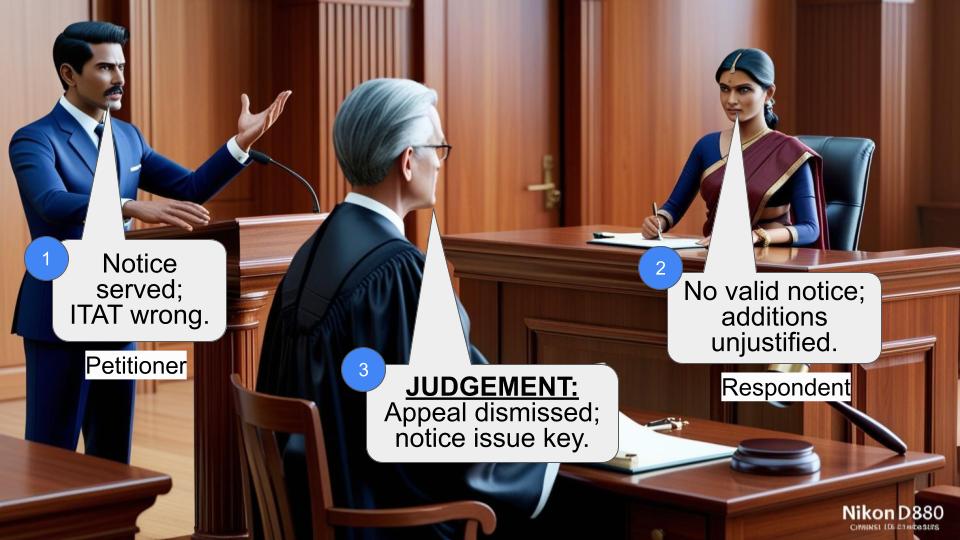
The case involves the Commissioner of Income Tax and Delhi Kalyan Samiti, where the main issue was whether the Assessing Officer (AO) could bypass issuing a notice under Section 143(2) (of Income Tax Act, 1961) and proceed directly under Section 144 (of Income Tax Act, 1961). The court ruled that it is mandatory for the AO to issue a notice under Section 143(2) (of Income Tax Act, 1961) if the return filed by the assessee is not accepted at face value.
Get the full picture - access the original judgement of the court order here
Case Name:
Commissioner of Income Tax & Ors. Vs. Delhi Kalyan Samiti & Ors. (High Court of Delhi)
ITA 696/2015
Date: 22nd March 2016
Key Takeaways:
- The court emphasized the necessity of issuing a notice under Section 143(2) (of Income Tax Act, 1961) before proceeding under Section 144 (of Income Tax Act, 1961).
- The decision reinforces the procedural requirements for assessment under the Income Tax Act.
- The ruling clarifies that a belated return cannot be ignored if filed before the assessment.
Issue
Can the Assessing Officer proceed directly under Section 144 (of Income Tax Act, 1961) without issuing a notice under Section 143(2) (of Income Tax Act, 1961) when the return filed by the assessee is not accepted at face value?
Facts
- The assessee, Delhi Kalyan Samiti, filed returns that were not accepted by the AO.
- The AO issued a notice under Section 142(1) (of Income Tax Act, 1961) but did not issue a notice under Section 143(2) (of Income Tax Act, 1961).
- The AO proceeded to pass assessment orders under Section 144 (of Income Tax Act, 1961), ignoring the returns filed by the assessee.
Arguments
- Revenue’s Argument: The Revenue contended that a notice under Section 143(2) (of Income Tax Act, 1961) was not necessary if the assessee failed to respond to a notice under Section 142(1) (of Income Tax Act, 1961).
- Assessee’s Argument: The assessee argued that the returns filed should not be ignored and that a notice under Section 143(2) (of Income Tax Act, 1961) is mandatory.
Key Legal Precedents
- Pr. CIT v. Silver Line and Anr.: Reinforces the necessity of issuing a notice under Section 143(2) (of Income Tax Act, 1961) when a return is not accepted at face value.
- ACIT v. Hotel Blue Moon: Establishes the procedural requirements for assessment.
- CIT v. Pawan Gupta: Supports the mandatory issuance of notice under Section 143(2) (of Income Tax Act, 1961).
Judgement
The court ruled in favor of the assessee, stating that the AO must issue a notice under Section 143(2) (of Income Tax Act, 1961) if the return is not accepted at face value. The court dismissed the Revenue’s appeal, emphasizing the procedural requirements under the Income Tax Act.
FAQs
Q1: What happens if the AO does not issue a notice under Section 143(2) (of Income Tax Act, 1961)?
A1: The AO cannot proceed under Section 144 (of Income Tax Act, 1961) without issuing a notice under Section 143(2) (of Income Tax Act, 1961) if the return is not accepted at face value.
Q2: Can a belated return be ignored by the AO?
A2: No, a belated return filed before the assessment cannot be ignored as invalid.
Q3: What is the significance of this judgment?
A3: It reinforces the procedural requirements for assessment under the Income Tax Act, ensuring fairness and due process for the assessee.

1. These appeals have been filed by the Revenue under Section 260A (of Income Tax Act, 1961) of the
Income Tax Act against a common order dated 4th March, 2015 („the impugned order‟ )passed by the Income Tax Appellate Tribunal („ITAT‟) for the Assessment Years („AYs‟) 2000-01, 2001-02 & 2002-03.
2. By the impugned order, the ITAT has disposed of six appeals – three
appeals filed by the Assessee and three appeals filed by the Revenue – assailing a common order dated 29th January, 2010 passed by the Commissioner of Income Tax [CIT(A)] which in turn disposed of the Assessees‟ appeals against separate assessment orders passed by the Assessing Officer („AO‟) under Section 144 (of Income Tax Act, 1961)/148 of the Act.
3. The Revenue has limited its challenge to the ITAT‟s finding that the
assessment orders in question are as having been passed without issuing any
notice under Section 143(2) (of Income Tax Act, 1961). It is contended on behalf of the
Revenue that in the facts of the case are that no such notice was necessary
before passing assessment orders under Section 144 (of Income Tax Act, 1961). The above
conclusion is disputed and it is further contended on behalf of the Assessee
that the issue stands fully covered by the decision of this Court in Principal Commissioner of Income Tax v. Silver Line (2016) 283 CTR 148 (Del).
4. The relevant facts necessary to consider the aforesaid controversy are as
under:
4.1. The Assessee is a society promoted by the Government of National
Capital Territory of Delhi and was registered under the Societies
Registration Act on 31st March, 1995. The Assessee applied for registration
under Section 12A (of Income Tax Act, 1961) and the same was granted with
effect from 1st April, 2005 by an order dated 12th January, 2006 passed by
the Director of Income Tax (Exemption).
4.2 The Assessee was established pursuant to a Cabinet decision no.125
dated 16th March, 1995 whereby an amount of Rs.38.74crores from the
erstwhile lottery fund, which was lying in a fixed deposit, was transferred to the Welfare Fund of the Assessee. The balance sheet of the Assessee for the year ended 31st March, 2002, 31st March, 2003 and 31st March, 2004
(relevant to AY 2002-03, 2003-04 and 2004-05) reflected an amount of
Rs.53.26 crores as “Deposit transferred from Delhi Lotteries”. The AO
believed that the income of the Assessee had escaped assessment for the
relevant AYs since the registration of the Assessee under Section 12A (of Income Tax Act, 1961) of the
Act was effective only from AY 2006-07 onwards. Accordingly, he issued a
notice under Section 148 (of Income Tax Act, 1961) on 29th March, 2007 for the relevant
AYs.
4.3 The Assessee objected to the reopening of the assessments, however, the
its objections were rejected by the AO.
4.4 It is relevant to note that the notices issued under Section 148 (of Income Tax Act, 1961) called upon the Assessee to file its returns for the respective AYs within a period of 30 days from the date of the notices. Concededly, the Assessee failed to file the same within the specific period.
4.5 Thereafter, the AO issued notices (all dated 12th September, 2007) under
Section 142(1) (of Income Tax Act, 1961), which were followed by similar notices on 15th
November, 2007 and 30th November, 2007. All the aforesaid notices were
in standard form and apart from calling upon the Assessee to file correct
return of income also called upon the Assessee to furnish details as per
questionnaire enclosed with the said notices.
4.6 The Assessee filed its returns of income on 19th December, 2007,
however, the same was not taken note of by the AO who proceeded to pass
assessment orders (all dated 24th December, 2007) under Section 144 (of Income Tax Act, 1961) read
with Section 147 (of Income Tax Act, 1961).
4.7 Admittedly, no notice under Section 143(2) (of Income Tax Act, 1961) was issued or
served on the Assessee and the assessment orders indicate that the AO did
not take note of the returns filed by the Assessee while passing the
assessment orders.
4.8 Mr Dileep Shivpuri, learned Senior Standing counsel submitted that
since the Assessee had failed to file its returns for the relevant AYs within the time prescribed in the notices issued under Section 148 (of Income Tax Act, 1961), the said returns were invalid and were rightly ignored by the AO. He submitted that in the circumstances no notice under Section 143(2) (of Income Tax Act, 1961) was required to be issued to the Assessee. He further submitted that the present assessments were framed under Section 144(1)(b) (of Income Tax Act, 1961) - on account of failure on the part of an Assessee to comply with all terms of a notice issued under Section 142(1) (of Income Tax Act, 1961) or failure to comply with directions issued under Section 142(A) (of Income Tax Act, 1961) - and issuance of notice under Section 143(2) (of Income Tax Act, 1961) is not a necessary precondition for the same. He contended that the position would be no different even if the returns were filed in the regular course. Mr Dileep Shivpuri relied on the decision of this Court in Ashok Chaddha v. ITO: (2011) 337 ITR 399 (Delhi) in support of its contention that no notice under Section 143(2) (of Income Tax Act, 1961) was required to be issued.
5. Mr Gautam Jain, learned counsel appearing for the Assessee countered
the submissions made by Mr Shivpuri and urged that the returns filed by the
Assessee could not be ignored as being invalid. He submitted that a delay in
filing a return pursuant to a notice under Section 148 (of Income Tax Act, 1961) did not
render the return invalid and the only consequences visited upon the
assessee would be levy of interest under Section 234A (of Income Tax Act, 1961).
6. Mr Gautam Jain further referred to the order sheet and pointed out that on 10th December, 2007, the Assessee‟s representative had informed the AO
that it was in the process of filing its returns and had sought adjournment,
which was granted. He contended that having granted the adjournment for
filing the return it would not be open for the AO to then ignore the said
returns. He submitted that in any event, the returns were filed within a
reasonable time of the last notice issued under Section 142 (of Income Tax Act, 1961) - 30th November, 2007.
7. We have heard the learned counsel for the parties.
8. At the outset, we are unable to accept Mr Shivpuri‟s contention that even
in cases where valid returns have been filed the AO could proceed to frame
an assessment under Section 144 (of Income Tax Act, 1961) without issuance of any notice
under Section 143(2) (of Income Tax Act, 1961).
9. It is now well established that if the AO does not accept the return filed by the Assessee on its face and he is required to issue a notice under Section 143(2) (of Income Tax Act, 1961) and provide an opportunity to the Assessee to produce the necessary material in support of his return. Mr Shivpuri had argued that a notice under Section 143(2) (of Income Tax Act, 1961) was required to be issued only in cases where the AO considers it necessary or expedient to do so and in cases where the Assessee had not filed its response to the notice under Section 142(1) (of Income Tax Act, 1961) it was not necessary for the AO to issue such notice under Section 143(2) (of Income Tax Act, 1961). In our view, this contention is bereft of any merits and completely ignores the scheme of the machinery provisions for assessment under the Act. It is now well settled by a number of decisions (See: Pr. CIT v. Silver Line and Anr.: 283 CTR 148 (Del), ACIT v. Hotel Blue Moon: 321 ITR 362 (SC) and CITv. Pawan Gupta: 318 ITR 322 (Del)) that whenever the return filed by an
Assessee is not accepted at its face, it is mandatory for the AO has to issue a notice under Section 143(2) (of Income Tax Act, 1961) for proceeding further. It is thus not open for the AO to not issue a notice under Section 143(2) (of Income Tax Act, 1961) and proceed directly under Section 144 (of Income Tax Act, 1961) by rejecting the return filed by the Assessee.
10. The decision of this Court in Ashok Chaddha (supra) was rendered in
the context of Section 153A (of Income Tax Act, 1961) and in our view, the same is not
applicable in the present case. This Court in several cases pertaining to
proceedings under Section 147 (of Income Tax Act, 1961) has held that a notice under Section 143(2) (of Income Tax Act, 1961) is
mandatory. [See: Alpine Electronics Asia (P.) Ltd. v. DGIT: 341 ITR 247
(Del), DIT v. Society for Worldwide Interbank Financial
Telecommunication: 323 ITR 249 (Del), Pr. CIT v Shri Jai Shiv Shankar
Traders Pvt. Ltd.: 282 CTR 435 (Del) and CIT v. Rajeev Verma: 336 ITR
(All)]. It is also relevant to note that clause (b) of the proviso to Section 148(1) (of Income Tax Act, 1961) also specifically extends the period for issuance of notice under Section 143(2) (of Income Tax Act, 1961).
11. Mr Jain‟s contention that a belated return filed by the Assessee prior
to the assessment cannot be ignored as an invalid return, prima facie,
appears to be merited. However, in the facts of the present case, the said
question does not arise as the AO had issued a notice under Section 142(1) (of Income Tax Act, 1961)
of the Act on 30th November, 2011, inter alia, calling upon the Assessee to
file its return. Further, on 10th December 2007, the AO was informed that
the Assessee was in the process of filing its return and an adjournment was
requested. The AO had acceded to his request, which would be wholly
unnecessary if the AO was of the view that a belated return would be
invalid. Thus, in the facts of the present case, the returns filed by the
Assessee could not be ignored by the AO.
12. We find no infirmity with the impugned order passed by the ITAT. No
substantial question of law arises in the present appeals. The same are,
accordingly, dismissed. However, in the circumstances, the parties are left to bear their own costs.
S.MURALIDHAR, J
VIBHU BAKHRU, J
MARCH 22, 2016
×
Similar Ripples
Questions
AO Must Issue Notice u/s 143(2) (of Income Tax Act, 1961) Before Proceeding u/s 144 (of Income Tax Act, 1961)
Write your CommentSimilar Posts


Generic
- Reportdata/2978.pdf
