


AO's Power to Reassess Upheld: Intimation Under 143(1)(a) Doesn't Bar Reopening


Full News

AO's Power to Reassess Upheld: Intimation Under 143(1)(a) Doesn't Bar Reopening
AO's Power to Reassess Upheld: Intimation Under 143(1)(a) Doesn't Bar Reopening
This case involves Paridhan Exports challenging the Income Tax Department's decision to reopen their assessment for the 1998-1999 tax year. The High Court upheld the Assessing Officer's (AO) jurisdiction to initiate reassessment proceedings, even when an intimation under section 143(1)(a) (of Income Tax Act, 1961) had been issued earlier.
Get the full picture - access the original judgement of the court order here
Case Name:
Paridhan Exports vs Assistant Commissioner of Income Tax (High Court of Madras)
Tax Case (Appeal) No.1181 of 2007
Date: 17th December 2007
Key Takeaways:
1. An intimation under section 143(1)(a) (of Income Tax Act, 1961) is not equivalent to a full assessment.
2. The AO retains the power to reopen assessments even after issuing an intimation.
3. "Reason to believe" in section 147 (of Income Tax Act, 1961) doesn't require conclusive proof, just reasonable grounds.
4. Failure to take steps under section 143(3) (of Income Tax Act, 1961) doesn't prevent the AO from initiating reassessment.
Issue:
Does the Assessing Officer have the jurisdiction to reopen an assessment under section 148 (of Income Tax Act, 1961) when an intimation under section 143(1)(a) (of Income Tax Act, 1961) has been previously issued?
Facts:
1. Paridhan Exports, a registered firm, filed a nil income tax return for the 1998-1999 assessment year on 2.11.1998.
2. The return was processed under section 143(1)(a) (of Income Tax Act, 1961) on 14.8.2000.
3. A notice under section 148 (of Income Tax Act, 1961) was issued on 24.8.2000 to reopen the assessment.
4. The AO made several disallowances in the reassessment order dated 4.3.2002.
5. The assessee appealed to the CIT(Appeals), then to the Income Tax Appellate Tribunal, both of which upheld the AO's jurisdiction to reopen the assessment.
Arguments:
Assessee's arguments:
1. The assessment was completed after active application of mind by the AO.
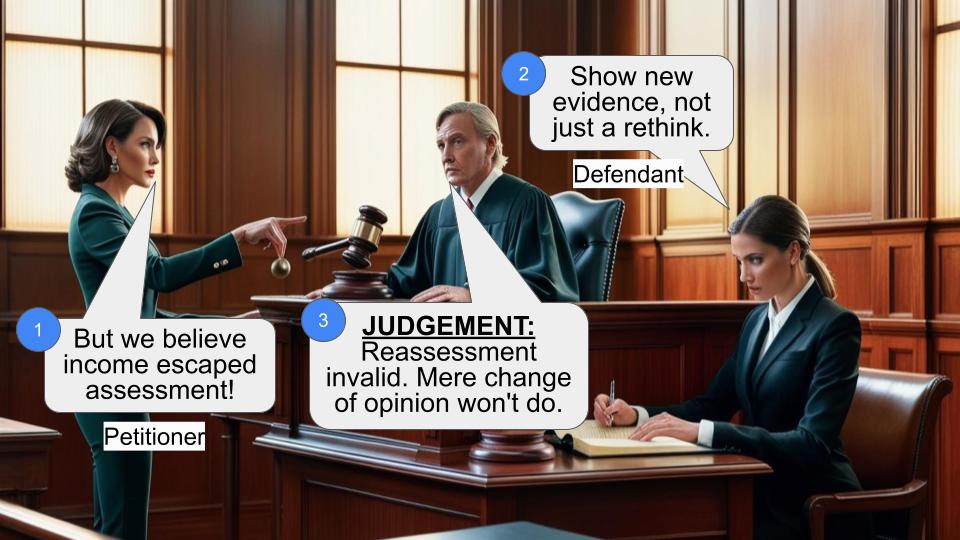
2. Reopening the assessment amounts to a change of opinion.
3. All relevant materials were truly and fully disclosed for the original assessment.
Department's arguments:
1. The original processing under 143(1)(a) was not a full assessment.
2. There was no change of opinion as no opinion was formed during the initial processing.
3. The AO had jurisdiction to reopen the assessment based on new information.
Key Legal Precedents:
The court heavily relied on the Supreme Court judgment in "Assistant Commissioner of Income Tax vs. Rajesh Jhaveri Stock Brokers P. Ltd." (291 ITR 500 (SC)). This case established that:
1. An intimation under section 143(1)(a) (of Income Tax Act, 1961) is not an assessment order.
2. The AO has no authority to make adjustments or adjudicate debatable issues under 143(1)(a).
3. The concept of "change of opinion" doesn't apply to intimations under 143(1)(a).
4. "Reason to believe" in section 147 (of Income Tax Act, 1961) doesn't require conclusive proof of income escaping assessment.
Judgement:
The High Court dismissed the appeal, upholding the AO's jurisdiction to reopen the assessment. Key points:
1. An intimation under 143(1)(a) is not a full assessment, so the question of change of opinion doesn't arise.
2. The AO had jurisdiction to issue notice under section 148 (of Income Tax Act, 1961) to bring to tax income escaping assessment.
3. Failure to take steps under section 143(3) (of Income Tax Act, 1961) doesn't render the AO powerless to initiate reassessment proceedings when an intimation under section 143(1)(a) (of Income Tax Act, 1961) has been issued.
FAQs:
1. Q: What's the difference between an intimation and an assessment?
A: An intimation under 143(1)(a) is a preliminary processing of the return, while an assessment under 143(3) involves detailed scrutiny by the AO.
2. Q: Can the AO reopen an assessment if they've already issued an intimation?
A: Yes, the AO retains the power to reopen an assessment even after issuing an intimation under 143(1)(a).
3. Q: What does "reason to believe" mean in the context of reopening an assessment?
A: It means the AO has reasonable grounds to think income has escaped assessment, but doesn't need conclusive proof at the notice stage.
4. Q: Does this judgment apply to all cases where an intimation was issued?
A: While it sets a precedent, each case would still be judged on its own merits and circumstances.
5. Q: How long after an intimation can an AO reopen an assessment?
A: The judgment doesn't specify a time limit, but generally, the law allows reopening within 4-6 years, depending on the amount involved.

The appeal is filed against the order of the Income-tax Appellate Tribunal, 'B' Bench, Chennai dated 27.7.2006 made in I.T.A.No.232/Mds/2003 for the assessment year 1998-1999.
2. The facts as culled out from the statement of facts are as follows:-
The assessee, a registered firm engaged in the business of manufacture and export of garments and also carrying on money lending business. For the assessment year 1998-99, the appellant-assessee filed its return of income on 2.11.1998 declaring nil total income after claiming deductions under Section 80 (of Income Tax Act, 1961) HHC and 80IA of Income Tax Act 1961. The return of income was processed and assessment completed under Section 143(1)(a) (of Income Tax Act, 1961) on 14.8.2000. Subsequently notice under Section 148 (of Income Tax Act, 1961) was issued on 24.8.2000 and the assessment was reopened. The appellant filed letter dated 4.10.2000 requesting to treat the original return of income filed in response to notice under Section 148 (of Income Tax Act, 1961). The assessing officer asked the assessee to explain as to why the interest income should not be treated as income from other sources and disallow the benefit under under Section 80 (of Income Tax Act, 1961) HHC as it was not derived from export business and (ii) as to whey the interest income and export entitlements /duty draw back should not be deducted from the profits for the purpose of deduction under Section 80 (of Income Tax Act, 1961) IA as these were not derived from the industrial undertaking ? While completing the assessment under Section 143(3) (of Income Tax Act, 1961) read with Section 147 (of Income Tax Act, 1961) vide order dated 4.3.2002 the following disallownaces were made by the assessing officer.
a) Interest income was treated as income from other sources and disallowed the benefit under Section 80HHC (of Income Tax Act, 1961).
(b) Interest income and export entitlements /duty drawback reduced from the profits of the business and disallowed the deduction u/s 80IA (of Income Tax Act, 1961) and
(c) Restricted the deduction u/s 80 (of Income Tax Act, 1961) HHC and 80IA to business income as arrived at by the assessing Officer at Rs.2,73,99,368/-.
3. The appellant carried the matter on appeal before the Commissioner of Income Tax (Appeals) primarily questioning the jurisdiction of the authorities to reopen the assessment. The Commissioner of Income Tax (Appeals) upheld the jurisdiction of the assessing officer in reopening the assessment and partly allowed the appeal on other issues on merits. Aggrieved by that portion of the order that went against him the appellant filed appeal before the Income Tax Appellate Tribunal. The Tribunal by its order dated 27.7.2006 dismissed the appeal by holding that original assessment was done u/s 143(1)(a) (of Income Tax Act, 1961) and it is not correct to contend that the assessment was made after active application of the assessing officer. The correctness of the said order is now put in issue before this Court by framing the following substantial questions of law:-
1. Whether on the facts and in the circumstances of the case, the Income Tax Appellate Tribunal was right in law in upholding the jurisdiction of the assessing Officer in reopening the assessment by holding that there was no change of opinion, even when the appellant had truly and fully disclosed all the relevant materials for completion of assessment ?
2. Whether on the facts and in the circumstances of the case, the Income Tax Appellate Tribunal was right in law in holding that when the assessment was completed u/s 143(1)(a) (of Income Tax Act, 1961), it cannot be considered to be assessment after active application of mind by the Assessing officer and there was no change of opinion and could be validly reopened ?
4. We heard the arguments of the learned counsel for the appellant and perused the materials on record.
5. The issue similar to the present case of reopening the assessment came to be considered by the Supreme Court in the case of ASSISTANT COMMISSIONER OF INCOME TAX VS. RAJESH JHAVERI STOCK BROKERS P.LTD (291 ITR 500 (SC). In that case, the apex Court considering the relevant provisions, has held that under the Scheme of Section 143(1) (of Income Tax Act, 1961) as substituted with effect from April 1, 1989, and prior to its substitution with effect from June 1, 1999, what were permissible to be adjusted under the first proviso to section 143(1)(a) (of Income Tax Act, 1961) were: (i) only apparent arithmetical errors in the return, accounts or documents accompanying the return, (ii) loss carried forward, deduction, allowance or relief, which was prima facie admissible on the basis of information available in the return but not claimed in the return, and similarly (iii) those claims which were, on the basis of the information available in the return, prima facie inadmissible, and were to be rectified/allowed/disallowed. What was permissible was correction of errors apparent on the basis of the documents accompanying the return. The Assessing officer had no authority to make adjustments or adjudicate upon any debatable issues. In other words, the Assessing Officer had no power to go behind the return, accounts and documents, either in allowing or in disallowing deductions, allowance or relief. Though technically the intimation issued was deemed to be a demand notice under Section 156 (of Income Tax Act, 1961), that did not preclude the right of the Assessing Officer to proceed under Section 143(2) (of Income Tax Act, 1961) : that right is preserved and not taken away. The apex Court further observed that with effect from April 1, 1998, the second proviso to section 143(1)(a) (of Income Tax Act, 1961) was substituted. During the period between April 1, 1998, and May 31, 1999, sending of an intimation was mandatory. The legislative intent is very clear from the use of the word "intimation" as substituted for "assessment" that two different concepts emerge. While making an assessment, the Assessing Officer is free to make any addition after grant of opportunity to the assessee. By making adjustments under the first proviso to section 143(1)(a) (of Income Tax Act, 1961) no addition which is impermissible by the information given in the return could be made by the Assessing Officer. The intimation under section 143(1)(a) (of Income Tax Act, 1961) could not be treated to be an order of assessment.
Under the first proviso to the newly substituted section 143(1) (of Income Tax Act, 1961), with effect from June, 1, 1999, except as provided in the provision itself, the acknowledgment of the return shall be deemed to be an intimation under Section 143(1) (of Income Tax Act, 1961) where (a) either no sum is payable by the assessee, or ( b) no refund is due to him. It is significant that the acknowledgment is not done by any Assessing Officer, but mostly by ministerial staff. It could not therefore be said that an "assessment" is done by them. The intimation under Section 143(1)(a) (of Income Tax Act, 1961) was deemed to be a notice of demand under Section 156 (of Income Tax Act, 1961) for the apparent purpose of making machinery provisions relating to recovery of tax applicable. By such application only recovery indicated to be payable in the intimation became permissible. Nothing more could be inferred from the deeming provisions. Therefore, there being no assessment under Section 143(1)(a) (of Income Tax Act, 1961), the question of change of opinion does not arise.
It was further observed by the apex Court that the expression "reason to believe" in Section 147 (of Income Tax Act, 1961) would mean cause or justification. If the Assessing officer has cause or justification to know or suppose that income had escaped assessment, he could be said to have reason to believe that income had escaped assessment. The expression could not be read to mean that the Assessing Officer should have finally ascertained the fact by legal evidence or conclusion. What was required is "reason to believe" but not the established fact of escapement of income. At the stage of issue of notice, the only question was whether there was relevant material on which a reasonable person could have formed the requisite belief. Whether material would conclusively prove escapement of income was not the concern at that stage. This was so because the formation of the belief is within the realm of the subjective satisfaction of the Assessing Officer.
Taxing income escaping assessment in the case of an intimation under Section 143(1)(a) (of Income Tax Act, 1961) is covered by the main provision of Section 147 (of Income Tax Act, 1961) as substituted with effect from April 1, 1989 and initiating reassessment proceedings in the case of intimation would be covered by the main provision of section 147 (of Income Tax Act, 1961) and not the proviso thereto. Only one condition has to be satisfied. Failure to take steps under Section 143(3) (of Income Tax Act, 1961) will not render the Assessing Officer powerless to initiate reassessment proceedings when intimation under Section 143(1) (of Income Tax Act, 1961) has been issued. The apex Court ultimately held that the assessing officer had jurisdiction to issue notice under section 148 (of Income Tax Act, 1961) for bringing to tax the income escaping assessment in an intimation under section 143(1)(a) (of Income Tax Act, 1961) on the ground that the claim for bad debts by the assessee was not acceptable as the conditions for allowance specified in section 36(1)(vii) (of Income Tax Act, 1961) and 2 (of Income Tax Act, 1961) were not fulfilled.
6. In view of the categorical exposition of law by the Supreme Court in respect of question of law raised, we are of the view that the appeal does not merit consideration and has to be dismissed and accordingly the same is dismissed. (K.R.P.,J.) (C.V.,J.)
17.12.2007
1.The Assistant Registrar, Income-Tax Appellate Tribunal, III Floor, Rajaji Bhavan, Besant Nagar, Madras 90 (with records five copies).
2.The Secretary, Central Board of Revenue, New Delhi (3 copies).
3. The Assistant Commissioner of Income Tax, Circle (IV) Chennai 34. K.RAVIRAJA PANDIAN,J
AND
CHITRA VENKATARAMANJ Dated : 17.12.2007
×
Similar Ripples
Questions
AO's Power to Reassess Upheld: Intimation Under 143(1)(a) Doesn't Bar Reopening
Write your CommentSimilar Posts

Generic
- Reportdata/5077.pdf
