


Full News
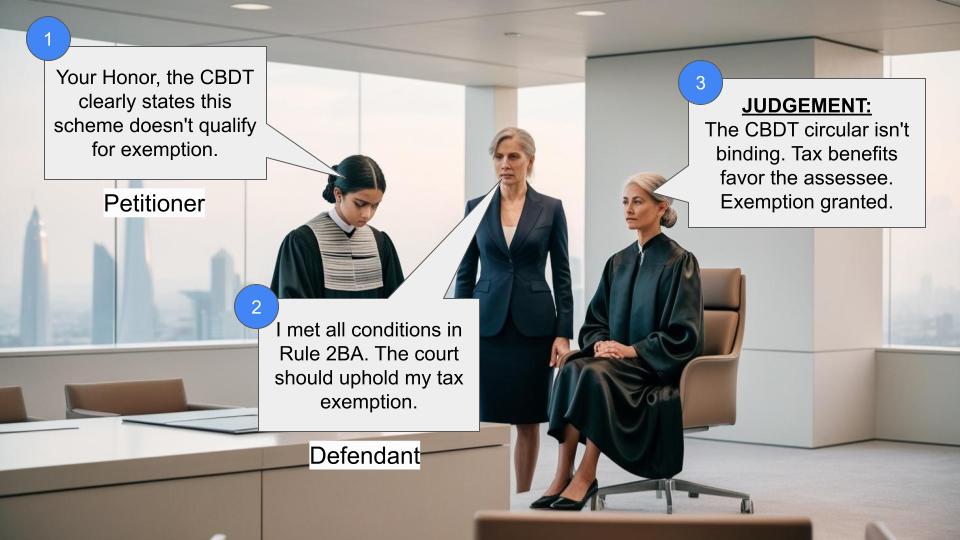
CBDT Clarification Not Binding on Courts: High Court Upholds Tax Exemption for Voluntary Retirement Scheme
CBDT Clarification Not Binding on Courts: High Court Upholds Tax Exemption for Voluntary Retirement Scheme
This case involves a dispute between the Income Tax Department and a retired employee of State Bank of India over the tax exemption of compensation received under a voluntary retirement scheme. The High Court ruled in favor of the retired employee, affirming that the Central Board of Direct Taxes (CBDT) clarification is not binding on the courts and upheld the tax exemption under Section 10(10C) (of Income Tax Act, 1961).
Case Name
: COMMISSIONER OF INCOME TAX VS APPASAHEB BABURAO KAMBLE
Key Takeaways:
1. CBDT clarifications are not binding on courts.
2. Tax benefits to assessees are generally interpreted in their favor.
3. Voluntary Retirement Scheme compensation can qualify for tax exemption under Section 10(10C) (of Income Tax Act, 1961), despite contrary CBDT circulars.
Issue:
Is the CBDT clarification, stating that the State Bank of India's "Exit Option" scheme does not qualify for tax exemption under Section 10(10C) (of Income Tax Act, 1961), binding on the courts?
Facts:
1. The respondent/assessee is a retired employee of State Bank of India, Belgaum.
2. He filed his income tax return for the assessment year 2008-2009, declaring a total income of Rs.6,94,390/-.
3. The assessee had opted for voluntary retirement under the 'Exit Option' scheme and claimed ex-gratia/compensation amount as tax-exempt under Section 10(10C) (of Income Tax Act, 1961).
4. The original Authority disallowed the claim, but the first Appellate Authority allowed it.
5. The Income Tax Appellate Tribunal confirmed the first Appellate Authority's decision.
6. The Department appealed this decision to the High Court.
Arguments:
Department's Arguments:
1. The Tribunal erred in ignoring the e-circular on the "EXIT OPTION" Scheme issued by State Bank of India, which stated that no tax exemption under section 10(10C) (of Income Tax Act, 1961) was intended.
2. The Tribunal ignored the CBDT's Instruction No.200/34/2009-IT.I dated 06.10.2009, which stated that the scheme framed by State Bank of India does not qualify for deduction under section 10(10C) (of Income Tax Act, 1961).
Assessee's Arguments (implied):
1. The conditions laid down in Rule 2BA (of Income Tax Rules, 1962) were fulfilled.
2. The CBDT clarification is not binding on the courts.
Key Legal Precedents:
1. COMMISSIONER OF INCOME TAX VS. KOODATHIL KALLYATAN AMBUJAKSHAN (2009) 309 ITR 113: This Bombay High Court judgment ruled that CBDT clarification based on RBI's letter stating that receipts under Voluntary Retirement Scheme did not qualify for exemption under Section 10(10C) (of Income Tax Act, 1961) is not binding on the Courts.
Judgement:
1. The High Court dismissed the Department's appeal and ruled in favor of the assessee.
2. The court affirmed that all conditions laid down in Rule 2BA (of Income Tax Rules, 1962) were fulfilled by the assessee.
3. The court cited the principle that provisions giving benefit to the assessee are generally interpreted in favor of the assessee. 4. The court relied on the Bombay High Court judgment in COMMISSIONER OF INCOME TAX VS. KOODATHIL KALLYATAN AMBUJAKSHAN, which has been followed by other courts for over five years.
FAQs:
Q1: What is the significance of this judgment?
A1: This judgment reinforces that CBDT clarifications are not binding on courts and that tax benefits should generally be interpreted in favor of the assessee.
Q2: Does this mean all voluntary retirement schemes qualify for tax exemption?
A2: Not necessarily. Each case would be evaluated based on whether it fulfills the conditions laid down in Rule 2BA (of Income Tax Rules, 1962).
Q3: Why did the court dismiss the Department's appeal?
A3: The court found that the assessee had fulfilled all conditions under Rule 2BA (of Income Tax Rules, 1962), and relied on the precedent set by the Bombay High Court that CBDT clarifications are not binding on courts.
Q4: What is Section 10(10C) (of Income Tax Act, 1961)?
A4: It's a provision that allows for tax exemption on compensation received under certain voluntary retirement schemes.
Q5: Can the Income Tax Department appeal this decision further?
A5: While the judgment doesn't mention it, generally, the Department could appeal to the Supreme Court if they believe there's a substantial question of law involved.

1. The respondent/assessee is a retired employee of State Bank of India, Belgaum; he filed his return of income on 04.06.2008 for the assessment year 2008-2009 by declaring the total income of Rs.6,94,390/-; during the said year, the assessee had exercised option of voluntary retirement under the ‘Exit Option’ scheme and claimed ex- gratia/compensation amount as determined under Section 10(10C) (of Income Tax Act, 1961). Though the original Authority disallowed the claim of the assessee on the ground that the scheme of State Bank of India did not satisfy the conditions laid down under Rule 2BA (of Income Tax Rules, 1962), the first Appellate Authority has allowed the claim of the assessee by allowing the appeal filed by the assessee. The said order of the first Appellate Authority is confirmed by Income Tax Appellate Tribunal.
2. The order of the first Appellate Authority as confirmed by the Income Tax Appellate Tribunal are questioned in this appeal.
3. The Department has raised the following two questions of law:
i) Whether the Tribunal is justified in not considering the fact that the Commissioner of Income Tax (Appeals) has erred in ignoring e-circular on “EXIT OPTION’ Scheme issued by the State Bank of India, Corporate Centre, Mumbai wherein, as per Para-10, it is clearly mentioned that no exemption of Ex-gratia from income tax under section 10(10C) (of Income Tax Act, 1961), 1961, is intended in that Scheme?
ii) Whether the Tribunal is justified in upholding the findings of the Commissioner of Income Tax (Appeals) that the conditions mentioned in Rule 2BA (of Income Tax Rules, 1962) have been met ignoring the e-circular of the State Bank of India, as well as the Board’s Instruction No.200/34/2009-IT.I dated 06.10.2009 wherein, it is clearly mentioned that the scheme framed by the State Bank of Patiala and State Bank of India does not lay out eligibility for deduction under section 10(10C) (of Income Tax Act, 1961)?
4. So far as the first question of law is concerned, the Income Tax Appellate Tribunal on facts has concluded that the respondent/assessee has served for a period of more than 10 years and at the time of retirement he was more than 40 years. Second’Exit Option’ Scheme of the State Bank of India was introduced to reduce the staff. It was just impossible to continue new environment of computerization applied to the workers and officers. The scheme has resulted in overall reduction of the employees. The assessee has furnished the declaration that he has not accepted any commercial employment in any company or concern belonging to the same management. Thus on facts, the first Appellate Authority has concluded that all the conditions laid down in Rule 2BA (of Income Tax Rules, 1962) are fulfilled. Hence, virtually the first question of law as raised by the Department is answered by the first Appellate Authority. Such order of the first Appellate Authority is confirmed by the Income Tax Appellate Tribunal. In addition to the same, any provision giving benefit to the assessee generally will be interpreted in favour of the assessee generally.
5. In respect of the second question of law, as raised by the Department, is no more res-integra in view of the judgment of the Bombay High Court in the case of COMMISSIONER OF INCOME TAX VS. KOODATHIL KALLYATAN AMBUJAKSHAN (2009) 309 ITR 113. In the said judgment, the Bombay High Court has ruled that CBDT clarification based on RBI’s letter stating that the receipts under Voluntary Retirement Scheme did not qualify for exemption under Section 10(10C) (of Income Tax Act, 1961) is not binding on the Courts. The said judgment is holding the field for more than five years and the same is being followed by other courts. In view of the same, the second question of law does not arise for consideration. In view of the same, no interference is called for. Appeal fails and the same stands dismissed.
SD/-
JUDGE
SD/-
JUDGE
×
Similar Ripples
Questions
CBDT Clarification Not Binding on Courts: High Court Upholds Tax Exemption for Voluntary Retirement Scheme
Write your CommentSimilar Posts

Generic
- Reportdata/4252.pdf
