


CBDT's Refusal to Condone Tax Return Delay Upheld by High Court


Full News
CBDT's Refusal to Condone Tax Return Delay Upheld by High Court
CBDT's Refusal to Condone Tax Return Delay Upheld by High Court
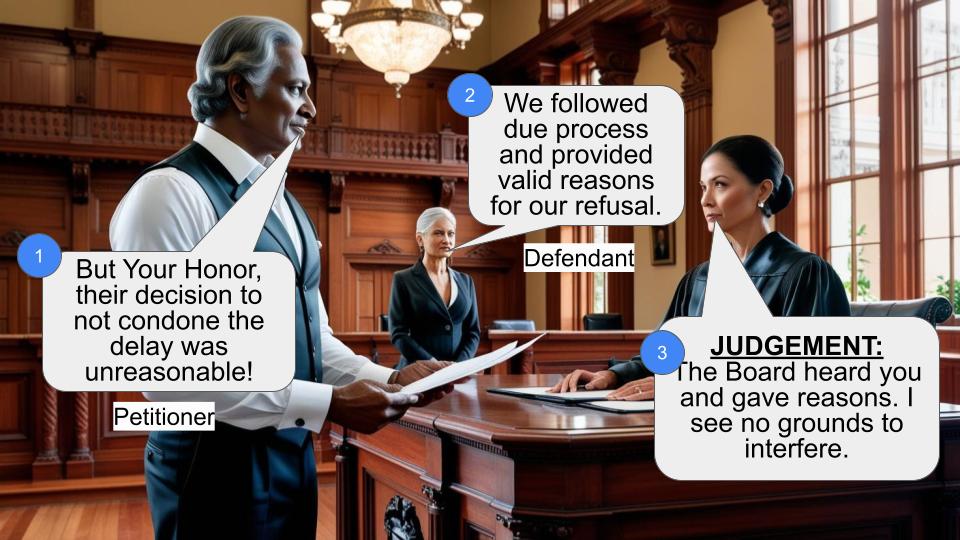
This case involves a petitioner who approached the Central Board of Direct Taxes (CBDT) to condone the delay in filing tax returns. The CBDT, after hearing the petitioner, refused to condone the delay. The High Court upheld CBDT's decision, finding no grounds for interference with the order.
Get the full picture - access the original judgement of the court order here
Case Name:
Desai Investments (P) Ltd Vs Central Board of Direct Taxes & Ors. (High Court of Bombay)
Writ Petition No.2118 of 2007
Date: 14th January 2008
Key Takeaways:
1. CBDT's decision to refuse condonation of delay, when made after hearing the petitioner and providing reasons, is generally not interfered with by the courts.
2. The court's reluctance to interfere suggests a high threshold for overturning administrative decisions in tax matters.
3. The judgment reinforces the importance of timely filing of tax returns.
Issue:
Should the High Court interfere with CBDT's order refusing to condone the delay in filing tax returns when reasons have been provided and the petitioner was given a hearing?
Facts:
1. The petitioner filed tax returns beyond the stipulated period.
2. The petitioner approached CBDT to condone the delay in filing returns.
3. CBDT considered the matter and heard the petitioner.
4. CBDT, in paragraphs 3 & 4 of its order, set out reasons for not condoning the delay.
5. The petitioner challenged CBDT's decision in the High Court.
Arguments:
While the specific arguments aren't detailed in the provided text, we can infer:
Petitioner's likely argument:
- CBDT's decision was unreasonable or arbitrary and should be overturned.
CBDT's likely argument:
- The decision was made after giving the petitioner a fair hearing and providing valid reasons for refusal.
Key Legal Precedents:
1. H.S.Anantharamaiah v. Central Board of Direct Taxes & Ors. (201 ITR 526 Kar):
This Karnataka High Court judgment held that the power exercisable by the Board under clause (b) of sub-section (2) of Section 119 (of Income Tax Act, 1961) is quasi-judicial in nature.
2. Section 119(2)(b) (of Income Tax Act, 1961):
This section grants CBDT the power to condone delays in certain circumstances. The court noted that it wasn't necessary to determine whether this power is quasi-judicial or an exercise in conditional or subordinate legislation for the purpose of this case.
Judgement:
1. The High Court refused to interfere with CBDT's decision.
2. The court noted that the petitioner was given an opportunity to be heard.
3. CBDT recorded reasons for rejecting the application after giving the petitioner a hearing.
4. The court found that this was not a case of "no reasons" or where the reasons were totally extraneous.
5. Given these circumstances, the court declined to exercise its extraordinary jurisdiction.
6. The petition was rejected.
FAQs:
Q1: Why did the High Court refuse to interfere with CBDT's decision?
A1: The court found that CBDT had given the petitioner a fair hearing and provided reasons for its decision. As there was no apparent arbitrariness or lack of reasoning, the court saw no grounds for interference.
Q2: What is the significance of Section 119(2)(b) (of Income Tax Act, 1961)?
A2: This section gives CBDT the power to condone delays in certain circumstances. The nature of this power (whether quasi-judicial or administrative) was discussed but not definitively determined in this case.
Q3: Does this judgment mean CBDT's decisions can never be challenged?
A3: No, it doesn't mean that. The judgment suggests that courts are unlikely to interfere when CBDT has followed due process (giving a hearing and providing reasons). However, if there's clear arbitrariness or lack of reasoning, courts may still intervene.
Q4: What's the key lesson for taxpayers from this case?
A4: The main takeaway is the importance of filing tax returns on time. Condonation of delay is discretionary, and even if reasons are provided, CBDT may refuse to condone the delay.
Q5: What would be considered "extraneous reasons" that might lead to court interference?
A5: While not specified in this judgment, extraneous reasons might include considerations unrelated to the case at hand, personal bias, or factors outside the scope of the relevant tax laws.

1. Petitioner approached CBDT for condoning the delay in filing returns. The returns were filed beyond the stipulated period. The matter was considered by the CBDT. The CBDT in paragraphs-3 & 4 has set out the reasons as to why they do not propose to condone the delay.
2. Our attention has been invited to the judgment of the Division Bench of the Karnataka High Court in H.S. Anantharamaiah v. Central Board of Direct Taxes & Ors. reported in 201 ITR 526 (Kar). It is held that the power exercisable by the Board under clause (b) of sub-section (2) of Section 119 (of Income Tax Act, 1961) is quasi-judicial in nature. At this stage, we do not propose to go into that issue as to whether the exercise of power under Section 119(2) (of Income Tax Act, 1961) is quasi judicial or an exercise in conditional or subordinate legislation.
3. Suffice it to say that the petitioner was given an opportunity. The petitioner was heard and after such opportunity, for reasons recorded, the application was rejected. This is not a case of "no reasons" or the case where the reasons can be said to be totally extraneous. We are therefore, not inclined to exercise our extra ordinary jurisdiction. Petition rejected.
(R.S.MOHITE,J) (F.I.REBELLO,J)
×
Questions
CBDT's Refusal to Condone Tax Return Delay Upheld by High Court
Write your CommentSimilar Posts

Generic
- Reportdata/5016.pdf
