


Co-op Bank Wins Tax Dispute Over Non-Performing Assets





Full News

Co-op Bank Wins Tax Dispute Over Non-Performing Assets
Co-op Bank Wins Tax Dispute Over Non-Performing Assets
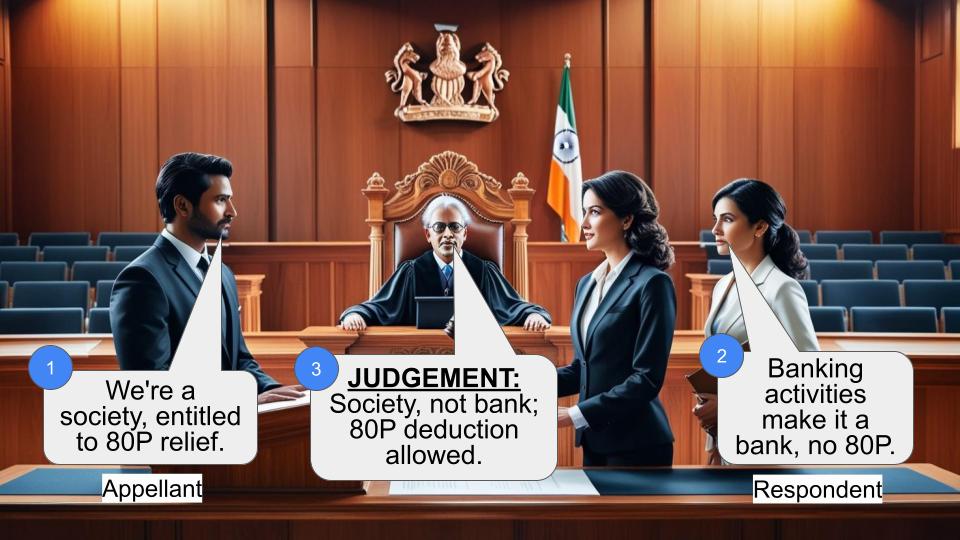
The case involves the Commissioner of Income-Tax and M/s. Davangere District Central Co-operative Bank Limited. The dispute centers on whether interest accrued on non-performing assets should be included in taxable income. The court ruled in favor of the co-operative bank, allowing them to exclude this interest from their taxable income.
Get the full picture - access the original judgement of the court order here
Case Name:
Commissioner of Income-Tax and Anr. Vs M/s. Davangere District Central Co-operative Bank Limited (High Court of Karnataka)
ITA No. 137 of 2015
Date: 13th November 2020
Key Takeaways:
- The court upheld the exclusion of interest on non-performing assets from taxable income, aligning with RBI guidelines.
- The decision reinforces the principle that non-performing assets do not yield revenue and thus should not be taxed.
- The ruling supports the application of RBI guidelines over certain provisions of the Income Tax Act when determining taxable income.
Issue
Should interest accrued on non-performing assets be included in the taxable income of a co-operative bank following the mercantile system of accounting?
Facts
- The assessee, a co-operative bank, became taxable like commercial banks from the Assessment Year 2007-08.
- The bank filed its income return for 2007-08, which was scrutinized by the Assessing Officer.
- Additions were made to the bank’s income for interest on non-performing assets and provisions for non-performing assets, audit costs, and other expenses.
Arguments
- For the Revenue: The interest on non-performing assets should be included in taxable income as per the mercantile system of accounting. RBI guidelines should not override the Income Tax Act.
- For the Assessee: Interest on non-performing assets should not be taxed as these assets do not yield revenue. The provision for non-performing assets was made according to RBI guidelines.
Key Legal Precedents
- UCO Bank Vs. CIT (237 ITR 889): The Supreme Court decision was cited to support the exclusion of interest on non-performing assets from taxable income.
- Catholic Syrian Bank Ltd. Vs. CIT (343 ITR 270): Discussed in relation to provisions for bad debts and their tax treatment.
- Commissioner of Income-Tax vs. Canfin Homes Ltd. (347 ITR 382): Referenced for the treatment of non-performing assets.
Judgement
The court ruled in favor of the co-operative bank, allowing the exclusion of interest on non-performing assets from taxable income. The court found that the bank’s approach was consistent with RBI guidelines and previous legal precedents. The appeal by the revenue was dismissed.
FAQs
Q1: Why was the interest on non-performing assets excluded from taxable income?
A1: The court found that non-performing assets do not yield revenue, and thus, taxing them would be inappropriate. This aligns with RBI guidelines and past legal precedents.
Q2: What was the significance of the RBI guidelines in this case?
A2: The RBI guidelines were crucial as they provided a framework for the treatment of non-performing assets, which the court upheld over certain provisions of the Income Tax Act.
Q3: How does this decision impact other co-operative banks?
A3: This decision sets a precedent that co-operative banks can rely on RBI guidelines for the treatment of non-performing assets, potentially reducing their taxable income.

1. This appeal under Section 260A (of Income Tax Act, 1961) (hereinafter referred to as the Act for short) has been preferred by the revenue. The subject matter of the appeal pertains to the Assessment year 2007-08. The appeal was admitted by a bench of this Court vide order dated 10.08.2015 on the following substantial questions of law:
(i) Whether on the facts and circumstances of the case, the Tribunal is right in law in deleting the interest accrued on non performing assets from the computation of taxable income for the assessment year under consideration despite the assessee maintaining mercantile system of accounting.
(ii) Whether on the facts and circumstances of the case, the Tribunal is
right in law in holding that the provision for non performing assets made by assessee is proper as it is done as per RBI guidelines without appreciating that RBI guidelines cannot override the mandatory provision of Section 145 (of Income Tax Act, 1961) which is a specific provision dealing with the method of accounting for determining income of particular year and the decision in the case of UCO Bank Vs. CIT (reported in 237 ITR page 889), the Supreme Court has not given findings regarding this issue and as such the Tribunal is not right in relying on this ruling of Apex Court.
2. Facts leading to filing of this appeal briefly
stated are that the assessee is a co-operative bank. The
co-operative Banks became taxable entity like the
commercial banks from the Assessment Year 2007-08.
The assessee therefore, filed the return of income for
the Assessment Year 2007-08. The return of income was
processed under Section 143(1) (of Income Tax Act, 1961) and the case
of the assessee was selected for scrutiny and notice
under Section 143(2) (of Income Tax Act, 1961) was issued. The
Assessing Officer by an order dated 23.12.2009 made
an addition of Rs.6,99,73,139/- on account of interest
income following the mercantile system of accounting,
provision made for non performing assets to the extent
of Rs.1,50,00,000/-. The Assessing Officer also made an
addition of Rs.4,00,000/- and Rs.17,38,222/- on
account of provision for audit cost and addition under
Section 40(a)(ia) (of Income Tax Act, 1961).
3. Being aggrieved, the assessee challenged the
aforesaid order in an appeal before the Commissioner of
Income Tax (Appeals) who by an order dated
29.12.2011 inter alia held that effective rate of interest
on the amount of advances was 7.5%, whereas,
Assessing Officer has considered the same to be 9%,
which is on the higher side. It was further held that the
Assessing Officer has to correctly work out the opening
and closing balances after giving reasonable opportunity
to the assessee and after verification of books of
accounts and work out the correct income accruing from
interest and to decide the issue in the light of the
decision of the Supreme Court in the case of UCO Bank
Vs. CIT, 237 ITR 889. The Commissioner of Income Tax
(Appeals) allowed the provision made for non
performing assets to the extent of RS.1,50,00,000/- by
following the decision of the Supreme Court in UCO
Bank supra and with regard to addition made under
Section 40(a)(ia) (of Income Tax Act, 1961) of Rs.17,38,222/-, the
Commissioner of Income Tax (Appeals) has given
direction to the Assessing Officer to call details of
previous payment and to check the return. Accordingly,
the appeal was partly allowed the appeal preferred by
the assessee. The revenue thereupon approached the
Income Tax Appellate Tribunal (hereinafter referred to
as 'the tribunal' for short). The tribunal by an order
dated 10.10.2014 dismissed the appeal preferred by the
revenue. In the aforesaid factual background, the
revenue has filed this appeal.
4. When the matter was taken up today,
learned counsel for the assessee submitted that first
substantial question of law has already been answered
by a bench of this court vide judgment dated
30.06.2014 passed in I.T.A.No.471/2013 (Commissioner
of Income Tax vs. The Urban Co-operative Bank Ltd)
and Special Leave Petition against the aforesaid order
has been dismissed by Supreme Court vide order dated
12.01.2015 keeping the question of law open. The
aforesaid aspect of the matter could not be disputed by
the learned counsel for the revenue. For the reasons
assigned in the judgment dated 30.06.2014 passed by
this court in I.T.A.No.471/2013, the first substantial
question of law is answered against the revenue and in
favour of the assessee.
5. With regard to the second substantial
question of law, learned counsel for the revenue
submitted that the assessee had claimed the benefit
under Section 36(1)(viia) (of Income Tax Act, 1961) and the assessee
has to first set off the bad debt written off against the
provision made under Section 36(1)(viia) (of Income Tax Act, 1961). It
is further submitted that if actual write off is in excess of
provision made under Section 36(1)(viia) (of Income Tax Act, 1961),
then as per proviso to Section 36(1)(vii) (of Income Tax Act, 1961), actual write off
in excess of provision of Section 36(1)(viia) (of Income Tax Act, 1961) would alone
be allowed under Section 36(1)(vii) (of Income Tax Act, 1961). It is also argued
that allowing the provision under Section 36(1)(viia) (of Income Tax Act, 1961) of
the Act and on actual write off under Section 36(1)(vii) (of Income Tax Act, 1961)
of the Act would amount to double deduction and the
same is in contravention of the law laid down by the
Supreme Court in CATHOLIC SYRIAN BANK LTD. VS. CIT
(SC) 343 ITR 270. It is further submitted that the
principle laid down in the aforesaid decision has not
been taken note of by the tribunal and therefore, the
matter requires re consideration. It is also urged that
reliance placed on decision of this court in
COMMISSIONER OF INCOME-TAX VS. CANFIN HOMES
LTD., 347 ITR 382 is of no assistance to the assessee as
in the aforesaid decision, the effect of Section
36(1)(viia) of the Act has not been considered.
6. On the other hand, learned counsel for the
assessee submitted that tribunal was justified in holding
that accounting interest income on non performing asset
on cash basis by the assessee though it was following
mercantile system of accounting was correct since, once
a particular asset is shown to be a non performing asset
then the assumption is that it is not yielding any
revenue and therefore, the question of showing that
revenue and paying tax would not arise. In support of
aforesaid submissions, reliance has been placed on
decisions in 'UCO BANK VS. CIT', 237 ITR 889 SC,
'CIT VS. CANFIN HOMES LTD.', 347 ITR 382 (KAR),
CIT VS. THE URBAN CO-OPERATIVE BANK IN ITA
NO.471/2013 (KAR), CIT VIS THE URBAN CO-
OPERATIVE BANK IN SLP NO.1066/2015 (SC) and
'UCO BANK VS. CIT', 360 ITR 567 (KOL).
7. We have considered the submissions made
by learned counsel for the parties and have perused the
record. In the course of assessment proceedings, it was
noticed that assessee had debited Rs.1.5 Crores as
provision for non performing asset but in the income
computation sheet the same has not been added. The
assessee was given an opportunity to explain why non
performing asset provision has not added back to the
total income, in the income computation sheet and
again deduction 7.5% under Section 36(1)(viia) (of Income Tax Act, 1961) has not
been claimed. The assessee thereupon submitted that a
provision has been made as per the norms of the
Reserve Bank of India and the details of non performing
assets as well as provisions made were provided. The
Commissioner of Income Tax (Appeals) held that
deduction for provision for bad and doubtful debt is
allowed under Section 36(1)(viia) (of Income Tax Act, 1961) in the light
of the decision of the Supreme Court in UCO Bank Ltd.
supra. The tribunal in its order dated 10.10.2014 inter
alia has held that though the assessee has used the
nomenclature as provision for non performing assets but
in pith and substance, the provision has been created
for bad and doubtful debts and in doing so the assessee
has followed the guidelines framed by Reserve Bank of
India. The tribunal has therefore, affirmed the finding
recorded by the Commissioner of Income Tax (Appeals).
8. This court in Canfin Homes Ltd. supra after
taking note of Section 145 (of Income Tax Act, 1961) has held that once
a particular asset is shown as non performing asset then
the assumption that it is not yielding any revenue. When
an asset is not yielding any revenue, the question of
showing that revenue and paying tax would not arise.
The contentions, which are sought to be raised by
learned counsel for the revenue do not arise for
consideration in the context of substantial question of
law, which has been framed by this court. The
concurrent findings have been recorded by the
Commissioner of Income Tax (Appeals) as well as
tribunal in this regard, which cannot be termed as
perverse.
In view of preceding analysis, the second
substantial question of law is answered against the
revenue and in favour of the assessee. In the result, we
do not find any merit in this appeal, the same fails and
is hereby dismissed.
Sd/-
JUDGE
Sd/-
JUDGE
×
Similar Ripples
Questions
Co-op Bank Wins Tax Dispute Over Non-Performing Assets
Write your CommentSimilar Posts


Generic
- Reportdata/6434.pdf
