


Co-op Society Wins Tax Deduction Battle: Not a Bank, Says Court


Full News

Co-op Society Wins Tax Deduction Battle: Not a Bank, Says Court
Co-op Society Wins Tax Deduction Battle: Not a Bank, Says Court
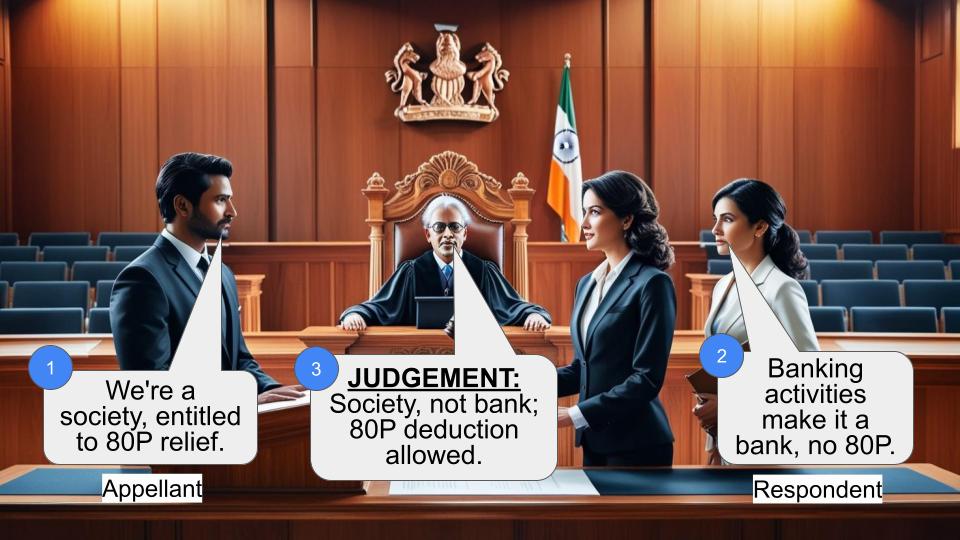
This is case where a co-operative society called The Quepem Urban Co-operative Credit Society Ltd. was fighting against the Assistant Commissioner of Income Tax. The society wanted a tax deduction under Section 80P (of Income Tax Act, 1961), but the tax department said, "No way, you're a bank!" The court looked at everything and said, "Actually, you're not a bank, so you can have that deduction." It's a win for the co-op society.
Get the full picture - access the original judgement of the court order here
Case Name:
The Quepem Urban Co-operative Credit Society Ltd. Vs Assistant Commissioner of Income Tax (High Court of Bombay)
Tax Appeal No.22,23 & 24 of 2015
Date: 17th April 2015
Key Takeaways:
1. A co-operative society providing credit facilities to members can get tax deductions under Section 80P(2)(a)(i) (of Income Tax Act, 1961).
2. To be considered a "primary co-operative bank," all three conditions in Section 5(ccv) of the Banking Regulation Act must be met.
3. Dealing with non-members doesn't automatically disqualify a society from getting the tax benefit, but the benefit is limited to income from member transactions.
Issue:
The main question here was: Is the appellant (our co-op society) a co-operative bank, making it ineligible for the tax deduction under Section 80P(2)(a)(i) (of Income Tax Act, 1961) due to the exclusion in Section 80P(4) (of Income Tax Act, 1961)?
Facts:
- The appellant is a co-operative society registered under the Goa Co-operative Societies Act, 2001.
- They filed tax returns claiming a deduction under Section 80P(2)(a)(i) (of Income Tax Act, 1961) for income from providing credit facilities to members.
- The Assessing Officer denied this deduction, saying they were a primary co-operative bank.
- The case went through appeals, with the CIT(A) allowing the deduction and the Tribunal denying it.
- The society accepted deposits from non-members in a few cases, but it was a small part of their business.
Arguments:
Appellant (Co-op Society):
- We're not a co-operative bank, just a credit society.
- We don't meet all conditions to be a "primary co-operative bank" under the Banking Regulation Act.
- We don't have a banking license from RBI, so we can't be a bank.
Revenue (Tax Department):
- The society's main business is banking.
- They deal with non-members, which disqualifies them from the tax benefit.
Key Legal Precedents:
The court mentioned the case of Commissioner of Income Tax and another vs. Sri Biluru Gurubasva Pattina Sahakari Sangha Niyamitha Bagalkot (2014) 369 ITR 86, which says a banking license is necessary to be recognized as a co-operative bank.
Judgement:
The court sided with the co-op society. Here's why:
1. The society doesn't meet all three conditions to be a "primary co-operative bank" under Section 5(ccv) of the Banking Regulation Act.
2. Their main business isn't banking, and their bylaws don't prohibit other co-op societies from becoming members.
3. Dealing with non-members doesn't disqualify them entirely, but the tax benefit is limited to income from member transactions.
The court allowed the appeal, granting the tax deduction under Section 80P(2)(a)(i) (of Income Tax Act, 1961), but only for income from providing credit facilities to members.
FAQs:
1. Q: Does this mean all co-op societies can claim this tax deduction?
A: Not necessarily. They need to meet specific criteria and primarily provide credit facilities to members.
2. Q: What if a co-op society does some business with non-members?
A: They can still get the deduction, but only on income from transactions with members.
3. Q: Why was the banking license important in this case?
A: The lack of a banking license supported the argument that the society wasn't primarily in the banking business.
4. Q: How does this affect other co-op societies?
A: It provides a precedent for similar societies to claim tax deductions if they meet the criteria outlined in this case.
5. Q: What should co-op societies do to ensure they can claim this deduction?
A: They should review their bylaws, ensure their primary business is providing credit to members, and keep clear records of member vs. non-member transactions.

1. These three appeals filed under Section 260A (of Income Tax Act, 1961) (hereinafter referred to as 'the Act') challenge the common order dated 26 November, 2014 passed by the Income Tax Appellate Tribunal (hereinafter referred to as 'the Tribunal')relating to assessment years 2008-09, 2009-10 and 2011-12. By the impugned order the Tribunal allowed the Revenue's appeal holding that the appellant is not entitled to the benefit of Section 80P(2)(a)(i) (of Income Tax Act, 1961), as it is a Primary Co-operative Bank, thus hit by the exclusion provided in Section 80P(4) (of Income Tax Act, 1961).
2. All the three appeals were admitted on 25 March, 2014 on the following substantial question of law :
Whether on the facts and in the circumstances of the case, the Hon'ble Tribunal was right in law in holding that the Appellant is a Co-operative Bank and hence, it is not entitled to deduction under Section 80P(2)(a)(i) (of Income Tax Act, 1961) by virtue of Section 80P(4) (of Income Tax Act, 1961) ?
3. The Appellant had taken out an application for interim reliefs. At that time it was noticed that the controversy is within a narrow compass, therefore at the request of the Counsel, it was decided to dispose of the appeal itself.
4. As the facts in all the three appeals are similar and the issues arising are identical it is agreed at the bar that the the decision on facts for any one assessment year would answer the question framed for the other two years. Therefore, for the purpose of convenience we shall refer to the facts in Appeal No.22/2015 relating to assessment year 2008-09, which are as under:
(a) The appellant is Co-operative society registered under the Goa Co-operative Societies Act, 2001 (hereinafter referred to as 'Co- operative Act'). On 26 December, 2009 the appellant filed its return of income declaring gross total income of Rs.1.31crores. However, the appellant claimed deduction of its entire income under Section 80P(2)(a)(i) (of Income Tax Act, 1961) resulting in nil taxable income.
(b) By order dated 14 February, 2014, the Assessing Officer disallowed the appellant's claim for deduction under Section 80P(2)(a)(i) (of Income Tax Act, 1961). This on the ground that the appellant was a primary Co-operative Bank and therefore, hit by the provisions of Section 80P(4) (of Income Tax Act, 1961) which excluded the benefit of Section 80P (of Income Tax Act, 1961) to cooperative banks. Consequently, the appellant was assessed to a income of Rs.1.65 crores by the order dated 14 February 2014 of the Assessing Officer under Section 143 (of Income Tax Act, 1961).
(c) Being aggrieved by the order dated 14 February, 2014 of the Assessing Officer, the appellant preferred an appeal to the Commissioner of the Income Tax (hereinafter referred to as 'CIT(A)). By an order dated 15 July, 2014, the CIT(A) allowed the appellant's appeal holding that the appellant is not a Co- operative Bank but a Co-operative Credit Society. Thus, not hit by the exclusion provided under Section 80P(4) (of Income Tax Act, 1961). Consequently, the Assessing Officer was directed to extend the benefit of deduction under Section 80P(2)(a)(i) (of Income Tax Act, 1961) to the appellant.
(d) Being aggrieved by the order dated 15 July, 2014 of the CIT(A), the Revenue preferred an appeal to the Tribunal. By the impugned order dated 26 November, 2014, the Tribunal allowed the appeal of the Revenue to the extent it held that the appellant is a Co- operative Bank and therefore, not entitled to the benefit of Section 80P(2)(a)(i) (of Income Tax Act, 1961) in view of the exclusion provided in Section 80P(4) (of Income Tax Act, 1961). Thus restored the order dated 14 February 2014 of the Assessing Officer.
5. The appellant-Assessee is in appeal before us from the impugned order dated 26 November 2014 of the Tribunal . It is contented that it is entitled to the benefit of Section 80P(2)(a)(i) (of Income Tax Act, 1961) and not hit by the exclusion in Section 80P(4) (of Income Tax Act, 1961). For the proper consideration of the rival submissions, it is necessary to reproduce the relevant provisions of Section 80P (of Income Tax Act, 1961) and also the definition of a primary Co-operative Bank and Banking as defined in chapter V of the Banking Regulation Act, 1949.
Section 80P (of Income Tax Act, 1961) : (1) Where, in the case of an assessee being a co-operative society, the gross total income includes any income referred to in sub-section (2), there shall be deducted, in accordance with and subject to the provisions of this section, the sums specified in sub-section (2), in computing the total income of the assessee.
(2) The sums referred to in sub-section (1) shall be the following, namely :-
(a) in the case of a co-operative society engaged in -
(i) carrying on the business of banking or providing credit facilities to its members, or...” the whole of the amount of profits and gains of business attributable to any one or more of such activities.
(4) The provisions of this section shall not apply in relation to any co-operative bank other than a primary agricultural credit society or a primary co- operative agricultural and rural development bank.
Explanation – For the purposes of this sub-section, -
(a) “co-operative bank” and “primary agricultural credit society” shall have the meanings respectively assigned to them in Part V of the Banking Regulation Act, 1949 (10 of 1949):
(b) “primary co-operative agricultural and rural development bank” means a society having its area of operation confined to a taluka and the principal object of which is to provide for long- term credit for agricultural and rural development activities.” Banking Regulation Act 1949 Section 5(CCV) (of Income Tax Act, 1961) : “Primary Co-operative Bank” means a co-operative society, other than a primary agricultural credit society - (1) the primary object or principal business of which is transaction of banking business : (2) the paid-up share capital and reserves of which are not less than one lakh of rupees : and (3) the bye-laws of which do not permit admission of any other co-operative society as a member :
Provided that this sub-clause shall not apply to the admission of a co-operative bank as a member by reason of such co-operative bank subscribing to the share capital of such Co-operative society out of finds provided by the State Government “for the purpose.”
6. Mr. Chythanya K. K., the learned Counsel for the appellant in support of the appeals submits as under :
(a) The appellant is admittedly a co-operative society registered under the Co-operative Societies Act and is engaged in providing credit facilities to its members. Consequently, the income earned by the appellant from its activity of providing credit facilities to its members, is entitled to deduction under Section 80P(2)(a)(i) (of Income Tax Act, 1961). The appellant is not a co-operative Bank and thus, the exclusion provided under Section 80P(4) (of Income Tax Act, 1961) would have no application.
(b) The impugned order erroneously holds that the appellant to be a primary co-operative Bank, on the ground that it does satisfy Section 5(1)(ccv) of the Banking Regulation Act, to the extent that it holds that, it satisfies all the three conditions (1), (2) and (3) specified therein. It is clear from the record the appellant society does not satisfy condition (1) & (3) above viz. Banking is not its primary object nor its principal business nor does it prohibit any other cooperative society from becoming its member. Thus the appellant is not a cooperative bank as defined in the Explanation to Section 80P(4) (of Income Tax Act, 1961) 0f the Act and therefore not hit by the exclusion provided therein; and
(c) The impugned order completely ignores the fact that the appellant cannot be held to have as its principal business as banking business in the absence of a banking licence issued to the appellant by the Reserve Bank of India under Banking Regulation Act. This licence is a sine quo non for recognizing to the appellant by a co-operative bank. The issue of the appellant not being a co-operative bank in the absence of a licnece to do banking business is concluded by the decision of the Karnakata High Court in Commissioner of Income Tax and another vs. Sri Biluru Gurubasva Pattina Sahakari Sangha Niyamitha Bagalkot (2014) 369 ITR 86.
7. As against the above, Ms. Asha Dessai, learned counsel tor the revenue in support of the impugned order submits as under :
(a) The impugned order is correct in law and thus calls for no interference ; and
(b) In any view of the matter, as there is finding of fact that the appellant is doing business along with non-members. Howsoever, miniscule, it would by itself disqualify the appellant from enjoying the exemption under Section 80P(2)(a)(i) (of Income Tax Act, 1961). This on the ground that Section 80P(2)(a)(i) (of Income Tax Act, 1961) specifically provided that the deduction thereunder will be available only in case of co-operative society which is providing facilities to its members.
8. Section 80P (of Income Tax Act, 1961) provides deduction in support of income of co-operative societies. Subsection (1) allows deduction to Cooperative Society to the extent its gross income includes any income referred to in subsection (2) in computing its total income. Subsection (2) refers to various incomes to which the deduction under subsection (1) is available. In this case we are concerned with clause (a)(i) of subsection (2), which refers to a cooperative society engaged in carrying on banking business or providing credit facilities to its members. Thus the deduction is available on either of the two activities i.e. banking business or providing credit facilities to its members. We are not concerned with the other subclauses of Subsection (2) or Subsection (3) of Section 80P(4) (of Income Tax Act, 1961) for the purposes of this case. Subsection (4) provides that Section 80P (of Income Tax Act, 1961) will not apply in relation to a cooperative bank other than a primary agricultural credit society or primary agricultural and rural development bank. Before us, the appellant is not claiming to be a primary agricultural credit society or primary agricultural and rural development bank but it claims to be engaged in providing credit facilities and not a banking society. Thus not hit by subsection (4) of Section 80P (of Income Tax Act, 1961).
9. There is no dispute between the parties that the appellant is a co- operative society as the same is registered under the Co-operative Societies Act. The appellant is claiming deduction of income earned on providing credit facilities to its members as provided under Section 80P(2)(a)(i) (of Income Tax Act, 1961). It is appellant's case that, it is not carrying on the business of the banking. Consequently, not being a co-operative bank the provisions of Section 80P(4) (of Income Tax Act, 1961) would not exclude the appellant from claiming the benefit of deduction under Section 80P(2)(a)(i) (of Income Tax Act, 1961). However in terms of Section 80P (of Income Tax Act, 1961) the meaning of the words Cooperative Bank is the meaning assigned to it in Chapter V of the Banking Regulation Act, 1949. A cooperative bank is defined in Section 5(cci) (of Income Tax Act, 1961) of Banking Regulation Act to mean a State Cooperative Bank, a Central Cooperative Bank and a primary cooperative bank. Admittedly, the appellant is not a State Cooperative Bank, a Central Cooperative Bank. Thus what has to be examined is whether the appellant is a primary Cooperative Bank as defined in Para V of the Banking Regulation Act. Section 5(ccv) of the Banking Regulation Act defines a primary cooperative bank to mean a cooperative society which cumulatively satisfies the following three conditions :
(1) Its principal business or primary object should be banking business of Banking;
(2) Its paid up share capital and reserves should not be less that rupees one lakh.
(3) Its bye-laws do not permit admission of any other cooperative society as its member. It is accepted position that condition No.(2) is satisfied as the share capital in an excess of rupees one lakh. It has been the appellant's contention that the conditions No. (1) and (3) provided above are not satisfied.
10. Therefore the issue that arises for consideration is whether the appellant satisfies condition No.(1) and (3) above. The impugned order after referring to the definition of 'Banking Business' as defined in Section 5 (of Income Tax Act, 1961)b of the Banking Regulation Act, held that the principal business of the Appellant is Banking. Section 5 (of Income Tax Act, 1961)b of the Banking Regulation Act defines banking to mean accepting of deposits for the purpose of lending or investment, of deposit of money from the public repayable on demand or otherwise. The impugned order juxtaposes the above definition with the finding of fact that the appellant did deal with non members in a few cases by seeing deposits. This read with Bye law 43 leads to the conclusion that it is carrying on banking business.
This fact of accepting deposits from people who are not members has been so recorded by the CIT(A) in his order dated 15 July, 2014. Before the Tribunal also the appellant did not dispute the fact that in a few cases they have dealt with non members. However so far as accepting deposits from non members is concerned it is submitted that the Bye-law 43 only permits the society to accept deposits from its members. It is submitted that Bye laws 43 does not permit receipt of deposits from persons other then members, the word “any person” is a gloss added in the impugned order as it is not found in Bye law 43. It is undisputed that the transactions with non members are insignificant/miniscule. On the above basis it cannot be concluded that the appellant's principal business is of accepting deposits from public and therefore it is in banking business. In fact, the impugned order erroneously relies upon bye-law 43 of the society which enables the society to receive deposits to conclude that it can receive deposits from public. However, the impugned order relies upon bye-law 43 to conclude that it enables the appellant to receive deposits from any person is not correct. Thus in the present facts the finding that the appellant's principal business is of Banking is perverse as it is not supported by the evidence on record. So far as the issue of primary object of the appellant is concerned the impugned order gives no finding on that basis to deprive the appellant the benefit of Section 80P (of Income Tax Act, 1961). The impugned order sets out the object clause of the appellant, which has 24 objects but thereafter draws no sequiter to conclude that the primary object is Banking. Consequently there is no occasion to deal with the same as that is not the basis on which the impugned order holds that it is a Primary Cooperative Bank.
11. In the above view, the alternative contention of the appellant that it is not in the business of Banking as the sine quo non to carry on banking business is a licence to be issued by the Reserve Bank of India, which it admittedly does not have, is not being considered.
12. So far as condition No.3 of the definition/meaning of Primary Cooperative Bank as provided in Section 5(ccv) of the Banking Regulation Act is concerned, the same requires the Bye laws of society to contain a prohibition from admitting any other cooperative society as its member. In fact the bye-laws of the appellant society originally in bye-law 9(d) clearly provided that no co-operative society shall be admitted to the membership of the society. Thus there was a bar but the same was amended w.e.f. 12 January, 2001 as to permit a society to be admitted to the membership of the society. Therefore for the subject assessment years there is no prohibition to admitting a society to its membership and one of three cumulative conditions precedent to be a primary cooperative bank is not satisfied. However the impugned order construed the amended clause 9(d) of the appellant's bye laws to mean that it only permits a society to be admitted to the membership of the appellant and not a co-operative society. According to the impugned order, a society and a co-operative society are clearly words of different and distinct significance and the membership is only open to society and not to a co-operative society. As rightly pointed out on behalf of the appellant the word society as referred to bye law 9(d) would include the co-operative society. This is so as the definition of a society under the Co-operative Act is co-operative society registered under the Co- operative Act. Besides the qualifying condition 3 for being considered as a primary Cooperative bank is that the bye laws must not permit admission of any other cooperative society. This is a mandatory condition i.e. the bye laws must specifically prohibit admission of any other cooperative society to its membership. The Revenue has not been able to show any such prohibition in the bye laws of the appellant. Thus even the aforesaid qualifying condition (3) for being considered as a primary cooperative bank is not satisfied. Thus, the three conditions as provided under Section 5(CVV) of the Banking Regulation Act, 1949, are to be satisfied cumulatively and except condition (2) the other two qualifying conditions re not satisfied. Ergo, appellant cannot be considered to be a co-operative bank for the purposes of Section 80P(4) (of Income Tax Act, 1961). Thus, the appellant is entitled to the benefit of deduction available under Section 80P(2)(a)(i) (of Income Tax Act, 1961).
13. The contention of Ms. Dessai, learned Counsel for the revenue that the appellant is not entitled to the benefit of Section 80P(2)(a)(i) (of Income Tax Act, 1961) in view of the fact that it deals with non-members cannot be upheld. This for the reason that Section 80P(1) (of Income Tax Act, 1961) restricts the benefits of deduction of income of co-operative society to the extent it is earned by providing credit facilities to its members. Therefore, to the extent the income earned is attributable to dealings with the non- members are concerned the benefit of Section 80P (of Income Tax Act, 1961) would not be available. In the above view of the matter, at the time when effect has been given to the order of this Court, the authorities under Act would restrict the benefit of deduction under Section 80P (of Income Tax Act, 1961) only to the extent that the same is earned by the appellant in carrying on its business of providing credit facilities to its members.
14. Accordingly, the substantial question of law as framed is answered in the negative i.e. in favour of the appellant and against the respondent-Revenue.
15. Appeals allowed in above terms. No order as to costs.
M. S. SANKLECHA, J. F. M. REIS, J.
×
Questions
Co-op Society Wins Tax Deduction Battle: Not a Bank, Says Court
Write your CommentSimilar Posts


Generic
- Reportdata/3842.pdf
