


Co-op Society Wins Temporary Relief in Income Tax Deduction Dispute


Full News

Co-op Society Wins Temporary Relief in Income Tax Deduction Dispute
Co-op Society Wins Temporary Relief in Income Tax Deduction Dispute
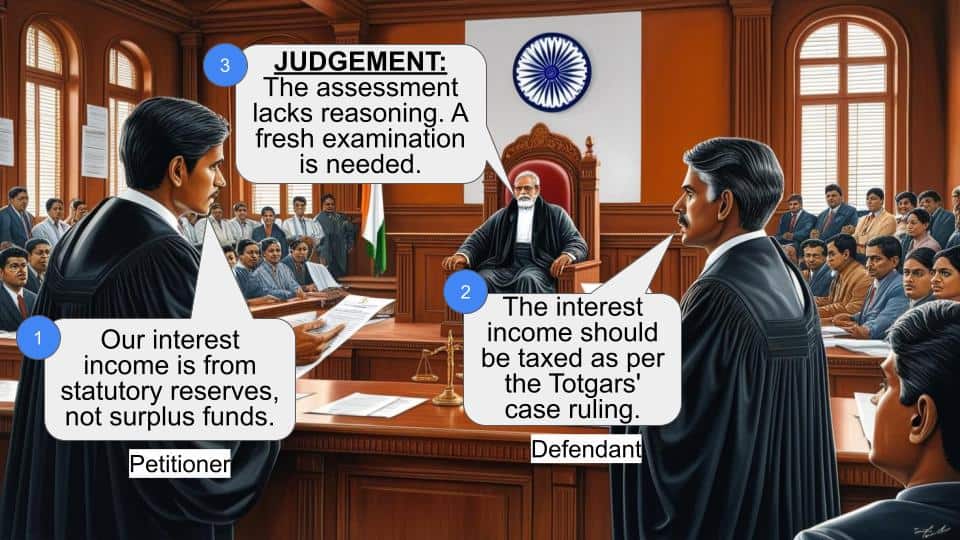
A case here involving a Co-operative Thrift and Credit Society challenging an income tax assessment order. The main issue? The tax office rejected their claim for a deduction under Section 80P (of Income Tax Act, 1961). The court didn't make a final decision but allowed the society to file an appeal and put a hold on tax recovery for now.
Get the full picture - access the original judgement of the court order here
Case Name:
K 114 Gobichettipalayam Public Servants Co-op Thrift & Credit Society Limited Vs Income Tax Officer & Anr. (High Court of Madras)
Writ Petition No.6451 of 2020 and WMP. Nos.7616 to 7618 of 2020
Date: 12th March 2020
Key Takeaways:
1. The court's decision is based on a similar case involving agricultural co-operative societies.
2. The main dispute revolves around the interpretation of Section 80P (of Income Tax Act, 1961) deductions for co-operative societies.
3. The court is allowing more time for this legal question to be settled in higher courts.
4. Co-operative societies in similar situations might get temporary relief from immediate tax demands.
Issue:
The central question here is: Is the Co-operative Thrift and Credit Society entitled to claim a deduction under Section 80P (of Income Tax Act, 1961) for the Assessment Year 2017-18?
Facts:
1. The petitioner is a Co-operative Thrift and Credit Society.
2. They received an assessment order dated 10.12.2019 for the Assessment Year 2017-18.
3. In this order, their claim for a deduction under Section 80P (of Income Tax Act, 1961) was rejected.
4. This case is similar to other cases involving Primary Agricultural Co-operative Societies that the court had dealt with earlier.
Arguments:
So, here's what both sides are saying:
Petitioner (The Co-operative Society):
- They argue that they should get the deduction under Section 80P (of Income Tax Act, 1961).
- They're likely saying that their income should be exempt based on the principle of mutuality (basically, that they're just dealing with their own members).
Tax Department:
- They're rejecting the claim for deduction under Section 80P (of Income Tax Act, 1961).
- They're probably arguing that the society doesn't meet all the criteria for this deduction.
Key Legal Precedents:
The court mentions a few important cases here:
1. K.2058, Saravanmpatti Primary Agricultural Co-operative Credit Society Ltd., Vs. The Income Tax Officer (W.P.Nos.17 of 2020 etc. batch dated 31.01.2020)
- This case dealt with similar issues of Section 80P (of Income Tax Act, 1961) deductions for co-operative societies.
2. Citizen Cooperative Society Ltd Vs. Assistant Commissioner of Income-tax, Circle - 9(1), Hyderabad reported in [2017] 84 taxmann.com 114 (SC)
- This Supreme Court case made distinctions between different types of members in co-operative societies.
3. The Principal Commissioner of Income Tax, Salem V. M/s.S-1303 Ammapet Primary Agricultural Cooperative Bank Ltd., Ammapet, Salem (T.C.(A)Nos.882 and 891 of 2018 dated 06.12.2018)
- A Madras High Court case that ruled in favor of the co-operative society's right to the deduction.
Judgement:
The court didn't make a final decision on the deduction issue. Instead, it:
1. Allowed the petitioner to file a statutory appeal before the Commissioner of Income Tax (Appeals) within three weeks.
2. Ordered that no recovery of the tax demand related to the Section 80P (of Income Tax Act, 1961) deduction should be enforced until the appeal is decided.
FAQs:
Q1: Did the court decide if the society gets the tax deduction?
A1: Not yet. The court is allowing the society to appeal first.
Q2: Does the society have to pay the disputed tax amount now?
A2: No, the court has put a hold on the tax recovery until the appeal is decided.
Q3: Why didn't the court make a final decision?
A3: The court noted that similar cases with higher stakes are pending in the Supreme Court, so it's waiting for those to be resolved.
Q4: What's the next step for the co-operative society?
A4: They need to file an appeal with the Commissioner of Income Tax (Appeals) within three weeks.
Q5: Does this decision apply to other co-operative societies too?
A5: While it's not a blanket ruling, other societies in similar situations might use this case to seek temporary relief.

Mr. A.P. Srinivas, learned Senior Standing Counsel accepts notice for R1 and is ready to proceed with the matter. Notice is not issued to R2 as it is not necessary in the view that I have taken in this matter.
2. The petitioner claims to be a Co-operative Thrift and Credit Society and challenges an order of assessment for Assessment Year 2017-18 dated 10.12.2019 rejecting the claim of deduction under Section 80P (of Income Tax Act, 1961) (in short 'Act').
3. I have had an occasion to consider an identical issue in a batch of writ petitions filed by several Primary Agricultural Co-operative Societies, and in the case of K.2058, Saravanmpatti Primary Agricultural Co-operative Credit Society Ltd., Vs. The Income Tax Officer (W.P.Nos.17 of 2020 etc. batch dated 31.01.2020), while dealing with a claim of deduction under Section 80P (of Income Tax Act, 1961) by the Co-operative Societies, I have stated as follows:
'23. The issue that arises in W.P.Nos.1124, 1123, 1127, 1131, 1133, 1136, 1138, 1141, 1143, 1145, 1149, 1293, 1299 and 1420 of 2020 also involves the entitlement of the petitioners that claim to be Primary Agricultural Co-operative Credit Societies, to deduction under Section 80P (of Income Tax Act, 1961). The petitioners were called upon to produce various details in support of their claims and a specific question raised for their response was as follows:
'4. Is the society having associate/nominal member. If yes, whether the society is carrying on business with them? If so, please show cause why the deduction u/s.80P (of Income Tax Act, 1961) cannot be denied in view of the decision of the Jurisdictional ITAT in the case of M/s S1234 Udyapatti PACCS Ltd., Udyapatti P.O, Salem - 636 140 in ITA No.2332/Chny/2017. Wherein the ITAT followed the decision of Hon'ble Supreme Court in the case of Citizen Co- operative Society Ltd Vs. Assistant Commissioner of Income-tax, Circle - 9(1), Hyderabad reported in [2017] 84 taxmann.com 114 (SC) and denied deduction u/s.80P (of Income Tax Act, 1961).'
24. We are concerned in these Writ Petitions only to the claim of the petitioners for exemption by application of the principle of mutuality and the rejection of the same. According to the petitioner, credit facilities are offered by it to members in A as well as B classes. The petitioners argued before the Assessing Authority that their income would be exempt on the ground of application of mutuality, since the inflows as well as outflows related to one common group of members with which the Society is in complete identity.
25. However, the officer draws a distinction between the two classes of members - B class members are non-shareholding members admitted only for the purpose of availing loans against specified securities. Non-refundable admission fee is remitted by them and the duration of their membership is restricted to a maximum of three years. B class members are not allotted shares and their membership does not carry with it the right to vote and participate in elections, become office bearers or participate in General Body Meetings. They also do not hold any right to the profits or gains of the Society, while shareholding members, i.e., A class members enjoy all the aforesaid rights denied to the B class members.
26. The Assessing Authority was thus of the view that the claim of the petitioners is liable to be rejected in the light of the judgment of the Supreme Court in the case of Citizen (supra). Reliance was specifically placed on paragraph 24 of the judgement, where a distinction is made between Nominal Members and Ordinary Members. Paragraph 24 reads as follows:
'Undoubtedly, if one has to go by the aforesaid definition of 'co- operative bank', the appellant does not get covered thereby. It is also a matter of common knowledge that in order to do the business of a co-operative bank, it is imperative to have a licence from the Reserve Bank of India, which the appellant does not possess. Not only this, as noticed above, the Reserve Bank of India has itself clarified that the business of the appellant does not amount to that of a co-operative bank. The appellant, therefore, would not come within the mischief of sub-section (4) of Section 80P (of Income Tax Act, 1961).'
27. Thus, though categorised as A and B, there are vital distinctions that were drawn between the members of the two classes and hence the principle of mutuality that was relied upon by the petitioners was rejected as being inapplicable to its case.
28. A Division Bench of this Court has, on identical facts as in the present case, in the case of The Principal Commissioner of Income Tax, Salem V. M/s.S-1303 Ammapet Primary Agricultural Cooperative Bank Ltd., Ammapet, Salem (T.C.(A)Nos.882 and 891 of 2018 dated 06.12.2018) held that the assessee would be entitled to deduction under Section 80P (of Income Tax Act, 1961). The reasoning was that under the TNCS Act, a member and an associate member are one and the same and an associate member has also been held to be holding the character of a member. The Division Bench has taken the view that as far as the State of Tamil Nadu is concerned, the TNCS Act equates both members and associate members and places them on par. Thus, the distinction carved out by the Supreme Court would not be applicable in these cases.
29. In several of the orders of assessment impugned before me (W.P.Nos.1131, 1136, 1141, 1145 AND 1420 of 2020) the Assessing Officer, making reference to the order of the Division Bench of the Madras High Court, has stated that the orders have not been accepted and have been challenged by way of Special Leave Petitions.
30. No counter has been filed in these writ petitions. Mr.Jayapratap however, fairly produces a copy of the order in SLP filed challenging the order of the Division Bench in Ammapet (supra) (Special Leave to Appeal (c) No.17745 of 2019 dated 17.01.2020), wherein the Department has withdrawn the Special Leave Petition on account of low tax effect. The question of law has been kept open. In such circumstances, the order of the Division Bench of this Court would hold the field till such time it is modified or reversed. The relevant portion of the order is as follows:
'12. Admittedly, the assessee – society is registered under the provisions of the TNCS Act. It defines the word 'members' under Section 2(16) (of Income Tax Act, 1961) to mean a person joining in the application for the registration of society and a person admitted to the membership after registration in accordance with the provisions of the Act, the Rules framed thereunder and the By-laws and includes an associate member. The expression 'associate member' is defined under Section 2(6) (of Income Tax Act, 1961) of the TNCS Act to mean a member, who possesses only such privileges and rights of a member and who is subject only to such liabilities of a member as may be specified in this Act, the Rules and the By-law.
13. Thus, the definition of the word 'members' includes an associate member and therefore, the Assessing Officer fell into an error in drawing a distinction between A Class members and B Class members. For the purpose of being entitled to a relief under Section 80P (of Income Tax Act, 1961), all that is required is that the cooperative society should answer the description of a society engaged in carrying on the business of providing credit facilities to its member. Once the description is answered, then automatically, the benefit of Section 80P (of Income Tax Act, 1961) would stand attracted subject to the provisions contained in Sub-Section (2) of Section 80P (of Income Tax Act, 1961).
14. Further, it is to be pointed out that in terms of Sub-Section (4) of Section 80P (of Income Tax Act, 1961), which was inserted vide the Finance Act, 2006 with effect from 01.4.2007 i.e from the assessment year 2007-08, the 'primary cooperative agricultural and rural development bank' means 'a society having its area of operation confined to a taluk, the principal object of which is to provide for long term credit for agricultural and rural development activities'. What was excluded was the 'cooperative banks' and admittedly, the assessee society is a primary agricultural cooperative credit society and therefore, would be entitled to the benefit of Section 80P (of Income Tax Act, 1961).
15. Further, for the assessment year 2014-15, the decision in the case of Citizen Cooperative Society Limited was relied upon by the Revenue before the Tribunal, which, in paragraph 6.1 of its order dated 28.2.2018 for the assessment year 2014-15, extracted the operative portion of that judgment. In that case, the Hon'ble Supreme Court found that the society carried on certain activities, which were contrary to the provisions of the Andhra Pradesh Mutually Aided Cooperative Societies Act, 1995 and that they accepted deposits from third parties, who were not members in the real sense and were using those deposits to advance gold loans. Therefore, the Hon'ble Supreme Court pointed out that such an activity of the said society was that of a finance business and could not be termed as a cooperative society and that the loans, which were disbursed, were without the approval from the Registrar of Mutually Aided Cooperative Societies, Ranga Reddy District. The Hon'ble Supreme Court found that the said society was not entitled to deduction under Section 80P (of Income Tax Act, 1961).
16. It is noteworthy to point out that the Hon'ble Supreme Court in the decision in the case of Citizen Cooperative Society Limited also observed that in the light of insertion of Sub-Section (4) to Section 80P (of Income Tax Act, 1961) by the Finance Act, 2006, such deduction should not be admissible to a cooperative bank and that if it is a primary agricultural credit society or a primary cooperative agriculture and rural development bank, the deduction would still be provided.
17. In the preceding paragraphs, we have pointed out the definitions of the expressions 'members' and 'associate member' under the TNCS Act and held that an 'associate member' is also a 'member' in terms of Section 2(16) (of Income Tax Act, 1961) of the TNCS Act. Furthermore, the Assessing Officer himself found that the associate members are also admitted as members of the society. In such circumstances, the Assessing Officer fell into an error in not granting any relief to the assessee society, which was rightly granted by the CIT (A) as confirmed by the Tribunal. In addition to that, the Assessing Officer has not pointed out that loans have been disbursed to all and sundry in terms of the provisions of the TNCS Act and in terms of Clause (b) to Sub-Section (4) of Section 80P (of Income Tax Act, 1961), the society has an area of operation, operates within the taluk and will provide long term credit for agricultural and rural development activities as well. The CIT (A) rightly granted the relief to the assessee as confirmed by the Tribunal. We do not find any good ground to entertain these appeals. 18. Accordingly, the above tax case appeals are dismissed. The substantial questions of law framed are answered against the Revenue. '
31. Learned counsel for the Revenue states that there are cases of other identically placed Agricultural Cooperative Marketing Societies that the Revenue has carried/intends to carry to the Supreme Court where the stakes involved are significantly higher, such as, Tiruchengode Agricultural Producers Cooperative Marketing Society Ltd. and Veerakeralam Primary Agricultural Cooperative Credit Society, Coimbatore. In such a case, the questions of law would be decided in those cases.
32. In the light of the fact that the questions of law in this regard are still at large, the petitioners are directed to file a statutory appeal before the Commissioner of Income Tax (Appeals) within a period of three(3) weeks from today. However, let no recovery of the demand relating to this issue be enforced till the disposal of the appeals.
4. In view of the identity of facts and legal position, the aforesaid order is equally applicable to the present case as well. The petitioner is thus permitted to file a statutory appeal challenging the order of assessment before the Commissioner of Income Tax (Appeals) within a period of three (3) weeks from today. No recovery of the demand in relation to deduction claimed under Section 80P (of Income Tax Act, 1961) be enforced till such time the appeal is disposed by the first appellate authority.
5. This Writ Petition is disposed in the aforesaid terms. No costs. Connected Miscellaneous Petitions are closed.
12.03.2020 Index : Yes/No Speaking Order/Non speaking Order sl Issue order copy on 17.03.2020.
Dr.ANITA SUMANTH,J.
×
Questions
Co-op Society Wins Temporary Relief in Income Tax Deduction Dispute
Write your CommentSimilar Posts


Generic
- Reportdata/5992.pdf
