


Court Allows Interest Deduction on Loans to Sister Company, Citing Commercial E…


Full News

Court Allows Interest Deduction on Loans to Sister Company, Citing Commercial Expediency
Court Allows Interest Deduction on Loans to Sister Company, Citing Commercial Expediency
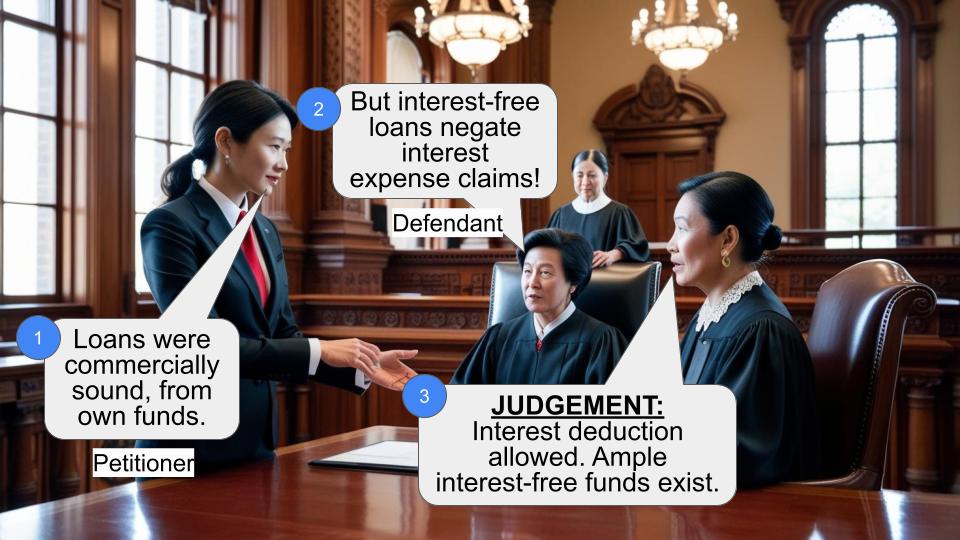
This case is all about a company that lent money to its sister companies at a lower interest rate than what it was paying on its own loans. The tax authorities weren’t happy about this and disallowed some of the interest deductions. But guess what? The court sided with the company, saying it was okay because it was done for business reasons.
Get the full picture - access the original judgement of the court order here
Case Name:
Hindalco Industries Co. Vs Commissioner of Income Tax (High Court of Allahabad)
Income Tax Reference No. 2 of 2010
Date: 9th August 2016
Key Takeaways:
- Interest on loans to sister companies can be deducted if it’s for business purposes.
- “Commercial expediency” is a broad term that includes what a smart businessperson would do.
- Tax authorities shouldn’t try to play businessman and decide what’s reasonable spending.
- Companies don’t have to always maximize profits in the eyes of the law.
Issue:
The main question here was: Is it okay for a company to deduct interest on loans it took, even if it lent money to its sister companies at a lower interest rate?
Facts:
- This all went down in the 1989-90 tax year.
- The company (let’s call them Hindalco) borrowed about Rs.2.31 crore.
- They paid interest on this loan at rates between 11% to 16%.
- But then, Hindalco lent money to its sister companies at only 6% to 12% interest.
- The tax folks weren’t thrilled about this difference in interest rates.
Arguments:
The tax authorities said:
- “Hey, you’re not a finance company!”
- “If you hadn’t lent that money, you wouldn’t have needed to borrow so much.”
- “You can’t deduct the full interest because you’re lending at a lower rate.”
Hindalco argued:
- “We did this for business reasons, not charity.”
- “Our sister companies needed help, and helping them ultimately helps us too.”
Key Legal Precedents:
The court looked at some important past cases:
- S.A. Builders Ltd. Vs CIT (Appeals) (2007) 288 ITR 1(SC): This case said that “for the purpose of business” is broader than just “for making profits”.
- CIT Vs Malayalam Plantations Ltd. (1964) 53 ITR 140 (SC) and CIT Vs Birla Cotton Spinning & Weaving Mills Ltd. (1971) 82 ITR 166 (SC): These backed up the S.A. Builders case.
- Madhav Prasad Jatia Vs CIT, 1979 (118) ITR 200 (SC): This one talked about “commercial expediency”.
- Hero Cycles P. Ltd. Vs Commissioner of Income Tax, (2015) 379 ITR 347 (SC): This recent case agreed with CIT Vs Dalmia Cement (B) Ltd., (2002) 251 ITR 377 (Delhi), saying tax authorities shouldn’t play businessman.
Judgement:
The court said, “You know what? Hindalco was right.” Here’s why:
- The loans were for business reasons (commercial expediency), not personal or sentimental reasons.
- Helping the sister companies could ultimately benefit Hindalco.
- The tax authorities shouldn’t try to decide what’s a reasonable business decision.
- Hindalco can deduct the full interest under Section 36(1)(iii) (of Income Tax Act, 1961).
FAQs:
Q: What does “commercial expediency” mean?
A: It’s basically anything a smart businessperson would do to help their business, even if they’re not legally required to do it.
Q: Does this mean companies can lend money at any interest rate they want?
A: Not exactly. It just means that if they can show it’s for business reasons, they might be able to deduct the interest.
Q: Why did the court disagree with the tax authorities?
A: The court felt that tax authorities shouldn’t try to make business decisions for companies. They should focus on whether something was done for business reasons, not whether it was the most profitable choice.
Q: Does this apply to all companies lending money to other companies?
A: Not necessarily. This case was about a company lending to its sister companies. Different circumstances might lead to different results.
Q: What’s the main lesson for businesses from this case?
A: If you’re lending money to related companies at lower rates, make sure you can explain how it benefits your business in the long run.

1. Heard Sri Vinod Upadhaya, Advocate, assisted by Sri R.S. Agarwal, Advocate, for the Assessee and Sri Shubham Agarwal for Revenue.
2. This is a reference under Section 256(2) (of Income Tax Act, 1961) (hereinafter referred to as 'Act 1961'). The dispute relates to Assessment Year 198990. Following question has been referred to be answered by this Court by Income Tax Appellate Tribunal (hereinafter referred to as 'Tribunal').
“Whether on the facts and in the circumstances of the case disallowance of the interest paid by the assessee on its borrowed funds in excess of 12% was justified under section 36(1) (of Income Tax Act, 1961), only because the assessee company had utilized its own funds to advance loans at a lower rate of interest to sister concern.”
3. Assessee borrowed and taken loan to the tune of Rs. 2,31,22,000/. It paid interest to Bank and others to the tune of Rs. 68,07,000/. The rate of interest paid to Bank was 16 percent whereas rate of interest to other deposits ranges between 11 percent to 16 percent.
4. Assessing Officer came to the conclusion that market rate of interest was 16 percent yet Assessee advanced loan to Sister Subsidiary Company at a lesser rate of 6 percent or 12 percent. The difference between interest i.e. market rate and the rate at which loan advanced to Sister Company, was disallowed. It has been affirmed by Commissioner Income Tax (Appeal) [hereinafter referred to as ‘CIT(A)’] on the ground that Assessee was not a financing company, had it not advanced loan, money could have been available to Assessee for its own business purpose and to that extent it may not have borrowed from Banks. It disallowed difference of interest under Section 36(1)(iii) (of Income Tax Act, 1961), and upheld by Tribunal also.
5. From the record, we find that it is not the case of Revenue Authorities that loan advanced to Sister Subsidiary Company was for non business purpose. Tribunal has recorded a finding concurrent with CIT(A) that no direct link could be established between borrowing and lendings and it is also not the case that loan was not advanced for commercial expediency of Sister Subsidiary Companies. But on mere fact that Assessee Company was a profit making Company, itself has paid higher rate of interest hence it was not justified to advance loan on lower rate of interest, hence difference has been disallowed under Section 36(1)(iii) (of Income Tax Act, 1961). The moot question is whether this approach of Revenue is justified.
6. Section 36 (of Income Tax Act, 1961) talks of permissible deductions. One of such deduction under Section 36(1)(iii) (of Income Tax Act, 1961) reads as under: “the amount of interest paid in respect of capital borrowed for the purposes of the business or profession: [Provided that any amount of the interest paid, in respect of capital borrowed for acquisition of an asset for extension of existing business or profession (whether capitalized in the books of account or not); for any period beginning from the date on which the capital was borrowed for acquisition of the asset till the date on which such asset was first put to use, shall not be allowed as deduction.]”
7. It talks of interest in respect to capital borrowed for the purpose of business or profession.
8. There is nothing on record to show that loan advanced to Sister Subsidiary was not in respect of capital borrowed for the purpose of business or profession.
9. This provision came up for consideration in S.A. Builders Ltd. Vs CIT (Appeals) (2007) 288 ITR 1(SC). Court held that the term “for the purpose of business” is wider in scope than the expression “for the purpose of earning profits” and relied on its earlier decisions in CIT Vs Malayalam Plantations Ltd. (1964) 53 ITR 140 (SC) and CIT Vs Birla Cotton Spinning & Weaving Mills Ltd. (1971) 82 ITR 166 (SC). It held that if borrowed amount is donated for sentimental or personal reasons and not on the ground of commercial expediency, interest thereon would not be allowed under Section 36(1)(iii) (of Income Tax Act, 1961), but if it is advanced to a third party for commercial expediency it must be allowed and for that purpose reliance was placed on Madhav Prasad Jatia Vs CIT, 1979 (118) ITR 200 (SC). Court referred the following expression discussing scope of “commercial expediency” and said “the expression “commercial expediency” is an expression of wide import and includes such expenditure as a prudent businessman incurs for the purpose of business. Expenditure may not have been incurred under any legal obligation, but yet it has allowable as a business expenditure if it was incurred on grounds of commercial expediency.”
10. In S.A. Builders Ltd. Vs CIT (supra) Court held that true test is, whether the amount advanced to subsidiary or associated company or any other party was advanced as a measure of commercial expediency. If so, interest was deductable.
11. Recently in Hero Cycles P. Ltd. Vs Commissioner of Income Tax, (2015) 379 ITR 347 (SC), matter has been discussed and Court agreeing with Delhi High Court judgment in CIT Vs Dalmia Cement (B) Ltd., (2002) 251 ITR 377 (Delhi), has observed;
“Once it is established that there was a nexus between the expenditure and the purpose of business, the Revenue cannot justifiably claim to put itself in the armchair of a businessman or in the position of the board of directors and assume the said role to decide how much is reasonable expenditure having regard to the circumstances of the case. Court also observed that no businessman can be compelled to maximise his profits and the Income Tax Authority must put themselves in the shoes of Assessee and see how a prudent businessman would act. The authorities must not look into the matter from their own point of view but that of a prudent businessman.”
12. In the present case, financial condition of Sister concerned was not good and to help those, for their smooth running, loan was advanced and a lesser rate of interest was charged. Both Sister Companies are subsidiary of Assessee and there is nothing perse averse. For the welfare and proper functioning of Sister Companies, Assessee in its wisdom, if decided to advance loan so that ultimately Sister Company may function properly, Assessee being holding Company would also be benefited. Thus, the loan advanced to Sister Companies was for commercial expediency and not for any charity, sentimental or personal reasons.
13. We therefore, answer the question in favour of Assessee and hold that Assessee was entitled for deduction of interest under Section 36(i)(III) (of Income Tax Act, 1961) and the view taken by Tribunal otherwise is not correct. Reference is answered accordingly and stands disposed of.
Order Date : 9.8.2016
Pravin
×
Questions
Court Allows Interest Deduction on Loans to Sister Company, Citing Commercial Expediency
Write your CommentSimilar Posts


Generic
- Reportdata/2538.pdf
