


Full News
Court Allows Property Swap to Secure Tax Liability, Expedites Appeal
Court Allows Property Swap to Secure Tax Liability, Expedites Appeal
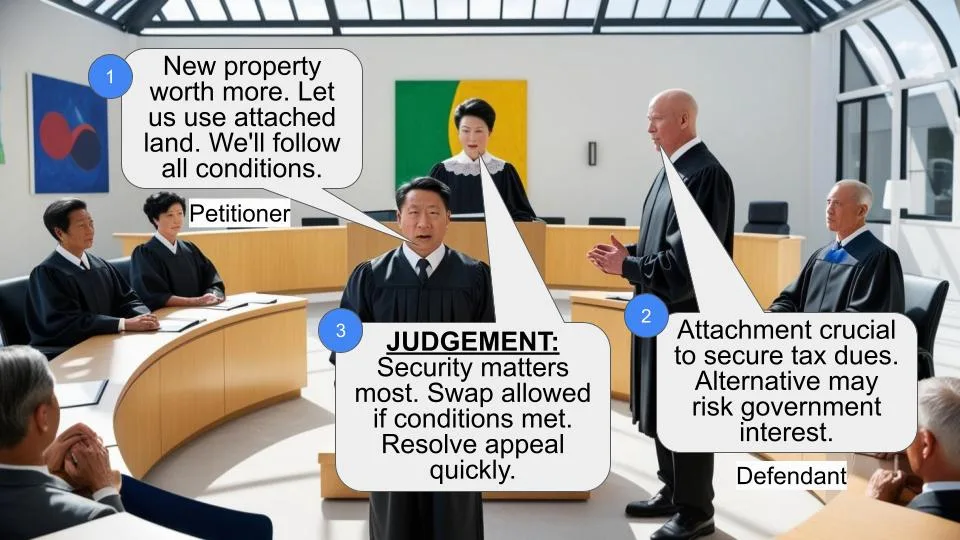
This case involves a private limited company engaged in real estate development that appealed against a tax liability order. The company requested to replace an attached property with another as security for the pending tax liability. The court granted this request, subject to certain conditions, and directed for a speedy resolution of the pending appeal.
Get the full picture - access the original judgement of the court order here
Case Name:
DAMAC HOLDINGS (P.) LTD. VS DEPUTY COMMISSIONER OF INCOME TAX
(High Court of Kerala)
Date:18 September 2012
Key Takeaways:
1. Courts may allow substitution of attached property if adequate security is provided.
2. The primary aim of property attachment in tax cases is to secure the government's interests.
3. Courts can expedite pending appeals to resolve tax disputes quickly.
Issue:
Should the court allow the petitioner (a private limited company) to substitute the property attached by tax authorities with another property as security for a pending tax liability?
Facts:
1. The petitioner is a private limited company involved in real estate development .
2. For the assessment year 2008-09, the 1st respondent (tax authority) passed an order (Ext.P1) imposing a tax liability on the petitioner .
3. The petitioner appealed, resulting in a reduced liability (Ext.P2), which was implemented (Ext.P3) and later rectified (Ext.P4) .
4. The current liability is around ₹2.15 crores .
5. The petitioner filed another appeal (Ext.P5) against Ext.P2, which is pending before the 5th respondent Tribunal .
6. Meanwhile, the 3rd respondent attached certain properties (Ext.P6) .
7. The petitioner requested to lift the attachment (Ext.P7 and Ext.P8), offering an alternative property worth ₹2.95 crores as security .
8. The request was initially denied (Ext.P9) .
Arguments:
Petitioner's argument:
- They want to utilize the attached property and offered an alternative property as security .
- The offered property is worth ₹2.95 crores, which is more than the current tax liability .
Respondents' argument:
- The attachment is necessary to secure the government's interest pending the appeal .
Key Legal Precedents:
No specific legal precedents were cited in the judgment. However, the court relied on general principles of securing government interests and allowing reasonable requests from taxpayers.
Judgement:
The court disposed of the writ petition with the following directions:
1. The petitioner must deposit ₹75,00,000 within one month .
2. The petitioner must deposit the title deeds of the property mentioned in Ext.P8 with the 1st respondent .
3. The court recorded the petitioner's submission that the offered property is unencumbered and they won't deal with it until the appeal is decided .
4. Once these conditions are met, the attachment under Ext.P6 will be lifted .
5. The 5th respondent Tribunal is directed to dispose of the Ext.P5 appeal expeditiously .
FAQs:
Q1: Why did the court allow the substitution of the attached property?
A1: The court recognized that the primary purpose of the attachment was to secure the government's interests. As long as this purpose could be achieved through other means, the court was willing to consider the petitioner's request.
Q2: What conditions did the court impose for lifting the attachment?
A2: The court required the petitioner to deposit ₹75,00,000, submit the title deeds of the alternative property, and commit to not dealing with the property until the appeal is decided.
Q3: Why did the court direct for an expedited appeal process?
A3: To resolve the tax dispute quickly and provide certainty to both parties, the court instructed the Tribunal to dispose of the appeal as expeditiously as possible.
Q4: Does this judgment set a precedent for other tax cases?
A4: While each case is unique, this judgment suggests that courts may be willing to consider alternative arrangements for securing tax liabilities, provided the government's interests are adequately protected.
Q5: What happens if the petitioner doesn't comply with the court's directions?
A5: If the petitioner fails to meet the conditions set by the court, the original attachment (Ext.P6) would likely remain in force.

1. Heard the learned counsel for the petitioner and also the learned standing counsel appearing for the respondents.
2. Petitioner is a private limited company engaged in real estate development. For the assessment year 2008-09, Ext.P1 order was passed by the 1st respondent fastening liability on the petitioner. Against that order, petitioner filed appeal in which Ext.P2 order was passed by the appellate authority reducing the liability to a considerable extent. That order was implemented and accordingly, Ext.P3 revised order was passed. That was subsequently rectified and Ext.P4 was issued. As a result of the whole exercise, now the liability of the petitioner according to them is around `2.15 crores. Against Ext.P2, the petitioner has filed Ext.P5 appeal which is pending consideration of the 5th
respondent Tribunal. In the meantime, by Ext.P6 order issued by the 3rd respondent, the properties mentioned therein were attached. According to the petitioner, they want to utilise the property and therefore they made Ext.P7 requesting to lift the attachment. There was no response to Ext.P7 and therefore they made Ext.P8 reiterating the request for lifting the attachment but however offering the property having an extent of 98.664 cents comprised in R.S.Nos.303/5, 303/6, 303/7, 303/8 and 303/9 covered by document No.4044/07 and situated in Thengode, Kakkanad as alternate security. Petitioner also pointed out that according to them, the value of the property is more than `2.95 crores. However by Ext.P9 dated 4/9/12, they were informed that the request for release of the property attached by Ext.P6 accepting the property offered in Ext.P8 cannot be considered “at this stage”. It is in these circumstances, the writ petition is filed.
3. I heard the learned counsel appearing for the respondents also.
4. Admittedly, the appeal filed by the petitioner against Ext.P2 order is pending consideration of the Tribunal. The intention of attaching the property mentioned in Ext.P6 is only to secure the interest of the respondents pending disposal of the appeal. If that interest of the respondents could be secured by making available other property or by other means or by both, there is no reason why the request of the petitioner shall not be considered.
5. In this case although the valuation of the property mentioned in Ext.P8 has not been done by any external agency, still going by the statements contained in Ext.P8, the property mentioned therein is worth `2.95 crores. Therefore, there is no reason to continue the attachment covered by Ext.P6 once the petitioner furnishes adequate security to take care of the interest of the respondents. With this in mind, I dispose of the writ petition with the following directions:-
(1) That the petitioner shall deposit an amount of `75,00,000/- (Rupees Seventy five lakhs only) within one month.
(2) Petitioner shall also deposit the title deeds pertaining to the property mentioned in Ext.P8 with the 1st respondent.
(3) I record the submission made on behalf of the petitioner that the property is free from encumbrance and that they will not deal with the property in any manner until the appeal is decided and the documents are released.
(4) Once the petitioner complies with the above directions, the attachment effected as per Ext.P6 will be lifted.
(5) The 5th respondent Tribunal is directed to dispose of Ext.P5 appeal with notice to the parties concerned and as expeditiously as possible.
ANTONY DOMINIC, JUDGE
×
Similar Ripples
Questions
Court Allows Property Swap to Secure Tax Liability, Expedites Appeal
Write your CommentSimilar Posts


Generic
- Reportdata/5430.pdf
