


Court Blocks Tax Reassessment After 4 Years, Citing Full Disclosure by Assessee


Full News
Court Blocks Tax Reassessment After 4 Years, Citing Full Disclosure by Assessee
Court Blocks Tax Reassessment After 4 Years, Citing Full Disclosure by Assessee
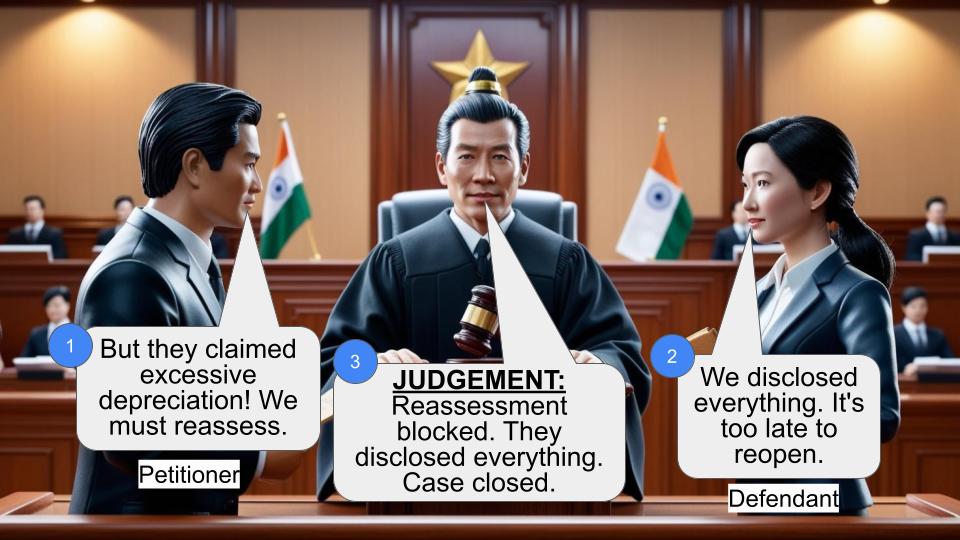
The tax department tried to reopen an assessment after four years, but the court said, "Nope, not happening!" The case involves Cholamandalam Investment & Finance Co. Ltd. and the Commissioner of Income Tax. The main issue was about claiming 100% depreciation on some assets. The court sided with the company, saying they had disclosed all the necessary information during the original assessment.
Get the full picture - access the original judgement of the court order here
Case Name:
Commissioner of Income Tax Vs Cholamandalam Investment & Finance Co. Ltd. (High Court of Madras)
Tax Case (Appeal) No.1387 of 2007
Date: 31st October 2007
Key Takeaways:
1. If you're honest and provide all the details during a tax assessment, the tax department can't come back after four years to reopen your case.
2. The responsibility is on the Assessing Officer to thoroughly examine the information provided during the original assessment.
3. Claiming high depreciation doesn't automatically mean you can be reassessed after the four-year limit.
Issue:
The main question here was: Can the Income Tax Department reopen an assessment after four years if the assessee (that's the taxpayer) had fully and truly disclosed all material facts during the original assessment?
Facts:
1. Cholamandalam Investment & Finance Co. Ltd. is in the leasing and finance business.
2. For the 1996-97 assessment year, they claimed 100% depreciation on some assets.
3. During the original assessment, the Assessing Officer (AO) asked for details about two specific purchases and lease transactions.
4. The company provided all the requested information, including invoices.
5. The AO completed the assessment based on this info.
6. Later, after four years, the tax department wanted to reopen the case.
Arguments:
The tax department's side:
- They argued that the case falls under Explanation 2(c)(iv) of Section 147 (of Income Tax Act, 1961), which allows reassessment if excessive loss or depreciation was claimed.
The company's side:
- They said they had provided all the required information during the original assessment.
- The AO had examined the details and made a decision, so reopening the case would just be a change of opinion.
Key Legal Precedents:
The court referred to the case of COMMISSIONER OF INCOME-TAX VS. ANNAMALAI FINANCE LIMITED reported in 275 ITR 451. This case likely dealt with similar issues of reopening assessments after the four-year period.
Judgement:
The court ruled in favor of Cholamandalam Investment & Finance Co. Ltd. Here's why:
1. The company had provided all the requested information during the original assessment.
2. The AO had examined the details, including invoices and lease agreements.
3. If there was any failure, it was on the part of the AO for not investigating further, not on the company.
4. The proviso to Section 147 (of Income Tax Act, 1961) applies here, which prevents reopening after four years if all material facts were disclosed.
FAQs:
1. Q: What's the significance of the four-year period?
A: After four years, the tax department can't reopen an assessment unless they prove the assessee didn't disclose all material facts.
2. Q: Does claiming 100% depreciation automatically allow for reassessment?
A: No, not if you've disclosed all the details during the original assessment.
3. Q: What should taxpayers learn from this case?
A: Always provide full and true disclosure of all material facts during your original assessment. It can protect you from future reassessments.
4. Q: Can the tax department appeal this decision?
A: They could try to appeal to a higher court, but based on the facts presented, their chances might be slim.
5. Q: Does this mean the AO can never reopen an assessment after four years?
A: They can, but only if they can prove the assessee failed to disclose all material facts fully and truly.

1. The appeal is filed against the order of the Income Tax Appellate Tribunal Madras 'A' Bench dated 23.11.2006 made in I.T.A.No.1227/Mds/2005 for the assessment year 1996-97.
2. The assessee is a company engaged in the business of leasing and finance. For the assessment year 1996-97, the assessing officer, while making the original assessment has called for the basic details regarding two purchasers. After receipt and taking into consideration of the details furnished by the assessee, the assessing officer came to the conclusion that the purchase of two items and leasing them to related parties do not fall under the category of sale and lease back transaction and therefore the assessing officer has not made any further investigation. The assessing officer disallowed the depreciation in respect of machineries got back under lease from two parties and added back to the total income. Against that order, the assessee preferred an appeal before the Commissioner of Income-tax (Appeals) and the Commissioner of Income-tax (Appeals) allowed the assessee's appeal stating that there was no fault of the assessee in disclosing the material facts and it was a case for change of opinion. Against that order, the Department preferred an appeal before the Income-tax Appellate Tribunal and the Income-tax Appellate Tribunal following the decision of this Court in the case of COMMISSIONER OF INCOME-TAX VS. ANNAMALAI FINANCE LIMITED reported in 275 ITR 451 dismissed the appeal filed by the Department. Being aggrieved by that order, the Department is in appeal before us by formulating the following question of law:
"Whether on the facts and in the circumstances of the case the Income-tax Appellate Tribunal is right in law in holding that the assessment has been reopened after 4 years from the end of the relevant assessment year, even though the assessee not disclosed fully and truly the material facts for completing the assessment ;is valid in law?"
3. Learned counsel appearing for the revenue relied on explanation (2) appended to Section 147 of the Income Tax Act, 1961 and contended that the case of the assessee would come within the purview of sub-clause (iv) of clause (c) of Explanation (2) to the effect that the assessee has claimed excessive loss or depreciation allowance and in that circumstance, Section 147 (of Income Tax Act, 1961) would apply.
4. We heard the argument of the learned counsel for the revenue and perused the materials on record.
5. In the original assessment order passed by the assessing officer, it was held that the assessee was asked vide questionnaire dated 31.8.1998 to give invoices for assets on which depreciation was claimed during the year (100% rate and 40% rate) along with list of lease transactions. The assessee submitted that information on 4.12.1998. In order to verify the genuineness of these transactions, a notice under Section 133(6) (of Income Tax Act, 1961) calling for certain information was issued to all the lessees and suppliers involved in the lease transactions. Further, the assessee was asked to clarify vide letter dated 18.12.1998 whether they had entered into any sale and lease back transactions during the relevant assessment year. As far as the regular transactions are concerned, they were thoroughly scrutinised. The invoices and lease agreements furnished by the assessee were compared with invoices, delivery notes/challans, lease agreement and other details submitted by the lessees/suppliers in response to notice under Section 133(6) (of Income Tax Act, 1961) and found that there was no discrepancy in it. From that, it was clear that while making the original assessment the assessing officer had called for the basic details regarding those purchases, and the assessee had furnished those details. On that basis, the assessment has been completed. This factum has been taken into consideration by the Commissioner of Income-tax (Appeals), who held that perhaps the assessing officer came to the conclusion that the purchase of these two items and leasing them to related parties do not fall under the category of "Sale and Lease Back Transaction" and therefore the assessing officer has not made further investigation. But the fact was that the assessing officer has spotted those two transactions and called for certain details and the assessee has furnished the same. In those circumstances, it could not be regarded that the assessee had failed to disclose fully and truly all material facts relevant for assessment. As the facts revealed that the assessing officer who made the original assessment order has called for all the details regarding the case where 100% depreciation were claimed and the assessee had furnished the invoices for purchase of assets on which 100 % depreciation were claimed, there was no failure on the part of the assessee and if at all there was any failure, according to the Commissioner of Income-tax (Appeals), it was on the part of the assessing officer, who made the original assessment without going behind the nature of the transactions accepting the details furnished by the assessee. The Tribunal also extracted that portion of the order and found on fact that there was no fault on the part of the assessee so as to enable the Department to reopen the assessment as the proviso to Section 147 of the Income Tax Act, 1961 would squarely apply to the case of the assessee. We find no infirmity in the order passed by the Tribunal. Hence, the appeal is dismissed.
(K.R.P.,J.) (C.V.,J.)
31.10.2007
Index:Yes
Internet: Yes
usk
To
1. The Assistant Registrar, Income Tax Appellate Tribunal, Chennai-600 034
2. The Commissioner of Income-tax (Appeals)- I Chennai
3.The Asst.Commissioner of Income Tax, Central Circle I(4) Chennai.
K.RAVIRAJA PANDIAN,J
AND
CHITRA VENKATARAMAN,J
×
Questions
Court Blocks Tax Reassessment After 4 Years, Citing Full Disclosure by Assessee
Write your CommentSimilar Posts


Generic
- Reportdata/5213.pdf
