


Court Clarifies Burden of Proof in Unexplained Share Capital Cases


Full News

Court Clarifies Burden of Proof in Unexplained Share Capital Cases
Court Clarifies Burden of Proof in Unexplained Share Capital Cases
This case involves an appeal by the Revenue against an order of the Income Tax Appellate Tribunal (ITAT) regarding the assessment of unexplained share application money received by Independent Media Pvt. Ltd. The High Court modified the ITAT's order, clarifying that while the Assessing Officer must allow cross-examination of witnesses, they are not required to prove that the funds originated from the assessee's coffers.
Case Name**:
Commissioner of Income Tax vs. Independent Media Pvt. Ltd.
**Key Takeaways**:
1. Section 68 (of Income Tax Act, 1961) does not require the Assessing Officer to prove the source of unexplained income.
2. The burden of proving the genuineness of share applications lies with the assessee.
3. The Assessing Officer must provide an opportunity for cross-examination when relying on third-party statements.
4. The court reaffirmed the principle that unexplained cash receipts can be treated as concealed income if the assessee fails to provide a satisfactory explanation.
**Issue**:
Is the Income Tax Appellate Tribunal correct in directing the Assessing Officer to verify the source of money of the shareholders and make additions in the hands of persons who provided the monies, rather than in the hands of the assessee company?
**Facts**:
1. Independent Media Pvt. Ltd., a company engaged in TV program production, received share capital of ₹2,20,00,000 .
2. The Income Tax Department reopened the assessment based on information from the Investigation Wing about the company's involvement in accommodation entries .
3. The Assessing Officer added this amount to the company's income, treating it as unexplained income from undisclosed sources .
4. The Commissioner of Income Tax (Appeals) deleted the addition based on documents provided by the assessee .
5. The Income Tax Appellate Tribunal (ITAT) upheld the deletion but directed further investigation into the source of the funds .
**Arguments**:
Assessee's arguments:
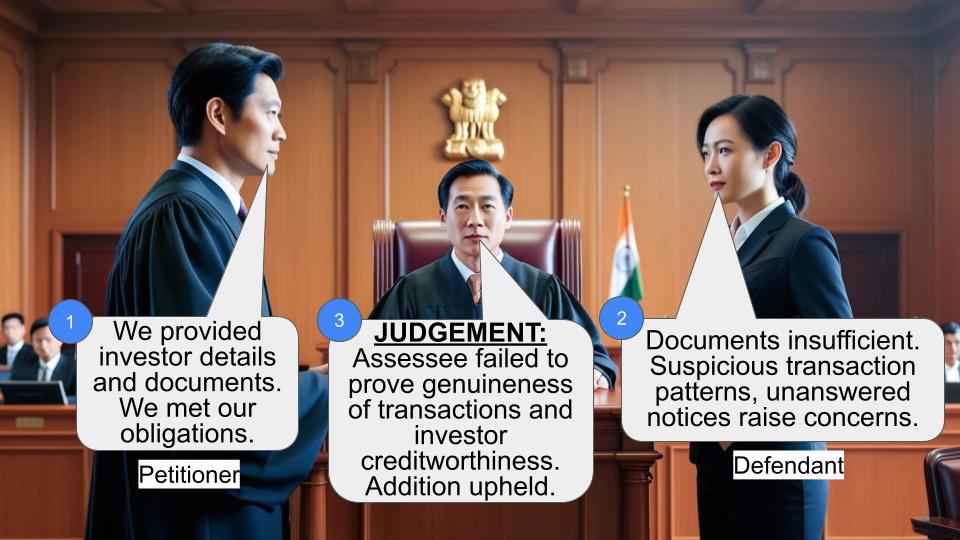
1. Provided documentation to prove the genuineness of share applications.
2. Claimed that subscriber companies had sufficient funds to invest.
Revenue's arguments:
1. Investigation Wing found evidence of accommodation entries.
2. Assessee failed to prove the creditworthiness and genuineness of transactions.
**Key Legal Precedents**:
1. A. Govindarajulu Mudaliar v. CIT, (1958) 34 ITR 807 (SC): Established that when an assessee fails to prove the source of cash receipts, the Income Tax Officer can infer it's assessable income .
2. CIT v. Devi Prasad Vishwanath Prasad, (1969) 72 ITR 194 (SC): Reaffirmed the principle from Govindarajulu Mudaliar .
3. CIT v. Lovely Exports Pvt. Ltd., (2008) 216 CTR 195: Cited by CIT(A) in deleting the addition .
**Judgement**:
1. The High Court partially allowed the Revenue's appeal.
2. It held that Section 68 (of Income Tax Act, 1961) does not require the Assessing Officer to prove that funds emanated from the assessee's coffers .
3. The court modified the ITAT's directions, stating that the Assessing Officer can make additions if the assessee's explanation is unsatisfactory, without needing to prove the source of funds .
4. The court directed the Assessing Officer to provide an opportunity for cross-examination of persons who gave statements to the Investigation Wing .
**FAQs**:
1. Q: What is the significance of Section 68 (of Income Tax Act, 1961) in this case?
A: Section 68 (of Income Tax Act, 1961) deals with unexplained cash credits. The court clarified that this section doesn't require the Assessing Officer to prove the source of funds, contrary to what the ITAT had suggested.
2. Q: Does the assessee have any responsibility in proving the genuineness of share applications?
A: Yes, the burden of proving the identity and creditworthiness of share applicants and the genuineness of transactions lies with the assessee.
3. Q: What should the Assessing Officer do in light of this judgment?
A: The Assessing Officer should allow cross-examination of witnesses, reassess the explanation provided by the assessee, and make additions if the explanation is unsatisfactory, without needing to prove the source of funds.
4. Q: How does this judgment impact similar cases of unexplained share capital?
A: This judgment reinforces the principle that unexplained receipts can be treated as income if the assessee fails to provide a satisfactory explanation, placing the onus on the assessee to prove the genuineness of transactions.
5. Q: What is the importance of cross-examination in such cases?
A: Cross-examination is crucial when the Assessing Officer relies on third-party statements. It ensures fairness by allowing the assessee to challenge the evidence used against them.

1. This is an appeal by the Revenue filed before this Court under Section 260A (of Income Tax Act, 1961) („Act‟ for short). It is directed against the order of the Income Tax Appellate Tribunal („Tribunal‟ for short) dated 11.03.2010 passed in ITA No.470/Del/2009.
2. The following substantial question of law is framed: -
“Whether the Tribunal is right in law in remitting the issue relating to the addition of `2,20,00,000/- made on account of unexplained share application money to the Assessing Officer with directions to verify the source of money of the shareholders and make additions in the hands of persons who provided the monies?”
3. The assessee is a private limited company. It is engaged in the business of production of TV Programmes. The original assessment was completed on 23.02.2005 in respect of the return filed on 01.11.2004 for the assessment year 2004-05. Subsequently notice reopening the assessment was issued under Section 148 (of Income Tax Act, 1961). The assessment was reopened on the ground that there was information received from Investigation Wing, New Delhi of the income tax department that the assessee was involved in giving and taking accommodation entries for commission. In the course of the reassessment proceedings it was noticed by the Assessing Officer that the assessee received share capital to the extent of `2,20,00,000/-. On the basis of the information received by him from the Investigation Wing, he called upon the assessee to prove the genuineness of the share subscription as also the creditworthiness and identity of the persons who subscribed for the shares. The assessee was also requested to furnish confirmation and explain how the money received as share subscription was utilised.
4. In response the assessee submitted the copies of the share application forms and the balance sheet of the companies which applied for the shares. No confirmation or evidence to establish the genuineness of the transaction or creditworthiness of the share applicants was filed. It was also noticed by the Assessing Officer that the persons who allegedly subscribed to the shares of the assessee company had given statements before the Investigation Wing that they were entry providers giving accommodation entries after receiving cash and after charging their commission. On this basis and taking note of the lukewarm response of the assessee to the notices calling upon it to furnish necessary proof in support of share application monies, the Assessing Officer issued a show-cause notice to the assessee in which he informed the assessee as follows: -
“The inquiries were conducted by the Investigation Wing of the Department wherein it was found that some persons are involved in giving and taking bogus entries. They are persons of no means but providing accommodation entries which represent the unsecured money of the persons taking entries. The persons providing such entries have admitted during the course of investigation that you are one of the beneficiaries and have been provided the entries to the extent of 2,20,00,000/-. You are, therefore, provided an opportunity to show cause why the entries taken by you to the extent of 2,20,00,000/- and the commission paid on such accommodation entries should not be treated as your income from undisclosed sources of income.”
5. In response to the show-cause notice it would appear that the assessee furnished the PAN number of the companies, share application forms, board resolutions, copy of bank statement, pay orders, confirmation from subscribers, their income tax returns, copies of their balance sheets, etc. and contended that the share application monies were genuine.
6. The Assessing Officer examined the papers filed by the assessee and disputed the assessee‟s claim that the confirmations from the subscribers were filed. He moreover held that the documents adduced by the assessee did not prove the identity and creditworthiness of the subscribers or the genuineness of the transactions. He also noticed that the share application monies were received through banker‟s cheques which were issued immediately after credits in the accounts of the subscriber-companies and that before and after the issue of cheques there was hardly any balance in the bank accounts. Ultimately the Assessing Officer held as follows: -
“12. Moreover, the arguments put forth by the assessee are not acceptable because it has been admitted by the person involved in giving entries, during the course of statement by Investigation Wing, that the assessee has accepted the adjustment entries from the persons who are involved in providing entries to a number of persons wherein cash is taken and cheque or draft is given by floating different companies. The assessee has received such entries from the said person. The assessee has merely received adjustment entries.
13. The share application money received by the assessee to the extent of 2,20,00,000/- (by taking the entries only once) is treated as income of the assessee from undisclosed sources and brought to tax as Income from other sources. Penalty u/s 271(1)(c) (of Income Tax Act, 1961) is initiated on this point for concealment of income.”
7. It may be noted that the Assessing Officer also added the amount of 4,40,000/- as commission paid by the assessee to obtain the accommodation entries @ 2% of 2,20,00,000/-.
8. The assessee challenged the additions as well as the jurisdiction of the Assessing Officer to reopen the assessment in appeal before the CIT (Appeals). The CIT (Appeals) turned down the objections against the jurisdiction to reopen the assessment.
However, on merits the additions were deleted. The findings on the basis of which the CIT (Appeals) deleted the additions are as follows: -
(a) The assessee has filed from each shareholder the share application forms, board resolutions for investment in the shares of the assessee, board resolutions of the assessee-company approving the allotment of the shares, distinctive number of shares, copies of pay orders used for the investment in the shares, copies of the bank statement of the subscriber-companies, their memorandum and articles of association, certificate of incorporation issued by the Registrar of Companies, their profit and loss account and balance sheet, particulars of income tax file numbers, copies of income tax returns filed by them and the intimations issued by the income tax department under Section 143(1)(a) (of Income Tax Act, 1961), return of allotment of shares filed with the ROC, etc.
(b) The bank accounts of the subscriber-company reveal that all of them have sufficient money with them before subscribing to the shares of the assessee company. The credit in the accounts before the issue of the pay orders represented transfer entries from third parties and there were no cash deposits in the accounts.
In the light of the above findings and applying the judgment of the Supreme Court in the case of CIT v. Lovely Exports Pvt. Ltd., (2008) 216 CTR 195 affirming the judgment of this Court in CIT v. Lovely Exports Pvt. Ltd., (2009) 319 ITR (St.) 5 (HC), the CIT (Appeals) deleted the addition of 2,20,00,000/- and consequently also deleted the addition of the commission payment of `4,40,000/-. The assessee‟s appeal was thus partly allowed.
9. The Revenue carried the matter in appeal before the Tribunal in ITA No.470/Del/2009. The Tribunal by and large summarised the findings of the CIT (Appeals) and held that since none of these findings have been controverted by the Revenue, it can be said that the assessee has discharged its onus to prove the receipt of share application monies and therefore no addition can be made in its assessment.
10. The Tribunal, however, did not stop there. It appears to have felt disturbed by the report of the Investigation Wing which was relied upon by the Assessing Officer. It rightly observed that the investigation report available to the Assessing Officer cannot be ignored. Having said so, the Tribunal proceeded to observe that a duty is cast on the Assessing Officer to verify the correctness of the statements wherein certain persons have allegedly stated that they had merely provided accommodation entries after accepting cash for commission, and that since no corroborative material was brought on record and no opportunity was given to the assessee to cross-examine those persons with reference to their statements in which they are alleged to have implicated the assessee, the addition can be considered only in the hands of the persons who had given the said money to these bogus companies for making investment in the form of share capital. According to the Tribunal no such inquiry had been done by the Assessing Officer nor any corroborative material had been brought on record. Reference was made to the judgment of this Court in CIT v. Value Capital Services Pvt. Ltd., (2008) 307 ITR 334 wherein it was held that if the Revenue accepts the existence of the share applicants and is not able to show that they did not have the means to make the investment, there is an additional burden upon it to show that the investment actually emanated from the coffers of the assessee company. According to the Tribunal since there was nothing in the present case to establish that the money has come from the coffers of the assessee-company, no addition is warranted in its assessment. Ultimately the Tribunal proceeded to hold as under: -
“Thus the action of CIT (A) is upheld to the extent of deletion of addition in the hands of assessee Company. At the same time the department is to look into the actual source from where money has come for investment by these companies. If after investigation such money is proved to be unaccounted money, then department is to consider the addition in the hands of those persons who had provided money and which has come to the coffers of these bogus shareholders for investment in share capital. In the instant case, the AO has not made independent enquiry with regard to statement recorded by the Investigation Wing. wherein it was alleged that these persons were involved in providing accommodation entries. No opportunity was provided to cross-examine such statement and the persons who have given such statement. Without bringing corroborative material on record with regard to truthfulness of such statement and without giving opportunity to cross-examine these persons, no addition can be made. On the facts and circumstances of the case, we restore the matter back to the file of AO to verify the source of such money having been come to these alleged bogus shareholders and after establishing the fact of money having been come from the coffers of such persons, the addition may be considered in the hands of such persons who had provided money to such bogus company for investing the same as share capital. We direct accordingly.”
11. The Revenue is aggrieved by the aforesaid order of the Tribunal and has filed the present appeal. We are unable to uphold the view of the Tribunal that it is incumbent upon the Assessing Officer, on the facts and circumstances of the case, to establish with the help of material on record that the share monies had come or emanated from the assessee‟s coffers. Section 68 (of Income Tax Act, 1961) casts no such burden upon the Assessing Officer. This aspect has been considered more than 50 years back by the Supreme Court in the case of A. Govindarajulu Mudaliar v. CIT, (1958) 34 ITR 807 where precisely the same argument was advanced before the Supreme Court on behalf assessee. The argument was rejected by the Court. Venkatarama Iyer, J. speaking for the Court observed as under (page 810 of the report): -
“Now the contention of the appellant is that assuming that he had failed to establish the case put forward by him, it does not follow as a matter of law that the amounts in question were income received or accrued during the previous year, that it was the duty of the Department to adduce evidence to show from what source the income was derived and why it should be treated as concealed income. In the absence of such evidence, it is argued, the finding is erroneous. We are unable to agree. Whether a receipt is to be treated as income or not, must depend very largely on the facts and circumstances of each case. In the present case the receipts are shown in the account books of a firm of which the appellant and Govindaswamy Mudaliar were partners. When he was called upon to give explanation he put forward two explanations, one being a gift of `80,000/- and the other being receipt of `42,000/- from business of which he claimed to be the real owner. When both these explanations were rejected, as they have been it was clearly upon to the Income-tax Officer to hold that the income must be concealed income. There is ample authority for the position that where an assessee fails to prove satisfactorily the source and nature of certain amount of cash received during the accounting year, the Income-tax Officer is entitled to draw the inference that the receipt are of an assessable nature. The conclusion to which the Appellate Tribunal came appears to us to be amply warranted by the facts of the case. There is no ground for interfering with that finding, and these appeals are accordingly dismissed with costs.”
A similar view was taken by the Supreme Court in CIT v. Devi Prasad Vishwanath Prasad, (1969) 72 ITR 194 (SC).
12. In the light of the aforesaid exposition of the legal position the view taken by the Tribunal cannot be upheld. The Tribunal, however, may be justified in directing the Assessing Officer to afford an opportunity to the assessee of cross-examining the persons who had allegedly given statements before the Investigation Wing implicating the assessee in the modus operandi adopted by them, namely, giving of accommodation entries for commission. The Assessing Officer had in his show-cause notice referred to these statements and the fact that the assessee had been named therein as one of the beneficiaries to whom entries to the extent of `2,20,00,000/- have been provided for commission. The assessee appears to have sought cross-examination of those persons but that opportunity was not given by the Assessing Officer as found by the Tribunal, a position not disputed before us on behalf of the Revenue. However, in the fresh round of proceedings it will be open to the Assessing Officer to make the addition in the hands of the assessee-company in case it appears to him, after complying with the directions of the Tribunal, that the explanation adduced by the assessee with regard to the identity and creditworthiness of the subscriber-companies and the genuineness of the transactions is not acceptable for valid reasons which must be clearly spelt out. He will not, however, be under any duty to further show or establish that the monies emanated from the coffers of the assessee company. To place such a burden on him, an impossible one at that, would be quite contrary to the judgments of the Supreme Court cited above. We may only state that the Assessing Officer shall act in accordance with law. The directions of the Tribunal, quoted above are modified to this extent.
13. In the result the substantial question of law is answered in the negative, in favour of the Revenue and against the assessee. The matter will, however, stand remitted to the Assessing Officer with our modified directions, for fresh consideration.
14. The appeal is accordingly disposed of with no order as to costs.
R.V.EASWAR, J
S. RAVINDRA BHAT, J
×
Questions
Court Clarifies Burden of Proof in Unexplained Share Capital Cases
Write your CommentSimilar Posts


Generic
- Reportdata/5647.pdf
