


Court clarifies deduction computation under Section 80-I(6) (of Income Tax Act,…


Full News
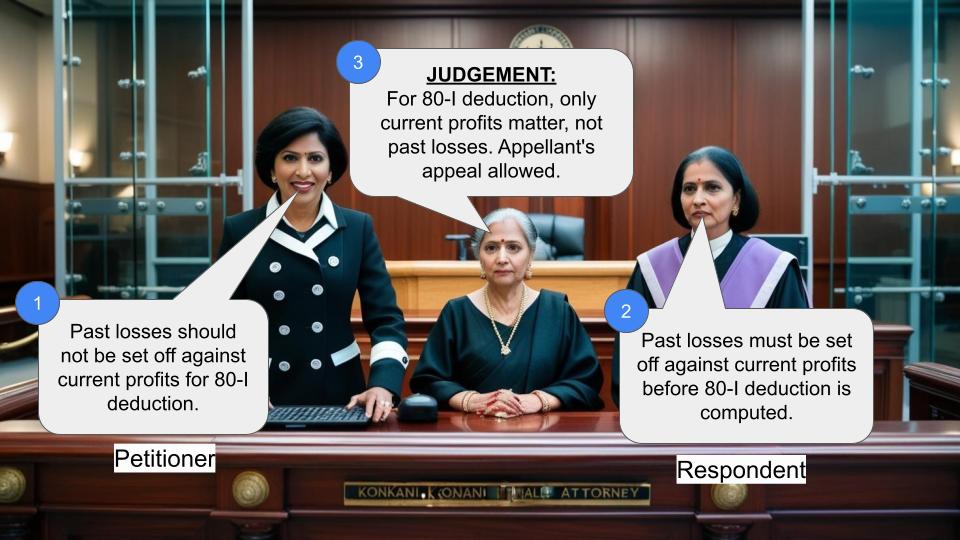
Court clarifies deduction computation under Section 80-I(6) (of Income Tax Act, 1961).
Court clarifies deduction computation under Section 80-I(6) (of Income Tax Act, 1961).
The case involves the interpretation of Section 80-I(6) (of Income Tax Act, 1961), specifically whether losses from previous years should be set off against profits for computing deductions. The court ruled that for the purpose of calculating deductions under Section 80-I (of Income Tax Act, 1961), profits should be treated as the only source of income, without considering past losses.
Get the full picture - access the original judgement of the court order here.
Case Name:
Carborundum Universal Ltd. Vs Joint Commissioner of Income Tax (High Court of Madras)
Tax Case (Appeal) Nos.2386 & 2387 of 2006
Key Takeaways
- The court emphasized that under Section 80-I(6) (of Income Tax Act, 1961), profits from an industrial undertaking should be treated as the only source of income for computing deductions.
- The decision aligns with the Supreme Court's ruling in Synco Industries Ltd. vs. Assessing Officer (Income Tax) and Another.
- The court clarified that the non-obstante clause in Section 80-I(6) (of Income Tax Act, 1961) applies only to the quantum of deduction, not to the computation of gross total income under Section 80B(5) (of Income Tax Act, 1961).
Issue
Should losses from previous years be set off against profits when computing deductions under Section 80-I (of Income Tax Act, 1961)?
Facts
- The appellant is engaged in manufacturing and selling abrasives, refractories, and grinding wheels.
- For the assessment year 1992-93, the Assessing Officer allowed deductions under Section 80-I (of Income Tax Act, 1961).
- Subsequently, a notice under Section 154 (of Income Tax Act, 1961) was issued to set off past losses against the profits for 1992-93.
- The Assessing Officer passed a rectification order, setting off past losses and withdrawing deductions for 1992-93 and 1993-94.
- The appellant's appeals were dismissed by the Commissioner of Income Tax (Appeals) and the Income Tax Appellate Tribunal.
Arguments
- Appellant:
Argued that deductions under Section 80-I (of Income Tax Act, 1961) should be based on profits earned during the year without setting off past losses.
- Respondent:
Contended that past losses should be set off against current profits for computing deductions.
Key Legal Precedents
- Synco Industries Ltd. vs. Assessing Officer (Income Tax) and Another (2008) 299 ITR 444:
The Supreme Court ruled that profits from an industrial undertaking should be treated as the only source of income for computing deductions under Section 80-I(6) (of Income Tax Act, 1961).
- Section 80-I(1) (of Income Tax Act, 1961) and 80-I(6):
These sections outline the computation of deductions and the treatment of profits from industrial undertakings.
Judgement
The court ruled in favor of the appellant, stating that for the purpose of calculating deductions under Section 80-I (of Income Tax Act, 1961), profits should be treated as the only source of income without considering past losses. The court followed its previous decision in T.C.(A)No.298 of 2004 and allowed the appeals.
FAQs
Q1: What was the main issue in this case?
A1: The main issue was whether past losses should be set off against current profits when computing deductions under Section 80-I (of Income Tax Act, 1961).
Q2: What did the court decide?
A2: The court decided that for the purpose of calculating deductions under Section 80-I (of Income Tax Act, 1961), profits should be treated as the only source of income without considering past losses.
Q3: Which legal precedents were cited?
A3: The court cited the Supreme Court's decision in Synco Industries Ltd. vs. Assessing Officer (Income Tax) and Another (2008) 299 ITR 444.
Q4: What sections of the Income Tax Act were relevant?
A4: Sections 80-I(1), 80-I(6), 80A(2), and 80B(5) were relevant to the case.
Q5: What was the outcome for the appellant?
A5: The court ruled in favor of the appellant, allowing the appeals and clarifying the computation of deductions under Section 80-I (of Income Tax Act, 1961).

The above Tax Case (Appeals) filed by the assessee as against the order of the Income Tax Appellate Tribunal were admitted by this Court on the following substantial questions of law:
"1. Whether on the facts and circumstances of the case, the Tribunal was right in holding that the losses incurred by the industrial undertaking claiming deduction under Section 80 (of Income Tax Act, 1961) I, which has been already set off against the profits of the other industrial undertaking should be notionally carried forward and set off against profit generated by the industrial undertaking during the relevant assessment year for determining the deduction under Section 80 (of Income Tax Act, 1961) I?
2. Whether on the facts and circumstances of the case, the Tribunal ought to have held that the issue of restricting the relief under Section 80I (of Income Tax Act, 1961) was debatable and hence cannot be carried out in an order of rectification under Section 154 (of Income Tax Act, 1961) particularly when a concurrent bench of the same Tribunal has held the issue in favour of the assessee?
3. Whether on the facts and circumstances of the case, the Tribunal was right in not appreciating that the rectification under Section 154 (of Income Tax Act, 1961) is permissible only where the mistake is apparent on the face of the record but not when the issue requires deliberation on legal issues and extensive investigation of facts from the records of earlier years?"
2. The appellant is engaged in the business of manufacturing and selling of abrasives, refractories, grinding wheels etc. For the assessment year 1992-93, the Assessing Officer allowed deductions under Section 80I (of Income Tax Act, 1961). Subsequently, notice under Section 154 (of Income Tax Act, 1961) was issued calling upon the assessee to show cause why losses incurred by the assessee upto the assessment year 1991-92 should not be set off against the profits that have been derived from the industrial undertaking during the assessment year 1992-93. In response to the show cause notice, the assessee filed a reply stating that deduction under Section 80 (of Income Tax Act, 1961) I of the Income Tax Act should be construed as profits earned during any year and it should not be treated as profits after setting off of the carried forward losses. However, the Assessing Officer did not agree with the said reply of the assessee and passed the rectification order by notionally carried forward the losses of the earlier years and setting off the same against the profit available during the assessment year 1992-93. Since deduction under Section 80I (of Income Tax Act, 1961) was negatived for the assessment year 1992-93, the Assessing Officer withdrew the deduction for the assessment year 1993-94 also.
3. Aggrieved by the assessment orders, the assessee filed appeals before the Commissioner of Income Tax (Appeals), who dismissed the appeals, thereby confirmed the order of the Assessing Officer.
4. As against the said orders of the Commissioner of Income Tax (Appeals), the assessee filed further appeals before the Income Tax Appellate Tribunal contending that notional carry forward losses should not be set off in computing the deduction under Section 80I (of Income Tax Act, 1961). Before the Tribunal, the assessee relied on the decision of the Tribunal in the case of TTK Pharma Limited in ITA No.2698 of 1994.
5. The Tribunal, without following its own decision, dismissed the appeals filed by the assessee holding that provisions of sub-section (6) of Section 80I (of Income Tax Act, 1961) has not been considered properly in the said decision and hence the said decision would not apply to the case of the assessee.
6. Aggrieved by the order of the Tribunal, the present Tax Case (Appeals) have been filed.
7. Learned counsel appearing for the appellant/assessee submits that the said decision of the Tribunal in the case of Commissioner of Income Tax, Chennai V. M/s.TTK Pharma Limited, Chennai has been taken on appeal by the Revenue before this Court and this Court after considering the entire gamut of the case, decided the issue in favour of the assessee. He further submitted that the said decision of this Court has not been challenged by the Revenue and hence had become final. He also submitted that the issue involved in the present case is identical to the issue decided by this Court dated 23.12.2009 made in T.C.(A)No.298 of 2004 in the case of Commissioner of Income Tax, Chennai V. M/s.TTK Pharma Limited, Chennai.
8. Heard learned counsel appearing for the assessee and the learned Standing Counsel appearing for the Revenue and perused the materials placed before this Court.
9. Whether the issue raised in these appeals is identical to the issue in the above-said decision of this Court in the case of TTK Pharma Limited (supra) needs to be seen.
10. The question raised in the above-said decision of this Court was whether for the purpose of allowing deduction under Section 80 (of Income Tax Act, 1961) I, the brought forward losses and unabsorbed depreciation etc., of the new industrial undertaking need not be taken into consideration, once they have been set off against other sources of income, especially in view of the clear provisions of sub-section 6 (of Income Tax Act, 1961) of Section 80I (of Income Tax Act, 1961), the application of which is mandatory.
11. The Division Bench of this Court relied upon the decision of the Supreme Court in the case of Synco Industries Ltd. Vs. Assessing Officer (Income Tax) and Another reported in (2008) 299 ITR 444, came to the conclusion that once the depreciation allowance and development rebate for the past assessment years were fully set off against the total income of the assessee for those assessment years, the question of carry forward the same does not arise, more so for the purpose of determining the deduction under Section 80I (of Income Tax Act, 1961). For better clarity, the relevant portion of the above-said decision of this Court reads as follows:
"14. Again in the case of Synco Industries Ltd. Vs. Assessing Officer (Income Tax) and Another reported in (2008) 299 ITR 444, while rejecting the contention of a similar nature raised by the Revenue before it, the Hon'ble Supreme Court observed as under:
"The contention that under section 80-I(6) (of Income Tax Act, 1961) the profits derived from one industrial undertaking cannot be set off against loss suffered from another and the profit is required to be computed as if profit making industrial undertaking was the only source of income, has no merit. Section 80-I(1) (of Income Tax Act, 1961) lays down that where the gross total income of the assessee includes any profits derived from the priority undertaking/unit/division, then in computing the total income of the assessee, a deduction from such profits of an amount equal to 20 per cent has to be made. Section 80-I(1) (of Income Tax Act, 1961) lays down the broad parameters indicating circumstances under which an assessee would be entitled to claim deduction. On the other hand, section 80-I(6) (of Income Tax Act, 1961) deals with determination of the quantum of deduction. Section 80-I(6) (of Income Tax Act, 1961) lays down the manner in which the quantum of deduction has to be worked out. After such computation of the quantum of deduction, one has to go back to section 80-I(1) (of Income Tax Act, 1961) which categorically states that where the gross total income includes any profits and gains derived from an industrial undertaking to which Section 80-I (of Income Tax Act, 1961) applies then there shall be a deduction from such profits and gains of an amount equal to 20 per cent. The words "includes any profits" used by the Legislature in section 80-I(1) (of Income Tax Act, 1961) are very important which indicate that the gross total income of the assessee shall include profits from a priority undertaking. While computing the quantum of deduction under section 80-I(6) (of Income Tax Act, 1961), the Assessing Officer, no doubt, has to treat the profits derived from an industrial undertaking as the only source of income in order to arrive at the deductions under Chapter VI-A. However, this court finds that the non obstinate clause appearing in section 80-I(6) (of Income Tax Act, 1961), is applicable only to the quantum of deduction, whereas, the gross total income under section 80B(5) (of Income Tax Act, 1961) which is also referred to in section 80-I(1) (of Income Tax Act, 1961) is required to be computed in the manner provided under the Act which presupposes that the gross total income shall be arrived at after adjusting the losses of the other division against the profits derived from an industrial undertaking. If the interpretation as suggested by the appellant is accepted it would almost render the provisions of section 80A(2) (of Income Tax Act, 1961) nugatory and, therefore, the interpretation canvassed on behalf of the appellant cannot be accepted. It is true that under section 80-I(6) (of Income Tax Act, 1961) for the purpose of calculating the deduction, the loss sustained in one of the units, cannot be taken into account because sub-section (6) contemplates that only the profits shall be taken into account as if it was the only source of income. However, section 80A(2) (of Income Tax Act, 1961) and section 80B(5) (of Income Tax Act, 1961) are declaratory in nature. They apply to all the sections falling in Chapter VI-A. They impose a ceiling on the total amount of deduction and, therefore, the non obstinate clause in section 80-I(6) (of Income Tax Act, 1961) cannot restrict the operation of sections 80A(2) and 80B(5) which operate in different spheres. As observed earlier, section 80 (of Income Tax Act, 1961)- I(6) deals with actual computation of deduction whereas section 80-I(1) (of Income Tax Act, 1961) deals with the treatment to be given to such deductions in order to arrive at the total income of the assessee and, therefore, while interpreting section 80-I(1) (of Income Tax Act, 1961), which also refers to gross total income one has to read the expression "gross total income" as defined in section 80B(5) (of Income Tax Act, 1961)...." (emphasis supplied)
15. The cumulative consideration of the principles set out in the above referred to decisions and the other factors involved in this case, wherein admittedly the entire depreciation allowance and development rebate for the past assessment years were fully set off against the total income of the assessee for those assessment years and no further depreciation allowance or development rebate remain unabsorbed and nothing could be deducted in respect of the set off while determining the deduction under Section 80I (of Income Tax Act, 1961)."
12. A reading of the above-said decision of this Court reveals that the issue raised in the present appeals is identical to the issue decided by this Court. It is relevant to note that the Revenue has not challenged the decision of this Court and hence the said decision has become final.
13. Since the issue raised in these appeals has been decided by this Court and we see no reason to differ with the view taken by this Court, following the decision of this Court dated 23.12.2009 made in T.C.(A)No.298 of 2004, the above Tax Case (Appeals) are allowed. No costs.
Index :Yes/No (R.S.,J) (R.K.,J)
Internet:Yes/No 12.01.2015
To
1. The Income Tax Appellate Tribunal 'A' Bench, Chennai
2. The Commissioner of Income Tax (Appeals) - V, Chennai-34.
3. The Joint Commissioner of Income Tax, Special Range I, Chennai-34.
R.SUDHAKAR,J.
AND
R.KARUPPIAH,J.
×
Questions
Court clarifies deduction computation under Section 80-I(6) (of Income Tax Act, 1961).
Write your CommentSimilar Posts


Generic
- Reportdata/4140.pdf
