


Court Denies Interest Netting in Export Profit Calculation for Tax Deduction


Full News
Court Denies Interest Netting in Export Profit Calculation for Tax Deduction
Court Denies Interest Netting in Export Profit Calculation for Tax Deduction
A carpet exporter (the Assessee) was trying to reduce their taxable income by netting interest earned against interest paid when calculating a tax deduction. The court said, "Nope, you can't do that!" Let's break it down, shall we?
Get the full picture - access the original judgement of the court order here
Case Name:
Kashmir Arts vs Commissioner of Income Tax
(High Court Of Delhi)
Date:12 October 2007
Key Takeaways:
1. Interest earned on Fixed Deposit Receipts (FDRs) kept as margin money isn't considered business income.
2. To apply interest netting, there must be a clear connection between interest paid and earned.
3. The court reinforced the importance of properly categorizing income sources for tax purposes.
Issue:
The main question here was: Can the Assessee reduce the interest paid from the interest received when calculating deduction under Section 80-HHC(3A) (of Income Tax Act, 1961) read with Explanation (baa) of the Income Tax Act, 1961?
Facts:
Alright, let's set the scene:
- We're dealing with the Assessment Year 1993-94.
- The Assessee is in the business of exporting carpets.
- They filed a return showing an income of Rs.12,04,030/-, later revised to Rs.12,82,976/-.
- The Assessee claimed a deduction of Rs.3,62,76,246/- under Section 80HHC (of Income Tax Act, 1961).
- They had FDRs with the bank as margin money for credit facilities.
- The Assessee earned Rs.8,50,858/- as interest on these FDRs and paid Rs.12,54,280/- as interest on credit facilities.
Arguments:
The Assessee's side:
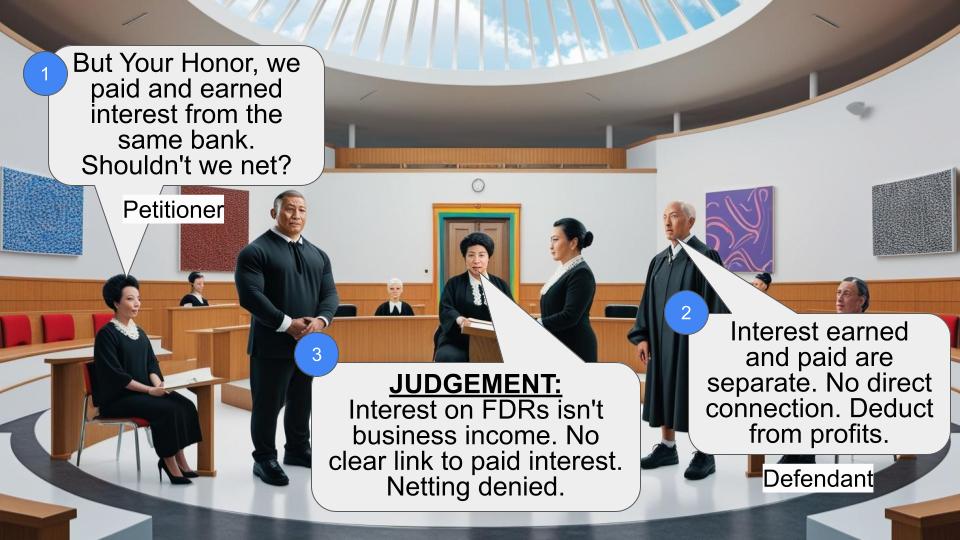
- They argued that since the interest was paid and received from the same bank, they should be allowed to net the two amounts when computing business income.
- They relied on some previous court decisions to support their case.
The Revenue's side:
- They said the interest paid and received were separate transactions.
- There was no direct link between the loans taken and the fixed deposits made.
- The interest earned on FDRs should be deducted from the business profits as per the tax rules.
Key Legal Precedents:
1. CIT vs. Shri Ram Honda Power Equip [2007] 289 ITR 475 (Del): This case established that interest earned on FDRs for credit facilities doesn't have a direct connection to export business.
2. K.Ravindranathan Nair v. CIT 262 ITR 669: This case found that interest from short-term deposits wasn't a direct result of exporting goods.
3. Lalsons Enterprises v. Deputy CIT (2004) 89 ITD 25 (Del) [SB]: This case discussed the netting principle but was modified by the Shri Ram Honda Power Equip decision.
Judgement:
The court sided with the Revenue. Here's why:
1. The interest earned on FDRs kept as margin money isn't considered business income. It's actually income from other sources.
2. For netting to be allowed, there needs to be a clear connection between the interest paid and earned. The Assessing Officer didn't find such a connection here.
3. The court followed the reasoning from the K.Ravindranathan Nair case and the modified interpretation of the Lalsons Enterprises case.
FAQs:
1. Q: Why couldn't the Assessee net the interest?
A: Because the interest earned on FDRs wasn't considered business income, and there wasn't a clear link between the interest paid and earned.
2. Q: What's the significance of this judgment?
A: It clarifies how interest income should be treated for tax purposes, especially in relation to export businesses.
3. Q: Does this mean businesses can never net interest for tax purposes?
A: Not necessarily. If a clear connection between interest paid and earned can be shown, netting might be allowed in some cases.
4. Q: How does this affect the calculation of deductions under Section 80HHC (of Income Tax Act, 1961)?
A: It means that gross interest earned on FDRs kept as margin money should be excluded from the profits used to calculate the deduction, without netting against interest paid.

1. This appeal under Section 260 (of Income Tax Act, 1961) A of the Income Tax Act, 1961 ('Act') is directed against the order dated 7th October, 2004 passed by the Income Tax Appellate Tribunal ('Tribunal'), Delhi Bench “G”, New Delhi in M.A. No.159/Del/2004 in ITA No.3523/Del/1997. By the said impugned order the Tribunal dismissed the application filed by the Appellant before it under Section 254(2) (of Income Tax Act, 1961) seeking rectification of its order dated 30th September, 2003 by which it dismissed the Assessee’s appeal.
1.2 It requires to be noticed that the Appellant had challenged the main order dated 30th September, 2003 passed by the Tribunal dismissing ITA No. 3523/Del/1997, in ITA No.34 of 2005. However, on 18th February, 2005 the appellant withdrew the ITA No. 34 of 2005 and accordingly this Court dismissed the said appeal as withdrawn on that date. Further this Court framed the following question of law for consideration in the present appeal :
“Whether the Income Tax Appellate Tribunal was correct in law in holding that the assessee is entitled to reduce interest paid by it from the interest received by it, while calculating deduction under Section 80-HHC(3A) (of Income Tax Act, 1961) read with Explanation (baa) of the Income Tax Act, 1961?”
Upon perusing the orders in the present matter and hearing submissions of counsel, we find that the question ought to be re-formulated in the following manner:
“Whether the Income Tax Appellate Tribunal was justified in declining to entertain the rectification application and consequently the Assessee's contention that it is entitled to reduce the interest paid by it from the interest received by it, while calculating deduction under Section 80-HHC(3A) (of Income Tax Act, 1961) read with Explanation (baa) of the Income Tax Act, 1961?”
2. The facts relevant for the present appeal are that for the Assessment Year 1993-94 the Assessee, which is in the business of exporting carpets, filed a return on 12th October, 1993 showing an income of Rs.12,04,030/-. Later on 3rd September, 1995 the Assessee filed a revised return disclosing an income of Rs.12,82,976/-. The case was processed by the Assessing Officer ('AO') under Section 143(1)(a) (of Income Tax Act, 1961).
3. While the assessment proceedings were in progress, the Assessee by its letter dated 19th September, 1995 claimed deduction of Rs.3,62,76,246/- (revised) under Section 80HHC (of Income Tax Act, 1961). In addition, the Appellant furnished an explanation that it had deducted 10% of the receipts amounting to Rs.50,48,648/- from the total indirect cost while calculating the said deduction.
4. The AO held that the Assessee's claim for a deduction of 10% of the receipts from the total indirect cost was not correct and disallowed the same. The AO further took the view that the Assessee had debited a sum of Rs.4,03,422/- to the Profit & Loss Account ('P&L Account') as interest on Fixed Deposit Receipts ('FDRs'). The details produced revealed that the Assessee had paid a sum of Rs.12,54,280/- as interest to the bank on the credit facilities enjoyed by it and received a sum of Rs.8,50,858/- as interest on FDRs kept as margin money with the bank. After ‘netting’ the interest earned against the interest paid, the difference was debited by the Assessee to the P&L account. The AO held that that the interest paid and the interest received were two separate transactions. Since the Assessee had utilised the loans from the bank for business purpose and the same not having used for making fixed deposits, there was no correlation between the loan taken by the Assessee from the bank and the fixed deposits kept with the bank. Accordingly the AO directed that the amount of Rs.8,50,858/- constituting the interest received on FDRs should be deducted from the profits and gains of the business in terms of Explanation (baa) (1) to sub Section (4A) of Section 80HHC (of Income Tax Act, 1961).
5. Aggrieved by the order of the AO, the Assessee filed an appeal before the Commissioner of Income Tax (Appeals) ['CIT(A)']. The CIT(A) by his order dated 18th March, 1997 held that “since interest was paid and received from the same bank, the net amount of the two transactions has to be considered while computing business income under Section 28 (of Income Tax Act, 1961) to 44.”
6. The Revenue then filed an appeal to the Tribunal. By an order dated 30th September, 2003 the Tribunal followed the dictum of the Kerala High Court in K.Ravindranathan Nair v. CIT 262 ITR 669 where in similar circumstances it was found that “the interest from short-term deposits received by the appellant was not the direct result of any export of any goods or merchandise” and that “the interest income received on the short term deposit though it could be attributed to the export business could not be treated as income derived from the export business.” Accordingly the appeal filed by the Revenue was allowed.
7. After the decision of the Special Bench of the Tribunal in Lalsons Enterprises v. Deputy CIT (2004) 89 ITD 25 (Del) [SB], the assessee filed an application before the Tribunal under Section 254(2) (of Income Tax Act, 1961) for rectification stating that it was entitled to netting of interest in terms of that decision. By its order dated 7th October, 2004 the Tribunal dismissed the application on the ground that the judgment in Lalsons Enterprises had been rendered after the decision dated 30th September 2003 of the Tribunal in the Assessee’s appeal and that therefore this did not constitute a ground for rectification.
8. The learned counsel for the Assessee submitted that in view of the judgments of this Court in Commissioner of Income Tax v. Shri Ram Honda Power Equip [2007] 289 ITR 475 (Del) and CIT v. Punjab Stainless Steel Ind. [2007] 162 Taxman 9 (Del) the Assessee is bound to succeed. Since according to him the AO had held that the interest income was business ITA No. 84 of 2005 page 4 of 8 income, netting had to follow.
9. We are unable to accept the submission made on behalf of the Assessee. We find that the decision of the Special Bench of the Tribunal in Lalsons Enterprises as explained and modified by this Court in Shri Ram Honda Power Equip does not help the Assessee at all. We may recall what was said in the said decision (ITR, p.506):
“....we entirely agree with the following formulation of the Special Bench of the Tribunal in Lalsons (ITD, p. 62):
“If the interest received is found to have a nexus with the business, still it remains to be excluded from the profits of the business by virtue of Explanation (baa) (1), but the claim is that the quantum of such interest income to be excluded must be determined in accordance with the computation provisions relating to business by allowing expenditure by way of interest which bears a nexus with the interest receipt. The computation provisions include Section 37(1) (of Income Tax Act, 1961) under which any expenditure incurred or laid wholly and exclusively for the purpose of the business is to be allowed as a deduction. Therefore, any expenditure incurred which has a connection or nexus with the interest receipt has to be allowed as a deduction and only the balance can be excluded from business profits.”
To the above, we may add a few lines by way of clarification. It will bear examination whether obtaining the loan and paying interest thereon (laying out the expenditure by way of interest) was “wholly and exclusively” for the purpose of earning the interest on the fixed deposit, to draw an analogy from Section 37 (of Income Tax Act, 1961). This nexus will have to be shown by the assessee for application of the netting principle.” (emphasis supplied)
This Court in Shriram Honda Power Equip further concluded (ITR, p.509): (iv) Where surplus funds are parked with the bank and interest is earned thereon it can only be categorised as income from other sources. This receipt merits separate treatment under section 56 (of Income Tax Act, 1961) which is outside the singe of profits and gains from business and profession. It goes entirely out of the reckoning for the purposes of section 80HHC (of Income Tax Act, 1961).
(v) Interest earned on fixed deposits for the purposes of availing of credit facilities from the bank, does not have an immediate nexus with the export business and therefore has to necessarily be treated as income from other sources and not business income.
(viii) The word ‘interest’ in clause (baa) of the Explanation connotes ‘net interest’ and not ‘gross interest’. Therefore, in deducting such interest, the AO will take into account the net interest i.e. gross interest as reduced by expenditure incurred for earning such interest. The decision of the Special Bench of the ITAT in Lalsons to this effect is affirmed. In holding as above, we differ from the judgments of the Punjab & Haryana High Court in Rani Paliwal and the Madras High Court in Chinnapandi and affirm the ruling of the Special Bench of the ITAT in Lalsons.
(ix) Where, as a result of the computation of profits and gains of business and profession, the AO treats the interest receipt as business income, then deduction should be permissible, in terms of Explanation (baa) of the net interest i.e. the gross interest less the expenditure incurred for the purposes of earning such interest. The nexus between obtaining the loan and paying interest thereon (laying out the expenditure by way of interest) for the purpose of earning the interest on the fixed deposit, to draw an analogy from Section 37 (of Income Tax Act, 1961), will require to be shown by the assessee for application ITA No. 84 of 2005 page 6 of 8 of the netting principle.”
It may be recalled that this Court in fact followed the line of reasoning adopted by the Kerala High Court in K.Ravindranathan Nair.
10. Turning to the case on hand, the first question is whether the interest earned by the Assessee on FDRs kept with the Bank for the purpose of margin money as a condition for availing credit facilities could be termed as business income? If the answer to this is in the affirmative the second question is whether netting is to be permitted? For the second question to be answered in the affirmative, the assessee will have to show that there is a nexus between the interest paid on the credit facilities availed from the Bank and the interest earned on the FDRs kept with the Bank. Nowhere in the Assessment Order has the AO found that the interest earned by the Assessee was business income.
Therefore the first question stands answered against the Assessee in view of the categorical pronouncement in Shriram Honda Power Equip that interest earned on FDRs kept for availing credit facilities is not business income but ‘income from other sources.’ The decision in Punjab Stainless Steel Ind. where the AO had held the interest income to be business income and which finding was not challenged is therefore of no assistance to the Assessee. Also, in view of the finding by the AO in the instant case that there is no nexus between the interest paid and the interest earned by the Assessee, the second question will also have to be answered against the Assessee.
11. In view of the above discussion, the question of law as re-framed by us in Para 1.2 above is answered in the affirmative, that is, against the Assessee and in favour of the Revenue.
12. The appeal is dismissed.
S. MURALIDHAR, J
MADAN B. LOKUR, J
×
Similar Ripples
Questions
Court Denies Interest Netting in Export Profit Calculation for Tax Deduction
Write your CommentSimilar Posts


Generic
- Reportdata/5268.pdf
