


Court Denies Tax Deduction Claim, Rules Manufacturing Began Earlier Than Claimed


Full News
Court Denies Tax Deduction Claim, Rules Manufacturing Began Earlier Than Claimed
Court Denies Tax Deduction Claim, Rules Manufacturing Began Earlier Than Claimed
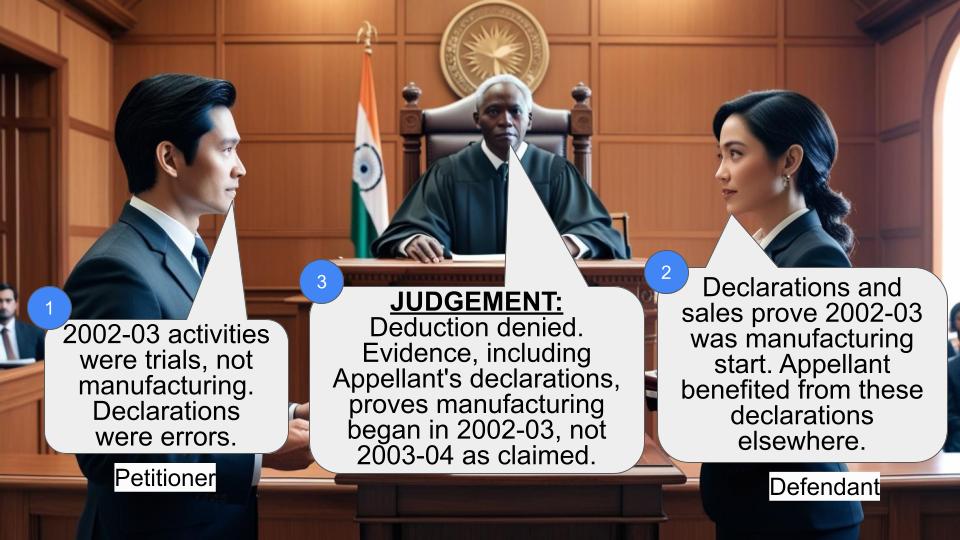
This case involves M/S Teracom Limited (the Appellant) and the Assistant Commissioner of Income Tax (the Revenue). The dispute centered around when the Appellant's manufacturing activities began, which affected their eligibility for tax deductions under Section 80IB (of Income Tax Act, 1961). The court ruled in favor of the Revenue, determining that manufacturing began in the 2002-03 assessment year, not 2003-04 as claimed by the Appellant.
Get the full picture - access the original judgement of the court order here
Case Name:
M/S Teracom Limited vs Assistant Commissioner of Income Tax (High Court of Bombay)
Tax Appeal No. 27 of 2011
Date: 5th November 2019
Key Takeaways:
1. The court emphasized the importance of consistent declarations made to various authorities.
2. Shifting stances in tax matters can be viewed as approbation and reprobation.
3. The court highlighted the significance of documentary evidence in establishing the commencement of manufacturing.
4. The judgment reinforces the principle that findings of fact by lower authorities are not easily overturned unless perversity is established.
Issue:
Did the Appellant's manufacturing activities begin in the assessment year 2002-03 or 2003-04 for the purpose of claiming deductions under Section 80IB (of Income Tax Act, 1961)?
Facts:
- The Appellant is a public limited company engaged in manufacturing and trading optical fiber cables and related products.
- For the assessment year 2007-08, the Appellant claimed a 100% deduction under Section 80IB (of Income Tax Act, 1961).
- The Assessing Officer allowed only a 30% deduction, stating that manufacturing began in 2002-03, making 2007-08 beyond the five-year full deduction period.
- The Appellant appealed, claiming manufacturing began in 2003-04, not 2002-03.
- The case went through various stages of appeal before reaching the High Court.
Arguments:
Appellant's Arguments:
- Activities in 2002-03 were merely testing or trial production, not actual manufacturing.
- Declarations made to other authorities were inadvertent mistakes or for different purposes.
- The beneficial provisions of Section 80IB (of Income Tax Act, 1961) should be interpreted in their favor.
Revenue's Arguments:
- The Appellant's own declarations to various authorities stated manufacturing began in 2002-03.
- Evidence shows finished products were manufactured and sold based on purchase orders in 2002-03.
- The Appellant derived benefits from these declarations under other statutes.
Key Legal Precedents:
1. Commissioner of Income Tax, Poona Vs Hindustan Antibiotics Ltd. (93 ITR 548)
2. CIT Vs Himalayan Magnesite Ltd.
3. Commissioner of Income Tax Vs Emptee Poly-Yarn P. Ltd.
4. Income Tax Officer, Udaipur Vs Arihant Tiles and Marbles (P) Ltd.
The court distinguished the current case from these precedents, noting that the factual circumstances were different.
Judgement:
The court ruled in favor of the Revenue, concluding that:
- Manufacturing began in the assessment year 2002-03, not 2003-04.
- The Appellant's claims of trial production or testing were not supported by evidence.
- The findings of the Assessing Officer and ITAT were not perverse and were supported by material evidence.
- The Appellant's shifting stances amounted to approbation and reprobation.
FAQs:
1. Q: What was the main dispute in this case?
A: The main dispute was about when the Appellant's manufacturing activities began, which affected their eligibility for tax deductions.
2. Q: Why did the court rule against the Appellant?
A: The court found that the evidence, including the Appellant's own declarations to various authorities, supported the conclusion that manufacturing began in 2002-03.
3. Q: What is the significance of "approbation and reprobation" in this case?
A: The court noted that the Appellant's shifting stances on when manufacturing began amounted to approbation and reprobation, which is generally not allowed in legal proceedings.
4. Q: How did the court view the Appellant's claim of "inadvertent mistake" in their declarations?
A: The court was not convinced by this claim, noting that no material was produced to correct these supposed mistakes and that the declarations were repeated.
5. Q: What lesson can businesses learn from this case?
A: Businesses should be consistent in their declarations to various authorities and maintain proper documentation of their activities, especially regarding the commencement of manufacturing or production.

1. Heard Mr. S. R. Rivankar, learned counsel for the Appellant and Ms. A. Razaq, learned Standing Counsel for the Respondent.
2. This appeal was admitted on 15th February, 2012 on the following substantial questions of law :-
(i) Whether the Appellate Tribunal is justified in law by allowing the appeal of the Revenue thereby setting aside the order passed by the CIT(A) on the ground that process of testing of optical fiber cable amount to manufacturing as contemplated under Section 80IB (of Income Tax Act, 1961), contrary to the view taken by our High Court in "CIT Vs. Hindustan Antibiotics Ltd", reported in (93 ITR 548) (Bom)?
(ii) Whether the Appellate Tribunal is justified in law by holding that Assessment Year 2002-03 is the initial Assessment Year, as contemplated under clause (c) of sub-section 14 (of Income Tax Act, 1961) of Section 80IB (of Income Tax Act, 1961) ?
(iii) Whether the Appellate Tribunal is justified in law by holding that the testing of optical fiber cable purchased from open market and then selling it after testing, in market amount to production of optical fiber cable?
3. The Assessee is a Public Limited Company engaged in the business of manufacturing and trading of optical fiber cable and accessories, insulated wires and power cable and other telecommunication equipment. On 14th November, 2007, the Appellant filed return of income for the Assessment Year (AY) 2007-08 declaring the income of Rs.Nil, after claiming deduction of Rs.15,98,63,200/- under Section 80IB (of Income Tax Act, 1961) ( IT Act).
4. This return was selected for scrutiny and notice under Sections 142(1) (of Income Tax Act, 1961) and 143(2) of the IT Act came to be issued to the Appellant. The Appellant filed responses on 4th December, 2009, 14th December, 2009 and 22nd December, 2009. Upon consideration of the same, the Assessing Officer allowed deduction of only 30% of the profit under Section 80IB (of Income Tax Act, 1961) as against 100% claimed by the Appellant. This is clear from the Assessment Order dated 30th December, 2009.
5. In the order dated 30th December, 2009, the Assessing Officer held that the Appellant began manufacture at the industrial undertakings set up by it at Kundaim Goa in the Assessment Year 2002-03 and therefore, in the Assessment Year 2007-08, which was beyond five years from the year in which the manufacturing began, the Appellant was entitled to deduction of only 30% of the profit and not 100% of profit as claimed by the Appellant.
6. The Appellant aggrieved by the Assessment Order dated 30th December, 2009, appealed to the Commissioner (Appeals) on or about 27th January, 2010. The Commissioner (Appeals) by order dated 10th November, 2010, allowed the Appellant's appeal and set aside the Assessment Order dated 30th December, 2009, thereby allowing deduction of 100% of the profit for Assessment Year 2007-08.
7. The Revenue appealed to the Income Tax Appellate Tribunal (ITAT) against the order dated 10th November, 2010. The ITAT by order dated 31st May, 2011 allowed the Revenue's appeal, set aside the order dated 10th November, 2010 and restored the Assessment Order dated 30th December, 2009. Hence, the present appeal against the ITAT's order dated 31st May, 2011.
8. Mr. Rivankar, learned counsel for the Appellant submits that the findings recorded in the Assessment Order dated 30th December, 2009 and ITAT's order dated 31st May, 2011 are vitiated by perversity because on the basis of the material on record, only conclusion possible was that the Appellant began to manufacture its industrial undertakings in the Assessment Year 2003-04 and not in the Assessment Year 2002-03. He submits that both the Assessing Officer as well as the ITAT have totally misconstrued the returns filed or declarations made by and on behalf of the Appellant before the Sales Tax Authority or Excise Authority, which returns, in any case were made for different purposes and in different context. He submits that the material on record overwhelmingly establishes that in the Assessment Year 2002-03 the Appellant purchased some material from outside sources solely for the purposes of testing or trial. He submits that merely because such material may have ultimately been sold for some paltry amount after some value additions, there was no scope to conclude that the Appellant's industrial undertakings began manufacturing in the Assessment Year 2002-03. He relies on Commissioner of Income Tax, Poona Vs Hindustan Antibiotics Ltd. 1 to submit that the trial production or production for the purpose of testing does not amount to manufacture for the purpose of Section 80IB (of Income Tax Act, 1961). He submits that inasmuch as this aspect has not been considered by both the Assessing Officer and the ITAT in its proper legal perspective, the substantial questions of law as framed, are required to be answered in favour of the Appellant and against the Revenue.
9. Mr. Rivankar submits that both the Assessing Officer as well as the ITAT have failed to appreciate that the object of the provisions in Section 80IB (of Income Tax Act, 1961) was to encourage the establishment of new industrial undertakings in backward areas and in that sense the provisions in Section 80IB (of Income Tax Act, 1961) are the provisions of beneficial to the Assessee. He submits that the Assessing Officer as well as the ITAT should therefore have adopted the principles of beneficial and construction in the matter, even when it came to appreciating the material on record, which clearly establishes that the actual manufacture at the industrial undertakings established by the Appellant began only in the Assessment Year 2003-04. He relies on Hindustan Antibiotics Ltd ( supra ), CIT Vs Himalayan Magnesite Ltd., 2 in support of this proposition.
10. Mr. Rivankar submits that in the Assessment Year 2007-08 expression “manufacture” was not defined under the IT Act and therefore, it was necessary to adopt its ordinary meaning. He submits that though the term 'manufacture' implies change, but, every change is not manufacture. He submits that this is the ratio of decision in Commissioner of Income Tax Vs Emptee Poly-Yarn P. Ltd., 3 . He submits that the material on record clearly establishes that there was no manufacturing in the Assessment Year 2002-03 and factually manufacturing began only in the Assessment Year 2003-04. He submits that in fact this position was never disputed by the Revenue when it came to assessment in the Assessment Years 2003-04 to 2006-07. He submits that only in the Assessment Year 2007-08, the Revenue has chosen to take a different view in the matter, which is clearly impermissible. He submits that on these grounds the impugned orders are required to be set aside.
11. Ms. Razaq, learned counsel for the Respondent defends the impugned orders on the basis of the reasonings reflected therein. She points out that when the ITAT has evaluated the entire evidence on record and arrived at the findings of fact that the manufacture in the present case began in the Assessment Year 2002-03. She submits that such findings of fact is borne out from the material on record and there is no case of perversity made out. She submits that the material on record bears out the purchase orders were received by the Appellant during the Assessment Year 2002-03 and in pursuance of the same, the Appellant manufactured finished products and sold them to the purchasers for a profit. She points out that the Appellant themselves filed returns and made declarations before the several authorities like Director of Industries, Sales Tax Authority and Excise Authority making it clear that the manufacture had commenced in Assessment Year 2002-03. The findings of fact recorded by the Assessing Officer as well as the ITAT is therefore borne out by the ample material referred to by the two authorities and there is absolutely no case is made out to warrant inference in the impugned orders.
12. Ms. Razaq points out that the substantial questions of law urged by the Appellant proceed on the basis that the manufacturing activities and the production of finished goods in Assessment Year 2002-03 was admitted to be on trial basis or for the purpose of testing by the Revenue. She submits that such position was never admitted but on the contrary it was consistent case of the Revenue that the manufacturing began in the Assessment Year 2002-03. Accordingly, she submits that the decisions in Hindustan Antibiotics Ltd., ( supra ), Himalayan Magnesite Ltd.,(supra ) and Emptee Poly-Yarn P. Ltd., ( supra ) are clearly distinguishable and inapplicable.
13. Ms. Razaq relies on Income Tax Officer, Udaipur Vs Arihant
Tiles and Marbles (P) Ltd., 4 to submit that even the conversion of marble blocks by sawing into slabs and tiles and polishing amounts to manufacture or production of articles or thing under Section 80IA (of Income Tax Act, 1961). She submits that the material on record clearly establishes that the Appellant made value additions to the material procured from outside sources and thereafter finished products were sold in terms of purchase orders already received. She submits that in these circumstances, the Authorities were entirely justified in concluding that the manufacture commenced in Assessment Year 2002-03 and not in the Assessment Year 2003-04 as claimed by the Appellant. For all these reasons, Ms. Razaq submits that this appeal may be dismissed.
14. The rival contentions now fall for our determination.
15. In order that the first substantial question of law as framed is answered in favour of the Appellant and against the Revenue, it is necessary to examine whether the material on record supports the Appellant's contention that the process undertaken by its industrial undertakings during the Assessment Year 2002-03 was not manufacturing process but only a process of testing optical fiber cable or trial production as contended by Mr. Rivankar, learned counsel for the Appellant. If it is established that the process was mere testing of optical fiber cable or process involved merely a trial production, then, following the decisions in Hindustan Antibiotics Ltd.,( supra ) as also Himalayan Magnestite Ltd., ( supra ), this substantial question of law might have to be answered in favour of the Appellant and against the Revenue. However, both the Assessing Officer as well as the ITAT have recorded categorical findings of fact that the process undertaken by the Appellant was industrial undertakings during the Assessment Year 2002-03 was not testing of optical fiber cable or commencing of only trial production but the process was in fact manufacture of finished products which was in fact sold for a profit to the purchasers on the basis of purchase orders already received. This means that the finished products were made to product on the basis of the purchase orders already received and not merely the products for testing of optical fiber cable or trial production as urged by and on behalf of the Appellant. The question which therefore arises is whether this categorical findings of fact are vitiated by perversity in the sense that such findings are not borne out from the evidence on record or that inferences drawn by the two authorities from the evidence on record are so absurd that the same can be stigmatized as perverse.
16. The material on record indicates that the Appellant themselves filed returns and made declarations before the various authorities including the Directorate of Industries, Sales Tax Authority and even the Central Excise Authority, in which they categorically stated that they had commenced manufacture in the Assessment Year 2002-03. Mr. Rivankar himself pointed out that in the Assessment Year 2007-08, there was no definition “manufacture” in the IT Act. Since the Appellant itself declared that it had commenced the manufacture during the Assessment Year 2002- 03, it was for the Appellant to explain as to how such manufacture was not required to be treated as manufacture for the purpose of provisions in Section 80IB (of Income Tax Act, 1961). Merely stating that the position under the various enactments is different and is too vague and the explanation to trickle out from the admissions made by the Appellant themselves before various statutory authorities. It is pertinent to note that on the basis of such declarations and returns the Appellant derived advantages under the respective statutes.
17. The ITAT has noted that the Appellant has went to the extent of contending that the declarations made in the Assessment Year 2002-03 were result of inadvertent mistake. The ITAT however noted that no material was produced on record to indicate that any admission was made to correct the so called inadvertent mistake and further this position was repeated in yet another declaration in which there was no explanation whatsoever.
18. The ITAT, upon appreciation of entire material on record has noted that the finished products manufactured and sold by the Appellant during the Assessment Year 2002-03 were in fact manufactured on the basis of purchase orders already received. Admittedly, the price at which the Appellant procured the material and the price at which the Appellant sold the material after value additions to the purchasers on the basis of purchase orders is almost double.
19. The ITAT has also noted that absolutely there is no evidence was produced on record that the processes undertaken in Assessment Year 2002-03 were in the nature of testing or trial production. No contemporaneous report of such trial production or testing were produced by the Appellant. No reports of production staff for testing were ever produced. According to us, all this material is more than sufficient to sustain the findings of fact recorded by the Assessing Officer and ITAT.
20. Further, it is not possible for us to say that the finding of fact recorded by the two authorities is vitiated by perversity or that the inferences drawn by the two authorities are not legal inferences that could have been drawn in the matter of this nature. In fact, the material on record suggests that prior to the amendment by Finance Act, 2002 in Section 80IB(4) (of Income Tax Act, 1961), the Appellant had declared the date that the Appellant's industrial undertakings began manufacture was 26th March, 2002. However, after the amendment of extended date for beginning of manufacture upto 31st March, 2004, the Appellant sought to contend that the manufacture began for the first time at its industrial undertakings only on 1st February, 2003. The ITAT has rightly observed that the Appellant has been shifting the stances. Such shifting of stances clearly amounts to approbation and reprobation.
21. In any case, even if the returns filed by the Appellant or declarations made by the Appellant are to be excluded from consideration, rest of the material on record also does not support the Appellant's contention that the processes undertaken during the Assessment Year 2002- 03 were in the nature of testing or trial run is only involvement, there is no element of manufacture. Accordingly, the first substantial question of law is required to be answered against the Appellant and in favour of the Revenue.
22. In Hindustan Antibiotics Ltd., ( supra ), the factual position was very clear inasmuch as crude penicillin which was produced as a precursor to sterile penicillin which was final saleable product, was not even ultimately sold by the Assessee. In the said case, there was no material that the products were actually sold to any purchasers and it is in this context, it was held that mere trial production or production for the purpose of testing does not amount to any manufacture. Taking into consideration the established factual position in the present case, the decision in the case of Hindustan Antibiotics Ltd. ( supra ) can be of no assistance to the Appellant.
23. In Himalayan Magnesite Ltd.,( supra), it was held that there should be manufacturing, the production must be with a view to sell the manufactured goods or articles in the market. In the present case, the material on record establishes that the Appellant on the basis of purchase orders received, processed the material by making value additions. The final product sold which was quite different from the inputs procured was then sold for a profit. Again, therefore, the ruling in Himalayan Magnesite Ltd., ( supra) can be of no assistance to the Appellant in the present case.
24. In Emptee Poly-Yarn P. Ltd., ( supra ) the issue involved was whether the twisting and texturising partially oriented yarn amounts to manufacture in terms of Section 80IA (of Income Tax Act, 1961). On facts and by reference the material produced on record by the parties, the Hon'ble Apex Court ruled that there was no element of manufacture in such process. However, the Hon'ble Apex Court made it abundantly clear that “.. the judgment in the present case is to be confined to the facts of the present case”. Accordingly, even the ruling in Emptee Poly-Yarn P. Ltd., ( supra ) is of no assistance to the Appellant.
25. The second substantial question of law is really not different from the first substantial question of law. In any case, taking into consideration the findings of fact recorded by the Assessing Officer and the ITAT that the manufacturing in the present case actually commenced in the Assessment Year 2002-03 and not in the Assessment Year 2003-04. Even this substantial question of law will have to be decided against the Appellant and in favour of the Revenue. It is pertinent to note that the findings of fact is not at all vitiated by any perversity and therefore, it cannot be said that the ITAT was not justified in holding that the Assessment Year 2002-03 is the final Assessment Year as contemplated under clause (c) of sub-section 14 (of Income Tax Act, 1961) of Section 80IB (of Income Tax Act, 1961).
26. The third substantial question of law is again required to be answered against the Appellant and in favour of the Revenue because the substantial question of law seems to proceed on the basis that there was no dispute that the process of purchasing the material by the Appellant from open market was only for the purpose of testing optical fiber cable. The material on record as noted earlier establishes that there was manufacture involved and the process undertaken by the Appellant during the Assessment Year 2002-03 was not restricted to mere testing or trial run. The findings of fact in this regard are amply borne out from the material on record and consequently are not vitiated by any perversity or absurdity. This substantial question of law is also therefore required to be answered against the Appellant and in favour of the Revenue.
27. The appeals under Section 260A (of Income Tax Act, 1961) are entertained and are required to be decided on the basis of substantial questions of law that may be involved in such matters. In the present case, we find that the Appellant basically wished us to reappreciate the evidence on record as if we were exercising some First Appellate jurisdiction. No doubt, even the findings of fact can, be assailed in an appeal under Section 260A (of Income Tax Act, 1961) but for that the Appellant has to establish that such findings of fact are vitiated by perversity. In the present case, the Appellant has failed to establish that the findings of fact recorded by the Assessing Officer and the ITAT are vitiated by perversity or that they are not backed by any material on record. In fact, the findings are duly supported by the material on record and even the inferences drawn by the two authorities suffer from no perversity or absurdity as was suggested on behalf of the Appellant.
28. For the all aforesaid reasons, this appeal fails and is hereby dismissed. There shall however be no order as to costs.
C. V. BHADANG, J. M. S. SONAK, J.
×
Questions
Court Denies Tax Deduction Claim, Rules Manufacturing Began Earlier Than Claimed
Write your CommentSimilar Posts


Generic
- Reportdata/5342.pdf
