


Court Disallows Interest Deduction on Loans Diverted to Subsidiaries


Full News
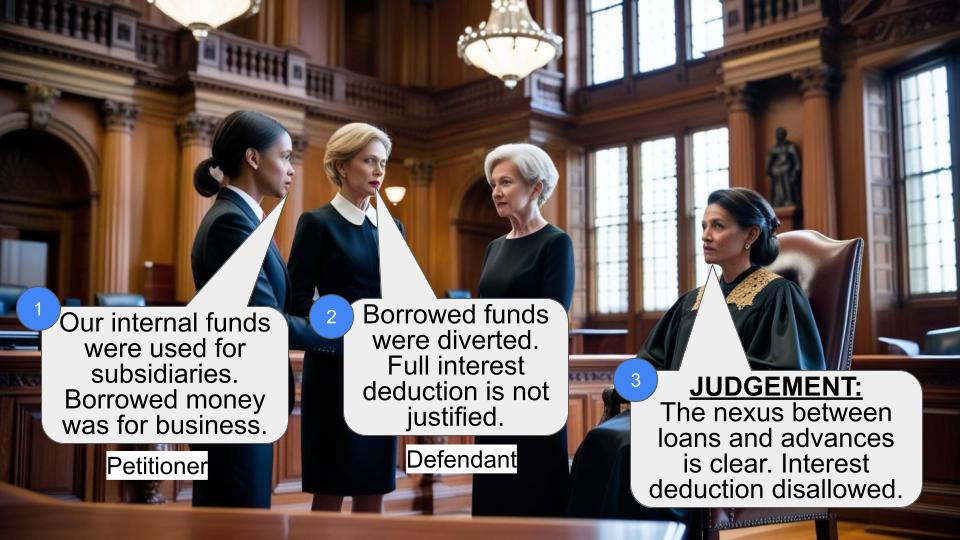
Court Disallows Interest Deduction on Loans Diverted to Subsidiaries
Court Disallows Interest Deduction on Loans Diverted to Subsidiaries
This case involves the Commissioner of Income Tax (Revenue) versus Harrisons Malayalam Ltd (Assessee) for the assessment year 1992-93. The main dispute was about the deduction of interest on loans taken by the assessee, which were then given as interest-free loans to its subsidiary companies. The court ruled in favor of the Revenue, disallowing the interest deduction to the extent of loans given to subsidiaries.
Case Name**: Commissioner of Income Tax vs Harrisons Malayalam Ltd
**Key Takeaways**:
1. Interest can be claimed as a deduction only when borrowed funds are employed in the business.
2. A direct nexus between borrowings and interest-free advances to subsidiaries can lead to disallowance of interest deduction.
3. For Section 80HHC (of Income Tax Act, 1961) deductions, the consolidated result of export activities for both manufactured and trading goods must be considered.
**Issue**:
Can a company claim interest deduction on loans when it has simultaneously given interest-free loans to its subsidiary companies?
**Facts**:
1. Harrisons Malayalam Ltd, engaged in plantations and other businesses, claimed interest deduction on loans of Rs. 7.75 crores for the assessment year 1992-93 .
2. The company had given interest-free loans to its wholly-owned subsidiary companies in the same year:
- Rs. 1,06,00,000 on 30.04.1991
- Rs. 1,08,66,825 on 08.07.1991
- Rs. 2,28,50,000 on 31.01.1992
3. The Assessing Officer disallowed part of the interest deduction, corresponding to the interest-free loans given to subsidiaries .
4. The company claimed that the loans to subsidiaries were from internal resources, while the borrowed funds were for day-to-day business operations .
**Arguments**:
Revenue's Argument:
- There was a direct nexus between the borrowings and the interest-free loans given to subsidiaries.
- The borrowed funds were not entirely used for business purposes, so the full interest deduction should not be allowed .
Assessee's Argument:
- The company had sufficient internal funds to give interest-free loans to subsidiaries.
- The borrowed funds were used for day-to-day business operations.
- There's no distinction between internal resources and borrowed funds in their single account .
**Key Legal Precedents**:
1. K. Somasundaram and Bros. v. C.I.T. [(1999) 238 ITR 939]: Supported the Revenue's stance on disallowing interest deduction when borrowed funds are diverted .
2. S.A. Builders Ltd. v. CIT (Appeals) [(2007) 1 SCC 781]: Emphasized the need to consider commercial expediency in such cases .
3. ITO v. Induflex Products P.Ltd. [(2006) 280 ITR 1 (SC)] and A.M. Moosa v. CIT [(2007) 294 ITR 1 (SC)]: Established that consolidated export activity results should be considered for Section 80HHC (of Income Tax Act, 1961) deductions .
**Judgement**:
1. The court ruled in favor of the Revenue, disallowing the interest deduction to the extent of loans given to subsidiaries .
2. The court found a direct nexus between the borrowings and the interest-free loans to subsidiaries .
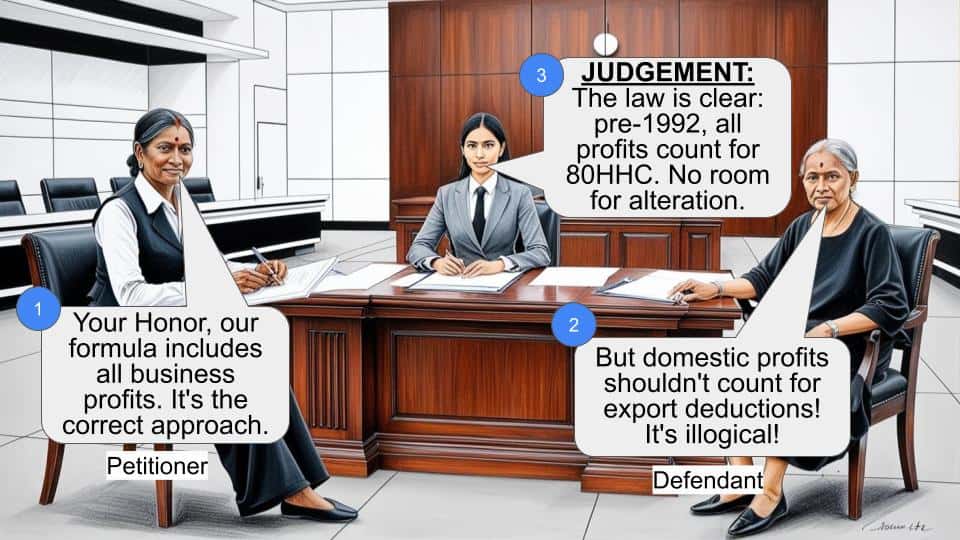
3. The court also upheld that for Section 80HHC (of Income Tax Act, 1961) deductions, the consolidated result of export activities for both manufactured and trading goods must be considered .
**FAQs**:
1. Q: Why did the court disallow the interest deduction?
A: The court found a direct connection between the borrowed funds and the interest-free loans given to subsidiaries, indicating that the borrowed money wasn't entirely used for business purposes.
2. Q: What is the significance of "commercial expediency" in this case?
A: While the court mentioned the S.A. Builders Ltd. case which emphasized commercial expediency, it found that in this case, the loans to subsidiaries were clearly distinguished from business expenses and couldn't be treated as a measure of commercial expediency.
3. Q: How does this judgment affect the interpretation of Section 80HHC (of Income Tax Act, 1961) deductions?
A: The judgment reinforces that for Section 80HHC (of Income Tax Act, 1961) deductions, companies must consider the consolidated results of their export activities for both manufactured and trading goods, not just the profitable segments.
4. Q: Can companies still claim interest deductions on borrowed funds if they give loans to subsidiaries?
A: Yes, but they need to clearly demonstrate that the loans to subsidiaries come from their own resources and not from borrowed funds. The burden of proof lies with the company.
5. Q: What lesson can businesses learn from this case?
A: Businesses should be cautious about giving interest-free loans to subsidiaries when they have outstanding loans themselves. They should maintain clear records to show the source of funds for such transactions.

The above appeal filed by the Revenue relates to the assessment year 1992-93.
2. The assessee company engaged in the business of plantations, inter alia, has business in execution of engineering works, agency service, bio-tech division, etc. In the returns filed for the assessment year, the assessee had claimed interest on loans availed by it to the extent of Rs.7.75 crores during the year. The assessing officer found that in the same year the assessee had advanced interest-free loans to its wholly owned subsidiary companies. On 30.04.1991, the assessee made an advance of Rs.1,06,00,000/-; on 8.7.1991 a sum of Rs.1,08,66,825/- and on 31.1.1992 a sum of Rs.2,28,50,000/-. These were interest-free loans said to be advanced to the subsidiary companies. The assessee had claimed as expenditure interest on the loan of Rs.7.75 crores. From and out of the interest paid on the borrowings, disallowances were made to the extent of the interest that would have accrued on the loans given to subsidiary companies. This amount, under two accounts, viz., Kerala Tea Account and Tamilnadu Tea Account, being Rs.17,13,406/- and Rs.3,31,747/- were respectively added on as income.
3. Further, the deduction under Section 80HHC (of Income Tax Act, 1961) claimed during the course of the proceedings was also disallowed. The Assessing Officer found that the export business of the assessee had resulted in a loss and, hence, there was no scope for granting such deduction. The deduction under Section 80HHC (of Income Tax Act, 1961), hereinafter referred to as “the Act”, was worked out by the assessee in respect of trading goods alone. The business of the assessee with respect to the manufactured tea had resulted in huge loss. Any deduction worked out under Section 80HHC (of Income Tax Act, 1961) on a computation of both these businesses together would have only resulted in a negative figure, hence the disallowance.
4. The first appellate authority reversed the decision of the Assessing Officer on both these counts. Though the lower authorities dealt with many other issues, keeping in mind the questions of law we are required to answer, we deal only with the above two issues. The Revenue went in appeal before the Tribunal inter alia on these two issues, both of which were answered against the Revenue, confirming the first appellate order.
5. The Revenue has framed the following three questions of law for our consideration and decision:
i. Whether, on the facts and in the circumstances of the case and also in the light of the decision of the Madras High Court in 238 ITR 939 the Tribunal is right in law and fact in allowing the amount of Rs.17,13,406/- and Rs.3,31,747/- charged to the Kerala Tea Account and Tamilnadu Tea Account as interest relatable to loans given to the subsidiary companies.
ii. Whether, on the facts and in the circumstances of the case, did the Tribunal hold that the subsidiary companies were cent percent owned by the assessee and, if so, is the Tribunal right in holding so based on the submission of Counsel?
iii. Whether, on the facts and circumstances of the case and the net result from export business being a loss and also considering the restriction in section 80AB of the Income Tax Act, 1961, the assessee is entitled to deduction u/s.80HHC (of Income Tax Act, 1961)?
6. The Revenue relied on a decision of the Madras High Court in K.Somasundaram and Bros. v. C.I.T. [(1999) 238 ITR 939]. In the said case, a firm engaged in construction, borrowed certain amounts for the purpose of its business and claimed deduction of interest paid on such borrowings. The Assessing Officer found that the assessee had simultaneously been advancing amounts to close relatives, that too interest-free. To the extent of deemed accrual of interest from such interest-free loans, disallowance was made on the deduction claimed on interest paid. The Madras High Court, while affirming the action of the Assessing Officer, held that deduction of interest can be claimed only when the amounts borrowed are invested in the business and continue to remain in the business. Only in such circumstance, the interest paid on such borrowing becomes an expenditure which is eligible for exemption. The interest-free advances made to the relatives were found to be not for business purposes and was held to be a clear diversion of funds.
7. In the instant case, the learned Senior Counsel for the Revenue would invite our attention to the specific facts noticed by the Assessing Officer. The assessee had taken a loan on 25.4.1991 from M/s.Jayasree Tea & Industries and Century Textiles. Five days thereafter, i.e. on 30.4.1991, a loan was advanced to its subsidiary company. Similarly, loans were availed by the assessee on 4.7.1991 and 22.12.1991, followed by granting of interest-free loans to subsidiary companies on 8.7.1991 and 31.1.1992.
8. The learned counsel for the assessee would contend that the assessee had sufficient funds available with it for giving interest-free loans to its subsidiary companies and such loans were given from its internal resources. However, to meet the day to day affairs of the business, loans were taken from other entities. The assessee maintains a single account and both the internal resources and the loans availed by the assessee are pooled into this account. The monies that come into this account are used for the purposes of the business and also for granting loans to subsidiary companies. There is no distinction between these two amounts and what is attempted by the Assessing Officer is artificial. No addition could be made on this count, is the submission on behalf of the assessee.
9. The learned counsel for the assessee would also rely on a number of judgments of various High Courts. Birla Gwalior Private Ltd. v. Commissioner of Income Tax [(1962) XLIV ITR 647] was a case in which the claim of deduction of interest paid on capital borrowed; at the rate of 63⁄4% was reduced to 3%. Whether any part of the interest could be disallowed on the ground that the rate of interest is unreasonably high, was the issue before the Court. The Court held that the interest paid having not been subjected to the test of reasonableness and the Income Tax Officer not being given any discretion to determine such sum as allowance having regard to the circumstances, the disallowance could not be sustained. The said decision is not at all relevant to the facts of the instant case. Woolcombers of India Ltd. v. C.I.T [1982) 134 ITR 219] dealt with the disallowance of interest paid on an overdraft account on the ground that substantial credit drawings in the overdraft account was on account of payment of advance tax. The assessee contended that the payment of advance tax was from the profits of the business of the year and that the overdraft was only with respect to business expenditure. The Calcutta High Court having regard to the fact that the profit of more than Rs.27 lakhs for the year was credited to the overdraft account and that the advance tax paid resulted only in the increase of the overdraft by Rs.14 lakhs, drew a presumption that the taxes were paid out of the profits of the year and not from the overdraft account.
Following the said decision, in Indian Explosives Ltd. v. C.I.T. [(1984) 147 ITR 392] the Calcutta High Court again held that when payments towards business expenditure and taxes were made from the same overdraft account, the interest paid on overdraft account maintained for the purpose of business would be allowable as deduction in its entirety. C.I.T. v. Hotel Savera [(1999) 239 ITR 795] C.I.T. v. Orissa Cement Ltd. [(2001) 252 ITR 878] and C.I.T. v. Tin Box Co. [(2003) 260 ITR 637] are all cases in which the High Courts refused to interfere with the findings of fact recorded by the Tribunal. C.I.T. v. Reliance Utilities and Power Ltd. [(2009) 313 ITR 340] was again a case in which it was factually found that the assessee had enough interest-free fund at their disposal for investment in the subsidiary companies, which like the assessee company, were also engaged in the energy sector. C.I.T. v. Bharti Televenture Ltd. [(2011) 331 ITR 502] was a case where no specific instance regarding the direct nexus between borrowed funds and the advances made to the subsidiaries were noted by the Assessing Officer.
10. In the instant case, it is not the case of the assessee that it had sufficient funds in its account to maintain interest-free loans to its subsidiaries. The assessee would, taking into account the total profits or rather receipts of the business of the year, contend that such receipts being more than the loans granted to the subsidiaries, it can only be assumed that the loans to the subsidiaries were from its own funds. The facts noticed by us regarding borrowings made immediately before the loans to subsidiaries were granted distinguishes the instant case on facts from the cases cited above. This fact noticed by the Assessing Officer would establish a direct nexus with the borrowings made by the assessee and loans granted by the assessee. We notice that all the judgments cited by the assessee were instances in which the High Court did not find any reason to interfere with the factual findings of the lower authorities. In any event, it is trite that we are not bound by the decisions of other High Courts and they only have a persuasive effect. We are inclined to follow the Madras High Court decision in K.Somasundaram's case (supra), which are more apposite to the facts of the above case and the reasoning of which is acceptable to us.
11. We would also notice, with respect, the decision of the Hon'ble Supreme Court in S.A.Builders Ltd. v. CIT (Appeals) [(2007) 1 SCC 781]. The assessee therein, during the relevant previous year, transferred an amount from the cash credit account of the assessee company to one of its subsidiary companies. The Assessing Officer considered this interest-free loan as a diversion of borrowed funds, since the cash credit account of the assessee showed a huge debit balance. Proportionate interest relating to the said amount was disallowed out of the total interest paid to the bank. While the first appellate authority granted some relief, the Tribunal upheld the disallowance as made by the Assessing Officer. The High Court also dismissed the appeal, recording the finding of fact of the Tribunal, that on the date on which the amount was advanced, there was no credit balance in the bank account of the assessee. The Supreme Court held that the approach of the Tribunal and the High Court was from an erroneous angle. The High Court and the Tribunal had considered the issue on the basis of the facts available with respect to the dates when advances were made and the credit balance available in the assessee's account with the bank. According to the Hon'ble Supreme Court, the test in such cases should be as to whether the advances were as a measure of commercial expediency. Noticing the difference between the expressions “for the purpose of business” and “for the purpose of earning income, profits or gains”, the Hon'ble Supreme Court considered various decisions and found that the consistent view has been that the former expression is wider in scope than the latter. Holding that what is relevant is whether the assessee advanced the money to its sister concern as a measure of commercial expediency, the Supreme Court remanded the matter to the Tribunal, since such facts were never examined. In the instant case, the specific contention of the assessee is that borrowals were made for its day to day business activities and the loans advanced to the subsidiary companies were from the receipts of the assessee's business. The assessee, hence, clearly distinguishes the loans granted to subsidiary companies from its business expenses and hence such advances to subsidiary companies cannot at all be treated as a measure of commercial expediency.
12. Admittedly loans have been taken, coming to Rs.7.75 crores, by the assessee from other entities. It cannot also be disputed that interest could be claimed as a deduction only when such funds have been employed in the business. The asssessee's case about the loans extended to subsidiary companies, being from its internal resources, is belied by the contention that the receipts of its business as also the loans availed come into the common pool, i.e, to one single account. In such event, we are of the opinion, that the assessee's contention that the loans have been paid out of own resources was not at all substantiated on facts. On facts a direct nexus between the borrowings and advances made was established. After the amounts come into the same account, there is no distinction from its business receipts and the amounts availed as loan. Obviously the loans to subsidiary companies were also not for the purpose of assessee's business.
13. The question then, would be; on facts what is discernible? As noticed above, every loan granted to a subsidiary company was preceded by the receipt of money by the assessee as loan from other entities. Undisputedly, even going by the assessee's contention that the loans to subsidiary companies were from its internal resources; if such interest-free loans were not made, then at least to that extent the assessee need not have borrowed from other entities. The borrowals purportedly made for meeting the day to day needs of business, to that extent could have been met from internal resources itself. Such funds then cannot be taken to be having been used for or invested in the business. To that extent there cannot be any claim for business expenditure. It is this disallowance that the Assessing Officer has made. We are of the opinion that on the facts as also the discussion of law made above, the 1st question has to be answered in favour of the Revenue and against the assessee. Having answered the question of law in favour of the Revenue, the orders of the Tribunal and the first appellate authority have to be reversed to that extent, reviving the order of the Assessing Officer.
14. In view of our finding on the 1st question, we are of the opinion that that the 2nd question as to the proof of degree of ownership of subsidiary companies pales into insignificance and does not arise for consideration at all. We refuse to answer the said question.
15. One other question raised is with respect to the negative result from export business being considered for deduction under Section 80HHC (of Income Tax Act, 1961). The Assessing Officer disallowed the claim, since the assessee was claiming deduction under Section 80HHC (of Income Tax Act, 1961) having worked out the same only with respect to the export business of trading goods. The assessee having incurred heavy loss in respect of manufactured goods, if deduction was consolidatedly worked out, then the result would be a negative figure. The said issue is no more res integra in view of the binding authoritative pronouncements of the Hon'ble Supreme Court in ITO v. Induflex Products P.Ltd. [(2006) 280 ITR 1 (SC)] and A.M.Moosa v. CIT [(2007) 294 ITR 1 (SC)]. The result of consolidated export activity of manufactured goods and trading goods are to be taken into account for claiming relief under Section 80HHC (of Income Tax Act, 1961) read with Section 80AB (of Income Tax Act, 1961). Respectfully following the above decisions, we hold that the said question has also to be answered in favour of the Revenue and against the assessee. The order of the Tribunal as well as that of the first appellate authority to that extent also stand reversed; reviving the order of the Assessing Officer.
The Income Tax Appeal is allowed.
Sd/-
Thottathil B.Radhakrishnan
Judge
Sd/-
K.Vinod Chandran
Judge
×
Similar Ripples
Questions
Court Disallows Interest Deduction on Loans Diverted to Subsidiaries
Write your CommentSimilar Posts


Generic
- Reportdata/5599.pdf
