


Court Dismisses Tax Appeal on School's Free Education Perks, Citing Misinterpre…



Full News
Court Dismisses Tax Appeal on School's Free Education Perks, Citing Misinterpretation of Rules
Court Dismisses Tax Appeal on School's Free Education Perks, Citing Misinterpretation of Rules
The Income Tax Department (Revenue) appealed against an order by the Income Tax Appellate Tribunal (ITAT) regarding Delhi Public School. The main issue was how to value the perk of free education given to staff children. The High Court dismissed the appeal, agreeing with the ITAT that the tax officer misinterpreted the rules.
Get the full picture - access the original judgement of the court order here
Case Name:
Commissioner of Income Tax Vs Delhi Public School (High Court of Delhi)
ITA 1117/2007
Date: 22nd November 2007
Key Takeaways:
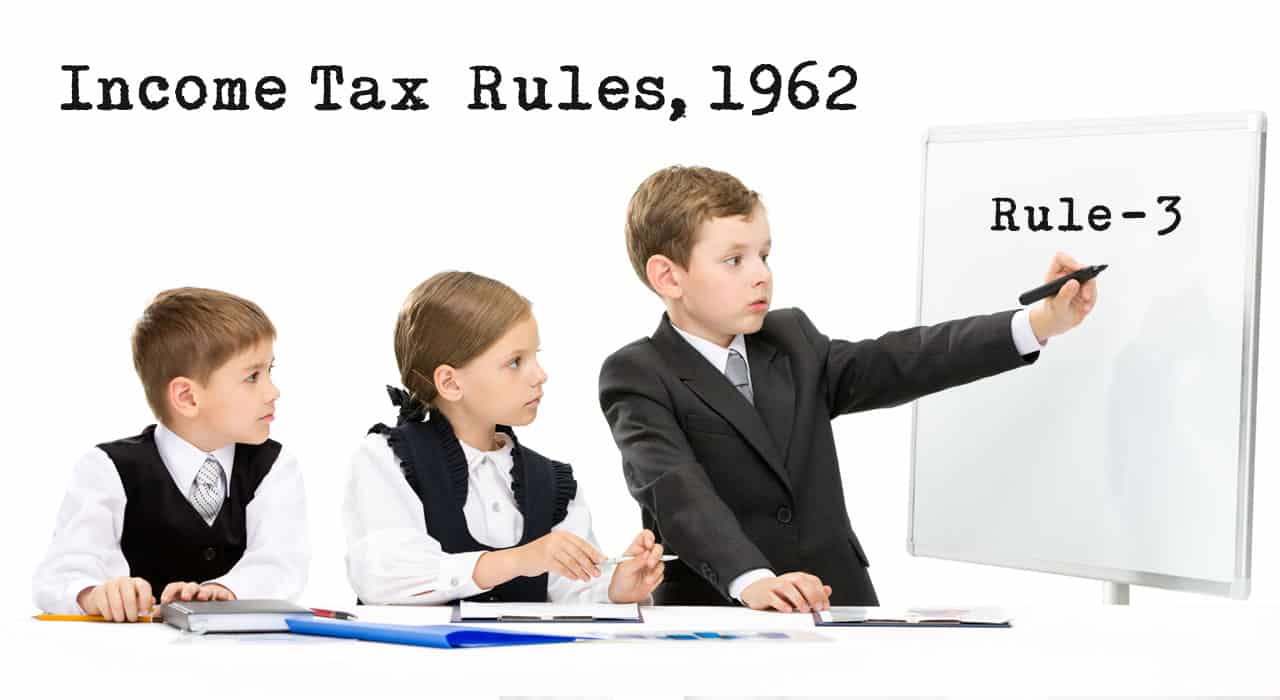
1. The tax officer misinterpreted Rule 3(5) (of Income Tax Rules, 1962).
2. The value of free education as a perk should be based on costs at similar nearby schools, not the school's own fees.
3. The court emphasized the importance of correctly applying tax rules when assessing perquisites.
Issue:
The main question here is: Did the Income Tax Appellate Tribunal (ITAT) make a mistake in its interpretation of Rule 3(5) (of Income Tax Rules, 1962), regarding how to value free education provided to employees' children as a perquisite?
Facts:
- This case is about Delhi Public School for the assessment year 2003-04.
- The school provides free education to its staff's children.
- The Assessing Officer (AO) considered this as a taxable perk for the employees.
- The ITAT had ruled in favor of the school, and the tax department wasn't happy about it.
- The case made its way to the High Court.
Arguments:
Tax Department's side:
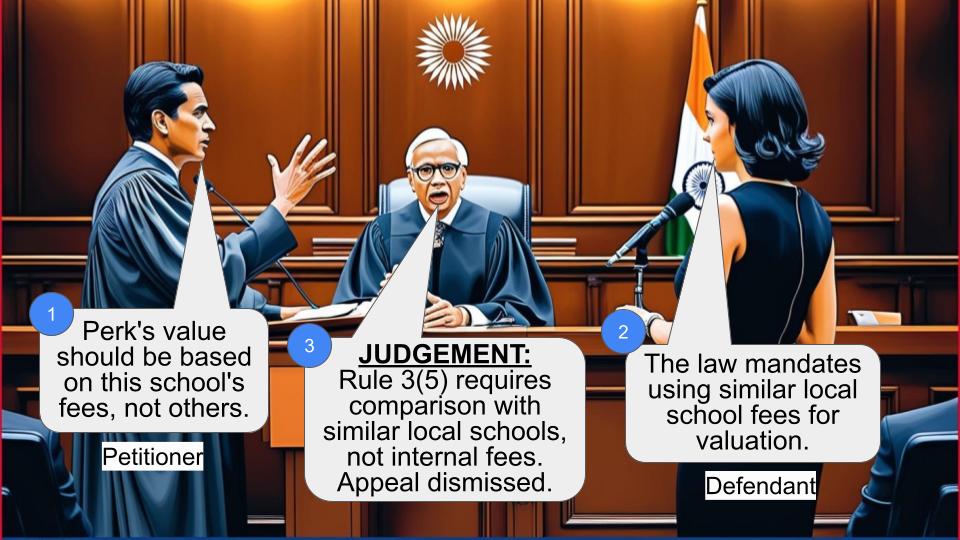
They believed the ITAT made a mistake in interpreting Rule 3(5) (of Income Tax Rules, 1962). They thought the value of the perk should be based on what other students pay at the same school.
School's side:
They argued that the AO misapplied the rule. The school said the value should be based on the cost of education at similar schools nearby, not their own fees.
Key Legal Precedents:
Interestingly, this case doesn't mention any specific legal precedents. It's more about the correct interpretation of Rule 3(5) (of Income Tax Rules, 1962).
Judgement:
The High Court sided with the school and the ITAT. They said:
1. The AO messed up by not looking at the second part of Rule 3(5) (of Income Tax Rules, 1962).
2. The correct way to value the perk is to look at similar schools nearby, not the school's own fees.
3. The ITAT was right to point out this error.
4. There's no substantial question of law here, so they dismissed the appeal.
FAQs:
1. Q: What was the main issue in this case?
A: The main issue was how to correctly value the perk of free education given to staff children for tax purposes.
2. Q: Why did the court dismiss the tax department's appeal?
A: The court found that the tax officer had misinterpreted Rule 3(5) (of Income Tax Rules, 1962), by not considering the cost of education in similar nearby schools.
3. Q: What does Rule 3(5) (of Income Tax Rules, 1962) say about valuing educational perks?
A: It says the value should be determined based on the cost of education in similar institutions in or near the locality, not necessarily the fees of the school providing the perk.
4. Q: Did the court make a final decision on whether the free education was taxable?
A: Not really. The court just said the tax officer used the wrong method to value the perk. They didn't decide if it was taxable or not.
5. Q: What's the takeaway for schools providing free education to staff children?
A: Schools should be aware that if this perk is considered taxable, its value should be based on fees at similar nearby schools, not their own fees.

1. The Revenue is aggrieved by an order dt. 23rd March, 2007 passed by the Income-tax Appellate Tribunal (‘the Tribunal’), Delhi Bench ‘H’ in ITA No. 483/Del/2006 relevant for the asst. yr. 2003-04.
2. The only issue that arises for consideration is with regard to the interpretation of r. 3(5) (of Income Tax Rules, 1962) (‘Rules’). The assessee’s school gives free education to the children of the staff. The question was whether this could be treated as a perquisite in their hands. Rule 3(5) (of Income Tax Rules, 1962) reads as follows :
"(5) The value of benefit to the employee resulting from the provision of free or concessional educational facilities for any member of his household shall be determined as the sum equal to the amount of expenditure incurred by the employer in that behalf or where the educational institution is itself maintained and owned by the employer or where free educational facilities for such member of employees’ household are allowed in any other educational institution by reason of his being in employment of that employer, the value of the perquisite to the employee shall be determined with reference to the cost of such education in a similar institution in or near the locality. Where any amount is paid or recovered from the employee on that account, the value of benefit shall be reduced by the amount so paid or recovered ;
Provided that where the educational institution itself is maintained and owned by the employer and free educational facilities are provided to the children of the employee or where such free educational facilities are provided in any institution by reason of his being in employment of that employer, nothing contained in this sub-rule shall apply if the cost of such education or the value of such benefit per child does not exceed Rs.1,000 per month."
3. We find that the AO did not apply his mind to the later part of r. 3(5) (of Income Tax Rules, 1962) where the determination of the value of the perquisite is with reference to the cost of such education in a similar institution in or near the locality. Instead he went by the cost of education for other students in the same school and took that as the perquisite value in the hands of the employee and levied tax on the assessee accordingly.
4. The Tribunal has pointed out, and in our opinion rightly, that the later part of r. 3(5) (of Income Tax Rules, 1962), which requires the AO to determine the cost of education in a similar institution in or near the locality was completely overlooked by the AO and, therefore, he proceeded on an entirely incorrect proposition.
5. Factually, the CIT(A) held that on the basis of the accounts maintained by the assessee, the cost of education was Rs. 902.27 per month per child and, therefore, the assessee is also entitled to the benefit of the proviso. But as we mentioned above, we are not going into this aspect of the matter because we find that on the first issue itself the AO has erred in understanding the Rules.
6. No substantial question of law arises.
7. Dismissed.
MADAN B. LOKUR, J
NOVEMBER 22, 2007 S. MURALIDHAR, J
kapil
×
Similar Ripples
Questions
Court Dismisses Tax Appeal on School's Free Education Perks, Citing Misinterpretation of Rules
Write your CommentSimilar Posts
Generic
- Reportdata/5153.pdf
