


Court Drops Tax Reassessment: No Higher Tax Even with Alleged Escaped Income


Full News

Court Drops Tax Reassessment: No Higher Tax Even with Alleged Escaped Income
Court Drops Tax Reassessment: No Higher Tax Even with Alleged Escaped Income
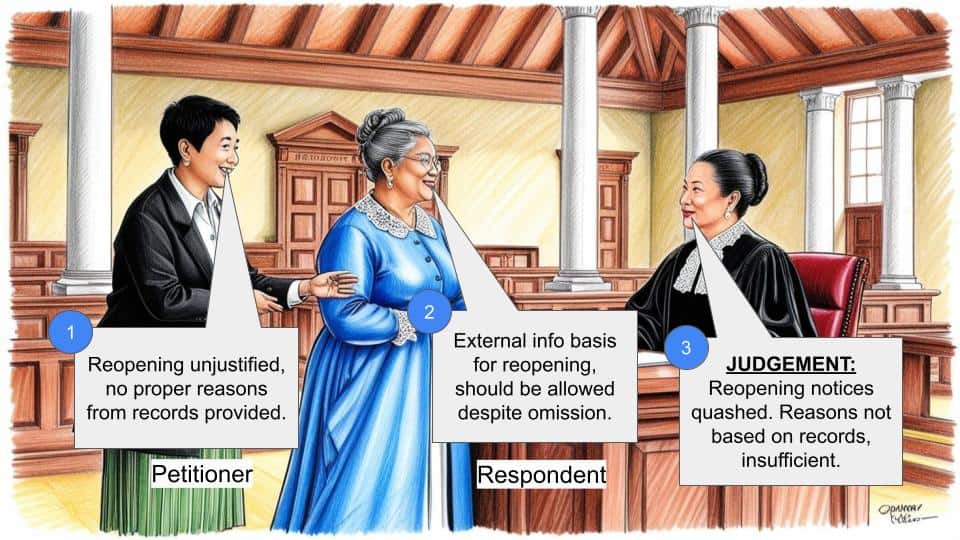
This case involves Motto Tiles P. Ltd. challenging a notice issued by the Assistant Commissioner of Income Tax to reopen their assessment for the 2011-12 tax year. The court ruled in favor of the company, quashing the reassessment notice on the grounds that even if the alleged escaped income was added, it wouldn't result in a higher tax liability for the company.
Get the full picture - access the original judgement of the court order here
Case Name:
Motto Tiles P. Ltd. vs Assistant Commissioner of Income Tax (High Court of Gujarat)
Special Civil Application No. 20109 of 2015
Date: 6th May 2016
Key Takeaways:
1. Reassessment notices can be challenged if they don't result in higher tax liability.
2. Book profit taxation under section 115JB (of Income Tax Act, 1961) can protect against reassessment in certain cases.
3. The court prioritized actual tax impact over theoretical income escapement.
Issue:
Can the Income Tax Department reopen an assessment when the alleged escaped income wouldn't result in a higher tax liability due to the application of Minimum Alternate Tax (MAT) under section 115JB (of Income Tax Act, 1961)?
Facts:
- Motto Tiles P. Ltd., a private company, filed a return for the 2011-12 assessment year showing a loss of Rs.77,51,810 and a book profit of Rs. 35,96,518.
- The case was initially processed under section 143(1) (of Income Tax Act, 1961).
- On 02.03.2015, the company received a notice under section 148 (of Income Tax Act, 1961) to reopen the assessment.
- The Assessing Officer alleged that income of Rs. 81,18,000 had escaped assessment due to high share premiums.
- The company was already assessed on book profit under section 115JB (of Income Tax Act, 1961).
Arguments:
Petitioner (Motto Tiles P. Ltd.):
- Even if the alleged escaped income is added, there would be no increase in tax liability due to MAT provisions.
- The Assessing Officer lacked tangible material to form a belief about escaped income.
- Cited previous court decisions supporting their stance.
Respondent (Income Tax Department):
- Argued that reduction in loss would affect future tax liabilities when set off is claimed.
- Contended that MAT is only a minimum alternative tax and doesn't negate the need for correct income assessment.
Key Legal Precedents:
1. PKM Advisory Services P. Ltd. v. Income Tax Officer, (2011) 339 ITR 585 (Guj.)
2. India Gelatine and Chemicals Ltd. v. Assistant Commissioner of Income Tax (No.1), (2014) 364 ITR 649 (Guj.)
3. Olwin Tiles (India) Pvt. Ltd. v. Deputy Commissioner of Income Tax – Morbi Circle (unreported decision dated 05.01.2016)
4. Deputy Commissioner of Income Tax v. Zuari Estate Development & Investment Co. Ltd., (2015) 373 ITR 661 (SC)
5. Commissioner of Income Tax (Central), Delhi v. Harprasad and Co. (P) Ltd., (1975) 99 ITR 118
Judgement:
The court ruled in favor of Motto Tiles P. Ltd., quashing the reassessment notice. Key points:
- Relied on the India Gelatine and Chemicals Ltd. case, which had similar facts.
- Held that if the proposed addition doesn't increase tax liability due to MAT provisions, there's insufficient basis to believe income escaped assessment.
- Emphasized that the revenue had accepted the India Gelatine decision by not challenging it in a higher forum.
FAQs:
1. Q: What is Minimum Alternate Tax (MAT)?
A: MAT is a provision under section 115JB (of Income Tax Act, 1961) that ensures companies pay a minimum tax on their book profits, even if their taxable income is low or nil due to various deductions and exemptions.
2. Q: Why did the court quash the reassessment notice?
A: The court determined that even if the alleged escaped income was added, it wouldn't increase the company's tax liability due to the MAT provisions already in place.
3. Q: Does this judgment mean companies can never be reassessed if they're paying MAT?
A: Not necessarily. The judgment is specific to cases where the proposed reassessment wouldn't result in additional tax liability. Other circumstances might still warrant reassessment.
4. Q: What's the significance of section 152(2) (of Income Tax Act, 1961) in this case?
A: This section allows an assessee to claim that reassessment proceedings should be dropped if they can show they've been assessed on an amount not lower than what they'd be liable for even if the alleged escaped income was considered.
5. Q: How might this judgment impact future tax assessments?
A: It may encourage tax authorities to more carefully consider the actual tax impact of potential reassessments, especially in cases where companies are already paying tax under MAT provisions.

1. Rule. Mr. Pranav Desai, learned Senior Standing Counsel waives service of notice of rule on behalf of the respondent.
2. Having regard to the nature of the controversy involved in the present case and with the consent of the learned counsel for the respective parties, the matter was taken up for final hearing today.
3. By this petition under Article 226 of the Constitution of India, the petitioner has challenged the notice dated 02.03.2015 issued by the respondent under section 148 (of Income Tax Act, 1961) (hereinafter referred to as “the Act”), seeking to reopen the assessment of the petitioner for assessment year 2011-12.
4. The petitioner, a Private Limited Company, was incorporated on 15.01.2010. For assessment year 2011-12, the petitioner submitted its return of income on 19.09.2011 showing total loss of Rs.77,51,810/- and a book profit of Rs.35,96,518/-. The case was processed under section 143(1) (of Income Tax Act, 1961). Thereafter, the petitioner received a notice dated 02.03.2015 issued under section 148 (of Income Tax Act, 1961) from the respondent. In response to the same, the petitioner requested for a copy of the reasons recorded for issuing the notice under section 148 (of Income Tax Act, 1961), which came to be furnished to the petitioner. In response to the reasons recorded for reopening the assessment, the petitioner filed its objections by a letter dated 14.09.2015, which came to be rejected by the respondent by an order dated 05.10.2015.
5. Mr. Manish Shah, learned advocate for the petitioner invited the attention of the court to the reasons recorded for reopening the assessment to submit that on the reasons recorded, the Assessing Officer could not have formed the belief that income chargeable to tax has escaped assessment. It was submitted that there is no new tangible material on record and even in a case covered under section 143(1) (of Income Tax Act, 1961), the Assessing Officer should have fresh tangible material on hand for forming the belief as regards escapement of income. It was submitted that the petitioner company had commenced commercial production on 27.12.2010 and hence, it was practically impossible to earn such an undisclosed income within a period of three months. According to the learned counsel, except suspicion, there was no tangible material before the Assessing Officer at the time of recording the reasons to support his belief that the income chargeable to tax has escaped assessment. It was submitted that in the present case, the petitioner has been assessed at book profit of Rs.35,96,518/- under section 115JB (of Income Tax Act, 1961), and that in the normal computation of income the petitioner has shown a total loss of Rs.77,51,810/-. Therefore, even if the total amount of Rs.81,18,000/- which is alleged to have escaped assessment is added, there would still be no additional tax liability on the part of the petitioner and that the petitioner would still be taxed on the book profit. Under the circumstances, the question of any income having escaped assessment would not arise.
5.1 In support of his submissions, the learned counsel placed reliance upon the decision of this court in the case of PKM Advisory Services P. Ltd. v. Income Tax Officer, (2011) 339 ITR 585 (Guj.), wherein, the court had recorded that when the tax payable as per the reasons recorded is less than the tax paid by the petitioner under the assessment framed under section 143(3) (of Income Tax Act, 1961), the question of any income having escaped assessment does not arise. The court recorded that the order recording reasons itself indicates that in fact no income has escaped assessment and as such, there is no basis for the formation of belief that income has escaped assessment. Reliance was also placed upon the decision of this court in the case of India Gelatine and Chemicals Ltd. v. Assistant Commissioner of Income Tax (No.1), (2014) 364 ITR 649 (Guj.), wherein, the court had recorded that even if the addition proposed by the Assessing Officer is sustained, it would make no difference to the ultimate tax liability of the assessee since on the computation of book profit under section 115JA (of Income Tax Act, 1961), the assessee had paid tax on much higher income of Rs.2.89 crores. The court recorded that under the normal computation, the assessee had declared a loss of Rs.1.44 crores (rounded off). Even if the disallowance of Rs.116.86 lakhs is made, there would be no difference in the assessee’s tax liability under section 115JA (of Income Tax Act, 1961). The court, placing reliance upon the decision of this court in the case of PKM Advisory Services P. Ltd. v. Income Tax Officer (supra), held that in the original assessment order, against the loss of Rs.1.44 crores under the normal computation, the assessment was framed on book profit of Rs.2.89 crores under section 115JA (of Income Tax Act, 1961). Therefore, even if the expenditure of Rs.116.86 lakhs is disallowed, there would be no resultant change in the petitioner’s tax liability since the petitioner has already paid much higher tax. The court, accordingly, quashed the notice under section 148 (of Income Tax Act, 1961). It was submitted that the above decisions would be squarely applicable to the facts of the present case and hence, since the tax liability even if the addition proposed to be made by the Assessing Officer is sustained, would not increase, there is no reason for formation of belief on the part of the Assessing Officer that income chargeable to tax has escaped assessment. It was accordingly, submitted that the assumption of jurisdiction on the part of the Assessing Officer is, therefore, without authority of law.
5.2 The learned counsel also placed reliance upon the decision of this court in the case of Siddhi Vinayak Transport v. Assistant Commissioner of Income Tax, (2014) 362 ITR 72.
6. Vehemently opposing the petition, Mr. Pranav Desai, learned Senior Standing Counsel for the respondent placed reliance upon an unreported decision of this court in the case of Olwin Tiles (India) Pvt. Ltd. v. Deputy Commissioner of Income Tax – Morbi Circle rendered on 05.01.2016 in Special Civil Application No.17307 of 2015 and allied matters, wherein, the court in a case where similar reasons had been recorded for reopening the assessment, had upheld the reopening of assessment and had dismissed the petitions. It was submitted that on the merits of the reopening, the above decision would be squarely applicable to the facts of the present case and hence, the Assessing Officer was wholly justified in forming the belief that income chargeable to tax has escaped assessment for the year under consideration.
6.1 Insofar as the second contention raised on behalf of the petitioner that even if the total amount as proposed to be added by the Assessing Officer is sustained, there would be no increase in the tax liability of the petitioner, the learned counsel submitted that this is a case where no scrutiny assessment has been made under section 143(3) (of Income Tax Act, 1961) and that the petitioner had declared income of Rs.35.96 lacs under section115JB (of Income Tax Act, 1961). It was submitted that in the present case, the tax levied under section 115JB (of Income Tax Act, 1961) is on the book profit. Even if any addition is made to the total income shown in the return of income filed, the same results into reduction of loss to be carried forward to subsequent years. In case of reduction in loss in the year under consideration, the revenue effect will be in the year in which the assessee claims such set off. Therefore, the contention of the petitioner that there will be no revenue effect in its case is not correct. It was submitted that the tax payable/paid by the assessee under section 115JB (of Income Tax Act, 1961) is only the minimum alternative tax payable during the year under consideration and that the assessee is eligible to get the credit of such tax paid against the tax liability of the assessment year in which the tax becomes payable on the total income computed in accordance with the provisions of law. It was submitted that therefore, the plea taken by the petitioner that there would be no difference in tax liability deserves to be rejected.
6.2 In support of his submissions, Mr. Desai placed reliance upon the decision of the Supreme Court in the case of Deputy Commissioner of Income Tax v. Zuari Estate Development & Investment Co. Ltd., (2015) 373 ITR 661 (SC), for the proposition that where the assessee’s return is accepted under section 143(1) (of Income Tax Act, 1961), there is no question of change of opinion, inasmuch as, while accepting the return under the said provision, no opinion is formed. The learned counsel also placed reliance upon the decision of the Supreme Court in the case of Commissioner of Income Tax (Central), Delhi v. Harprasad and Co. (P) Ltd., (1975) 99 ITR 118, for the proposition that income also includes loss.
6.3 It was further submitted that the petitioner in the computation of his income, has claimed loss which will be set off in the subsequent years. Hence, despite the fact that for the year under consideration, he may be assessed on the book profit under section 115JB (of Income Tax Act, 1961), the loss claimed under the regular computation would remain and the petitioner would get the benefit thereof in subsequent years. Therefore, the income chargeable to tax has escaped assessment, though it may not have any effect on the tax liability in the year under consideration. It was submitted that here, there is a loss on which a right accrues as there is carry forward effect which would have a direct impact on future years. Benefit accrues to the assessee which is to the detriment of the revenue. It was, accordingly, urged that at the threshold, at the stage of notice under section 148 (of Income Tax Act, 1961), the revenue should not be precluded from examining the issues. It was contended that the decision of this court in the case of PKM Advisory Services P. Ltd. v. Income Tax Officer (supra), would not be applicable to the facts of the present case, inasmuch as, in the said case, it was not a case where the assessee had declared a loss. It was submitted that insofar as the decision of this court in the case of India Gelatine and Chemicals Ltd. v. Assistant Commissioner of Income Tax (No.1) (supra) is concerned, though the same has been rendered in a similar set of facts, such decision has to be reconsidered.
7. Before adverting to the merits of the case, it may be germane to refer to the reasons recorded for reopening the assessment, which read thus:
“Reasons for reopening of assessment:
In this case, on verification of records, it is found that the Assessee is a Private Ltd. Company engaged in the business of manufacturing of Ceramic Tiles. On the basis of the information available with this office,assessee company had issued its shares at huge premiums during F.Y. 2010-11. On verification of “PART-A – BS” of return of income filed by the assessee company, it is found that the assessee company has shown “Issued, Subscribed and Paid-up” share capital of Rs.75,91,600/=. During the F.Y. 2010-11, the assessee had issued 9,000 shares at a face value of Rs.10 per share with a premium of Rs.990/- per share. Hence, the premium received by the assessee per share is Rs.990 for the share of face value of Rs.10/-. On the basis of the assets and liabilities furnished by the assessee company in its balance sheet, and computing the net worth of the company, per share valuation of the assessee company comes out to be Rs.98/-. Hence, the shares of the company have been subscribed by the shareholders at a premium which is very high in comparison to the real worth of the shares. Further, assessee company has shown total income of Rs. NIL for A.Y. 2011-12.
It is difficult to accept the fact that a person will invest in the share capital of a Private Limited Company at such a huge premium which is even higher than the real worth of the share. In fact, a sound investor will never subscribe to the shares of a company with such meager profits at such high premiums. A detailed analysis of the data furnished by the assessee with its return shows that whereas the net worth of the shares issued is Rs,98/-, the same have been allotted for Rs.1000/- i.e. an excess of Rs.902/-.
In my opinion, this excess premium amount of Rs.902/- is unexplained cash-credit in the hands of the assessee. Hence, I have reasons to believe that income to the extent of Rs.81,18,000/- has escaped assessment in the hands of the assessee for A.Y. 2011-12.
I have, therefore, reasons to believe that income/gain chargeable to tax has escaped assessment for the A.Y. 2011-12. The above income / gain chargeable to tax has escaped assessment by reason of the failure on the part of the above named assessee who failed to disclose fully and truly all material fact necessary for the assessment for the A.Y. 2011-12 within the meaning of explanation 2(b) of section 147 (of Income Tax Act, 1961).
Hence, it is a fit case for re-opening the assessment for A.Y. 2011-12.
Issue Notice under section 148 (of Income Tax Act, 1961) of the I. T. Act, 1961.”
8. On a perusal of the reasons recorded it can be seen that the Assessing Officer has sought to reopen the assessment on the ground that the shares of the company have been subscribed by the shareholders at a premium which is very high in comparison to the real worth of the shares. According to the Assessing Officer, per share valuation of the assessee company comes to Rs.98/-, whereas the shares having face value of Rs.10/- were sold with a premium of Rs.990/- per share. Insofar as the basis for reopening the assessment is concerned, on similar grounds, the concerned Assessing Officer had sought to reopen the assessment in the case of Olwin Tiles (India) Pvt. Ltd. v. Deputy Commissioner of Income Tax – Morbi Circle (supra). In the said case, the court, for the detailed reasons recorded in the judgement and order dated 05.01.2016, had upheld the reopening and had dismissed the petitions. The court did not find the reasons to be perverse or so untenable as to terminate the assessment on the ground that the Assessing Officer could not be stated to have any reason to believe or tangible material to form such an opinion that income chargeable to tax had escaped assessment. Therefore, on the merits of the reopening, the present case is squarely covered by the above decision against the petitioner.
9. However, on behalf of the petitioner, it has been pointed out that in terms of the reasons recorded, the income chargeable to tax to the extent of Rs.81,18,000/- has escaped assessment. In the return of income filed by the petitioner, the petitioner has disclosed loss of Rs.77,51,810/- and the petitioner has been assessed at an income of Rs.35,96,518/- on the book profit under section 115JB (of Income Tax Act, 1961). It has, accordingly, been contended that even after making the proposed addition, there would be no difference in the taxable income of the petitioner and it will still be governed by the provisions of section 115JB (of Income Tax Act, 1961).
10. The learned counsel for the petitioner has also drawn the attention of the court to the provisions of section 152(2) (of Income Tax Act, 1961), which provides that where an assessment is reopened under section 147 (of Income Tax Act, 1961), the assessee may, if he has not impugned any part of the original assessment order for that year either under sections 246 (of Income Tax Act, 1961) to 248 or under section 264 (of Income Tax Act, 1961), claim that the proceedings under section 147 (of Income Tax Act, 1961) shall be dropped on his showing that he had been assessed on an amount or to a sum not lower than what he would be rightly liable for even if the income alleged to have escaped assessment had been taken into account, or the assessment or computation had been properly made. It was submitted that in view of the above provision, the proceedings are even otherwise required to be dropped because even if the income which is alleged to have escaped assessment is taken into account, the petitioner would not be assessed at a higher amount.
11. Insofar as the second contention raised on behalf of the petitioner is concerned, the controversy stands squarely concluded by the decision of this court in the case of India Gelatine and Chemicals Ltd. v. Assistant Commissioner of Income Tax (No.1) (supra) wherein, the court in a case where the assessee had declared a loss of Rs.1.44 crores under the normal computation and the assessment was framed on book profit of Rs.2.89, had held that even if the expenditure of Rs.116.86 lakhs is disallowed, there would be no resultant change in the petitioner’s tax liability since the petitioner had already paid much higher tax and had allowed the petition. It appears that the revenue has accepted the said decision and has not challenged the same before the higher forum. The learned counsel for the respondent has urged that the decision requires reconsideration. Having regard to the facts and circumstances of the case, as well as the fact that the revenue has accepted the said decision, the court does not find any reason to refer the matter for consideration to a Larger Bench.
12. In the light of the decision of this court in the case of India Gelatine and Chemicals Ltd. v. Assistant Commissioner of Income Tax (No.1) (supra), having regard to the fact that even if the entire amount which is proposed to be added by the Assessing Officer is sustained, there would be no addition to the tax liability of the petitioner and the petitioner would still be governed by the provisions of section 115JB (of Income Tax Act, 1961) and assessed on the same book profit, it cannot be said that there was sufficient material before the Assessing Officer to form the belief that income chargeable to tax has escaped assessment. The impugned notice issued under section 148 (of Income Tax Act, 1961), therefore, cannot be sustained.
13. For the foregoing reasons, the petition succeeds and is, accordingly, allowed. The impugned notice dated 02.03.2015 issued by the respondent under section 148 (of Income Tax Act, 1961) is hereby quashed and set aside. Rule is made absolute, accordingly, with no order as to costs.
(HARSHA DEVANI, J.)
(G.R.UDHWANI, J.)
×
Similar Ripples
Questions
Court Drops Tax Reassessment: No Higher Tax Even with Alleged Escaped Income
Write your CommentSimilar Posts


Generic
- Reportdata/2853.pdf
