


Court Excludes Comparables in Transfer Pricing Case Due to Lack of Segmental Da…


Full News

Court Excludes Comparables in Transfer Pricing Case Due to Lack of Segmental Data
Court Excludes Comparables in Transfer Pricing Case Due to Lack of Segmental Data
This case involves a dispute between the Principal Commissioner of Income Tax and Cashedge India Pvt. Ltd. regarding the inclusion of certain companies as comparables in a transfer pricing exercise. The Income Tax Appellate Tribunal (ITAT) excluded two companies and remanded the issue for one company. The High Court upheld the ITAT's decision, emphasizing the importance of segmental data in transfer pricing comparisons.
Get the full picture - access the original judgement of the court order here
Case Name:
Principal Commissioner of Income Tax Vs Cashedge India Pvt. Ltd. (High Court of Delhi)
ITA 279/2016
Date: 4th May 2016
Key Takeaways:
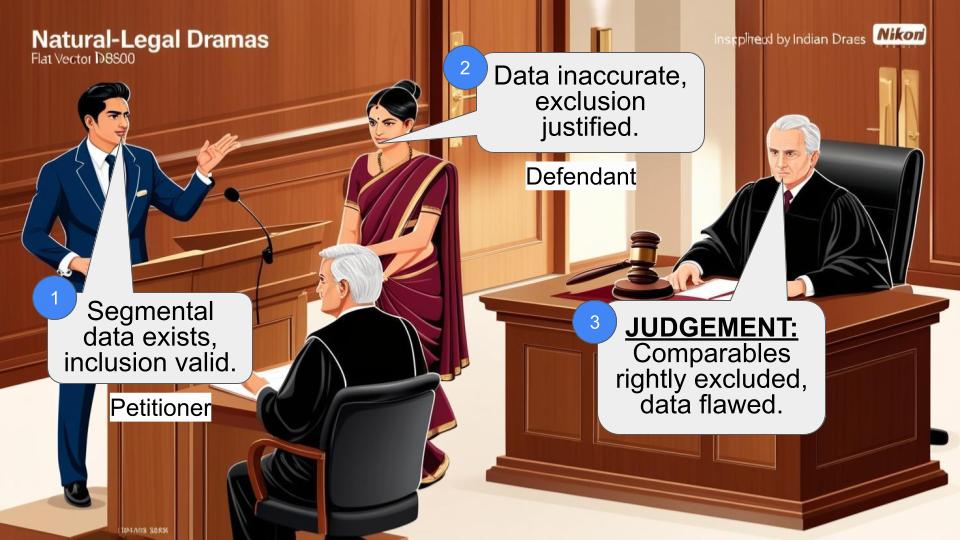
1. Segmental data is crucial for including a company as a comparable in transfer pricing.
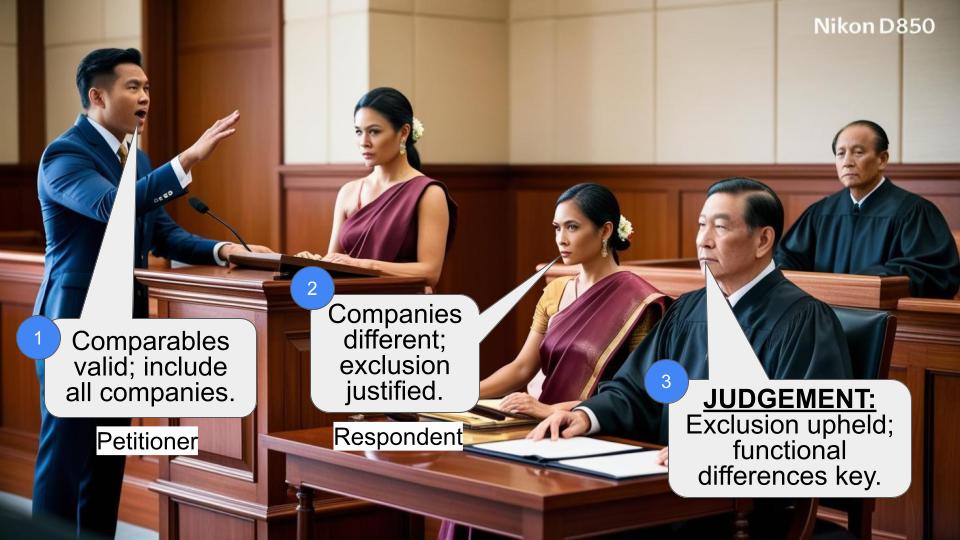
2. The court emphasized the importance of functional similarity in transfer pricing comparisons.
3. Safe Harbour Rules cannot be applied retrospectively to assessment years before their notification.
Issue:
Should companies without published segmental data be included as comparables in a transfer pricing exercise?
Facts:
1. Cashedge India Pvt. Ltd. (the assessee) is in the business of software development.
2. For the assessment year 2010-11, the assessee filed its return with transfer pricing reports.
3. The Transfer Pricing Officer (TPO) included three companies as comparables: Persistent Systems Ltd., Zylog Systems Ltd., and Wipro Technology Services.
4. The assessee objected to this inclusion and approached the Dispute Resolution Panel (DRP), which rejected their contentions.
5. The assessee then appealed to the Income Tax Appellate Tribunal (ITAT).
Arguments:
Revenue's Arguments:
1. The 75% service filter proposed by the assessee justified the inclusion of Persistent Systems Ltd.
2. Wipro Technology Services should not have been excluded by the ITAT.
3. The ruling on foreign exchange fluctuation was not justified in law.
Assessee's Arguments:
1. The companies included by the TPO were not functionally similar.
2. Published segmental data was not available for the included companies.
3. Safe Harbour Rules were not applicable for the concerned assessment year.
Key Legal Precedents:
The judgment doesn't explicitly mention any specific legal precedents. However, it refers to Transfer Pricing Rules under Rule 10(b) (of Income Tax Rules, 1962) to 10(e) of the Income Tax Rules, which guide the selection of comparables in transfer pricing cases.
Judgement:
1. The High Court upheld the ITAT's decision to exclude Persistent Systems Ltd. and Wipro Technology Services as comparables.
2. The court agreed that the lack of published segmental data for these companies made them unsuitable as comparables.
3. Regarding Zylog Systems Ltd., the court supported the ITAT's decision to remand the issue for further investigation of audited segmental data.
4. The court ruled that Safe Harbour Rules were not applicable to the assessment year in question (2010-11) as they were notified later.
5. The Revenue's appeal was dismissed as no substantial question of law arose from the ITAT's factual findings.
FAQs:
1. Q: Why were Persistent Systems Ltd. and Wipro Technology Services excluded as comparables?
A: They were excluded due to the lack of published segmental data, which is crucial for accurate comparison in transfer pricing cases.
2. Q: What is the significance of the 75% service filter mentioned in the case?
A: The 75% service filter was proposed by the assessee to identify companies with similar income structures for comparison purposes.
3. Q: Why couldn't the Safe Harbour Rules be applied in this case?
A: The Safe Harbour Rules came into force after the assessment year 2010-11, which was the year in question for this case. Therefore, they couldn't be applied retrospectively.
4. Q: What is the importance of functional similarity in transfer pricing cases?
A: Functional similarity ensures that the companies being compared have similar operations and business models, making the comparison more accurate and fair.
5. Q: What is the key lesson from this judgment for transfer pricing assessments?
A: The judgment emphasizes the importance of having published segmental data for companies to be considered as valid comparables in transfer pricing assessments.

1. The Revenue proposes two questions of law, i.e., (1) the correctness of the exclusion of two comparables in the transfer pricing exercise carried out in the assessee’s case, and the remand in the case of one comparable company; and (2) the refusal in the impugned order to give effect to the “Safe Harbour Rules” under Section 92CA(3) (of Income Tax Act, 1961) so as to exclude the element of gain on account of foreign exchange fluctuation, in respect of which relief was claimed by the assessee.
2. The facts are that the assessee carried out the business for software development; it was in the past as indeed in the present case for assessment year 2010-11 filed its return along with transfer pricing reports in form No.3CEB of the Income Tax Rules. The Assessing Officer (“AO”) referred the matter for consideration to the Transfer Pricing Officer (“TPO”) under Section 144C (of Income Tax Act, 1961). The TPO inter alia held that the data of three comparable companies, i.e., Persistent Systems Ltd., Zylog Systems Ltd. and Wipro Technology Services had to be included. This was objected to by the assessee which had approached the Dispute Resolution Panel (“DRP”); the latter by its order dated 14.11.2014 rejected the assessee’s contentions.
3. The Income Tax Appellate Tribunal (“ITAT”) to which the assessee appealed excluded its companies holding that the inclusion of Persistent Systems Ltd. and Wipro Technology Services (WTS) was unwarranted. It, however, remitted the issue with respect to Zylog Systems Ltd. to ascertain the audited segmental data for ultimately deciding the comparable component in issue. So far as the question of fluctuation of foreign exchange was concerned, the ITAT ruled that the relevant provision, i.e., “Safe Harbour Rules” had not been notified for the concerned assessment year and were, therefore, inapplicable.
4. The Revenue urges that the Tribunal fell into error. It seeks to firstly urge that the filters proposed by the assessee, i.e., 75% service filter (an extent of income derived from services rendered by the assessee) as opposed to the income derived from other businesses meant that Persistent Systems Ltd. was a comparable. Likewise, urged the counsel for the Revenue that Wipro Technology Services could not have been excluded as was done by the ITAT in its impugned order. Learned counsel also urged that the ruling of foreign exchange fluctuation was not justified in law.
5. The proceedings before the TPO clarified that the assessee had not proposed Persistent Systems Ltd. or Zylog Systems Ltd. There is no doubt that it did propose 75% service built up. However, the TPO suo motu appears to have included the data of three companies holding that they were functionally similar. The question as to whether indeed they are functionally similar as contended by the Revenue.
6. As far as the first company, i.e., Persistent Systems Ltd. is concerned, the material on record - as found by the ITAT - shows that this company was involved in software development, software products and marketing. Furthermore and perhaps more importantly published segmental data was not available. In these circumstances, having regard to the specificity of the Transfer Pricing Rules under Rule 10(b) (of Income Tax Rules, 1962) to 10 (e) of the Income Tax Rules, the data of the said firm, i.e., Persistent Systems Ltd. could not have been included. Likewise as far as the Wipro Technology Services goes, it was part of the Citi Group and was during the financial year in question acquired on 21.01.2009 by the Wipro Ltd. as a subsidiary. As a part of the arrangement, the existing contracts pertaining to the work of the Citi Group continued to be with the newly created entity, i.e., Wipro Technology Services. Equally importantly, is that there was no published segmented data as far as software development or its finances were concerned with respect to Wipro Technology Services. In these circumstances, the findings of the ITAT are purely factual and cannot be gone into as no substantial question of law arises for consideration.
7. As far as the question, i.e., foreign exchange fluctuation element is concerned, the records clearly reveal that the Safe Harbour Rules came into force later whereas the facts of this case pertain to the assessment year 2010-11 (Financial year 2009-10). As a consequence, the impugned order cannot be interfered with. No question of law thus arises. The appeal is consequently dismissed.
S. RAVINDRA BHAT, J
DEEPA SHARMA, J
MAY 04, 2016
×
Questions
Court Excludes Comparables in Transfer Pricing Case Due to Lack of Segmental Data
Write your CommentSimilar Posts

Generic
- Reportdata/2862.pdf
