


Full News

Court Grants Interim Stay on Tax Demand After Assessee Pays 25%
Court Grants Interim Stay on Tax Demand After Assessee Pays 25%
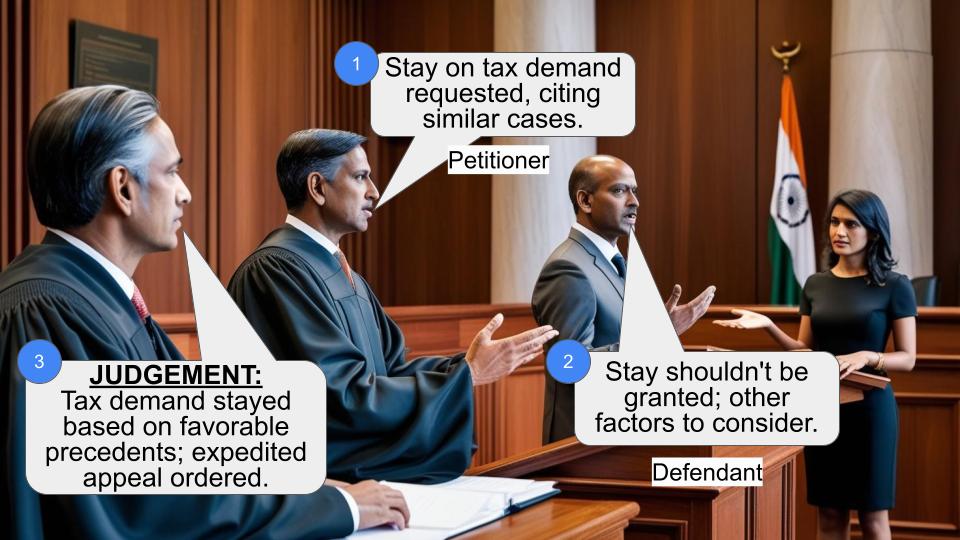
This case involves a dispute between Dr. Pratima Venkatachalam (the petitioner) and the Commissioner of Income Tax (the respondent). The petitioner challenged an order that required her to pay 40% of a tax demand to get a stay on the remaining amount. The High Court modified the order, granting an interim stay after the petitioner paid 25% of the demand.
Get the full picture - access the original judgement of the court order here
Case Name
Dr. Pratima Venkatachalam vs. Commissioner of Income Tax (High Court of Madras)
W.P.No.8520 of 2016 and WMP No.7581 of 2016
Date: 5th April 2016
Key Takeaways
- Paying a portion of a tax demand can lead to a stay on the remaining amount.
- Courts may modify tax collection orders based on the circumstances of the case.
- Timely disposal of tax appeals is crucial for taxpayer rights.
Issue
Was the order requiring the petitioner to pay 40% of the tax demand for granting a stay justified, or should a lower percentage be considered sufficient?
Facts
- On April 15, 2015, Dr. Venkatachalam filed an appeal with the Commissioner of Income Tax (CIT) and requested a stay on tax collection.
- On June 4, 2015, the CIT refused to stay the collection and ordered the petitioner to deposit the full amount.
- The petitioner then filed another petition on June 12, 2015, seeking an interim stay to prevent recovery proceedings.
- Despite this pending stay application, the Income Tax Officer issued a notice on August 14, 2015, demanding immediate payment of Rs.98,73,120.
- The petitioner challenged this notice in the High Court (WP No. 28629 of 2015).
- On September 11, 2015, the High Court set aside the notice and directed the CIT to decide on the stay petition within four weeks.
- On September 30, 2015, the CIT granted a stay on the condition that the petitioner pay 40% of the demand.
- The petitioner then filed this writ petition challenging the 40% condition.
Arguments
Unfortunately, the connected document doesn’t provide detailed arguments from both sides. However, we can infer that:
- The petitioner likely argued that the 40% payment condition was too high and unjustified.
- The tax authorities probably argued that the condition was necessary to protect government revenue while the appeal was pending.
Key Legal Precedents
The judgment doesn’t mention any specific legal precedents. However, it’s clear that the court has the power to modify orders related to tax demand stays, balancing the interests of the taxpayer and the government.
Judgment
Here’s what the court decided:
- The High Court modified the CIT’s order dated September 30, 2015.
- It granted an interim stay on the entire tax demand, conditional on the petitioner paying 25% of the demand.
- The court noted that the petitioner had already paid this 25%, which was confirmed by the government’s counsel.
- The CIT was directed to decide the appeal on its merits within three months from receiving the court’s order.
- The interim stay would remain in effect until the CIT decides on the appeal.
FAQs
Q: Why did the court reduce the payment condition from 40% to 25%?
A: The court likely found that 25% was a more reasonable amount to balance the interests of both parties. The fact that the petitioner had already paid this amount probably influenced the decision.
Q: What happens if the CIT doesn’t decide the appeal within three months?
A: The judgment doesn’t specify consequences, but the interim stay would likely continue until the CIT makes a decision.
Q: Does this case set a precedent for all tax demand stays?
A: While it might be considered in similar cases, each situation is unique. The court will likely consider various factors when deciding on stay conditions.
Q: What options does the tax department have now?
A: They must wait for the CIT to decide on the appeal. If they disagree with the CIT’s decision, they may have options to appeal further.
Q: Can the petitioner get back the 25% paid if they win the appeal?
A: If the CIT decides in favor of the petitioner, they would likely be entitled to a refund, but the judgment doesn’t specifically address this.

1. Challenging the order dated 30.09.2015 on the file of the first respondent, the petitioner has filed the above writ petition for issuance of a writ of Certiorarified Mandamus and consequently forbearing the second respondent from initiating any proceedings for the recovery of Income Tax till the disposal of the Appeal pending on the file of the first respondent.
2. According to the petitioner, she preferred an appeal before the first respondent on 15.04.2015 and also filed an application for the grant of stay before the second respondent . By order dated 04.06.2015, the first respondent refused to stay the collection of the demand and the petitioner was directed to deposit the amount. Thereafter, the petitioner filed a petition before the first respondent on 12.06.2015, seeking for an order of interim stay to ensure that no recovery proceedings are initiated by the second respondent as per its impugned order dated 4.6.2015. However, notwithstanding the pendency of the stay application, the second respondent issued a notice dated 14.08.2015, calling upon the petitioner to pay the demand of Rs.98,73,120/-immediately and produce the copy of the challan for the payment of tax. Aggrieved over the issuance of notice dated 14.08.2015, the petitioner has filed a Writ Petition in WP No.28629 of 2015 before this Court. By Order dated 11.9.2015, this Court set aside the notice dated 14.08.2015, issued by the second respondent and directed the first respondent to pass orders in the stay petition, filed by the petitioner, within a period of four weeks. The first respondent, by order dated 30.09.2015, granted an order of stay on condition that the petitioner paying 40% of the demand and stayed the balance demand till the disposal of the appeal, filed by the petitioner. Aggrieved over the order dated 30.09.2015, the petitioner has filed the above writ petition.
3. When the matter came up for hearing on 08.03.2016, this Court granted an order of interim stay on condition that the petitioner paying 25% of the demand within ten days.
4. When the matter is taken up for hearing today, the learned counsel on either side, submitted that the petitioner had complied with the conditional order passed by this court on 08.03.2016. Admittedly, the appeal, filed by the petitioner, is pending before the first respondent.
5. Mr.Arun Kurrian Joseph, learned Standing Counsel, appearing for the respondents, submitted that the petitioner had complied with the order by paying 25% of the demand.
6. Since the petitioner had paid 25% of the demand, which was also admitted by the standing counsel appearing for the respondents, the impugned order dated 30.09.2015 is modified as follows:
“There shall be an order of interim stay till the disposal of the appeal, preferred by the petitioner on payment of 25% of the demand, which was already paid by the petitioner. The first respondent is directed to decide the appeal and pass orders in the appeal, on merits and in accordance with law within three months from the date of receipt of a copy of this order and till such time, there shall be an order of interim stay.
With this observation, the writ petition is disposed of. No costs. Consequently, connected MP is closed.
Index : No
website:yes
To
1. The Commissioner of Income Tax (Appeals), No.121, Nungambakkam High Road, Chennai – 600 034
2. Income Tax Officer, International Taxation-2(1), 7th floor, Annex Building, No.121, Nungambakkam High Road, Chennai – 600 034
M.DURAISWAMY, J.,
×
Similar Ripples
Questions
Court Grants Interim Stay on Tax Demand After Assessee Pays 25%
Write your CommentSimilar Posts


Generic
- Reportdata/2934.pdf
