


Court Halts Tax Reassessment as Basis for Notice Crumbles


Full News
Court Halts Tax Reassessment as Basis for Notice Crumbles
Court Halts Tax Reassessment as Basis for Notice Crumbles
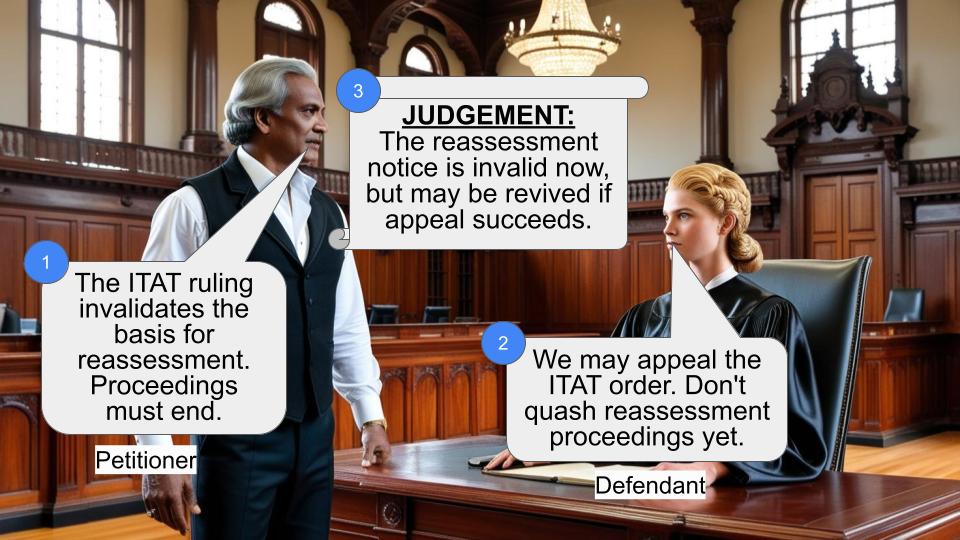
This case involves A.T. Kearney India (the petitioner) challenging a notice issued under Section 148 (of Income Tax Act, 1961) for reassessment of the 2006-07 assessment year. The notice was based on findings from the 2009-10 assessment year, which were later overturned by the Income Tax Appellate Tribunal (ITAT). The High Court disposed of the case, closing the reassessment proceedings but allowing potential revival if the Revenue's appeal succeeds.
Get the full picture - access the original judgement of the court order here
Case Name:
A.T. Kearney India Vs Income Tax Officer (High Court of Delhi)
W.P.(C) 4183/2012 and CM No. 8700/2012
Date: 16 September 2014
Key Takeaways:
1. Reassessment notices can be challenged if the basis for issuing them is invalidated.
2. Courts may dispose of cases conditionally, allowing for potential revival based on future developments.
3. The importance of considering ongoing appeals when making decisions on related cases.
Issue:
Is the notice issued under Section 148 (of Income Tax Act, 1961) for reassessment of the 2006-07 assessment year valid when the basis for its issuance (findings from the 2009-10 assessment year) has been overturned by the ITAT?
Facts:
1. The Income Tax Department issued a notice under Section 148 (of Income Tax Act, 1961) on 22.03.2012 for reassessment of A.T. Kearney India's 2006-07 assessment year.
2. The notice was based on findings from the scrutiny of the 2009-10 assessment year, alleging excessive deduction under Section 10A (of Income Tax Act, 1961).
3. The petitioner filed objections, which were rejected by the Assessing Officer.
4. The ITAT allowed the appeal for the 2009-10 assessment year, effectively invalidating the basis for the reassessment notice.
Arguments:
Petitioner's Arguments:
1. The basis for the reassessment notice no longer exists due to the ITAT's decision.
2. The proceedings should be quashed based on the precedent set in the Silver Oak Laboratories case.
Revenue's Position:
1. The ITAT's order is recent, and there's still time to file an appeal.
2. The reassessment proceedings should not be quashed outright due to the possibility of an appeal.
Key Legal Precedents:
1. Silver Oak Laboratories Private Limited and Another v. Deputy Commissioner of Income-Tax, Circle 8(1), New Delhi (W.P.(C) 17719-20/2006): This case established that reassessment proceedings could be quashed if the basis for reassessment is invalidated.
2. National Agricultural Cooperative Marketing Federation of India Ltd. v. Assistant Commissioner of Income Tax – Circle 32(1) (W.P.(C) 5895/2010): This case provided a precedent for conditionally disposing of cases while allowing for potential revival.
Judgement:
1. The court disposed of the writ petition, closing the reassessment proceedings for now.
2. Both parties were given liberty to seek revival if needed.
3. If the Revenue's appeal against the ITAT order succeeds, they can revive the reassessment proceedings.
4. The assessee (A.T. Kearney India) cannot claim limitation if proceedings are revived.
5. The court did not express an opinion on the validity of the original Section 148 (of Income Tax Act, 1961) notice.
FAQs:
Q1: What happens if the Revenue doesn't file an appeal against the ITAT order?
A1: If no appeal is filed, the reassessment proceedings will remain closed.
Q2: Can A.T. Kearney India claim that the reassessment is time-barred if proceedings are revived?
A2: No, the court explicitly stated that the assessee cannot take up the plea of limitation if proceedings are revived.
Q3: Did the court rule on the validity of the original Section 148 (of Income Tax Act, 1961) notice?
A3: No, the court specifically mentioned that it did not express any opinion on the validity of the notice when it was initially issued.
Q4: What's the significance of the Silver Oak Laboratories case in this judgment?
A4: The Silver Oak Laboratories case provided a precedent for quashing reassessment proceedings when the basis for reassessment is invalidated. However, the court noted a key difference in this case - the possibility of an appeal by the Revenue.
Q5: How does this judgment balance the interests of both parties?
A5: The judgment protects the assessee by closing the proceedings for now, while also protecting the Revenue's interests by allowing for potential revival if their appeal succeeds.

1. This writ petition is directed against the notice dated 22.03.2012 issued under Section 148 (of Income Tax Act, 1961) in respect of the assessment year 2006-07. The reasons given for the re-opening were inter alia based on the scrutiny proceedings of the very same petitioner for the assessment year 2009-10. The issue pertains to the high level of operating profits and the consequent alleged excessive deduction taken by the petitioner / assessee under Section 10A of the Income Tax Act, 1961.
2. The petitioner had filed its objections and the Assessing Officer passed an order rejecting the objections. In that order the Assessing Officer specifically noted that the fact that the assessee was claiming excessive deduction, as above, under Section 10A (of Income Tax Act, 1961) surfaced for the first time during the assessment proceedings for assessment year 2009-10 in the case of the petitioner itself. It was also noted that while going through the income tax return details for the subject year it was observed that here also the petitioner / assessee had adopted the same mechanism and had thus claimed excessive deduction under Section 10A of the Income Tax Act, 1961. According to the Assessing Officer, these findings constituted the new tangible material on record which was the basis for the reason to believe that income by way of excessive deduction under Section 10A (of Income Tax Act, 1961) had escaped assessment and that it was not a case of mere change of the opinion. It was also pointed out in the order rejecting the objections that the assessee had also not been able to distinguish as to how the facts of assessment year 2006-07 were different from those of assessment year 2009-10. It was concluded by the Assessing Officer that, where all other things remain the same, the inference drawn during the assessment proceedings for assessment year 2009-10 with respect to the excessive deduction claimed under Section 10A of the Income Tax Act, 1961 was equally applicable in respect of the assessment year 2006-07.
3. We are now informed by the learned counsel appearing on behalf of the petitioner that the appeal in respect of the assessment year 2009-10 being ITA No. 348/Del/2013 has been allowed by the Income Tax Appellate Tribunal, New Delhi. Apart from the observations on law, on facts it has been held by the Tribunal as under:-
“It can be seen from the facts of the instant case that the AO has simply treated high profit earned by the assessee as a reason to summon sub-section (10), without even remotely demonstrating the existence of any „arrangement‟ between the assessee and its AEs aimed at producing extra ordinary profits in the hands of the assessee. The conclusion drawn by the authorities below in such circumstances cannot be ex consequenti sustained.”
4. The consequence of the above decision by the Tribunal is that the very basis for forming the purported reason to believe that income had escaped assessment in respect of the assessment year in question does not survive any further. The learned counsel for the petitioner, therefore, contended that the proceedings pursuant to the impugned notice under Section 148 (of Income Tax Act, 1961) ought to be quashed as also the order rejecting the objections needed to be set aside. He placed reliance on a decision of this court in Silver Oak Laboratories Private Limited and Another v. Deputy Commissioner of Income- Tax, Circle 8(1), New Delhi, in W.P. (C) 17719-20/2006 decided on 18.12.2008. The facts of that case were somewhat similar to the present case. In that case also, during the assessment proceedings of other assessment years, certain facts were noticed and, based upon that, the notice under Section 148 (of Income Tax Act, 1961) for re-assessment had been issued in respect of the year in question. It was evident that the reasons recorded for the proposed re-assessment did not contain any specific allegation with regard to the year in question in that case, namely, the assessment year 1999-2000 and that the sole and entire basis of re-opening the assessment were the additions made in respect of the assessment years 1998-99 and 2001-02. No other reason had been given by the Assessing Officer for re-opening the assessment. Since the Tribunal, in that case had already deleted the additions in respect of the assessment years 1998-99 and 2001-02, the very basis for continuing any further with the re-assessment proceedings in respect of the relevant assessment year (1999-2000) did not survive any further. It was specifically noted in the said decision in Silver Oak Laboratories (supra) that there was no specific allegation with regard to the assessment year 1999-2000 regarding suppression of the sale figures and that the re-assessment proceeding depended entirely on the additions made in respect of the assessment years 1998-99 and 2001-02, which, as pointed out above, had been deleted by the Tribunal. It was also noted in the said decision that the Revenue had not filed any appeal against the decision of the Tribunal deleting the said additions.
5. In these circumstances this court, in Silver Oak Laboratories (supra), quashed further proceedings in respect of the notice under Section 148 (of Income Tax Act, 1961) and also set aside the order whereby the objections of the assessee had been rejected by the Assessing Officer. A similar order is sought by the learned counsel for the petitioner in the present case.
6. We find that there is one factor which is different from that case and, that is, that while in the previous case no appeal had been filed against the Tribunal‟s order, in the present case the Tribunal‟s order had been passed only on 26.08.2014 and there is still time for filing of the appeal on the part of the Revenue. In these circumstances, while the very basis for the issuance of the notice under Section 148 (of Income Tax Act, 1961) no longer survives, we are of the view that as there is still time for the filing of an appeal by the Revenue before this court, a different order would be required to be passed.
7. It is clear that as the position stands today, the reasons do not survive. However, subsequently the position may be altered in case the Revenue files and appeal and succeeds therein. Therefore, the Revenue also has to be protected. Consequently, we are inclined to adopt the approach indicated in National Agricultural Co-operative Marketing Federation of India Ltd. v. Assistant Commissioner of Income Tax – Circle 32(1), W.P.(C) 5895/2010 decided on 07.08.2014 wherein we passed the following order:-
“In these circumstances, we find that as of now, the very basis of initiating the re-assessment proceedings by virtue of the notice dated 02.02.2010 issued under Section 148 (of Income Tax Act, 1961) does not survive. Therefore, we are disposing of this writ petition with liberty to both sides to seek revival in case the need arises. We make it clear that in case it is ultimately held in favour of the revenue, then the revenue shall be entitled to revive its proceedings pursuant to the notice under Section 148 of the Income Tax Act, 1961 and the assessee shall not take up the plea of limitation.
The writ petition stands disposed of accordingly.”
8. Consequently, we direct that the re-assessment proceedings stand closed and the present writ petition is disposed of with liberty to both sides to seek revival in case the need arises. We make it clear that if the case is ultimately decided in favour of the Revenue in respect of the assessment year 2009-10, then the Revenue shall be entitled to revive its proceedings pursuant to the impugned notice under Section 148 of the Income Tax Act, 1961 and the assessee shall not take up the plea of limitation. As of now, the re-assessment proceedings initiated by virtue of the impugned notice under Section 148 (of Income Tax Act, 1961) does not survive. We are making it clear that we have not expressed any opinion with regard to the validity of the issuance of the notice under Section 148 (of Income Tax Act, 1961) on the date on which it was issued.
9. With these observations, the writ petition stands disposed of.
BADAR DURREZ AHMED, J
SIDDHARTH MRIDUL, J
SEPTEMBER 16, 2014
×
Questions
Court Halts Tax Reassessment as Basis for Notice Crumbles
Write your CommentSimilar Posts


Generic
- Reportdata/4595.pdf
