


Court Limits Disallowance to Exempt Income, Dismisses Revenue’s Appeal


Full News
Court Limits Disallowance to Exempt Income, Dismisses Revenue’s Appeal
Court Limits Disallowance to Exempt Income, Dismisses Revenue’s Appeal
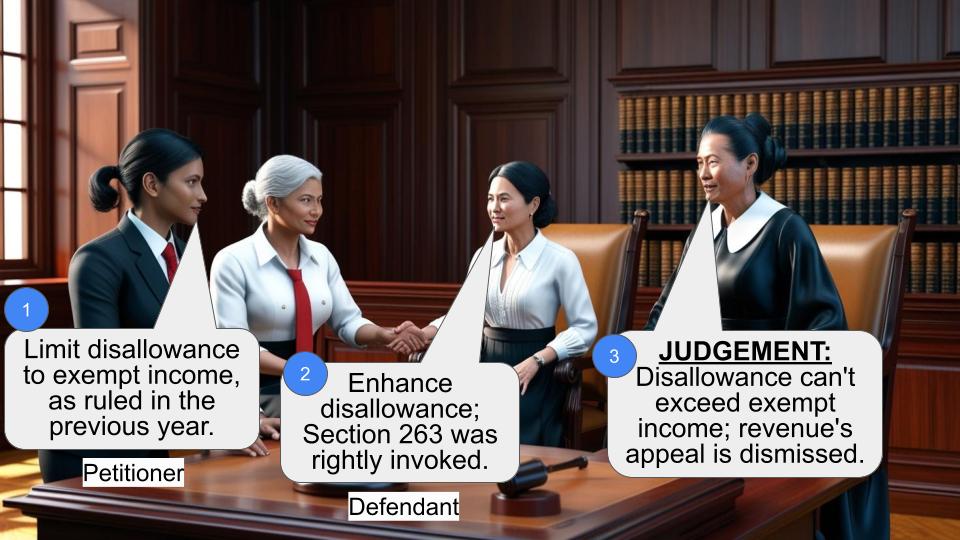
In the case involving the Principal Commissioner of Income Tax and the State Bank of Patiala, the High Court ruled in favor of the assessee, restricting the disallowance under Section 14A (of Income Tax Act, 1961) to the amount of exempt income. The court dismissed the revenue’s appeal, finding no substantial question of law.
Get the full picture - access the original judgement of the court order here
Case Name:
Principal Commissioner of Income Tax Vs. State Bank of Patiala (High Court of Punjab & Haryana)
ITA No. 270 of 2016 (O&M)
Date: 27th February 2017
Key Takeaways:
- The court decided that disallowance under Section 14A (of Income Tax Act, 1961) should not exceed the exempt income.
- The decision reinforces the principle that disallowance should be limited to the actual exempt income, not a higher computed figure.
- The ruling highlights the court’s stance on the application of Section 263 (of Income Tax Act, 1961), deeming it unnecessary to discuss when the main issue is resolved in favor of the assessee.
Issue
Should the disallowance under Section 14A (of Income Tax Act, 1961) exceed the amount of exempt income, and is the invocation of Section 263 (of Income Tax Act, 1961) appropriate in this context?
Facts
- The case involves the assessment year 2009-10 for the State Bank of Patiala.
- The Assessing Officer initially made a disallowance of ₹2.32 crores under Section 14A (of Income Tax Act, 1961), which was limited to the amount of exempt dividend income.
- The Commissioner of Income Tax (CIT) sought to enhance this disallowance to ₹45.76 crores under Section 263 (of Income Tax Act, 1961).
- The Income Tax Appellate Tribunal quashed the CIT’s order, leading to the revenue’s appeal to the High Court.
Arguments
- Assessee’s Argument: The disallowance should be limited to the exempt income, as previously decided in a similar case for the assessment year 2008-09.
- Revenue’s Argument: The CIT’s invocation of Section 263 (of Income Tax Act, 1961) was appropriate, and the disallowance should be enhanced as per the computed figure.
Key Legal Precedents
- Principal Commissioner of Income Tax vs. State Bank of Patiala (2017) 78 3: This precedent was crucial as it had previously resolved a similar issue in favor of the assessee for a different assessment year.
Judgement
The High Court dismissed the revenue’s appeal, affirming that the disallowance under Section 14A (of Income Tax Act, 1961) should be restricted to the amount of exempt income. The court found no substantial question of law, rendering the discussion on Section 263 (of Income Tax Act, 1961) academic since the main issue was resolved in favor of the assessee.
FAQs
Q1: What does Section 14A (of Income Tax Act, 1961) entail?
A1: Section 14A (of Income Tax Act, 1961) deals with the disallowance of expenditure incurred in relation to income that does not form part of the total income under the Act.
Q2: Why was the CIT’s order under Section 263 (of Income Tax Act, 1961) quashed?
A2: The Tribunal quashed the CIT’s order because the main issue of disallowance was already resolved in favor of the assessee, making the invocation of Section 263 (of Income Tax Act, 1961) unnecessary.
Q3: What is the significance of this judgment?
A3: This judgment reinforces the principle that disallowance under Section 14A (of Income Tax Act, 1961) should not exceed the exempt income, providing clarity on the application of this section.

1. This appeal has been preferred by the appellant-revenue under Section 260A (of Income Tax Act, 1961) (in short, “the Act”) against the order dated 28.3.2016, Annexure A.3, passed by the Income Tax Appellate Tribunal, Division Bench, Chandigarh (in short, “the Tribunal”) in ITA No. 447/Chd/2014, claiming following substantial question of law for the assessment year 2009-10:-
(i) “Whether in the facts and circumstances of the case, the Hon’ble ITAT is right in law in quashing the order under Section 263 (of Income Tax Act, 1961) without considering the observations made by the CIT in that order?
2. Briefly, the facts necessary for adjudication of the controversy involved, as narrated in appeal, may be noticed. During the assessment proceedings under Section 143(3) (of Income Tax Act, 1961), vide order dated 23.12.2011,the Assessing Officer made disallowance of ` 2,32,60,607/- under Section 14A (of Income Tax Act, 1961) in addition to the disallowance of ` 5,00,117/- made by the assessee in the return of income. On examination of the assessment record and the assessment order of the assessee for the assessment year 2009-10, it was revealed that the Assessing Officer had limited the disallowance under Section 14A (of Income Tax Act, 1961) to the amount of exempt dividend income, even though he had computed the disallowance under Rule 8D (of Income Tax Rules, 1962), (in short, “the Rules) to be at a higher figure. The assessee was given show cause notice under Section 263(1) (of Income Tax Act, 1961) to show cause as to why the disallowance under Section 14A (of Income Tax Act, 1961) should not be enhanced to 45.76 crores as against 2.32 crores made by the Assessing Officer.
After considering the assessee’s reply, the Commissioner of Income Tax, (CIT) vide its order dated 18.03.2014 enhanced the disallowance to ` 45.76 crores and directed the Assessing Officer to pass an order accordingly. Aggrieved by the order, the assessee filed an appeal before the Tribunal. Vide order dated 28.03.2016, Annexure A.3, the Tribunal quashed the order dated 14.03.3014 passed under Section 263 (of Income Tax Act, 1961) holding that since while deciding the assessee’s appeal for the same year, it had deleted the addition made by the Assessing Officer under Section 14A (of Income Tax Act, 1961), the action of the CIT under Section 263 (of Income Tax Act, 1961) is also quashed being on the same issue. Hence the instant appeal by the revenue.
3. We have heard learned counsel for the parties.
4. At the outset, learned counsel for the assessee submitted that the CIT while issuing notice under Section 263 (of Income Tax Act, 1961) exercising revisional jurisdiction had primarily sought to make the disallowance under Section 14A (of Income Tax Act, 1961) to the extent of the income earned irrespective of the amount of exempt dividend income. Learned counsel relied upon decision of a Division Bench of this Court in Principal Commissioner of Income Tax Vs. State Bank of Patiala, (2017) 78 Taxmann.com 3, in the case of the assessee relating to the assessment year 2008-09 wherein the issue on merits has been answered in favour of the assessee and against the revenue. The appeal in the said case was accordingly dismissed. It was urged that on merits, the issue is required to be answered in favour of the assessee. Once that was so, the exercise of revisional jurisdiction under Section 263 (of Income Tax Act, 1961) was improper.
5. However, learned counsel for the appellant-revenue urged that though the issue has been decided in favour of the assessee, yet invoking the provisions of Section 263 (of Income Tax Act, 1961) cannot said to be inappropriate in the facts and circumstances of the case.
6. After hearing learned counsel for the parties, we notice that the issue on merits has been decided in favour of the assessee in State Bank of Patiala’s case (supra). The amount of disallowance under Section 14A (of Income Tax Act, 1961) was restricted to the amount of exempt income only and not at a higher figure.Once that was so, we do not consider it appropriate to discuss the scope of Section 263 (of Income Tax Act, 1961) as the same has been rendered academic in view of the issue being answered in favour of the assessee on merits. Thus, no substantial question of law arises. Consequently, the appeal stands dismissed.
(Ajay Kumar Mittal)
Judge
February 27, 2017 (Ramendra Jain)
‘gs’ Judge
Whether speaking/reasoned Yes/No
Whether reportable Yes
×
Similar Ripples
Questions
Court Limits Disallowance to Exempt Income, Dismisses Revenue’s Appeal
Write your CommentSimilar Posts
Generic
- Reportdata/HC-PH-270-2016.pdf
