


Court Limits Disallowance Under Section 14A (of Income Tax Act, 1961): Expendit…


Full News

Court Limits Disallowance Under Section 14A (of Income Tax Act, 1961): Expenditure Can’t Exceed Exempt Income
Court Limits Disallowance Under Section 14A (of Income Tax Act, 1961): Expenditure Can’t Exceed Exempt Income
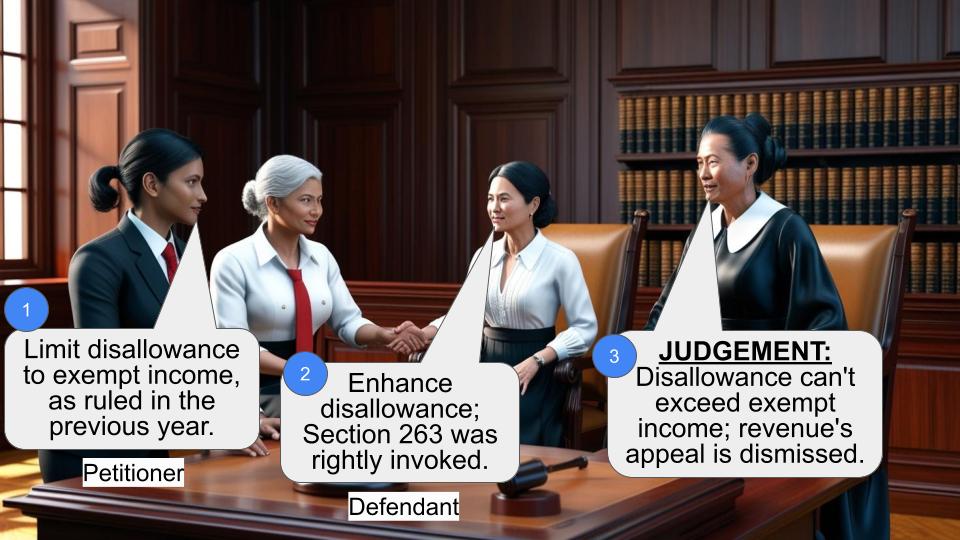
This case involves a dispute between the Principal Commissioner of Income Tax and Empire Package § Ltd. The main issue was the disallowance of expenses under Section 14A (of Income Tax Act, 1961). The court ruled in favor of the assessee (Empire Package), stating that the tax authorities cannot disallow an amount greater than the exempt income earned.
Get the full picture - access the original judgement of the court order here
Case Name
Principal Commissioner of Income Tax vs. Empire Package § Ltd. (High Court of Punjab & Haryana)
ITA No. 415 of 2015 (O&M)
Date: 12th January 2016
Key Takeaways
- Disallowance under Section 14A (of Income Tax Act, 1961) requires proof of actual expenditure incurred for earning exempt income.
- The amount disallowed cannot exceed the exempt income earned.
- The Assessing Officer must collect evidence to determine the expenditure related to exempt income.
- The case was remanded to the Assessing Officer for fresh consideration.
Issue
Can the tax authorities disallow an amount under Section 14A (of Income Tax Act, 1961) that exceeds the exempt income earned by the assessee?
Facts
This company called Empire Package § Ltd. They’re in the business of making and selling corrugated boxes and sheets. For the 2009-10 assessment year, they filed a tax return showing a loss of ₹64,455.
Now, here’s where it gets interesting. The company had invested about ₹10,87,172 in shares and mutual funds. From this, they earned a dividend income of ₹1,11,564, which is tax-exempt. They also had some agricultural income of ₹32,000, which is also exempt from tax.
The tax officer, looking at these exempt incomes, decided to disallow ₹4,09,675 under Section 14A (of Income Tax Act, 1961). This section basically says that expenses related to earning exempt income can’t be claimed as a deduction.
Arguments
Empire Package argued that they hadn’t incurred any specific expenses to earn this exempt income. They felt the tax officer was being unfair by disallowing an amount that was even higher than the exempt income they earned.
The tax department, on the other hand, stuck to their guns. They believed the disallowance was correct based on their calculation under Rule 8D (of Income Tax Rules, 1962).
Key Legal Precedents
The court relied heavily on a previous case, CIT vs. Deepak Mittal (2013) 38 Taxman 83 . This case established that for a disallowance under Section 14A (of Income Tax Act, 1961), there must be actual evidence of expenses incurred to earn the exempt income. If no such expenses were incurred, the disallowance can’t stand.
Judgement
The court sided with Empire Package. They said, “Hey, you can’t disallow more than the exempt income itself. That’s just not fair!”
They pointed out that while the company’s exempt income was only ₹1,11,564, the tax officer had disallowed ₹4,09,675. That’s nearly four times the exempt income!
The court decided to send the case back to the Assessing Officer. They said, “Look, you need to do this again. Find out if there were actually any expenses incurred to earn this exempt income. And remember, you can’t disallow more than the exempt income itself.”
FAQs
Q: What is Section 14A (of Income Tax Act, 1961)?
A: Section 14A (of Income Tax Act, 1961) deals with the disallowance of expenses incurred to earn exempt income. It ensures that taxpayers can’t claim deductions for expenses related to income that isn’t taxed.
Q: Why did the court send the case back to the Assessing Officer?
A: The court felt that the Assessing Officer needed to gather more evidence about the actual expenses incurred for earning exempt income. They wanted a fair assessment based on facts.
Q: Does this mean companies can now claim all expenses even if they have exempt income?
A: Not exactly. The judgment just says that the disallowance can’t exceed the exempt income. Companies still need to prove that they didn’t incur specific expenses for earning exempt income.
Q: How might this judgment affect other taxpayers?
A: This could be good news for taxpayers who have been facing large disallowances under Section 14A (of Income Tax Act, 1961). It sets a limit on how much can be disallowed and emphasizes the need for actual evidence of expenses.

1. This appeal has been preferred by the revenue under Section 260A (of Income Tax Act, 1961) (in short, “the Act”) against the order dated 18.6.2015, Annexure A.3 passed by the Income Tax Appellate Tribunal, Chandigarh Benches - 'SMC' in ITA No.978/Chd/2013 for the assessment year 2009-10, claiming following substantial question of law:-
“Whether in the facts and circumstances of the case, the Hon'ble ITAT is justified in law to hold that the disallowance made under section 14A (of Income Tax Act, 1961) read with Rule 8D (of Income Tax Rules, 1962) cannot exceed the exempt income, in the absence of any such restriction being there in the relevant section or rule?”
2. A few facts relevant for the decision of the controversy involved as narrated in the appeal may be noticed. The assessee is a company engaged in the business of manufacturing and sale of corrugate boxes and sheet. It filed its return of income for the assessment year in question declaring loss of `64,455/-. The assessee had made investment in shares and mutual funds amounting to ` 10,87,172/- and declared dividend income of 1,11,564/- and agricultural income of ` 32,000/-. As the agricultural income and dividend income are exempt incomes, the Assessing Officer made disallowance of ` 4,09,675/- by invoking the provisions of section 14A (of Income Tax Act, 1961) read with Rule 8D (of Income Tax Rules, 1962) (in short, “the Rules”). Aggrieved by the order, the assessee filed appeal before the Commissioner of Income Tax (Appeals) [CIT(A)]. Vide order dated 18.7.2013, Annexure A.2, the CIT(A) partly allowed the appeal. Still not satisfied, the assessee filed appeal before the Tribunal. Vide order dated 18.6.2015, Annexure A.3, the Tribunal set aside the order passed by the CIT (A) and remitted the matter to the Assessing Officer with the direction to decide the issue afresh in accordance with law. Hence the instant appeal by the revenue.
3. We have heard learned counsel for the appellant-revenue.
4. The Tribunal has only remanded the matter to the Assessing Officer after considering the factual position and the relevant case law on the point. It relied upon the decision rendered by this Court in CIT vs.Deepak Mittal, (2013) 38 Taxman 83 holding that disallowance under Section 14A (of Income Tax Act, 1961) requires finding of incurring of expenditure in respect of exempted income and where it is found that for earning exempted income, no expenditure has been incurred, disallowance under section 14A (of Income Tax Act, 1961) cannot stand. In the present case, when the assessee claimed that it had not made any expenditure on earning exempt income, the Assessing Officer in terms of sub section (2) of Section 14A (of Income Tax Act, 1961) was required to collect such material evidence to determine expenditure if any incurred by the assessee in relation to earning of exempt income. The income from dividend had been shown at ` 1,11,564/- whereas disallowance under Section 14A (of Income Tax Act, 1961) read with Rule 8D (of Income Tax Rules, 1962) worked out by the Assessing Officer came to ` 4,09,675/-. Thus, the Assessing Officer disallowed the entire tax exempt income which is not permissible as per settled position of law. Consequently, the Tribunal remitted the matter to the Assessing Officer with a direction to decide the same afresh in accordance with law after affording due and reasonable opportunity of being heard to the assessee. The relevant finding recorded by the Tribunal reads thus:-
“7. In the instant case, the income from dividend has been shown at 1,11,564/-, the disallowance under section 14A (of Income Tax Act, 1961) read with Rule 8 (of Income Tax Rules, 1962) D worked out by the Assessing Officer comes to 4,09,675/-. Thus, it is clear that the AO has disallowed the entire tax exempt income which is not permissible in view of the judgment of the Hon'ble Delhi High Court referred to above. The Hon'ble Delhi High Court held that the window for disallowance is indicated in section 14A (of Income Tax Act, 1961), and is only to the extent of disallowing expenditure “incurred by the assessee in relation to the tax exempt income”. The disallowance under section 14A (of Income Tax Act, 1961) read with Rule 8D (of Income Tax Rules, 1962) as worked out by the Assessing officer is not in accordance with law and as such working is not sustainable.
8. In view of the above observations, I think it is appropriate to set aside the order of the learned CIT(A) on this issue and remit the matter to the file of AO with a direction to decide the issue afresh in accordance with law after affording due and reasonable opportunity of being heard to the assessee.”
Additionally, the tax effect involved is of ` 1,26,589/- only.
5. The view adopted by the Tribunal being a plausible view based on factual position and the relevant case law on the point, does not warrant any interference by this Court. Learned counsel for the appellant-revenue has not been able to show any illegality or perversity in the impugned order.
Thus, no substantial question of law arises. Consequently, the appeal stands dismissed.
(Ajay Kumar Mittal)
Judge
January 12, 2016 (Raj Rahul Garg)
‘gs’ Judge
×
Similar Ripples
Questions
Court Limits Disallowance Under Section 14A (of Income Tax Act, 1961): Expenditure Can’t Exceed Exempt Income
Write your CommentSimilar Posts


Generic
- Reportdata/3180.pdf
