


Full News
Court Modifies Valuation Method in Gift Tax Case, Balancing Land Value and Building Depreciation
Court Modifies Valuation Method in Gift Tax Case, Balancing Land Value and Building Depreciation
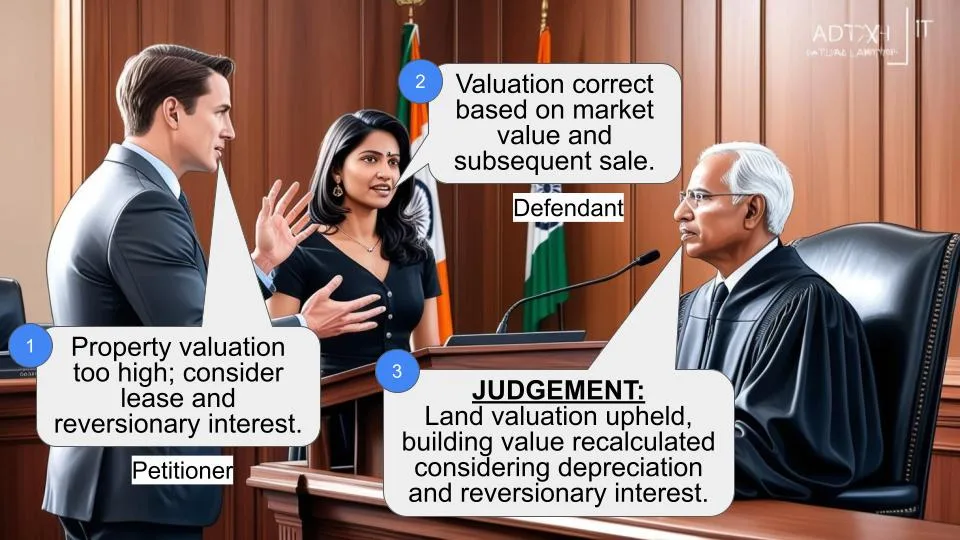
This case involves Gemini Pictures Circuit P. Ltd. appealing against a Gift Tax assessment made by the Deputy Commissioner of Income Tax. The dispute centered around the valuation of a property transferred to a subsidiary company, which the tax authorities deemed as a gift. The High Court partially allowed the appeal, modifying the valuation method while upholding certain aspects of the tax assessment.
Get the full picture - access the original judgement of the court order here
Case Name:
Gemini Pictures Circuit P. Ltd. Vs Deputy Commissioner of Income Tax (High Court of Madras)
TC.(A).No. 1267 of 2005
Date: 22nd June 2012
Key Takeaways:
1. The court emphasized the importance of considering reversionary interest in property valuation for Gift Tax purposes.
2. The judgment highlights the need to follow Schedule II of the Gift Tax Act, which adopts Schedule III of the Wealth Tax Act for valuation.
3. The court recognized the validity of using recent sale instances for land valuation but stressed the importance of considering depreciation for building valuation.
Issue:
Was the valuation method used by the tax authorities for assessing deemed gift under Section 4(1) of the Gift Tax Act appropriate, considering the property's lease encumbrance and reversionary rights?
Facts:
- On September 25, 1986, Gemini Pictures Circuit P. Ltd. transferred a property (23.6 grounds with building) to its subsidiary, Gemini Film Processing Industries Private Limited, for Rs. 10 lakhs.
- The property was under lease to Vasan Publications Private Limited since April 1, 1979, with a 30-year lease and an option to renew for another 30 years.
- The tax authorities deemed the difference between the transfer value (Rs. 10 lakhs) and the assessed market value (Rs. 1,98,51,600) as a gift, subject to Gift Tax.
- The assessee argued that only the reversionary interest was transferred, and the valuation should consider the long-term lease encumbrance.
Arguments:
Assessee's Arguments:
- The valuation should consider the long-term lease encumbrance on the property.
- Only the reversionary interest was transferred, not the entire property value.
- The valuation should follow Schedule II of the Gift Tax Act, which adopts Wealth Tax Act valuation methods.
Revenue's Arguments:
- The lease agreement was collusive due to common management between lessor and lessee companies.
- The property's value should be based on comparable sale instances near the transfer date.
- The subsequent transfer of leasehold rights for Rs. 2,59,50,000 within nine months indicates undervaluation in the original transfer.
Key Legal Precedents:
The judgment primarily relies on the interpretation of the Gift Tax Act and Wealth Tax Act, particularly:
- Section 4(1) of the Gift Tax Act
- Schedule II of the Gift Tax Act
- Schedule III of the Wealth Tax Act, especially Part B and Rules 3, 4, 5, 8, and 20
Judgement:
The High Court partially allowed the appeal:
1. Upheld the land valuation method used by the District Valuation Officer (Rs. 8,30,800 per ground).
2. Directed recalculation of the building value, considering depreciation at Rs. 1.125 per year and adopting a 9% return for annual letting value.
3. Ordered the use of an 8% capitalization factor to arrive at the final valuation.
4. Emphasized the need to consider reversionary interest in the valuation process.
FAQs:
1. Q: What was the main issue in this case?
A: The main issue was the appropriate method for valuing a property transfer for Gift Tax purposes, considering lease encumbrances and reversionary rights.
2. Q: Why did the court partially allow the appeal?
A: The court agreed with the land valuation method but found that the building valuation needed modification to account for depreciation and proper capitalization.
3. Q: What is reversionary interest, and why was it important in this case?
A: Reversionary interest is the right to regain possession of a property after a lease expires. It was crucial because the transferred property was under a long-term lease, affecting its current value.
4. Q: How does this judgment impact future Gift Tax valuations?
A: It emphasizes the need to consider all aspects of property ownership, including lease encumbrances and reversionary rights, when valuing property for Gift Tax purposes.
5. Q: What specific laws were central to this case?
A: The Gift Tax Act (particularly Section 4(1) (of Income Tax Act, 1961) and Schedule II) and the Wealth Tax Act (Schedule III) were central to the legal arguments and the court's decision.

1. The present appeal is by the assessee by raising following questions of law :-
"(1)Whether the Appellate Tribunal is right in law confirming the order of the Gift Tax Officer in bringing to tax the deemed gift on transfer of reversionary right attached to the property as being otherwise than for adequate consideration, ignoring the value of the tenancy rights granted?
(2) Whether the Appellate Tribunal is right in law directing adoption of the market value of the property for determining the deemed gift, while only the reversionary rights were transferred?
(3) Whether the Appellate Tribunal was right in law in not holding that the transfer has to be valued as per Schedule II of the Gift Tax Act?"
2. The assessee herein had transferred an immovable property measuring about 23.6 grounds of land with building situated at No. 67, Dr.Radhakrishnan Salai, Madras to M/s.Gemini Film Processing Industries Private Limited, Madras for a consideration of Rs.10 lakhs on 25.9.1986. This conveyance was exempted from Stamp Duty under the Notification Numbers 2620 and 5121 of 1964 dated 22.10.1964 of the Government of Tamilnadu, by reason of fact that the transferree is a closely held company of the assessee, however for the purpose of registration, the value was taken at Rs.80,26,874/-. Taking note of the difference in value and hence, there was deemed gift arising out of the transfer of the immovable property to subsidiary company viz., M/s. Gemini Film Processing Industries Private Limited, the Assessing Authority invoked Section 4(1) of the Gift Tax Act. With a view to determine the fair market value, the Assessing Authority referred the matter to the District Valuation Officer, who in turn arrived at a sum of Rs.41,93,000/-. Since the value quoted by the District Valuation Officer did not give the fair market value of the property, once again the matter was referred to the District Valuation Officer to determine the fair market value as on 25.9.86. On a second reference, the District Valuation Officer determined the value of the aforesaid property at Rs.1,98,51,600/- as on 25.9.98. Thus the difference in the consideration to the value of 1,98,51,600/- was deemed to be the gift made by the company. The said value was resisted by the assessee on the ground that the District Valuation Officer had valued the property on the assumption that the property was free hold property when there was a long lease upto the year 2039 and that the assessee was entitled to receive the rent initially for 30 years and the said lease was again renewed upto 2039. The Gift Tax Officer rejected the assessee's objection and ultimately arrived at the taxable gift as had been arrived at by the valuation officer. Aggrieved by this, the assessee went on appeal before the Commissioner of Income Tax (Appeals). The assessee contended therein that the valuation adopted by the officer failed to take into account the lease encumbering the property upto 2039. If that had been taken note of, then the value of the reversionery right would not be more than Rs.10 lakhs. It is seen from the order of the Commissioner of Income Tax (Appeals) that in the course of the proceedings, the Assessing Officer and the District Valuation Officer were called to submit reports supporting the stand taken in the valuation made. It was pointed out therein that even though the property had been leased out for a period of 60 years, the Board of Directors of the lessor company and lessee company are one and the same. Taking note of the same, the monthly lease rent of Rs.2000/- per month for the land more than 23 grounds and building, was not a real market value. However, the Valuation Officer pointed out that under the lease deed dated 18.2.99, the property in question was leased for 30 years from 1.4.79, with the option to renew the lease. Therefore, the lease period was not for 60 years as mentioned by the assessee. It was further contended that the lease was colourable one and the lessee being none other than Vasan Publications (P) Limited, where the assessee's Directors are holding the controlling shares. In considering the said contention, the Commissioner of Income Tax (Appeals) held that the lessor and lessee companies are distinct legal entities and agreement entered into these two legal entities need to be respected as an agreement at arms length and hence, due consideration should have been paid in the matter of valuing the property.
3. Referring to the fact that the property was leased for the period of 30 years from 1.4.79 to 2009 with the option to renew the lease for further period of 30 years, the Commissioner pointed out that as per District Valuation Officer the market value of the property was at Rs.1,98,51,600/- and as per assessee, it was Rs.10 lakhs. The reversionery value of the property would be Rs.5,66,243/- as per District Valuation Officer and if the same is for 30 years, the reversionery value would be Rs.35,22,620/-. The Commissioner of Income Tax (Appeals) pointed out that the assessee was receiving lease rent of Rs.24000/- per year, after capitalising the same at 12% per annum, the value would be Rs.2 lakhs. The balance payment of Rs.8 lakhs received by the assessee would be towards the reversionery right of the property which would be delivered back to the owner in the year 2039. In the above circumstances, the Commissioner held that the valuation given by the assessee was acceptable. Referring to the District Valuation Officer's computation, the Commissioner of Income Tax (Appeals) held that the reversionery value of the property calculated by the District Valuation Officer only supported the stand of the assessee. Thus, ultimately the Commissioner held that the transaction did not attract the provisions of Section 4(1) of the Gift Tax Act. Aggrieved by the order of the Commissioner of Income Tax (Appeals), the Revenue went on appeal before the Income Tax Appellate Tribunal.
4. Before the Tribunal, the Revenue took the contention that when considering the merits of the valuation done by the Officer, the Commissioner had failed to take note of the lease hold rights of the property transferred to M/s. Gemini Film Processing unit by lessee on 15.7.87, after the date of the sale on 25.9.86 for further value of Rs.2,59,50,000/- and this in fact showed the real value of the subject property transferred to Gemini Film Processing Unit. The Revenue further contended that the Commissioner of Income Tax (Appeals) omitted to note that the valuation done by the District Valuation Officer took note of the reversionery value of the leased property and that he pointed out that the lease rent did not reflect the fair market rent. In the circumstances, the Revenue pleaded that the value adopted by the Officer is correct. On considering the rival submissions, the Tribunal pointed out that the property in question was transferred by the assessee to its subsidiary company whose shares were transferred within 8 years from the date of transfer of the said capital asset and holding company ceased to hold the shares of the subsidiary company after the transfer of the property. The agreement of surrender of lease hold right by M/s.Vasan Publication Private Limited to M/s.Gemini Film Processing Industries Private Limited was entered on 15.7.87 after the financial year under consideration 31.3.1987 and this agreement entered into after the end of the financial year, could not be given any importance. Taking note of the fact that the management and control was with the assessee, the Tribunal pointed out that it was for the assessee to establish the truth of those documents relied on by the assessee. As a owner of the property, the reversionery right was valued at Rs.2,59,50,000/- by M/s.Gemini Film Processing Unit to Vasan Publications. In the background of the fact that the lessee surrendering the right was paid 2.59 crores in contrast to the owner being paid a sum of Rs.10 lakhs only for selling the absolute interest, the Tribunal held that the deemed gift at Rs.1,88,51,600/- arrived by the Assessing officer on the basis of difference between the fair market value and actual sale consideration was justified. Aggrieved against this order, the assessee is on present appeal.
5. Learned counsel appearing for the assessee placed heavy reliance on the sale deed dated 25.9.1986 only to contend that the subject matter of the sale of the property to Gemini Film Processing Industries Private Limited in fact was as regards the reversionery right attached to the property. As such, the valuation arrived at by the assessee, taking note of the lease period for 60 years could not be faulted with. Learned counsel further pointed out that considering the fact that the property sold was encumbered with a lease for a period of 60 years, the valuation done by the officer without taking into account the said aspect is incorrect. There are no circumstances to say that the value adopted by the assessee for effecting the transfer were illusory or abnormal to adopt the value of the District Valuation Officer to make the assessment under Section 4(1) of the Gift Tax Act. The assessee also placed before us the copy of the valuation report under the Wealth Tax Act dated 9.3.1988 relevant to the assessment year 1985-86.
6. As far as the valuation report submitted by the District Valuation Officer for the purpose of assessment under 4(1) of the Gift Tax Act is concerned, the assessee submitted that the manner of determination of the value of the property has to be in the manner laid down in II Schedule to the Act. When the determination is made in accordance with II Schedule as pointed out by the Commissioner, there would no case at all for the Revenue to bring the assessment under Section 4(1) of the Gift Tax Act. Considering the mandate given under Section 4(1) of the Gift Tax Act, what was transferred was only reversionery interest in the property, it is not open to the Revenue to ignore these facts and to adopt the value as given by the District Valuation Officer.
7. Per contra, learned standing counsel for the Revenue pointed out that when the purchaser himself had valued the reversionery interest of the property at Rs.2,59,50,000/-, within a short period of nine months from the date of sale, it is clear that the consideration shown in the document at Rs.10 lakhs under valued one and did not reflect the adequate consideration. In the circumstances, rightly the Tribunal considered the case of the Revenue to restore the assessment.
8. Heard learned counsel for the assessee as well as learned Standing counsel for the Revenue and perused the records.
9. A perusal of the deed of sale executed on 25th September 1986 by the assessee in favour of its subsidiary company M/s.Gemini Film Processing Industries Private Limited shows that a sum of Rs.10 lakhs was paid by the transferree to the assessee transferor as a consideration for the transfer of the assessee's right and interest in the property including the right to receive the rent from the lessees during the subsistence of the lease together with the reversionery right, title and interest of the transfer to take over possession of the property from the lessee Vasan Publication Private Limited, after the expiry of the lease or the renewed period of lease. The sum of Rs.10 lakhs was paid by allotment of shares to the transferor. Thus, it is clear from reading of the sale deed that what was transferred was the right, title, interest to the transferor which was inclusive of reversionery right plus the right to receive rent from the lessee.
10. It is a matter of record that as far as the presence of lessee therein is concerned, it had been there as a lessee ever since 1.4.1979 and the lease dated 18.2.90 even though originally was for a period of 30 years, there was an option to renew the lease for further period of 30 years. A perusal of the valuation report dated 9.3.88 done for a immediate preceding year show that the value of the property under the Wealth Tax Act as on 31.3.84 was arrived at Rs.41,93,000/- as against the proposed estimate at Rs.63,17,000/-. A reading of the said valuation report shows that the Valuation Officer took into consideration the sale instances at Door No.58, Cathedral Road, Madras for an extent of 6.22 grounds as well as at Door No.2, 7th Street, Dr.Radhakrishna Road, for an extent of 2.092 grounds. Taking the normal escalation in land value at 20% per annum on the above sale instances of the year 1983-84, the Valuation Officer arrived at Rs.2,31,000/- as on 31.3.84. As far as the rental value was concerned, the assessee itself submitted that the District Valuation Officer at best would adopt the fair rent applicable as per Rent Control provisions as on the valuation date instead of lease rent reserved in the lease deed dated 18.2.80. In paragraph 7.2.1., the District Valuation Officer thus arrived at fair rent based on reproduction cost as on the valuation done as envisaged under provisions of the Tamil Nadu Rent Control Act and adopted for capitalisation to arrive at the fair market value. Thus, the final valuation was arrived at Rs.41,93,000/-, wherein taking Rs.2,31,000/- as the value per ground, the extent of 23.60 grounds was valued at Rs.54,51,600/-. Admittedly, the Officer did not have any grievance over this. Now a perusal of the order would go to show that the Valuation Officer for the purpose of Gift Tax Act considered the sale instances of the properties considered under the Wealth Tax Act. One of the property is situated at Door No.58, Cathedral Road, Madras to an extent of 6.22 grounds. The sale had been taken place in the year 1983. The valuation report dated 16.10.91 refers to 98, Radhakrishna Salai, Madras of an extent of 10.653 grounds and the total consideration as on 19.2.1987, the date of sale was 96,00,000/-. Thus, taking note of the above sale instances and the increase in the land rate to be linear with respect to time factor, the value of one ground as on September 1986 was arrived at the rate of Rs.8,30,800/- per ground as against Rs.2,31,000 adopted and arrived at the fair market value at Rs.1,98,51,600/-. The assessee pointed out that the valuation had been made by the Officer under the assumption that it was free hold property. When the property in question was subjected to long term lease, the valuation should have been done taking note of the above said aspect and had it been done, the value as indicated by the assessee in the sale deed could be accepted as a correct value. The valuation Officer however rejected the contention and pointed out that at the time of execution of lease deed, the key Board of Directors of the lessee company M/s. Vasan Publications Private Limited and lesser company Gemini Pictures Circuit Private Limited was one and the same. He therefore pointed out that the rent fixed was collusive one, which was not a real market rent, hence, the same could not be relied on. The Valuation Officer further pointed out that the value worked out by the land and building method gave intrinsic value, which was a fair estimate of the market value. Apparently persuaded by the said reasoning of the Valuation Officer, the Gift Tax Officer held that the valuation thus done based on comparable cases, the valuation as done by the District Valuation Officer could be considered. Thus, the Assessing Authority found that the assessee had transferred the immovable property situated at No.67, Radhakrishnan Salai for a total consideration of Rs.10 lakhs, though the fair market value was at Rs.1,98,51,600/-. Thus, the difference between the market price and sale price was assessed as deemed gift at the hands of the assessee company.
11. As far as the contention raised by the assessee as per Section 4(1) of the Gift Tax Act is concerned, it is no doubt true that for the purpose of arriving at the adequate consideration, the determination has to follow Schedule II of the Gift Tax Act. A perusal of Schedule II of the Gift Tax Act reveal that for the purpose of determining the value of the property under Gift Tax Act, coming under the deemed gift, the determination has to be in accordance with the provisions of Schedule III to the Wealth Tax Act. Part B of Schedule III under the Wealth Tax Act deals with valuation of immovable property. Rule 3 of Part B states that subject to the provisions of rules 4,5,6,7 and 8, for the purposes of sub section (1) of section 7 (of Income Tax Act, 1961), the value of any immovable property, being a building or land appurtenant thereto, or part thereof, shall be the amount arrived at by multiplying the net maintainable rent by the figure 12.5. Rule 4 (of Income Tax Rules, 1962) deals about net maintainable rent computation and Rule 5 (of Income Tax Rules, 1962) deals with gross maintainable rent computation. Explanation to Rule 5 (of Income Tax Rules, 1962) defines "annual rent" to mean where the property is let throughout the year ending on the valuation date, the actual rent received or receivable by the owner in respect of such year. Explanation to the rules defines annual rent. We are not concerned about the property let for a part of the previous year. Hence, the relevant clause is (a) which states that in the case of property let through out the year ending on the valuation date, the actual rent received or receivable by the owner in respect of such would be the annual rent. For the time being, we are not concerned about the clauses in the proviso. Rule 8 (of Income Tax Rules, 1962) states circumstances under which Rule 3 (of Income Tax Rules, 1962) shall not apply. Rule 8 (of Income Tax Rules, 1962) provides for the method. The value of the property shall be determined in the manner laid down under Rule 20 (of Income Tax Rules, 1962). Rule 20 (of Income Tax Rules, 1962) is a residuary provision which states that for the purposes of the Wealth Tax Act, the valuation of assets, being an asset which is not covered by rules 3 to 19, other than cash, shall be estimated to be the price which, in the opinion of the Assessing Officer, it would fetch if sold in the open market on the valuation date. Keeping this in the background that the valuation for the purpose of deemed gift has also go to be done as per the Wealth Tax Rules, if one analyses the valuation done for assessment under the Wealth Tax Act and under the Gift Tax Act, the difference in the method adopted would be clear.
12. As far as the valuation done under the Wealth Tax assessment is concerned, after arriving at the land value at Rs.2,31,000/- per ground, for the purpose of Wealth Tax assessment, the Valuation Officer took note of the reversionery interest therein and he adopted fair rent provisions under the Rent Control Act as against the lease rent and arrived at the value of the property at Rs.19,29,213/- . Taking depreciation value for 49 years at Rs.1.125/- per year, the building was valued at Rs.8,65,734/-. Thus, the annual letting value at 9% return was taken at Rs.5,68,560/-. Taking note of such value, applying the factor at 8%, the value of the property was arrived at Rs.41,93,000/-. In contrast to that, for the purpose of Gift Tax Act, as rightly pointed out by the assessee, there is no consideration of the reversionery interest which was the subject matter of sale under the sale deed dated 25th September 1986. The District Valuation Officer reasoned out that the lease being between the closely held company and where there is common management, and the lease rent agreed upon between the parties did not reflect the real market rent, he treated it as an collusive one. In a matter of valuation, for the purpose of Section 4(1) of the Gift Tax Act, when one has to go by Schedule II of the Act, which in turn adopt Schedule III of the Wealth Tax Act, when this specific clause under the sale deed would include reversionery interest too, valuation should have been gone in lines what was considered by the District valuation officer, while arriving at the value for the purpose of Wealth Tax Act.
13. However, as far as the valuation of the land is concerned, we agree with the Revenue's contention that valuation done by the Valuation Officer taking note of the sale instances which are near to the date of sale merit acceptance.
14. Thus, as far as the land value of 23.60 grounds is concerned, the value arrived at by the District Valuation Officer at Rs.8,30,800/- does not call for any disturbance in determining what could be the value of the deemed gift for the purpose of assessment. Apart from that, the building portion value arrived at by the Gift Tax Act at Rs.24,46,711/- is to be considered with appropriate depreciation at Rs.1.125 per year to arrive at annual letting value at 9% return. Thus after arriving at the annual letting value, deducting the outgoings and adopting 8% capitalisation factor, the value has to be arrived at by Revenue which would be in the spirit of Schedule II of the Gift Tax Act.
15. In the circumstances, we partly allow the Tax Case (Appeal) filed by the assessee only to the extent referred to above taking into consideration the matter of valuation done by the Assessing Authority by adopting the District Valuation Officer including the reversionery interest. In short, we upheld the valuation of the land as had been done by the valuation officer, however on the portion of the building accepting the valuation in calculating the annual letting value, the Officer shall take note of depreciation allowed on the building portion and adopt capitalisation factor at 8% to arrive at the valuation for the purpose of assessment.
16. To the above stated extent, the order of the Tribunal stands modified. No costs.
(C.V.,J) (K.R.C.B.,J)
22.06.2012
Index : Yes/No
Internet : Yes/No
To
1. The Deputy Commissioner of Income Tax Company circle IV (5), Chennai
2. The Income Tax Appellate Tribunal, Madras A Bench, Chennai
CHITRA VENKATARAMAN,J
and
K.RAVICHANDRABAABU,J
22.06.2012
×
Similar Ripples
Questions
Court Modifies Valuation Method in Gift Tax Case, Balancing Land Value and Building Depreciation
Write your CommentSimilar Posts
Generic
- Reportdata/5751.pdf
