


Court Nixes Tax Penalty, Citing Altered Assessment Basis


Full News

Court Nixes Tax Penalty, Citing Altered Assessment Basis
Court Nixes Tax Penalty, Citing Altered Assessment Basis
This case involves an appeal by the Revenue (tax authorities) against an order passed by the Income Tax Appellate Tribunal (ITAT). The ITAT had affirmed the decision of the Commissioner of Income Tax (Appeals) [CIT(A)] to delete a penalty imposed by the Assessing Officer (AO) under Section 271(1)(c) (of Income Tax Act, 1961). The High Court dismissed the Revenue's appeal, agreeing with the ITAT's decision.
Get the full picture - access the original judgement of the court order here
Case Name:
Pr. Commissioner of Income Tax Vs Fortune Technocomps (P) Ltd. (High Court of Delhi)
ITA 313/2016
Date: 13th May 2016
Key Takeaways:
1. Once the basis for initiating penalty proceedings is altered or modified by an appellate authority, the Assessing Officer loses jurisdiction to proceed based on the original findings.
2. If an addition made by the AO is significantly changed on appeal, the original basis for penalty proceedings becomes non-existent.
3. When a finding of bogus purchases is set aside, it cannot be said that there was concealment of facts or furnishing of inaccurate particulars warranting a penalty under Section 271(1)(c) (of Income Tax Act, 1961).
Issue:
Can a penalty under Section 271(1)(c) (of Income Tax Act, 1961) be imposed when the original assessment order has been significantly modified on appeal?
Facts:
1. The case pertains to the Assessment Year 2007-08.
2. The Assessing Officer initially made an addition of Rs. 3,62,49,274/- to the assessee's income, alleging bogus purchases from nine untraceable parties.
3. On appeal, the CIT(A) held that the entire purchases couldn't be treated as bogus and deleted the AO's addition.
4. Instead, the CIT(A) made a smaller addition of Rs.68,31,196 based on estimated calculations.
5. Despite this, the AO continued with penalty proceedings under Section 271(1)(c) (of Income Tax Act, 1961).
6. The CIT(A) set aside this penalty, which was then affirmed by the ITAT.
Arguments:
Revenue's Argument:
- The disallowance of loss of Rs.55,53,994 was not based on any estimate, so the penalty should not have been deleted.
- The AO still had the power to initiate penalty proceedings as the CIT(A) had merely modified the original assessment order.
Assessee's Argument (implied):
- Once the CIT(A) significantly altered the assessment order, the basis for penalty proceedings no longer existed.
- There was no concealment of facts or furnishing of inaccurate particulars warranting a penalty.
Key Legal Precedents:
The ITAT relied on the decision of the Calcutta High Court in CIT v. Ananda Bazar Patrika Pvt. Ltd. (1979) 116 ITR 416 (Cal). This case established that once the basis for initiating penalty proceedings is altered or modified by the first appellate authority, the Assessing Officer has no jurisdiction to proceed based on the findings of the first appellate authority.
Judgement:
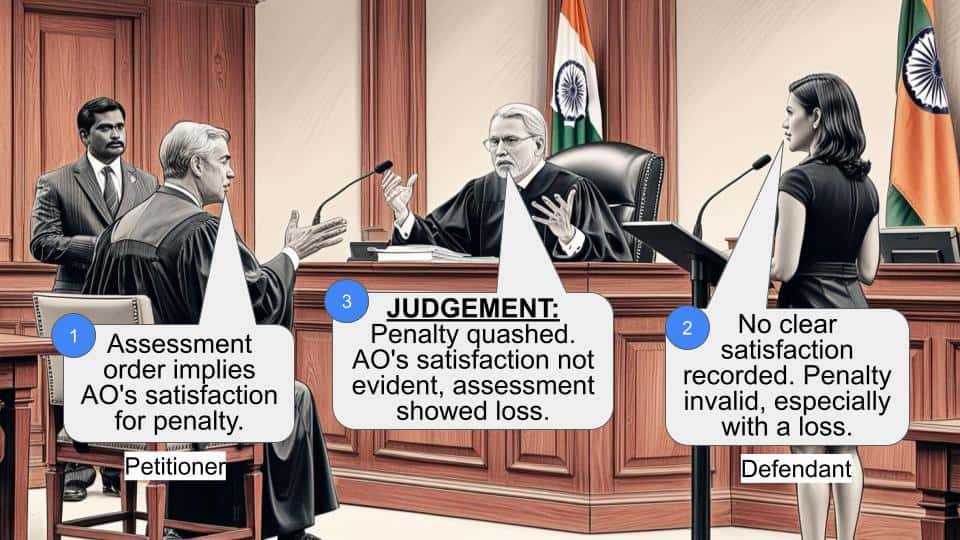
The High Court dismissed the Revenue's appeal, agreeing with the ITAT's decision. The court held that:
1. Once the CIT(A) significantly altered the AO's assessment order, the basis for initiating penalty proceedings became non-existent.
2. The AO could not continue penalty proceedings based on the original notice after the CIT(A)'s modifications.
3. After the finding of bogus purchases was set aside, there was no concealment of facts or furnishing of inaccurate particulars by the Assessee that warranted a penalty under Section 271(1)(c) (of Income Tax Act, 1961).
FAQs:
1. Q: What is Section 271(1)(c) (of Income Tax Act, 1961)?
A: Section 271(1)(c) (of Income Tax Act, 1961) deals with penalties for concealment of income or furnishing inaccurate particulars of income.
2. Q: Why did the court dismiss the Revenue's appeal?
A: The court found no legal infirmity in the ITAT's analysis and conclusion. It agreed that the basis for penalty proceedings became non-existent after the CIT(A) significantly altered the original assessment.
3. Q: What's the significance of this judgment for taxpayers?
A: This judgment reinforces the principle that tax authorities cannot impose penalties based on findings that have been substantially modified or set aside on appeal.
4. Q: Does this mean that penalties can never be imposed if an assessment is modified on appeal?
A: Not necessarily. The judgment suggests that penalties should not be imposed when the very basis of the penalty (like alleged concealment or inaccuracy) has been set aside or significantly altered on appeal.
5. Q: What should taxpayers do if they face a similar situation?
A: If facing penalties based on assessments that have been significantly modified on appeal, taxpayers may consider citing this judgment in their defense. However, it's always advisable to consult with a tax professional for specific cases.

CM No. 17985 of 2016(exemption)
1. Allowed subject to all just exceptions.
ITA No. 313 of 2016
2. This appeal by the Revenue is against the order dated 19th October 2015 passed by the Income Tax Appellate Tribunal (‘ITAT’) in ITA No.4539/Del/2013 for the Assessment Year (‘AY’) 2007-08.
3. By the impugned order the ITAT affirmed the order of the Commissioner of Income Tax (Appeals) [CIT(A)] deleting the penalty imposed by the Assessing Officer (‘AO’) under Section 271(1)(c) (of Income Tax Act, 1961) (‘Act’). The ITAT has in the impugned order noted that in the appeal filed by the Assessee in the quantum proceedings against the order of the AO making addition on account of bogus purchases, the CIT (A) disallowed the loss of Rs.55,53,994 claimed by the Assessee on sale of some of the unbranded items out of the purported purchases made from nine parties. Further a sum of Rs.12,77,202 was added as additional income by applying the estimated gross profit rate of 4.25% on the declared sales. The ITAT thus concluded that the CIT(A) had made the overall addition of Rs. 68,31,196 on ‘estimated basis’. Consequently, the ITAT felt that this is not a case where a penalty was leviable under Section 271(1)(c) (of Income Tax Act, 1961).
4. Mr. P.Roy Chaudhuri, learned counsel for the Revenue urged that while additions of Rs. 12.77 lakhs may have been the basis of the estimated gross profit rate, the disallowance of loss of Rs.55,53,994 was not based on any estimate, therefore the penalty could not be deleted. He further submitted that the ITAT was in error in holding that the AO was denuded of the power to initiate penalty proceedings once the CIT (A) had deleted the additions made by the AO in the original assessment proceedings. According to him, the CIT (A) had merely modified the order of the AO.
5. The Court notes that in the quantum proceedings originally the AO had proposed an addition to the extent of Rs.3,62,49,274/- as bogus transactions of purchases shown by the assessee from nine parties, as the alleged sellers were not traceable. In the appeal by the Assessee the CIT (A) held that the entire purchases could not be treated as bogus since the assessee had established the identity of the suppliers who had made substantial supplies. The CIT (A) held that the purchases made by the assessee were genuine and deleted the addition made by AO and instead made an addition of Rs. 68,31,196 in the manner and for the reasons noted hereinabove. This order of the CIT (A) stood affirmed by the ITAT when it dismissed the Revenue's quantum appeal.
6. Despite the basis for issuance of the penalty notice under Section 271(1)(c) (of Income Tax Act, 1961) having disappeared with the deletion by the CIT (A) of the addition made by the AO, the latter continued with the penalty proceedings and imposed the penalty as noted above. This was set aside by the CIT (A). The Revenue then went in appeal before the ITAT which by the impugned order affirmed the order of the CIT (A). Relying on the decision of the Calcutta High Court in CIT v. Ananda Bazar Patrika Pvt. Ltd. (1979) 116 ITR 416 (Cal), the ITAT held that "once the basis for initiation of penalty proceedings was altered or modified by the first appellate authority, the Assessing Officer has no jurisdiction thereafter to proceed on the basis of the findings of the first appellate authority."
7. Having examined the impugned order of the ITAT and having considered the submissions of the learned counsel for the Revenue, the Court is unable to discern any legal infirmity in the analysis or conclusion reached by the ITAT. Once the assessment order of the AO in the quantum proceedings was altered by the CIT (A) in a significant way, the very basis of initiation of the penalty proceedings was rendered non-existent. The AO could not have thereafter continued the penalty proceedings on the basis of the same notice.Also, the Court concurs with the CIT (A) and the ITAT that once the finding of the AO on bogus purchases was set aside, it could not be said that there was any concealment of facts or furnishing of inaccurate particulars by the Assessee that warranted the imposition of penalty under Section 271(1)(c) (of Income Tax Act, 1961).
8. No substantial question arises for determination.
9. The appeal is dismissed.
S.MURALIDHAR, J
VIBHU BAKHRU, J
MAY 13, 2016
×
Questions
Court Nixes Tax Penalty, Citing Altered Assessment Basis
Write your CommentSimilar Posts


Generic
- Reportdata/2839.pdf
