


Court Orders Fresh Review of Tax Revision Application in Property Sale Dispute



Full News
Court Orders Fresh Review of Tax Revision Application in Property Sale Dispute
Court Orders Fresh Review of Tax Revision Application in Property Sale Dispute
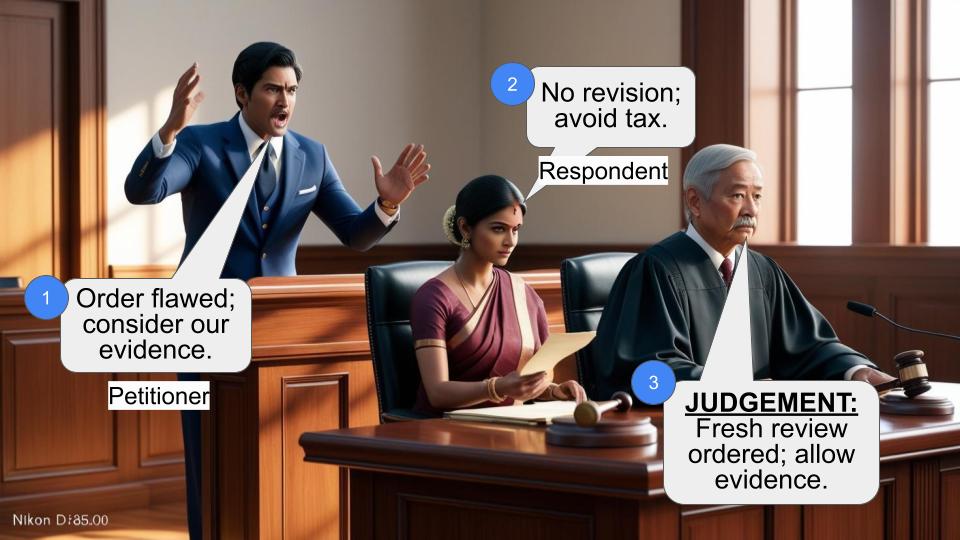
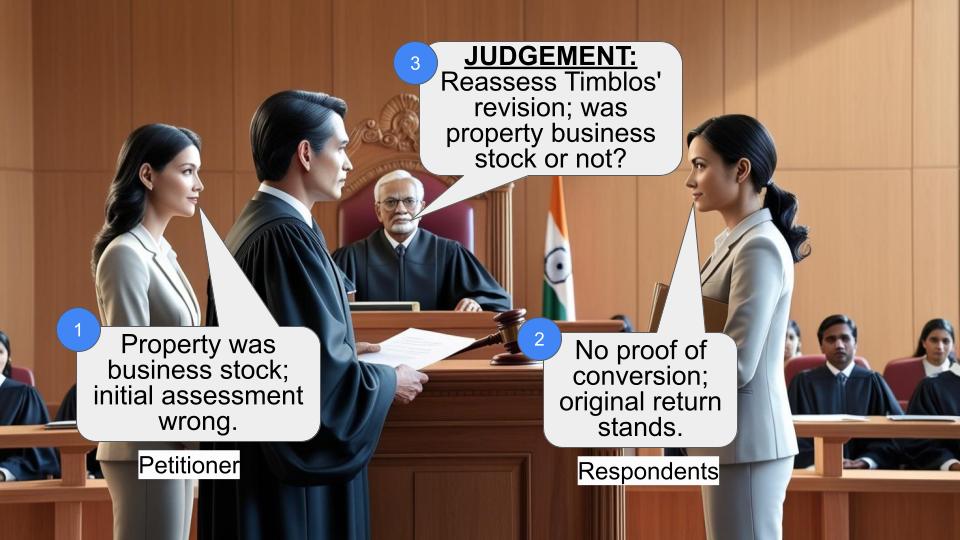
This case involves petitioners Rajesh Prakash Timblo and another versus the Principal Commissioner of Income Tax and another. The petitioners challenged an order dismissing their application to revise tax returns for the Assessment Year 2015-16. The High Court set aside the original order and directed a fresh review of the petitioners' application.
Get the full picture - access the original judgement of the court order here
Case Name:
Rajesh Prakash Timblo & Anr. vs Principal Commissioner of Income Tax & Anr.
(High Court of Bombay)
Writ Petition No.924 of 2019
Key Takeaways:
1. The court emphasized the importance of considering all relevant facts in tax revision cases.
2. Taxpayers may be given an opportunity to present additional evidence in revision proceedings.
3. The case highlights the complexity of determining the nature of income from property transactions.
Issue:
Whether the Principal Commissioner of Income Tax erred in dismissing the petitioners' application under Section 264 (of Income Tax Act, 1961), seeking to revise their tax returns for Assessment Year 2015-16?
Facts:
1. The petitioners, a married couple, purchased a property in Seraulim, Goa for ₹50 lakhs on 02.05.2012.
2. They disclosed this investment in their tax returns for Assessment Years 2013-14 and 2014-15.
3. On 02.04.2014, they claim to have converted the property from "Investment" to "stock in trade" through a book entry.
4. The property was sold on 05.05.2014 for ₹90 lakhs.
5. In their 2015-16 tax return, the petitioners erroneously reported the profit as short-term capital gain instead of business income.
6. They filed applications under Section 264 (of Income Tax Act, 1961) to revise this return, which were dismissed by the Principal Commissioner.
Arguments:
Petitioners:
1. The dismissal order misread their previous tax returns and overlooked evidence of property disclosure.
2. They made a genuine mistake in filing the 2015-16 return, which they sought to correct through the Section 264 (of Income Tax Act, 1961) application.
3. They had evidence of converting the property to stock in trade, including book entries and balance sheet changes.
Respondents:
1. The petitioners provided no contemporaneous evidence of converting the property to stock in trade.
2. The case appeared to be an afterthought to avoid capital gains tax.
3. The petitioners didn't produce crucial evidence during the original hearing.
Key Legal Precedents:
The judgment doesn't cite specific case laws but refers to:
1. Section 264 (of Income Tax Act, 1961), which allows for revision of orders.
2. Section 45(2) (of Income Tax Act, 1961), relating to capital gains on transfer of capital assets.
3. A Circular dated 29.02.2016, to be read with Section 45(2) (of Income Tax Act, 1961).
Judgement:
1. The High Court set aside the impugned order of the Principal Commissioner.
2. The court directed a fresh consideration of the petitioners' Section 264 (of Income Tax Act, 1961) applications.
3. The petitioners were granted liberty to present additional evidence .
4. The Principal Commissioner was asked to decide the matter within four months .
FAQs:
1. Q: What was the main issue in this case?
A: The main issue was whether the petitioners could revise their tax returns to change the classification of income from the sale of a property from capital gains to business income.
2. Q: Why did the court set aside the original order?
A: The court found that the original order may have been based on irrelevant circumstances and didn't consider all the available evidence.
3. Q: Does this judgment mean the petitioners won their case?
A: Not necessarily. The court only ordered a fresh review of their application, keeping all issues open for reconsideration.
4. Q: What's the significance of converting a property from "investment" to "stock in trade"?
A: This conversion can affect how the income from the property's sale is taxed - as capital gains or as business income.
5. Q: What lesson can taxpayers learn from this case?
A: It's crucial to maintain proper documentation and present all relevant evidence when seeking revision of tax returns or challenging tax orders.

1. Heard Mr. Jitendra Jain, Mr. G. Panandikar and Ms. Eesha Dukle for the Petitioners and Ms. Amira Razaq, learned Standing Counsel for the Respondents.
2. Rule. Rule is made returnable forthwith with the consent and at the request of learned counsel for the parties. The counsel appearing for the respondents waives service.
3. The challenge in this petition is to the order dated 30.03.2019 by which the Principal Commissioner of Income Tax has dismissed the petitioner's applications under Section 264 (of Income Tax Act, 1961) (I.T. Act) seeking to revise the returns for Assessment Year (A.Y.) 2015-16 and the consequential orders made thereon.
4. It is the case of the petitioners that they are married to each other under the Portuguese Civil Code and therefore the provisions of Section 5A (of Income Tax Act, 1961) are applicable to them. This section provides for apportionment of income earned by the spouses governed by the Code. It is also the case of the petitioners that they, on 02.05.2012 purchased an immovable property (land) at Seraulim, Goa for a consideration of `50 lakhs. For A.Y. 2013-14, they filed income tax returns in ITR Form-4 therein, as against the head of “Investment”, the petitioners disclosed an amount of `5,35,33,507/-, which amount included the investment of `50 lakhs made in the Seraulim property. It is the case of the petitioners that in ITR-4, there was no specific provision in relation to investment in properties. The return of income for A.Y. 2013-14 was duly accepted by the department under Section 143(1) (of Income Tax Act, 1961).
5. It is further the case of the petitioners that for A.Y. 2014-15, the petitioners filed their returns in ITR Form-1. Since this form allowed disclosure of only income from salary, no details with regard to the Seraulim property were indicated. However, in the balance sheet for the year ending 31.03.2014, an amount of `4,03,87,633/- was disclosed, which includes the Seraulim property valued at `50 lakhs. Even this return of income was accepted Section 143(1) (of Income Tax Act, 1961).
6. It is the case of the petitioners that on 02.04.2014 they converted the Seraulim property which were earlier shown under the head of “Investment” into stock in trade for purposes of development. This was done by making a book entry in the books of account/ledgers. However, the petitioners, instead of themselves developing the property, vide registered sale deed dated 05.05.2014, sold the Seraulim property, which was already converted as stock in trade for a consideration of `90 lakhs and necessary entries were made in the books of account.
7. The petitioners, on 07.06.2016 filed their return of income for A.Y. 2015-16. However, it is the case of the petitioners that they erroneously and inadvertently computed the profits from sale of Seraulim property under the head of “income from capital gains” and arrived at short term capital gain of `20 lakhs after giving effect to the provisions of Section 5A (of Income Tax Act, 1961). This return was filed in ITR- 4. However, since no business income was shown, the relevant details in ITR-4 relating to the balance sheet was reflected as “0” as per the Income Tax Software provided by the department. This return of income was accepted on 06.07.2016 under Section 143(1) (of Income Tax Act, 1961).
8. It is the case of the petitioners that they realized that they had committed a mistake in the filing of the returns and therefore, vide applications dated 26.06.2017, made within the prescribed period of limitation, invoked the provisions of Section 264 (of Income Tax Act, 1961) and applied for revision of the intimation under Section 143(1) (of Income Tax Act, 1961) for assessing the gain on the sale of Seraulim property as business income and not as any short term capital gain. By impugned order dated 30.03.2019, the Principal Commissioner has rejected the said applications. Hence the present petition.
9. Mr. Jitendra Jain, the learned counsel for the petitioners submits that the impugned order proceeds on the basis that the Seraulim property was not at all reflected in the returns for A.Y. 2012-13, 2013- 14, 2014-15 and 2015-16. He submits that this is patently incorrect and amounts to misreading the returns and material furnishes therewith. He submits that were such a doubt to be expressed in the course of personal hearing, the petitioners, would have clarified and demonstrated otherwise. He submits that the observation that the conversion of the investment qua the Seraulim property to stock in trade being dubious as a mere ipse dixit based upon no material on record. He submits that the fact that the petitioners made an inadvertent error in the filing of returns for 2015-16, is not at all indicative of any dubious act but, rather, the applications under Section 264 (of Income Tax Act, 1961) were filed precisely to correct such inadvertent error.
10. Mr. Jain points out that necessary book entry had been made in the books of account/ledgers to indicate the conversion of investment in Seraulim property as stock in trade. He submits that applying the principles set out in Circular dated 29.02.2016, which is to be read along with the provisions of Section 45(2) (of Income Tax Act, 1961), there was ample material on record to evidence the conversion. He submits that inasmuch as all these relevant aspects have not been taken into consideration and since the impugned order proceeds on the basis of irrelevant observations, the same warrants interference.
11. Ms. Razaq, the learned Standing Counsel for the respondents defends the impugned order on the basis of the reasoning reflected therein. She submits that the issue is not about non-disclosure of the Seraulim property but the issue is whether there is any material at all produced on record by the petitioners to suggest that there was any genuine mistake in filing of returns for A.Y. 2015-16. She submits that there was absolutely no evidence or contemporaneous material produced on record by the petitioners in support of alleged conversion of investment into stock in trade. She submits that there are no entries even in the books of account/ledgers unilaterally maintained by the petitioners to indicate any determination of fair value or any entries to support the conversion. She submits that this is clearly a case of afterthought and the impugned order was quite correctly made.
12. Ms. Razaq pointed out that this is not at all case of failure of natural justice because the petitioners were offered hearing, which offer, the petitioners have availed. She points out that even the extracts from ledgers now produced along with this petition were neither produced before the respondent no.1 at the time of hearing nor along with the applications under Section 264 (of Income Tax Act, 1961).
13. For all the aforesaid reasons, Ms. Razaq submits that the impugned order may not be interfered with and this petition may be dismissed.
14. The rival contentions now fall for our determination.
15. On perusal of the impugned order, we find that respondent no.1 has adverted to the returns for A.Y. 2012-13, 2013-14, 2014-15 and 2015-16 and thereafter observed that the entry in the context of Seraulim property is not evident even under the head of “Investment”. It is not quite clear as to whether this is one of the reasons for rejection of the petitioner's applications under Section 264 (of Income Tax Act, 1961). If this is one of the reasons, then, Mr. Jain, is quite correct in his submission that the returns for the said assessment years have not been read in their entirety. In any case, the petitioners, do have a plausible explanation in this regard and were they informed that this is one of the tentative reasons, then, they were clearly in a position to demonstrate that the Seraulim property was indeed referred to in the returns. In fact, the returns for A.Y. 2012-13 are totally irrelevant for the present case.
16. The other reason discernible from the impugned order is the reasoning of the respondent no.1 that in the previous assessment years, the Seraulim property was indicated as capital asset and this position continued even for A.Y. 2015-16. Respondent no.1 has also observed that the petitioners themselves treated the Seraulim property as a capital asset and further, they have produced no evidence to support their claim of conversion of this capital asset into a stock in trade.
17. In response to Ms. Razaq's contentions that there was no contemporaneous material produced on record by the petitioners, Mr. Jain, offered to produce on record the balance sheet/profit and loss account for A.Y. 2015-16. Upon production, on behalf of the petitioners, it was pointed out that in the balance sheet for the year ending 31.03.2013 the investment in property was valued at `3,48,10,633/-. Similarly, in the balance sheet for the year ending 31.03.2014 this figure increased to `4,03,87,633/- which, included the value of the Seraulim property. However, in the balance sheet for the year ending 31.03.2015, this figure has again come down to `3,53,87,633/-. It was pointed out that this, at least, prima facie, indicates that the petitioners did convert this capital asset into a stock in trade and this position was reflected not only in the books of account/ledgers but also in the balance sheet.
18. According to us, although, it is true that neither the books of account/ledgers nor the balance sheets were produced by the petitioners along with their applications under Section 264 (of Income Tax Act, 1961) or during the course of personal hearing thereon, the interests of justice would require that the petitioners are given an opportunity to produce this material before respondent no.1. The impugned order, makes reference to certain reasons or circumstances, which, may not be entirely relevant. In any case, the impact of such irrelevant circumstances on the ultimate decision is also not quite clear from perusal of the impugned order. The fact that for A.Y. 2015-16, the respondents themselves treated the Seraulim property as capital asset is really begging the point because it is the case of the petitioners that this was the error committed by them on account of which they filed their applications under Section 264 (of Income Tax Act, 1961).
19. The aforesaid means that the impugned order is based upon certain circumstances, which can be styled as irrelevant. The petitioners, though had not placed any contemporaneous material before respondent no.1 at the time of hearing of their applications under Section 264 (of Income Tax Act, 1961), have, in the course of present hearing, placed some material. The effect of such material cannot be decided by this Court and it is only appropriate that the same is decided by the respondent no.1 afresh. The impugned order also does not reflect that the same was based on the alleged failure on the part of the petitioners to make any fair valuation of the Seraulim property at the stage of their alleged conversion into stock in trade. No doubt, all these matters might be relevant for determining whether this is a case where the petitioners had made a genuine error, as contended by them, or whether, this is a case where the petitioners, merely, by way of an afterthought, seek to invoke provisions of Section 264 (of Income Tax Act, 1961) and thereby avoid paying capital gains tax.
20. Accordingly, we are of the opinion that the interest of justice would be met if the impugned order is set aside and the respondent no.1 is directed to once again consider the petitioners' applications under Section 264 (of Income Tax Act, 1961) and to dispose of the same on their own merits and in accordance with law. We grant the petitioners liberty to place additional material on record before the respondent no.1 and we request respondent no.1 to dispose of the petitioners' applications under Section 264 (of Income Tax Act, 1961) as expeditiously as possible and in any case within a period of four months from today.
21. We make it clear that none of the observations in this order may be treated as conclusive or binding one way or the other. The issue as to whether the petitioners' applications under Section 264 (of Income Tax Act, 1961) shall be allowed or not is kept entirely open and respondent no.1 is required to decide the same on their own merits and in accordance with law. No doubt, this time, without being influenced by any of the observations in the impugned order, which, in any case, we have now set aside.
22. We further clarify that all issues i.e. the contentions on behalf of the petitioners as well as the respondents are specifically kept open and the burden of satisfying the respondent no.1 that this was indeed a case of a genuine error will lie squarely upon the respondents who will be expected to discharge the same in accordance with law.
23. The impugned order is accordingly set aside. The matter is remanded to the respondent no.1 to dispose of petitioners' applications under Section 264 (of Income Tax Act, 1961) afresh, on their own merits and in accordance with law. We request respondent no.1 to dispose of these applications as expeditiously as possible and in any case within a period of four months from today.
24. The Rule is made absolute in the aforesaid terms. There shall be no orders as to the costs.
25. All the concerned to act on the basis of an authenticated copy of this order.
SMT. M. S. JAWALKAR, J. M. S. SONAK, J.
×
Similar Ripples
Questions
Court Orders Fresh Review of Tax Revision Application in Property Sale Dispute
Write your CommentSimilar Posts


Generic
- Reportdata/6325.pdf
