


Court Orders Reconsideration of Tax Refund Withholding, Citing Flawed Reasoning



Full News

Court Orders Reconsideration of Tax Refund Withholding, Citing Flawed Reasoning
Court Orders Reconsideration of Tax Refund Withholding, Citing Flawed Reasoning
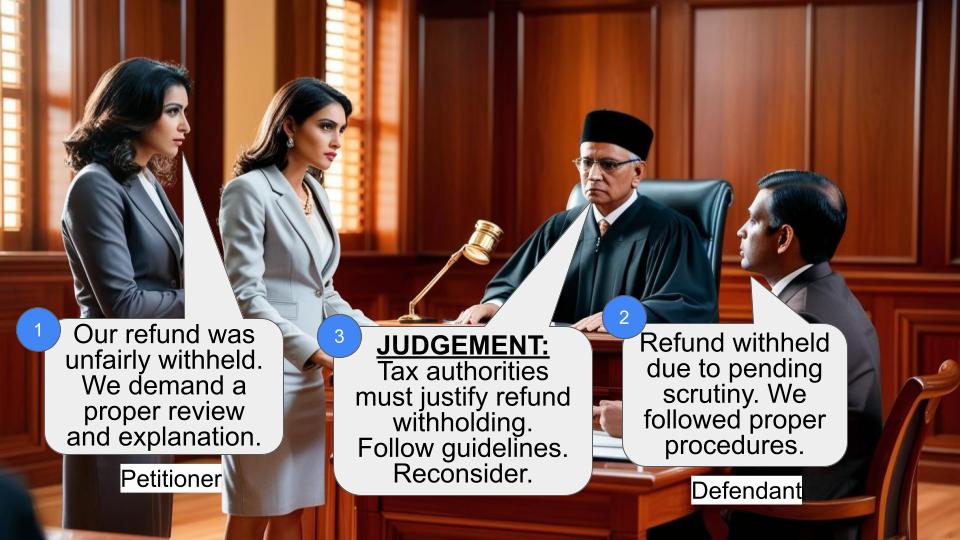
This case involves a dispute between Cooner Institute of Health Care and Research Centre Pvt. Ltd. (the petitioner) and the Income Tax Officer (the respondent). The petitioner sought a mandamus directing the respondent to grant a tax refund determined under Section 143(1) (of Income Tax Act, 1961). The Delhi High Court allowed the petition, setting aside the order withholding the refund and directing the respondent to reconsider the matter within three weeks.
Get the full picture - access the original judgement of the court order here
Case Name:
Cooner Institute of Health Care and Research Centre Pvt. Ltd. Vs Income Tax Officer (High Court of Delhi)
W.P. (C) 430/2020
Date: 27th July 2020
Key Takeaways:
1. Mere selection for scrutiny is not sufficient grounds to withhold a tax refund under Section 241A (of Income Tax Act, 1961).
2. The Income Tax Officer must provide specific, justifiable reasons for withholding a refund, beyond simply citing that a scrutiny notice has been issued.
3. The court emphasized the importance of fair and credible dealings by the state in tax matters.
Issue:
Was the Income Tax Officer's decision to withhold the tax refund under Section 241A (of Income Tax Act, 1961) justified and in accordance with the law?
Facts:
1. The petitioner, a company providing hospital services, filed its income tax return for the Assessment Year 2018-19 on October 29, 2018, claiming a refund of Rs.1,43,48,810/- due to excess tax deduction at source.
2. The case was selected for limited scrutiny under Section 143(2) (of Income Tax Act, 1961) on September 22, 2019.
3. On November 12, 2019, the Centralised Processing Centre processed the return under Section 143(1) (of Income Tax Act, 1961), resulting in a refund of Rs. 1,57,83,688/-.
4. The refund was not granted, and the petitioner made several representations regarding this.
5. The petitioner was informed that the refund had been withheld under Section 241A (of Income Tax Act, 1961), but no copy of the order or reasons were initially provided.
6. The petitioner filed a writ petition seeking directions, which was later amended to challenge the order dated January 10, 2020, withholding the refund.
Arguments:
Petitioner's Arguments:
1. The action of withholding the refund is contrary to Section 241A (of Income Tax Act, 1961).
2. The reasons given for withholding the refund are inherently flawed and cannot be considered valid.
3. The petitioner cited two previous Delhi High Court judgments (Maple Logistics and Ericsson India) to support their case.
Respondent's Arguments:
1. The case is distinguishable from the precedents cited by the petitioner.
2. There are genuine reasons for withholding the refund.
3. The case has been selected for limited scrutiny, and the refund should be withheld until the assessment is finalized.
Key Legal Precedents:
1. Maple Logistics Private Limited v Principal Commissioner of Income Tax 2019 SCC OnLine Del 10961
2. Ericsson India Private Limited v Assistant Commissioner of Income Tax MANU/DE/0763/2020
These cases established that merely issuing a scrutiny notice is not sufficient grounds to withhold a refund under Section 241A (of Income Tax Act, 1961), and that the Assessing Officer must provide specific, justifiable reasons for withholding a refund.
Judgement:
1. The court found the reasons given for withholding the refund to be "inherently flawed and contrary to the views expressed by this Court" in the cited precedents.
2. The court set aside the impugned order dated January 10, 2020.
3. The respondents were given three weeks to reconsider whether the refund, or any part thereof, should be withheld under Section 241A (of Income Tax Act, 1961), in line with the court's previous decisions.
4. If no decision is made within three weeks, the respondents are directed to transmit the refund amount along with interest to the petitioner.
5. If reasons are recorded for withholding the refund, they must be approved by the Principal Commissioner of Income Tax and provided to the petitioner promptly.
FAQs:
1. Q: What is Section 241A (of Income Tax Act, 1961)?
A: Section 241A (of Income Tax Act, 1961) allows the Income Tax Officer to withhold a refund if they believe granting it would adversely affect revenue collection. However, this must be done with proper justification and approval.
2. Q: Can a tax refund be withheld just because a case is selected for scrutiny?
A: No, the court clearly stated that mere selection for scrutiny is not sufficient grounds to withhold a refund. Specific, justifiable reasons must be provided.
3. Q: What happens if the Income Tax Department doesn't reconsider the refund within the given three weeks?
A: If no decision is made within three weeks, the department is directed to transmit the full refund amount along with interest to the petitioner.
4. Q: Does this judgment mean the petitioner will definitely get their refund?
A: Not necessarily. The judgment allows the Income Tax Department to reconsider the matter and potentially withhold the refund if they can provide proper justification in line with the court's guidelines.
5. Q: How does this judgment impact other taxpayers?
A: This judgment reinforces the principle that tax authorities must provide specific, justifiable reasons for withholding refunds, beyond merely citing that a scrutiny notice has been issued. This could potentially benefit other taxpayers in similar situations.

1. The present writ petition under Article 226 of the Constitution of India inter alia seeks mandamus for directing the respondent to grant refund as determined under Section 143(1) (of Income Tax Act, 1961) (‘the Act’).
2. Petitioner, a company providing hospital services to the general public,filed its return of income for the Assessment Year (‘AY’) 2018-19 on 29th October, 2018 claiming refund of Rs. 1,43,48,810/- on account of excess deduction of tax at source. Revenue selected the case of the petitioner for limited scrutiny under Section 143(2) (of Income Tax Act, 1961) vide notice dated 22nd September, 2019. Subsequently, the ‘Centralised Processing Centre’processed the return of income vide order dated 12th November, 2019 under Section 143(1) (of Income Tax Act, 1961) which resulted in refund of Rs.1,57,83,688/-.
However, since the said refund was not granted, petitioner submitted various representations dated 29.11.2019, 16.12.2019 and 17.12.2019 in this respect.
Thereafter, in a personal hearing granted to the petitioner, it was informed that the refund had been withheld under Section 241A (of Income Tax Act, 1961). Neither the copy of the order nor the reasons for withholding the refund were provided to the petitioner and accordingly, the present writ petition has been filed seeking directions in this regard. During the course of hearing, the reasons for withholding the refund were provided to the petitioner and consequently,the writ petition was amended to assai the order dated 10th January, 2020 whereby the refund has been withheld.
3. Mr. Mukesh Chand, learned counsel for the petitioner assailed the reasons for withholding the refund by arguing that the action of the respondent is contrary to Section 241A (of Income Tax Act, 1961). He argued that the Income-Tax Officer, with the approval of the PCIT, withheld the refund merely on the ground that the case of the petitioner has been selected for limited scrutiny and cited the same reason for which the scrutiny has been ordered to be undertaken. He submitted that the aforesaid reasoning is thus inherently flawed and cannot be considered as a valid ground to withhold the refund. In support of his submission, learned counsel for the petitioner relied upon the judgments of this Court in Maple Logistics Private Limited v Principal Commissioner of Income Tax 2019 SCC OnLine Del 10961 and Ericsson India Private Limited v Assistant Commissioner of Income Tax MANU/DE/0763/2020.
4. Ms. Vibhooti Malhotra, learned senior standing counsel for the Revenue on the other hand sought to distinguish the cases relied upon by the petitioner on facts. She argued that in the instant case, there are in fact genuine reasons for withholding the refund and therefore, the Assessing Officer has rightly exercised the jurisdiction under Section 241A (of Income Tax Act, 1961).
She submitted that the case of the petitioner has been selected for limited scrutiny and therefore till the finalization of the assessment, the refund has been rightly withheld under Section 241A (of Income Tax Act, 1961).
5. The reasons for withholding the Revenue as contained in the letter dated 10th January, 2020 read as under:
“The assessee filed return of income for A.Y. 2018-19 vide ack. No. 3.54565941291018, dated 29.10.2018 declaring loss of Rs. 1,58,92,872/- and has claimed refund of Rs.1,43,48,810/-. Subsequently, the case has been selected for scrutiny under CASS for A.Y. 2018-19 and notice u/s 143(2) (of Income Tax Act, 1961) dated - .2.09.2019, has already been issued and duly served. The case has been selected m Limited Scrutiny with the following reasons:-
i. Claim of Large Value Refund.
ii Lower amount disallowed u/s 40(a)(i) (of Income Tax Act, 1961) in ITR (Part A- OI) in comparison to audit report – Amount disallowable under section 40(a)(i) (of Income Tax Act, 1961) on account of non-compliance with the provisions of Chapter XVII-B as per 3CD 2. Amount disallowable under section 40(a)(i) (of Income Tax Act, 1961) on account of non- compliance with the provisions of Chapter XVII-B as per Part A-OI of ITR.
The genuineness of refund claimed by the assessee remains to be verified as the assessment is yet to be complete. In view of the above I am satisfies that issued of refund may adversely affect the revenue.”
6. From a reading of the aforesaid reasons, it is apparent that only ground for withholding refund is that since case of the petitioner has been selected for scrutiny for AY 2018-19, under Section 143(2) (of Income Tax Act, 1961), the assessment is yet not complete and therefore genuineness of the refund claimed by the assessee is yet to be verified. We find that the aforesaid reason is inherently flawed and contrary to the views expressed by this Court in aforesaid two cases i.e. Maple Logistics (Supra) and Ericsson India Private Limited (Supra). In the case of Maple Logistics, the Court had specifically stated as under:
31. In the present case, the AO has completely lost sight of the words in the provision to the effect that, “the grant of the refund is likely to adversely affect the revenue”. The reasons that are relied upon by the Revenue to justify the witholding of the refund in the present case, are abysmally lacking in reasoning. Except for reproducing the wordings of Section 241A (of Income Tax Act, 1961), they do not state anything more. The entire purpose of Section 241A (of Income Tax Act, 1961) would be negated, in case the AO was to construe the said provision in the manner he has sought to do. It would be wholly unjust and inequitable for the AO to withhold the refund, by citing the reason that the scrutiny notice has been issued. Such an interpretation of the provision would be completely contrary to the intent of the legislature. The AO has been completely swayed by the fact that since the case of the assessee has been selected for scrutiny assessment, he is justified to withhold the refund of tax.
32.The power of the AO has been outlined and defined in terms of the Section 241A (of Income Tax Act, 1961) and he must proceed giving due regard to the fact that the refund has been determined. The fact that notice under section 143(2) (of Income Tax Act, 1961) has been issued, would obviously be a relevant factor, but that cannot be used to ritualistically deny refunds. The AO is required to apply its mind and evaluate all the relevant factors before deciding the request for refund of tax. Such an exercise cannot be treated to be an empty formality and requires the AO to take into consideration all the relevant factors. The relevant factors, to state a few would be the prima facie view on the grounds for the issuance of notice under section 143(2) (of Income Tax Act, 1961); the amount of tax liability that the scrutiny assessment may eventually result in vis-a-vis the amount of tax refund due to the assessee; the creditworthiness or financial standing of the assessee, and all factors which address the concern of recovery of revenue in doubtful cases.
33. Therefore, merely because a notice has been issued under section 143(2) (of Income Tax Act, 1961), it is not a sufficient ground to withhold refund under section 241A (of Income Tax Act, 1961) and the order denying refund on this ground alone would be laconic. Additionally, the reasons which are to be recorded in writing have to also be approved by the Principal Commissioner, or Commissioner, as the case may be and this should be done objectively.” (Emphasis supplied)
7. Further in the case of Ericsson (Supra), the views were reiterated in the following words:
18. The refund of amounts claimed – where they appear justified, by itself cannot be said to be adverse to the interest of the revenue. The interest of revenue lies in collecting revenue in a legal and justified manner. It does not lie in retaining the collected taxes in excess of what is justified, since the excess collection cannot even be properly termed as “revenue”. The excess collection of tax is a liability of the State and it lies in the interest of the revenue of the State to discharge its interest bearing liability without any delay. The sovereign cannot, but, be seen as fair, honest and credible in its dealings with its subjects. Any lapse in this regard tarnishes the image and credibility of the sovereign. It certainly cannot act like any unscrupulous businessman, who is seen to dodge his liabilities by resort to frivolous excuses and devious ways.”
8. The exercise of withholding of refund under section 241A (of Income Tax Act, 1961), pursuant to notice u/s 143(2) (of Income Tax Act, 1961), without recording justifiable reasons, is not in consonance with the legislative intent and mandate of the aforesaid provision. The reasons cited do not support the finding that refund would adversely affect the Revenue. In view of the aforesaid, we hold that the reasoning given by the Income-Tax Officer is contrary to Section 241A (of Income Tax Act, 1961). Accordingly, we set aside the impugned communication/ order dated 10.01.2020. We, therefore, grant three weeks' time to the respondents to re-consider the aspect whether the amount found due to be refunded, or any part thereof, is liable to be withheld under Section 241A (of Income Tax Act, 1961) in line with the decisions of this court as noted above. The entire consideration, with the approval of the Principal Commissioner of Income Tax to the withholding of the refund amount, or any part thereof, should be completed within three weeks from today, failing which, we direct that without awaiting any further orders, the respondents shall transmit the amount of refund determined under section 143(1) (of Income Tax Act, 1961) alongwith interest to the petitioner. In the eventuality of the respondents recording any reasons for withholding a part thereof, or the entire amount due for refund to the petitioner under Section 143(1) (of Income Tax Act, 1961), the reasons thereof as approved by the Principal Commissioner of Income Tax shall be provided to the petitioner forthwith. It shall be open to the petitioner to take remedial steps in respect of any orders for withholding of refund that may be passed. Needless to state that the reasons recorded for withholding of refund under section 241A (of Income Tax Act, 1961) would only amount to a tentative view and would not come in the way of the Assessing Officer to frame the assessment under section 143(3) (of Income Tax Act, 1961).
9. The writ petition is accordingly allowed in the above terms. Copy of this judgment be forwarded to the learned counsel for parties through email.
SANJEEV NARULA, J
MANMOHAN, J
JULY 27, 2020
×
Similar Ripples
Questions
Court Orders Reconsideration of Tax Refund Withholding, Citing Flawed Reasoning
Write your CommentSimilar Posts


Generic
- Reportdata/6204.pdf
