


Court Orders Speedy Refund in Tax Dispute, Criticizes Revenue Department's Delay


Full News

Court Orders Speedy Refund in Tax Dispute, Criticizes Revenue Department's Delay
Court Orders Speedy Refund in Tax Dispute, Criticizes Revenue Department's Delay
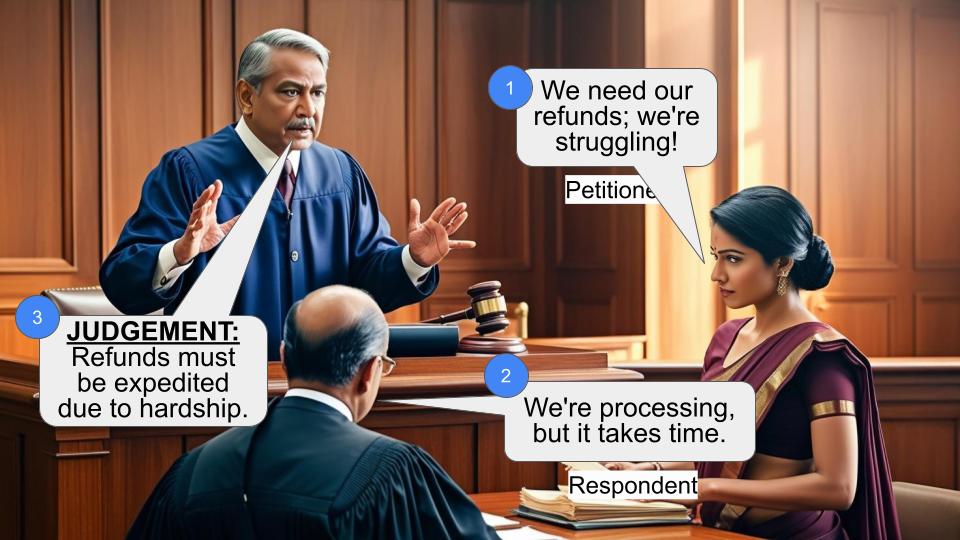
This case involves Agilent Technologies India Pvt. Ltd. (the petitioner) seeking a refund of approximately Rs. 5.19 Crores for the Assessment Year 2011-12, along with interest under Section 244A (of Income Tax Act, 1961). The petitioner also requested a rectification order on their application dated August 19, 2020. The court criticized the Revenue Department for delays and ordered them to process the refund and pass necessary orders within four weeks.
Get the full picture - access the original judgement of the court order here
Case Name:
Agilent Technologies India Pvt. Ltd. Vs Assistant Commissioner of Income Tax & Anr. (High Court of Delhi)
W.P.(C) 8062/2020 & CM APPL.26231/2020
Date: 6th November 2020
Key Takeaways:
1. The court emphasized the importance of timely processing of tax refunds and appeal effect orders.
2. The judgment highlights the inefficiency in the Tax Department's functioning, particularly in implementing tribunal orders.
3. The court's directive for quick action sets a precedent for similar cases of delayed refunds.
Issue:
Should the Revenue Department be directed to grant the tax refund and pass the rectification order as requested by the petitioner, given the delays in processing the Appeal Effect Order?
Facts:
1. The Assessing Officer initially made an addition of Rs.10,76,09,517/- to the petitioner's income, computing the total assessed income at Rs.19,33,25,320/-.
2. The Income Tax Appellate Tribunal (ITAT) stayed the demand, subject to partial payment. The petitioner deposited Rs.3,00,97,380/- and had Rs.2,18,00,000/- adjusted against outstanding refunds.
3. Following a remand order by ITAT, the Transfer Pricing Officer recomputed the income at Rs.14,00,83,935/- on July 9, 2019.
4. On February 19, 2020, the Transfer Pricing Officer reduced the additional income to Nil after the petitioner filed an application under Section 154 (of Income Tax Act, 1961).
5. The petitioner filed a writ petition as the order dated February 19, 2020, was not given effect, and the refund was not issued.
Arguments:
The petitioner argued that they were entitled to the refund and rectification order based on the Transfer Pricing Officer's order dated February 19, 2020. The Revenue Department requested more time to obtain instructions, citing a new incumbent in office and rearrangement of jurisdiction.
Key Legal Precedents:
While no specific legal precedents were cited in this judgment, the court relied on general principles of administrative law and tax procedures.
Judgment:
1. The court criticized the Revenue Department for not passing the Appeal Effect Order for about eight months.
2. It noted that the need for an assessee to file a writ petition to implement a favorable order reflects poorly on the Tax Department's functioning.
3. The court directed the Revenue Department to:
a) Pass the Appeal Effect Order in pursuance of the Transfer Pricing Officer's order dated February 19, 2020.
b) Grant the refund along with interest under Section 244A (of Income Tax Act, 1961).
c) Pass rectification orders on the petitioner's application dated August 19, 2020.
4. All these actions were to be completed within four weeks in accordance with the law.
FAQs:
Q1: What was the main issue in this case?
A1: The main issue was the delay in processing a tax refund and implementing an Appeal Effect Order in favor of the petitioner.
Q2: How much refund was the petitioner seeking?
A2: The petitioner was seeking a refund of approximately Rs. 5.19 Crores for the Assessment Year 2011-12.
Q3: What criticism did the court make against the Revenue Department?
A3: The court criticized the Revenue Department for the delay in passing the Appeal Effect Order and noted that such delays force assessees to file additional legal proceedings to implement favorable orders.
Q4: What specific directions did the court give to the Revenue Department?
A4: The court directed the Revenue Department to pass the Appeal Effect Order, grant the refund with interest, and pass rectification orders on the petitioner's application, all within four weeks.
Q5: What section of the Income Tax Act deals with interest on refunds?
A5: Section 244A (of Income Tax Act, 1961) deals with interest on refunds.
Q6: Does this judgment set any precedent for similar cases?
A6: While not explicitly stated, this judgment emphasizes the need for timely processing of tax refunds and implementation of tribunal orders, which could be referenced in similar cases of administrative delay in tax matters.

1. The petition has been heard by way of video conferencing.
2. Present writ petition has been filed seeking directions to the respondents to grant a refund of Rs.5.19 Crores (Rupees Five Crores Nineteen Lacs only) (approx.) for the Assessment Year 2011-12 along with interest under Section 244A (of Income Tax Act, 1961) (hereinafter referred to as ‘Act’) as well as to pass a rectification order on the application of the petitioner dated 19th August, 2020 within a period of fifteen days.
3. On 16th October, 2020, the respondents had requested time to obtain instructions. Today, also the learned counsel for the respondents prays for further time to obtain instructions on the ground that there is a new incumbent in office as well as there has been re-arrangement of jurisdiction.
4. A perusal of the file reveals that an addition of Rs.10,76,09,517/- (Rupees Ten Crores Seventy Six Lacs Nine Thousand Five Hundred Seventeen only) was made by the Assessing Officer and the assessed total income was computed at Rs.19,33,25,320/- (Rupees Nineteen Crores Thirty Three Lacs Twenty Five Thousand Three Hundred Twenty only) while passing the final assessment order under Section 143(3) (of Income Tax Act, 1961).
5. Upon the matter being carried forward in appeal, the Income Tax Appellate Tribunal (for short ‘ITAT’) stayed the demand subject to payment of partial outstanding tax demand. Accordingly, the petitioner deposited Rs.3,00,97,380/- (Rupees Three Crores Ninety Seven Lacs Three Hundred Eighty only). A further sum of Rs.2,18,00,000/- (Rupees Two Crores Eighteen Lacs only) (approx.) was adjusted against the outstanding refunds.
6. In pursuance to the remand order passed by the ITAT, the Transfer Pricing Officer, vide order dated 09th July, 2019, recomputed the petitioner’s total income at Rs.14,00,83,935/- (Fourteen Crores Eighty Three Thousand Nine Hundred Thirty Five only). 7. Thereafter, upon the petitioner filing an application under Section 154 (of Income Tax Act, 1961), the Transfer Pricing Officer reduced the additional income to Nil vide order dated 19th February, 2020. 8. However, as the order dated 19th February, 2020 was not given effect to and the refund was not issued, petitioner filed the present writ petition. 9. Having perused the paper book, this Court is of the view that it is strange that the Appeal Effect Order was not passed for around eight months.
10. The fact that an assessee after succeeding in a protracted litigation has to file another legal proceeding i.e. a writ petition to implement and execute the said order, does not reflect well on the functioning of the Tax Department.
11. Consequently, this Court is of the view that the respondents should have given effect to the Appeal Effect Order as well as issued the refund immediately and there should have been no occasion for the petitioner to file the present writ petition.
12. Keeping in view of the aforesaid facts, the request for adjournment, once again, is declined and the respondents are directed to pass the Appeal Effect Order in pursuance to Transfer Pricing Officer’s order dated 19th February, 2020 and to grant refund along with interest under Section 244A (of Income Tax Act, 1961) as well as to pass rectification orders on the petitioner’s application dated 19th August, 2020 within four weeks in accordance with law.
13. With the aforesaid directions, the present writ petition and application stand disposed of.
14. The order be uploaded on the website forthwith. Copy of the order be also forwarded to the learned counsel through e-mail.
MANMOHAN, J
SANJEEV NARULA, J
NOVEMBER 06, 2020
×
Similar Ripples
Questions
Court Orders Speedy Refund in Tax Dispute, Criticizes Revenue Department's Delay
Write your CommentSimilar Posts


Generic
- Reportdata/6156.pdf
