


Court Overturns Tax Addition on Broker's Alleged Undisclosed Property Profits


Full News
Court Overturns Tax Addition on Broker's Alleged Undisclosed Property Profits
Court Overturns Tax Addition on Broker's Alleged Undisclosed Property Profits
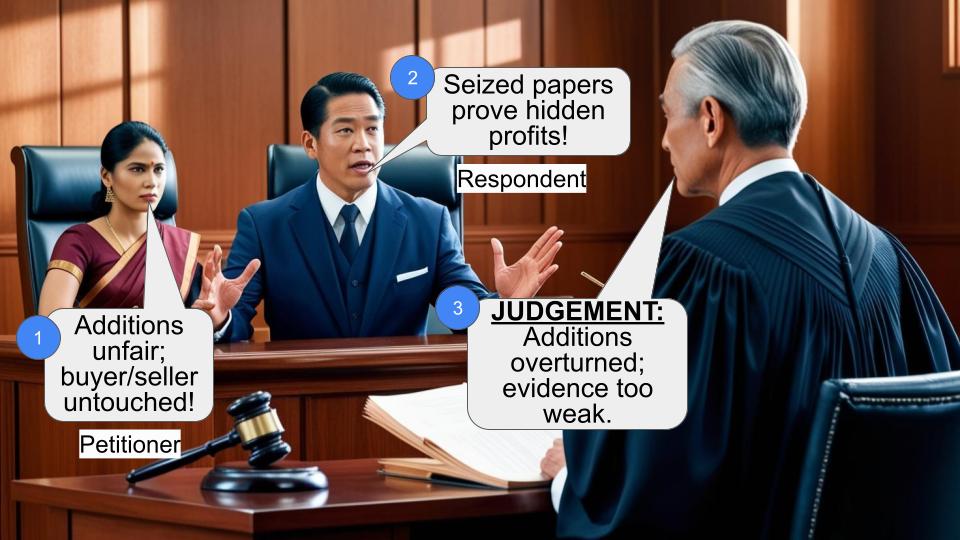
This case involves an appeal by Navneet Jhamb against the Income Tax Department regarding additions made to his income based on alleged undisclosed profits from property transactions. The Delhi High Court allowed the appeal, ruling in favor of the assessee (Navneet Jhamb) and overturning the tax additions made by the lower authorities.
Get the full picture - access the original judgement of the court order here
Case Name:
Navneet Jhamb vs Assistant Commissioner of Income Tax (High Court of Punjab & Haryana)
ITA No. 497 of 2018
Date: 29th January 2020
Key Takeaways:
1. The court emphasized the importance of concrete evidence in making tax additions, especially when based on seized documents.
2. Additions made on the basis of loose papers and without corroborating evidence from involved parties (buyers/sellers) were deemed unsustainable.
3. The judgment highlights the need for consistency in tax treatment across related parties in a transaction.
Issue:
Whether the addition made to the assessee's income on account of undisclosed earned profit from the sale and purchase of property owned and sold by others could be sustained, especially when a similar addition in the hands of the purchaser, based on the same seized documents, had been set aside?
Facts:
1. On August 4, 2005, a search and seizure operation was conducted at the premises of the appellant, Navneet Jhamb, who is a partner in a real estate brokerage firm called Reliance Estate Agency.
2. Certain documents and loose papers were seized from his residential premises.
3. A notice under Section 153A (of Income Tax Act, 1961) was issued, and the appellant filed a return declaring an income of ₹4,13,720.
4. The Assessing Officer made additions to the appellant's income, including an addition for undisclosed earned profit on the sale of industrial plots at village Jharsentli, Tehsil Ballabgarh, District Faridabad.
5. The land in question was owned by M/s Indo American Electricals Limited, with Manmohan Singh as the Managing Director.
6. The Assessing Officer concluded that the actual sale consideration for 16 plots was much higher than the figures shown in the registered sale deeds.
7. Based on seized loose sheets mentioning cash and cheque amounts, the Assessing Officer calculated a profit and divided it equally between the assessee and Manmohan Singh.
8. The assessment was finalized on December 24, 2007. Subsequent appeals to the Appellate Authority and the Tribunal were unsuccessful, leading to this appeal in the High Court.
Arguments:
Appellant's Arguments:
1. The Tribunal erred in sustaining the addition when similar additions made to the purchaser's income were deleted by the Tribunal and upheld by the Delhi High Court.
2. No addition was made to the income of the actual property owner (the seller company) or its Managing Director.
Revenue's Arguments:
1. The addition made in the buyer's case was deleted on technical grounds and doesn't help the appellant's case.
2. The documents were seized from the appellant's premises, justifying the additions.
Key Legal Precedents:
1. K.P. Varghese Vs. Income Tax Officer, Ernakulam and Another 131 ITR 597 (SC): This case established that the burden of proving understatement or concealment in consideration shown lies with the Revenue.
2. C.I.T. vs. P.V. Kalyanasundaram (2007) 294 ITR 49 (SC): This case dealt with allegations of undisclosed money transactions based on non-convincing loose sheets found during a search. The additions were deleted by the Tribunal and affirmed by the High Court and Supreme Court.
Judgement:
1. The High Court allowed the appeals in favor of the assessee, Navneet Jhamb.
2. The court found that the Tribunal's reasoning for sustaining the additions was not plausible and against the record.
3. The court noted that the additions made to the buyer's income based on the same documents were deleted on substantive grounds, not merely technical ones.
4. The court emphasized that there was no evidence of unaccounted cash being paid by the buyer or received by the seller, and no statement from the seller about receiving any undisclosed amount.
5. The court concluded that it would be inappropriate to saddle only the intermediary or broker with additions when no additions were sustained for the buyer or seller.
FAQs:
1. Q: What was the main issue in this case?
A: The main issue was whether tax additions could be made to a broker's income based on alleged undisclosed profits from property transactions, when similar additions to the buyer's income were set aside and no additions were made to the seller's income.
2. Q: Why did the court rule in favor of the assessee?
A: The court ruled in favor of the assessee because there was insufficient evidence to support the tax additions. The additions were based solely on loose papers without corroborating evidence from the buyer or seller.
3. Q: What is the significance of this judgment for tax assessments?
A: This judgment emphasizes the need for concrete evidence in making tax additions and highlights the importance of consistent treatment across all parties involved in a transaction.
4. Q: Can tax authorities make additions based on seized documents alone?
A: This judgment suggests that tax authorities should not rely solely on seized documents, especially loose papers, without corroborating evidence or statements from other parties involved in the transaction.
5. Q: How does this case impact real estate brokers and intermediaries?
A: This case provides some protection for brokers and intermediaries against arbitrary tax additions based on transactions where they were not the primary buyer or seller.

1. By this common order, three appeals bearing ITA Nos. 496, 497 and 3508 of 2018 are being disposed of as similar issue is involved. The assessment years involved are 2001-02 to 2003-04. For the sake of convenience, facts from ITA No. 497 of 2018 are taken. Following substantial questions of law have been claimed:
“(i) Whether in the facts and circumstances of the case, the ITAT has erred in law on facts in upholding the orders passed by the Lower Authority and in confirming the action of Ld. A.O. in making the addition of Rs. 78,88,222/- as undisclosed income allegedly being profit on sale of plot merely on the basis of conjecture and surmises and without of any basis?
(ii) Whether in the facts and circumstances of the case, the ITAT has fallen in error in sustaining the additions made by the A.O. and CIT (A) on the basis of loose papers which were even not being the documents within the meaning of Section 32 (of Income Tax Act, 1961) of Indian Evidence Act, 1972?
(iii) Whether in the facts and circumstances of the case, the ITAT has failed to consider the fact that the Ld. A. O. had made the additions on the basis of calculations taken from loose documents found during search in which the Appellant was even not mentioned as a buyer or seller, which is totally perverse as and when the seller was M/s Indo American Electricals Ltd., and the purchaser was Shri G. L. Verma, then where is the occasion for the assessee/appellant to show any profit or loss arising from these transactions in his return of income.
(iv) Whether in the facts and circumstances of the case, the ITAT has erred in law and on facts in confirming the action of Lower Authorities in framing the assessment U/s 153A (of Income Tax Act, 1961) in violation of principles of natural justice and passing the impugned order by recording incorrect facts and findings and without confronting the entire adverse material used against the assessee?”
2. Though number of substantial questions have been claimed, yet the pin-pointed controversy is:
“Whether the addition made on account of undisclosed earned profit on sale and purchase of property owned and sold by others could be sustained, especially when the addition in the hands of the purchaser on the basis of seized document has been set aside”.
3. The facts of the case are that on 4.8.2005, search and seizure was conducted at the premises of the appellant, he is partner of the real estate broker concern, namely, Reliance Estate Agency. Certain documents and loose papers were seized from his residential premises. Notice under Section 153A (of Income Tax Act, 1961) (for short, 'the Act') was issued, return was filed declaring income of `4,13,720/-. Apart from other additions, the Assessing Officer made addition on account of undisclosed earned profit on sale of industrial plots at village Jharsentli,Tehsil Ballabgarh, District Faridabad. The land was owned by M/s Indo American Electricals Limited (hereinafter described as 'the seller'). Manmohan Singh was the Managing Director of the company. It was noted that M/s Reliance Estate Agency was appointed by the seller to advertise and procure bids for sale of the land. M/s TML Investments (P) Ltd. showed interest but the deal did not mature, thereafter plots were subsequently sold.
The Assessing Officer came to the conclusion that actual sale consideration of 16 plots tabulated in the assessment order was much more than the figures shown in the registered sale-deeds. The Assessing Officer relying upon the loose sheet seized, mentioning the amount received in cash and cheques calculated the profit and divided the same in half vis-a-vis the assessee and Manmohan Singh, Managing Director of the seller-company. The assessment was finalised on 24.12.2007. The Appellate Authority videorder dated 28.1.2011 partly allowed the appeal, however, sustained the additions of profit. Further appeal was filed before the Tribunal which was dismissed on 25.6.2018, hence the present appeal.
4. Learned counsel for the appellant argued that the Tribunal erred in sustaining addition inspite of the fact that the additions made on the same basis, in the hands of the purchaser was deleted by the Tribunal and in case of ITA No. 1985 of 2010 --Prem Parkash Nagpal v.Assistant Commissioner of Income-tax, and the appeal filed by the revenue was dismissed by Delhi High Court. It is submitted that no addition was made in the hands of the owner of the property, i.e. either the seller-company or the Managing Director.
5. Learned counsel for the revenue defended the order and argued that the addition made in the case of buyer was deleted on technical ground, moreover the documents were seized from the premises of the appellant and the said deletion is of no help to the appellant.
6. There is no dispute that on the basis of the loose sheet seized during the search, the addition was made on the buyer and the same has been deleted. Learned counsel for the revenue is not in a position to dispute the averment that no addition was made in the hands of the seller.
7. The Tribunal while dealing with the averment that there is deletion of addition made on buyer stated that the same is of no consequence, as it was deleted only on technical ground. The reason recorded is against record and not plausible. The relevant portion of the order of the Tribunal in the case of ITA No. 4802/Del/2009-- ITO v. M/s Dua Auto Components P. Ltd., which was followed in cases of other buyers, like ITA No. 3532/Del/2008—M/s Flowmore Anti Counterfeit Security System P. Ltd. v. Income Tax Officer, ITA No. 3514/Del/2010 —DCIT, Circle 11(1) v. M/s Indication Instruments Ltd. etc. is reproduced below:
“6.1 We find that the Assessing Officer has not brought even a single word regarding the nature of document and how he has concluded that they belong to the assessee's and on money transaction has been taken place. He has simply relied upon the reasons recorded without showing any application of mind on his part.
6.2 In this regard we note that it is also not the case that the seller has made any statement or had accepted the receipt of on money i.e. consideration over and above that disclosed. It is also not the case that the seized documents were in the handwriting of the assessee or the seller or were seized from the premises of seller and purchaser. Ld. Commissioner of Income Tax (Appeals) has brought out various discrepancies in the seized documents relied upon by the revenue and striking feature of these anomalies is that in the seized documents, it has been mentioned that the impugned plot was not sold. Thus, the working and the figures mentioned therein can at best be said to be tentative or expected amount. This by no stretch of imagination can be treated as conclusive proofs of on money transactions. Moreover, it is an admitted fact that the documents being relied upon showed account as on 31.10.2001, while as per the registered sale deed the plot was sold on 23.5.2002. Under the circumstances, these additions have been made on the basis of documents found during search at the place of a third party which at best only showed the tentative/ projected purchase consideration. It is not the case that the Circle Rate or the value as per stamp registration authorities of the impugned property is more than what has been disclosed. It is also not the case that unaccounted cash has been found to be paid by the assessee or received by the seller. There is also no statement of the seller on record that he has obtained on money. Under the circumstances, the additions made in this regard is not sustainable.
6.3 In this regard, we place reliance upon the Hon'ble Apex Court in the case of K. P. Varghese Vs. Income Tax Officer, Ernakulam and Another 131 ITR 597 (SC), wherein it has been held that the burden of proving is that of Revenue when there is allegation of understatement on concealment in the consideration shown.
6.4 We also place reliance upon the judgement of the Hon'ble Apex Court in the case of C.I.T. vs. P. V. Kalyanasundaram in (2007) 294 ITR 49 (SC) in which allegations of on money transaction on the basis of non-convincing loose sheets found during the course of search and conflicting statement of the seller, was deleted by the Tribunal (to which, one of us the Accountant Member was the party) and the same was affirmed by the Hon'ble High Court and Hon'ble Apex Court.”
8. While deleting the additions, the Tribunal recorded that the figures mentioned in the document at the best be said to be tentative or expected amount. The document seized showed account as on 31.10.2001 while the registered sale deed of the plot was dated 23.5.2002. It was not the case of the revenue that the circle rate was more than what had been disclosed. No unaccounted cash was found to be paid by the buyer to the seller. There is no statement of the seller regarding obtaining the money and therefore the addition was not sustained.
9. It may be noted at this stage that it is not the case of the department that the property was owned by the appellant or M/s Reliance Estate Agency. The case set up was that apart from the amount mentioned in the registered sale deeds or the payment received by cheques, there were certain cash transactions which were divided between the assessee and the Managing Director of the seller-company. Without having any quarrel with the issue that there may be a possibility that the assessee could apart from commission earn profit in a sale-purchase transaction but the basic issue would be that some cash amount would have been paid by the purchaser. The addition on said account made on the buyer never withstood the scrutiny in appeal. There is nothing on record to show that any addition was made in hand of the seller or the Managing Director of the seller-company for the alleged cash amount received. In this background, it would not be appropriate to hold that only intermediatory or the broker can be saddled with the additions.
9. The contention of learned counsel for the revenue that the role of the appellant was more than that of a broker and he had earned profit also does not enhance the case of the revenue for the reasons mentioned above. 10. The appeals are allowed. The question formulated in para 2 of the judgment is answered in favour of the assessee.
×
Similar Ripples
Questions
Court Overturns Tax Addition on Broker's Alleged Undisclosed Property Profits
Write your CommentSimilar Posts


Generic
- Reportdata/6306.pdf
