


“Court Overturns Tribunal’s Decision on Apparent Mistake in Tax Deduction Case”


Full News
“Court Overturns Tribunal’s Decision on Apparent Mistake in Tax Deduction Case”
“Court Overturns Tribunal’s Decision on Apparent Mistake in Tax Deduction Case”
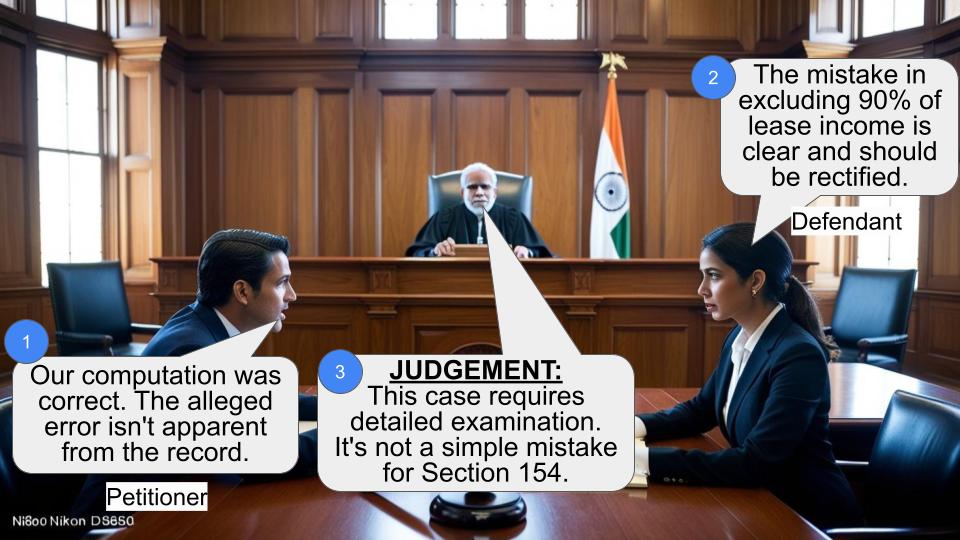
In this case, the court examined whether the Income Tax Appellate Tribunal was correct in upholding an order under Section 154 (of Income Tax Act, 1961), which allows for rectification of mistakes apparent from the record. The dispute centered around the computation of a tax deduction under Section 80HHC (of Income Tax Act, 1961), specifically whether 90% of gross lease income should be excluded from business profits. The court ultimately decided that the mistake was not apparent and set aside the Tribunal’s decision.
Get the full picture - access the original judgement of the court order here
Case Name
Seshasayee Paper & Boards Ltd. Vs Deputy Commissioner of Income Tax (High Court of Madras)
Tax Case Appeal No.489 of 2007
Date: 18th January 2016
Key Takeaways
- Section 154 (of Income Tax Act, 1961): This section allows for rectification of mistakes that are obvious and self-evident from the record.
- Apparent Mistake: The court emphasized that a mistake must be clear and not require extensive reasoning or debate to be considered “apparent.”
- Tribunal’s Limitation: The Tribunal cannot modify judgments unless the mistake is apparent as per Section 154 (of Income Tax Act, 1961).
- Outcome: The court found that the issue required detailed examination and was not a simple mistake, thus the Tribunal’s decision was overturned.
Issue
Was the Tribunal correct in upholding the rectification order under Section 154 (of Income Tax Act, 1961) for excluding 90% of gross lease income from business profits in the tax deduction computation?
Facts
- The appellant, a company, filed a tax return for the assessment year 1998-1999.
- The Assessing Officer included lease income as business income but omitted to exclude 90% of it when calculating deductions under Section 80HHC (of Income Tax Act, 1961).
- A rectification notice under Section 154 (of Income Tax Act, 1961) was issued to correct this.
- The Tribunal upheld the rectification, but the appellant challenged this decision.
Arguments
- Appellant: Argued that the mistake was not apparent and required detailed examination, thus Section 154 (of Income Tax Act, 1961) was not applicable.
- Revenue: Claimed the mistake was obvious and self-evident, justifying the use of Section 154 (of Income Tax Act, 1961).
Key Legal Precedents
- Mepco Industries Ltd v. CIT: Established that a rectifiable mistake must be obvious and not require extensive reasoning.
- T.S. Balaram, Income-Tax Officer v. Volkart Brothers: Highlighted that debatable issues cannot be rectified under Section 154 (of Income Tax Act, 1961).
Judgement
The court ruled in favor of the appellant, stating that the mistake was not apparent on the face of the record as it involved complex issues requiring detailed examination. Therefore, the Tribunal’s decision to uphold the rectification under Section 154 (of Income Tax Act, 1961) was set aside.
FAQs
Q: What is Section 154 (of Income Tax Act, 1961)?
A: It allows for the rectification of mistakes that are apparent from the record, meaning they are obvious and do not require extensive reasoning.
Q: Why was the Tribunal’s decision overturned?
A: The court found that the issue was complex and not a simple mistake, thus not meeting the criteria for rectification under Section 154 (of Income Tax Act, 1961).
Q: What does this mean for the appellant?
A: The appellant’s challenge was successful, and the rectification order was set aside, meaning the original assessment stands.

1. The appellant is a company, registered under the Companies Act, 1956. The assessee filed the return of income, declaring an income of Rs.4,51,06,850/-, in respect of the Assessment Year 1998-1999. The assessment order was passed under Section 143(3) (of Income Tax Act, 1961), 1961 (hereinafter referred to as “the Act”), on 19.03.2001.
2. In the assessment order, the Assessing Officer took cognizance of the 'lease income return' and included the same as 'income from business', on a protective basis. However, while working out deduction under Section 80HHC (of Income Tax Act, 1961), 90% of the gross lease income was omitted to be reduced from the business income to work out eligible business profits. To rectify this mistake, a notice under Section 154 (of Income Tax Act, 1961) was issued.
3. By an order, dated 27.06.2001, the Assessing Officer, revised the assessment order, dated 19.03.2001 and excluded 90% of the gross lease income, from the eligible profits of business, while determining the deduction under Section 80 (of Income Tax Act, 1961) HHC of the Act, on the ground that such exclusion has been upheld by the Commissioner of Income Tax (Appeals) for the earlier assessment year.
4. The assessee appealed to the Commissioner of Income Tax (Appeals), against the order, dated 27.06.2001 (under Section 154 (of Income Tax Act, 1961)) and the Commissioner dismissed the appeal. The Commissioner upheld the validity of the rectification order. A further appeal was taken before the Income Tax Appellate Tribunal. The appellant challenged the validity of the order passed under Section 154 (of Income Tax Act, 1961), both on merits as well as on jurisdiction. The Tribunal also dismissed the appeal.
5. Challenging the dismissal, the Assessee has filed this appeal, raising various substantial questions of law, out of which, the appeal has been admitted only on the following two substantial questions of law:-
“1. Whether on the facts and in the circumstances of the case, the Income Tax Appellate Tribunal is right in law in confirming the order dated 27.6.2001 passed under Section 154 (of Income Tax Act, 1961) by the Assessing Officer for the assessment year 1998/99?
2. Whether on the facts and in the circumstances of the case, the Income Tax Appellate Tribunal is right in law in not noting that Section 154 (of Income Tax Act, 1961) would have no application to the instant case?”
6. The main issue raised in this appeal is the applicability of Section 154 (of Income Tax Act, 1961), in the light of the facts stated supra.
7. Section 154 (of Income Tax Act, 1961) reads as under:
154. Rectification of mistake:
(1) With a view to rectifying any mistake apparent from the record an income- tax authority referred to, in section 1 (of Income Tax Act, 1961) 16 may,-
(a) amend any order passed by it under the provisions of this Act;
(b) amend any intimation sent by it under sub- section (1) of section 143 (of Income Tax Act, 1961), or enhance or reduce the amount of refund granted by it under that sub- section.]
(1A) Where any matter has been considered and decided in any proceeding by way of appeal or revision relating to an order referred to in sub- section (1), the authority passing such order may, notwithstanding anything contained in any law for the,, time being in force, amend the order under that sub- section in relation to any matter other than the matter which has been so considered and decided.]
(2) Subject to the other provisions of this section, the authority concerned--
(a) may make an amendment under sub- section (1) of its own motion, and
(b) shall make such amendment for rectifying any- such mistake which has been brought to its notice by the assessee, and where the authority concerned is the Deputy Commissioner (Appeals)]
7.1. Section 154 (of Income Tax Act, 1961) provides for rectification of any mistake apparent from the record by any Income Tax Authority. In order to attract the application of Section 154 (of Income Tax Act, 1961), a) it must be a case of mistake and b) the mistake must be apparent from the record, i.e. the mistake must be obvious, clear, and patent.
8. The Income Tax Appellate Tribunal is not a Court having plenary powers, but, the Tribunal which cannot function outside or de hors the Act. Once the Judgment or order is pronouced, the Tribunal or Adjudicating Authority becomes functus officio. Such judgments or orders cannot be changed or varied or modified. An exception is provided under Section 154 (of Income Tax Act, 1961) provided the conditions mentioned supra remain satisifed. Therefore, it is for this Court to find out whether there was any mistake and if so, whether that mistake was apparent on the face of the record and whether the Assessing Officer was justified in invoking Section 154 (of Income Tax Act, 1961)?
9. The learned counsel for the assessee / appellant contended that Section 154 (of Income Tax Act, 1961) deals with rectification of an error apparent on the face of the record and that when the mistake is not patent and self-evident, Section 154 (of Income Tax Act, 1961) cannot be invoked; it is pointed out that, the issue pertains to computation of deduction under Section 80HHC (of Income Tax Act, 1961), by excluding 90% of the gross lease income from the business profits and when the issue to be resolved involves determination of complicated facts and law, there is no justification to invoke the provisions of Section 154 (of Income Tax Act, 1961).
9.1. The learned counsel for the Revenue would submit that the assessee cannot challenge the validity of the order passed invoking Section 154 (of Income Tax Act, 1961), as the issue was not raised before the Commissioner of Income Tax (Appeals) and Income Tax Appellate Tribunal and therefore, that issue cannot be raised before this Court.
9.2. This contention of the learned counsel for the Revenue could not be accepted, as the assessee has raised the very same issue before the Income Tax Appellate Tribunal (Ground No.1.2). Even assuming that this issue was never raised before the Commissioner of Income Tax (Appeals) and the Income Tax Appellate Tribunal, there is no legal bar in raising this issue, raising the issue of jurisdiction, anew before this Court.
9.3. The learned counsel for the Revenue would submit that the issue to be considered by the Assessing Officer can be decided on mere looking and does not need long-drawn-out process of reasoning and therefore, the Assessing Officer is right in invoking Section 154 (of Income Tax Act, 1961) to rectify the mistake, which was apparent on the face of the record. In other words, it is contended that the mistake is patent, self-evident and apparent and therefore, it is a case to invoke Section 154 (of Income Tax Act, 1961) and rightly the Assessing Officer has done so. Per contra, the learned counsel for the Assessee has submitted that, when the issue is an debetable issue, and that when a debatable issue is invoked, the mistake cannot be construed to be apparent mistake and in support of the proposition, he relied upon the following decisions:
(i) (2009) 319 ITR 208 (SC) (Mepco Industries Ltd. v. CIT (SC)):-
“.... that the right to recify mistakes under Section 154 (of Income Tax Act, 1961) could not be invoked in a case of mere change of opinion. A rectifiable mistake was a mistake which was obvious and not something which had to be established by a long drawn process of reasoning or where two options were possible. A decision on a debatable point of law could not be treated as a “mistake apparent from the record”.
(ii) (2007) 295 ITR 525 (Raj) (Commissioner of Income Tax v. Ram Kishan Leela):-
“...Held, dismissing the appeal, (i) that the original reassessment proceedings having already been restored to the file of the Assessing Officer, the second reassessment proceedings became infructuous as orders could be passed on the basis of the available material including information received while finalising the proceeding under Section 143(3) (of Income Tax Act, 1961) read with Section 147 (of Income Tax Act, 1961) in pursuance of the reassessment proceedings commenced earlier; (ii) that the finding of the Tribunal that the society and the assessee were separate entities and independent of each other was a finding of fact and that finding had not been challenged. On the basis of that finding also, the reassessment order framed in favour of the assessee could not be sustained.”
(iii) (1971) 82 ITR 50 (T.S.Balaram, Income-Tax Officer, Company Circle IV, Bombay v. Volkart Brothers and others):-
“Held, (i) that the question whether Section 17(1) (of Income Tax Act, 1961) of 1922 was applicable to the case of the respondent firm was not free from doubt, and it was not open to the Income-tax Officer to go into the true scope of the provisions of the Act in a rectification proceeding under Section 154 (of Income Tax Act, 1961): the officer was wrong in holding that there was a mistake apparent from the record of assessments of the firm; (ii) that, however, the High Court was not justified in going into the question whether the original assessments were in accordance with the law.”
10. From the reported decisions, it is clear that no error can be said to be apprent on the face of the record, when it is not manifest or self-evident, but requires an examination or argument to establish it. Admittedly, the issue involved pertains to permissibility of computation of deduction under Section 80HHC (of Income Tax Act, 1961), by excluding 90% of the gross lease income from the business profits. The issue admittedly involves closer scrutinity/ examination of facts and application of law to the facts stated supra and therefore, the mistake cannot be construed to be apparent on the face of the record. Therefore, the Assessing Officer has no jurisdiction to invoke Section 154 (of Income Tax Act, 1961), while making the assessment order dated 27.06.2001. Therefore, the order by the Tribunal upholding the same has to be set aside.
11. In the result, this Tax Case Appeal is allowed. The order passed by the Tribunal in ITA.No.88/Mds/03 dated 19.05.2006 stands set aside.
(M.J.J.) (S.V.J.)
18.01.2016
Internet : Yes/No
Index : Yes/No
To
1. The Income Tax Appellate Tribunal, Chennai 'D' Bench, Chennai.
2. The Deputy Commissioner of Income Tax, Central Circle II (1), 108 Uthamar Gandhi Salai, Chennai – 600 034.
M.JAICHANDREN, J.
and
S.VIMALA, J.
×
Similar Ripples
Questions
“Court Overturns Tribunal’s Decision on Apparent Mistake in Tax Deduction Case”
Write your CommentSimilar Posts


Generic
- Reportdata/3171.pdf
