


Court Quashes Income Tax Reassessment: Full Disclosure Bars Reopening After 4 Y…


Full News

Court Quashes Income Tax Reassessment: Full Disclosure Bars Reopening After 4 Years
Court Quashes Income Tax Reassessment: Full Disclosure Bars Reopening After 4 Years
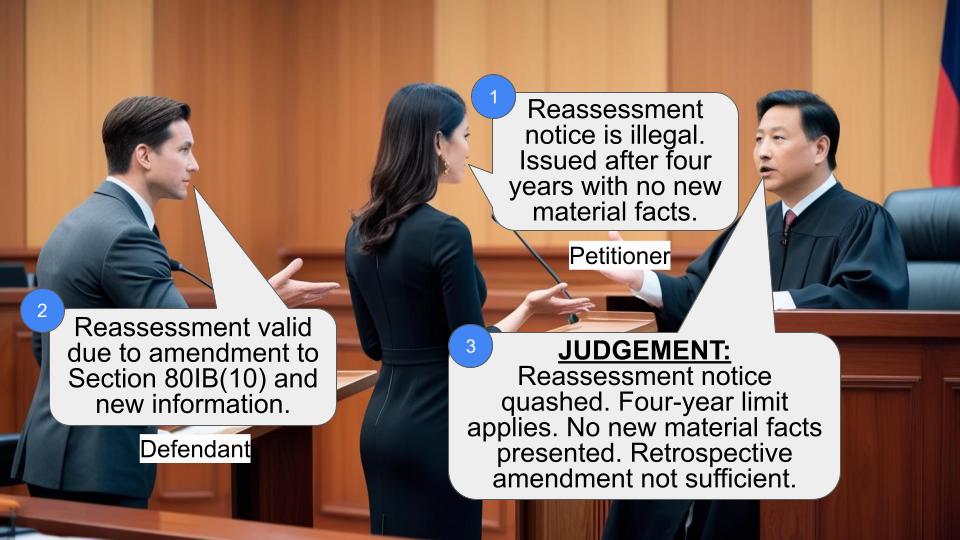
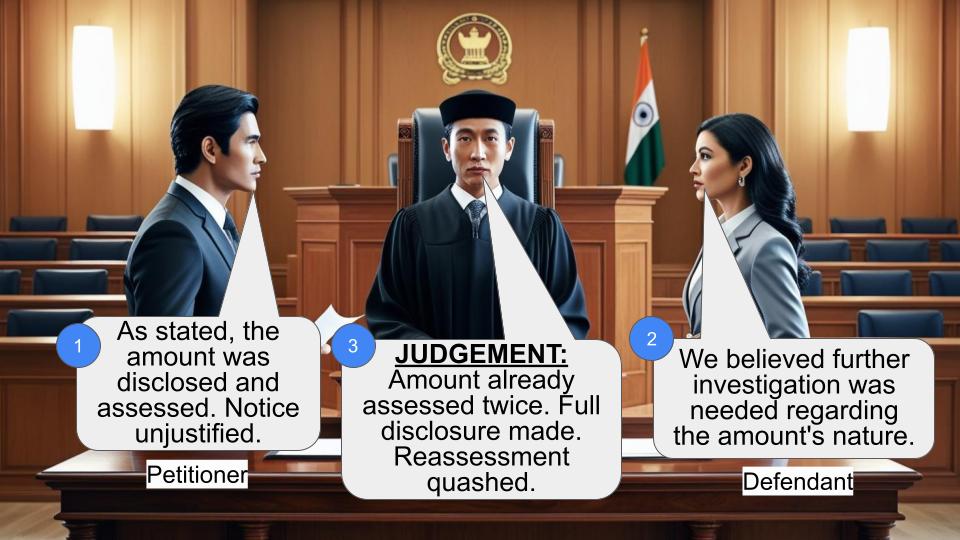
This case involves Kohinoor Hatcheries Pvt. Ltd. challenging a notice issued by the Deputy Commissioner of Income Tax to reopen their 2008-2009 assessment after four years. The High Court ruled in favor of Kohinoor Hatcheries, stating that the Income Tax Department cannot reopen the assessment based on a mere change of opinion when there was a full and true disclosure of facts during the original assessment.
Get the full picture - access the original judgement of the court order here
Case Name:
Kohinoor Hatcheries Pvt. Ltd. Vs Deputy Commissioner of Income Tax (High Court of Andhra Pradesh)
W.P.No.2148 of 2015
Date: 16th August 2016
Key Takeaways:
- Reopening of assessment after 4 years requires failure to disclose material facts fully and truly.
- Mere production of documents differs from full and true disclosure of material facts.
- Change of opinion is not a valid ground for reopening assessment under Section 147 (of Income Tax Act, 1961).
- The assessee’s duty ends with true and full disclosure; they’re not responsible for the inferences drawn by the Assessing Officer.
Issue:
Can the Income Tax Department reopen an assessment after four years when the assessee had made a full and true disclosure of all material facts during the original assessment?
Facts:
- Kohinoor Hatcheries filed a return for the Assessment Year 2008-09 on 30-09-2008, showing a loss of Rs.1,98,26,817/- and a profit on land sale of Rs.14,35,77,640/-.
- The assessment was completed under Section 143(3) (of Income Tax Act, 1961) on 31-12-2010, determining a total loss of Rs.1,87,83,175/-.
- On 26-03-2014, the Deputy Commissioner issued a notice under Section 148 (of Income Tax Act, 1961) to reopen the assessment.
- The reason given was that the profit from land sale was related to land sold to a Real Estate Company for a Special Economic Zone, and thus not exempt as agricultural land.
- Kohinoor Hatcheries challenged this reopening in the High Court.
Arguments:
Kohinoor Hatcheries (Petitioner):
- They had made a full and true disclosure of all material facts during the original assessment.
- The reopening was based on a mere change of opinion, which is not allowed under law.
Income Tax Department (Respondent):
- The petitioner failed to disclose fully and truly all material facts necessary for the assessment.
- The land sale was to a Real Estate Company for an SEZ, making it taxable.
Key Legal Precedents:
- Commissioner of Income Tax vs. Kelvinator India Ltd. (2010) 320 ITR 561 (SC): Clarified that Section 147 (of Income Tax Act, 1961) doesn’t confer arbitrary powers to reopen assessment based on mere change of opinion.
- Calcutta Discount Co. Ltd., v. Income Tax Officer and another (1961) 41 ITR 191 (SC): Established that the assessee’s duty ends with true and full disclosure and doesn’t extend to assisting with inferences.
- Commissioner of Income Tax, Calcutta v. Burlop Dealers Limited (1971) 79 ITR 609 (SC): Clarified that Explanation 1 to Section 147 (of Income Tax Act, 1961) doesn’t impose an onerous obligation on the assessee.
Judgement:
The High Court ruled in favor of Kohinoor Hatcheries, setting aside the reopening of assessment. Key points:
- The petitioner had made a full and true disclosure of all material facts during the original assessment.
- The Assessing Officer had examined the claim of agricultural land sale during the original assessment.
- Reopening the assessment after 4 years based on a new interpretation of the same facts amounts to a change of opinion, which is not permitted under Section 147 (of Income Tax Act, 1961).
- The court distinguished between mere production of documents and true and full disclosure of material facts.
FAQs:
Q: What’s the difference between “production of materials” and “disclosure of materials”?
A: Production merely involves presenting documents, while disclosure involves actively bringing attention to and explaining relevant facts.
Q: Can the Income Tax Department reopen any assessment after 4 years?
A: No, they can only do so if the assessee failed to disclose material facts fully and truly during the original assessment.
Q: What is meant by “change of opinion” in this context?
A: It refers to the Assessing Officer forming a different view on the same set of facts that were available during the original assessment.
Q: Does this judgment apply to all cases of reassessment?
A: No, it specifically applies to cases where reassessment is attempted after 4 years and where there was a full disclosure of facts initially.
Q: What should taxpayers learn from this case?
A: The importance of making a full and true disclosure of all material facts during the original assessment to prevent future reopening of settled assessments.

1. The petitioner has come up with the above writ petition challenging a notice dated 26-03-2014 issued under Section 148 (of Income Tax Act, 1961), for reopening the assessment for the year 2008-2009.
2. Heard Sri Y. Ratnakar, learned counsel for the petitioner and Sri Narasimha Sarma, learned senior standing counsel for the respondents.
3. The petitioner/assessee filed a return of income for the Assessment Year 2008-09 on 30-09-2008, admitting (i) a loss of Rs.1,98,26,817/- and (ii) a profit on sale of land to the tune of Rs.14,35,77,640/-. The assessment was completed under Section 143(3) (of Income Tax Act, 1961) on 31-12-2010. The total loss was determined at Rs.1,87,83,175/-.
4. Thereafter, a notice dated 26-03-2014 was issued under Section 148 (of Income Tax Act, 1961) by the Deputy Commissioner of Income Tax, claiming that he had reason to believe that the petitioner’s income chargeable to tax for the Assessment Year 2008-09, had escaped assessment within the meaning of Section 147 (of Income Tax Act, 1961) and that therefore, the petitioner should deliver the return in the prescribed form.
5. Since the said notice did not contain any reasons for reopening of assessment, the petitioner made a request on 25-04-2014. In response, the Assessing Officer issued a reply dated 14-07-2014 indicating that the profit on sale of land amounting to Rs.14,35,77,640/-, related to land sold to a Real Estate Company for the construction of a Special Economic Zone and that therefore, the sale was not exempt as agricultural land in view of the decision of the Supreme Court in Sarifabibi, Mohammed Ibrahim v. Commissioner of Income Tax (204 ITR 631 (SC).
6. In response to the reasons communicated by the Assessing Officer, the petitioner sent detailed objections on 22-08- 2014. But these objections were rejected by the Assessing Officer, by an order dated 23-01-2015. By the same order, the petitioner was called upon to appear before the Assessing Officer on 30-01-2015.
7. After appearing before the Assessing Officer on 30-01- 2015 the petitioner came up with the above writ petition challenging the very reopening of assessment under the notice dated 26-04-2014. This Court, while ordering notice before admission in the writ petition on 05.02.2015, permitted the Assessing Officer to complete the reassessment, but not to give effect to the same, until further orders of this Court.
8. But It appears that by the time this court passed the said order, the assessing officer had already completed the assessment on 31-01-2015.
9. Therefore, despite the interim order passed by this court, the Assessing officer communicated the assessment order dated 31-01-2015 and the petitioner appears to have filed a statutory appeal on 09-03-2015, so that they do not miss the bus, in the event of the writ petition being decided against them.
10. In the light of the above developments, a preliminary objection is taken by Sri Narasimha Sarma, learned senior Standing Counsel for the department, on the basis of the decisions of the Supreme Court in Commissioner of Income Tax and others v. Chabbil Agrawal[1]and Ess Ess Kay Engineering Company Limited v. Commissioner of Income Tax[2] that the writ petition deserves to be dismissed on the ground of availability of alternative remedy. But we do not think that the said contention can be upheld in the case on hand. The law is well settled that the refusal to entertain writ petitions on the ground of availability of alternative remedies, is a self-imposed restriction. This self- imposed restriction, as pointed out even in Commissioner of Income Tax and others v. Chabbil Agrawal’s case is not without exceptions. These exceptions, which are not exhaustive, but only illustrative, are: (1) where the remedy available is ineffective; (2) where the statutory authority did not act in accordance with the provisions of the enactment; (3) where the statutory authority acted in defiance of fundamental principles of judicial procedure; (4) where the statutory authority resorted to invoke the provisions that are not available; and (5) where the statutory authority acted in total violation of the principles of natural justice.
11. In the case on hand, the petitioner challenges the very initiation of proceedings for reopening of assessment, as being without jurisdiction and also in complete defiance of the statutory prescriptions. Therefore, this is not a case, which can be thrown out on the ground of availability of alternative remedy.
12. Coming to the merits of the case, the reopening of assessment had happened in this case, admittedly after 4 years. This is also a case where an assessment under sub-section (3) of Section 143 (of Income Tax Act, 1961) had already been made on 31-12-2010 for the relevant Assessment Year. Therefore, by virtue of the proviso to Section 147 (of Income Tax Act, 1961), no action could have been taken, after the expiry of 4 years from the end of the relevant Assessment Year, unless any income chargeable to tax has escaped assessment, by reason of any one of the 3 contingencies viz., a) failure on the part of the assessee, to make a return under Section 139 (of Income Tax Act, 1961); b) failure on the part of the assessee to make a return response to a notice under Section 142(1) (of Income Tax Act, 1961) or under Section 148 (of Income Tax Act, 1961); and c) failure on the part of the assessee to disclose fully and truly all material facts necessary for the assessment.
13. It is neither the case of the Assessing Officer nor that of the learned senior Standing Counsel that the present case would fall under the first or the second contingency. The respondents attempt to bring the case of the writ petitioner, under the third category, viz., failure to disclose fully and truly all material facts necessary for the assessment.
14. Before testing whether the petitioner was guilty of failure to disclose fully and truly all material facts necessary for the assessment, we must keep in mind the prescription contained in Explanation 1 to Section 147 (of Income Tax Act, 1961). By this Explanation, it is made clear that the production before the Assessing Officer of all account books or other evidence from which material evidence could, with due diligence, have been discovered by the Assessing Officer, will not necessarily amount to disclosure within the meaning of the proviso.
15. Therefore, the proviso as well as the Explanation 1 to Section 147 (of Income Tax Act, 1961) make it obligatory on the part of the assessee (1) to make a full disclosure; 2) to make a true disclosure and 3) to ensure that such true and full disclosure is of material facts necessary for the assessment. A clear signal is sent to the assessee by Explanation 1 that the mere production of books of accounts or other evidence before the Assessing Officer will not be treated as a disclosure. In other words, a distinction is sought to be made between production of materials and disclosure of materials.
16. Such a distinction between a mere production of materials and a true and full disclosure of materials is sought to be maintained on account of the fact that under the Act, an Assessing Officer has now power of review. This is why the Supreme Court clarified in Commissioner of Income Tax vs. Kelvinator India Ltd.,[3] that though the power to reopen assessment, after the Direct Tax Laws (Amendment) Act, 1987 was much wider, Section 147 (of Income Tax Act, 1961) cannot be taken to confer arbitrary powers to reopen assessment on the basis of mere change of opinion.
17. The question of change of opinion would arise only if there had been a formation of opinion in the first instance. It is not necessary that upon mere production of material evidence, a formation of opinion or the possibility of formation of an opinion could inevitably happen. But, on the contrary, upon disclosure of material facts, fully and truly, the Assessing Officer could, nay, expected to, form an opinion. Once an opinion is formed or the possibility of forming an opinion is stepped up, at the time of assessment, the assessing officer is not allowed thereafter, by law, to take recourse to Section 147 (of Income Tax Act, 1961).
18. By making a distinction between a mere production of necessary materials and a true and full disclosure of materials necessary for assessment, the statute ensures two things viz., a) that an officer, who had once formed an opinion, does not seek to change it later; and b) that an officer, who, deliberately or by his negligence, omitted to form an opinion, despite being made aware of the material facts, do not take refuge latter under Section 147 (of Income Tax Act, 1961) to cover up his negligence.
19. A question may arise in the second category of cases as to whether the interests of the Revenue would not suffer in such cases. But the answer is not too difficult to find out. It is only to safeguard the interests of the Revenue in cases of this nature that an express power is conferred upon the Commissioners under Section 263 (of Income Tax Act, 1961).
20. Therefore, what is important in cases of this nature where a challenge is made to the reopening of assessment, is to see (1) whether there was a true and full disclosure of all materials or (2) whether there was a mere production of materials.
21. As pointed out by the Constitution Bench of the Supreme Court in Calcutta Discount Co. Ltd., v. Income Tax Officer and another[4], the duty of the assessee stops with a true and full disclosure and does not extend to assisting the Assessing Officer with the inferences that could be drawn from out of what was disclosed.
22. Explanation 1, as pointed out by the Supreme Court in Commissioner of Income Tax, Calcutta v. Burlop Dealers Limited[5], does not impose an onerous obligation upon the assessee. It merely clarifies what could not be treated as true and full disclosure.
23. Therefore, keeping the fundamental distinction between what is mere production of material facts and what tantamounts to a true and full disclosure, let us now come back to the facts of the present case.
24. It is the positive case of the petitioner that during the course of initial assessment proceedings, a detailed questionnaire was issued and the petitioner submitted their reply on 9-11-2010. There was a specific question covering the sale of agricultural lands and its taxability. The reply submitted by the petitioner to these questions at Sl.Nos.4 and 5 of the letter dated 9.11.2010 were as follows:
“The details of total land holding of the company are enclosed. We have sold 28.13 acres of agricultural land during the financial year 2007-2008. Copies of the relevant sale deeds are enclosed along with working of computation of profit on sale of agricultural land. These lands sold are ‘agricultural lands’ within the meaning of ‘agricultural land’ as defined in Income Tax Act. Hence, the gain on sale is exempt for tax.”
25. Thereafter, the order of assessment dated 31-12-2010 was passed. Even in the order of assessment there was a clear indication to the following effect: “The information was called and questioned that why the profit on sale of land not offered to tax though disclosed in the return and asked for to substantiate its claim that the said profit is not taxable income. The assessee was also issued a letter calling for information and produce books of accounts, bank statements, vouchers/bills etc. The AR of the assessee, Sri Syed Mansoor, CA, appeared from time to time and produced books of accounts with relevant vouchers/bills etc. and the information with regard to land details etc. After examining the books of accounts and other details at length, the case was discussed with the AR of the assessee. However, upon verification of the balance sheet, the assessee is claiming differed tax liability of Rs.9,96,257 and also agricultural expenses of Rs.47,385 was debited to P & L account......”
26. The fact (1) that a questionnaire was issued during the initial assessment proceedings; (2) that a reply was submitted on 9.11.2010; (3) that the reply contained details about the sale of the land; (4) that the reply to the questionnaire was accompanied by the relevant sale deeds; (5) that there was a positive claim in the reply that the lands sold were agricultural lands; and (6) that the said claim was actually examined by the Assessing Officer before passing the original order of assessment dated 31-12-2010 are all patently clear from the records.
27. Therefore, the respondents cannot shy away from the fact that there was a full and true disclosure of all material facts necessary for assessment. This case will not fall under the category of mere production of books of accounts and other records. This case very clearly falls under the category of true and full disclosure, upon which the first assessment order was passed on the opinion that the lands sold were agricultural lands. Therefore, to say after 4 years that the lands were sold to a Real Estate Company for the purpose of forming a Special Economic Zone, would undoubtedly tantamount to a change of opinion, which is not permitted by law.
28. Therefore, the writ petition is allowed and the impugned proceedings are set aside. There will be no order as to costs.
29. As a sequel thereto, miscellaneous petitions, if any, pending shall stand closed.
________________________ V. RAMASUBRAMANIAN, J
__________ ANIS, J
Date: 16-08-2016
×
Similar Ripples
Questions
Court Quashes Income Tax Reassessment: Full Disclosure Bars Reopening After 4 Years
Write your CommentSimilar Posts

Generic
- Reportdata/2512.pdf
