Court Quashes Income Tax Reassessment Notice, Citing Change of Opinion


Full News
Court Quashes Income Tax Reassessment Notice, Citing Change of Opinion
Court Quashes Income Tax Reassessment Notice, Citing Change of Opinion
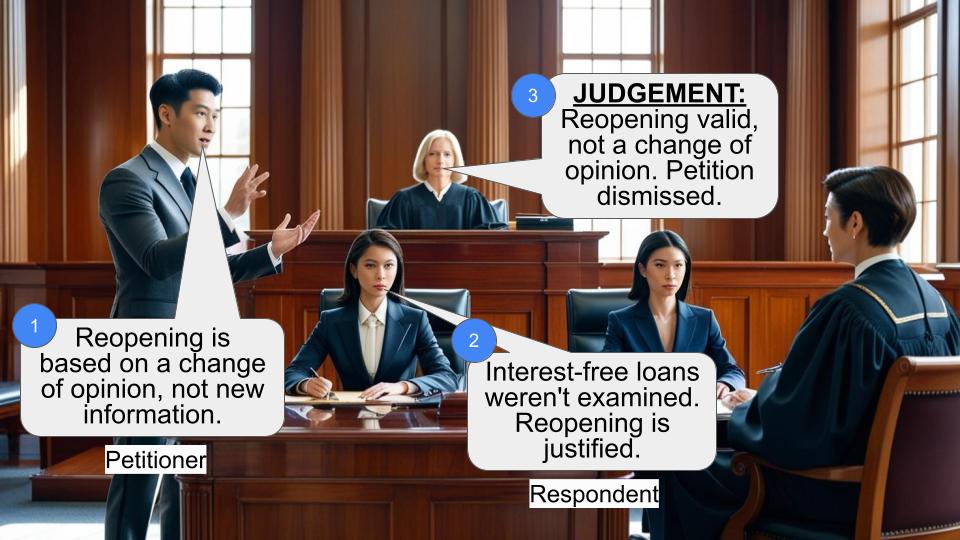
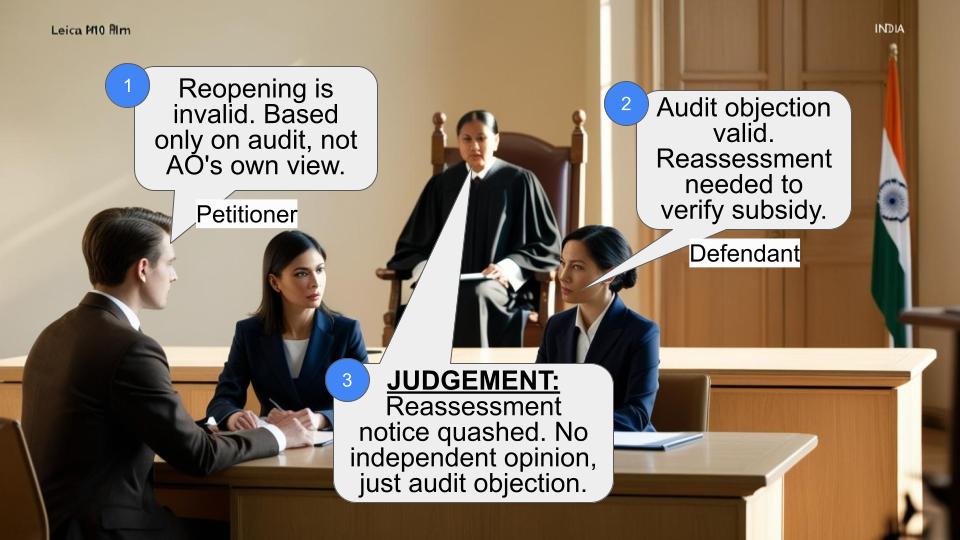
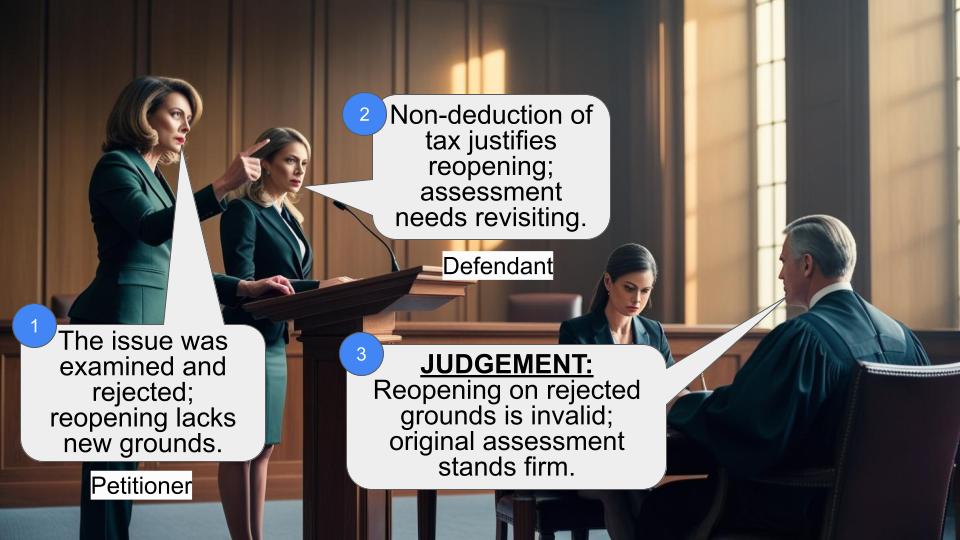
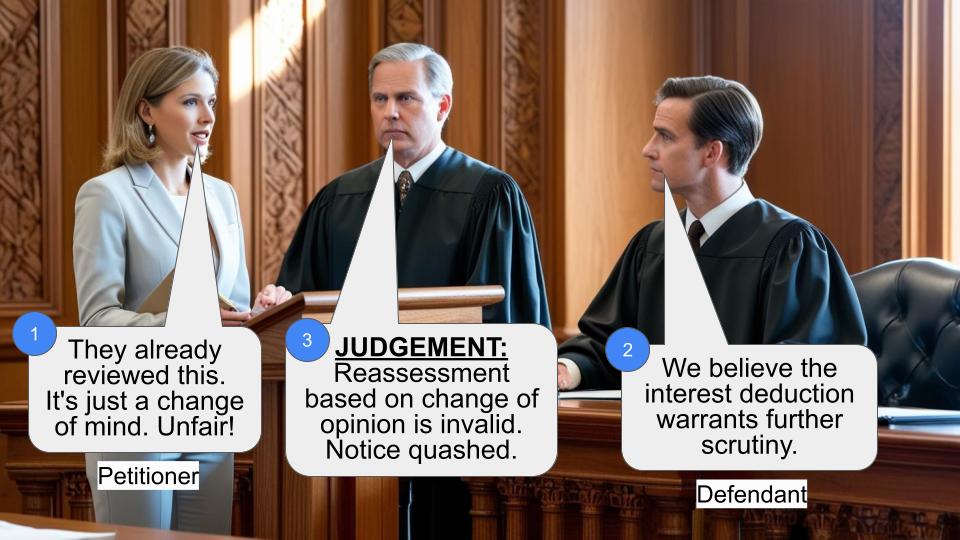
The Gujarat High Court quashed a notice issued by the Deputy Commissioner of Income Tax to reopen the assessment of Aryan Arcade Ltd. for the 2010-11 assessment year. The court ruled that the attempt to reopen the assessment was based on a mere change of opinion, which is not permissible under law.
Get the full picture - access the original judgement of the court order here
Case Name:
Aryan Arcade Ltd. Vs Deputy Commissioner of Income Tax (High Court of Gujarat)
Special Civil Application No. 2798 of 2016
Date: 5th July 2016
Key Takeaways:
1. Reopening an assessment based on a change of opinion is not allowed.
2. When an issue has been scrutinized during the original assessment, it cannot be reopened later.
3. The court's decision reinforces the importance of finality in tax assessments.
Issue:
Was the notice issued by the Deputy Commissioner of Income Tax to reopen the assessment of Aryan Arcade Ltd. for the assessment year 2010-11 valid and legal?
Facts:
1. Aryan Arcade Ltd. filed a nil income tax return for the assessment year 2010-11 on 15.10.2012.
2. The company had raised funds of Rs. 14.89 crores through Optionally Fully Convertible Debentures (OFCD).
3. The company claimed interest expenditure of Rs. 7.28 crores on borrowed funds.
4. The original assessment was completed on 05.02.2013 with no additions.
5. On 23.03.2015, the Deputy Commissioner of Income Tax issued a notice to reopen the assessment.
Arguments:
Petitioner (Aryan Arcade Ltd.):
1. The entire claim of interest on borrowed funds was examined during the original assessment.
2. The attempt to disallow the claim now is based on a change of opinion.
3. There was no escapement of income chargeable to tax.
4. The issue was raised by the audit party, and the original Assessing Officer was convinced that the interest expenditure couldn't be disallowed.
Respondent (Deputy Commissioner of Income Tax):
1. The question of allowing expenditure on borrowed funds not used for acquiring house property was never examined in the original assessment.
2. The notice for reopening was issued within four years and with proper reasons.
3. The current Assessing Officer acted independently and not at the behest of the audit party.
Key Legal Precedents:
1. Adani Exports Ltd. vs. Deputy Commissioner of Income-tax (Asstts) reported in 240 ITR 224 (Guj)
2. Indian and Eastern Newspaper Society, New Delhi Vs. Commissioner of Income Tax New Delhi, reported in 119 ITR 996 (SC)
These cases were mentioned in relation to the issue of reopening assessments at the instance of audit parties, though they weren't directly applied in this case.
Judgement:
The court quashed the notice dated 23.03.2015 issued by the Deputy Commissioner of Income Tax. The court held that:
1. The entire claim of interest expenditure was before the Assessing Officer during the original assessment proceedings.
2. The Assessing Officer had raised several queries and examined various details before allowing the claim.
3. Any attempt to reopen this issue would be based on a mere change of opinion, which is not permissible under law.
FAQs:
1. Q: What was the main reason for quashing the reassessment notice?
A: The main reason was that the attempt to reopen the assessment was based on a mere change of opinion, which is not allowed under law.
2. Q: Can tax authorities reopen an assessment if they've already examined the issue during the original assessment?
A: Generally, no. If an issue has been scrutinized during the original assessment, it cannot be reopened later unless there's new information that wasn't available during the original assessment.
3. Q: What is the significance of this judgment for taxpayers?
A: This judgment reinforces the principle of finality in tax assessments and protects taxpayers from repeated scrutiny on issues that have already been examined.
4. Q: Did the court consider the issue of the audit party's involvement in the reassessment?
A: While the court noted this issue, it didn't make a definitive ruling on it as the case was decided on other grounds.
5. Q: What is the key lesson for tax authorities from this judgment?
A: Tax authorities should be cautious about reopening assessments and ensure they have substantial reasons beyond a mere change of opinion to do so.

1. The petitioner has challenged a notice dated 23.03.2015 issued by the respondent, seeking to reopen the petitioner's assessment for the assessment year 2010-11. Brief facts are as under.
2. The petitioner is a company registered under the Companies Act. For the assessment year 201011, the petitioner had filed return of income on 15.10.2012, declaring nil income. During the relevant period, the petitioner had raised funds to the tune of Rs.14.89 crores (rounded off) by issuing Optionally Fully Convertible Debentures ('OFCD' for short). On such OFCD, the petitioner would also incur interest liability duly reflected in its profit and loss accounts duly audited. The Assessing Officer took the return of the petitioner in scrutiny, during which, he raised various queries. The Assessing Officer framed the order of assessment on 05.02.2013 making no additions. To reopen this assessment, impugned notice came to be issued which may be noticed, was done within a period of four years from the relevant assessment year. In order to issue the notice, the Assessing Officer had recorded following reasons:
“In this case the assessee filed the return of income on 15.10.2010 showing total income at Rs.NIL/. An order u/s. 143(3) (of Income Tax Act, 1961) passed on 05.02.2013 determining total income at Rs.NIL/.
Subsequently, on verification of the details it is noticed that the assessee company engaged in the business of renting of property had shown receipts from rent at Rs.4,48,01,028/. The assessee claimed statutory deduction Rs.1,34,40,308/ u/s. 24(i) (of Income Tax Act, 1961). The assessee also claimed deduction of Rs.7,28,00,166/ on account of interest paid on loan. It was further seen that in the balance sheet as on 31.03.2010 there is no unsecured loan. However, the unsecured loan in the form of Optionally Fully Convertible Debentures (OFCD) at Rs.41.43 cr. have been shown. The assessee has claimed the interest payable on these OFCDs at Rs.7,28,00,166/ from the income from house property due to following reasons. (a) The interest paid on loan taken for purchase of property is an allowable expenditure u/s. 24(ii) (of Income Tax Act, 1961). In the instant case, it can be seen from the statement of fixed assets that the addition on building during the year was just Rs.34,53,367/ whereas the assessee had obtained loan of Rs.14,89,67,078/ by way of new Debentures.
(b) The new Optionally Fully Convertible Debenture was not used for purchase of property or repayment of earlier loan. The interest to the extent of Rs.2,68,14,074/ (18% of Rs.14,89,67,078/) was paid on New Optionally Fully Convertible Debenture of Rs.14,89,67,078/. Out of this, the addition on building amounting to Rs.34,53,367/ as shown in the statement of fixed assets can be treated as loan utilized for addition in the existing property and interest of Rs.6,21,606/ (18% on Rs.34,53,367/) was required to be allowed.
Therefore, the interest paid to the extent of Rs.2,61,92,468/ is required to be disallowed. Since the assessee has not disallowed the said interest of Rs.2,61,92,468/ there is escapement of income to the extent of Rs.6,21,606/ (18% on Rs.34,53,367/ was required to be allowed. Therefore, the interest paid to the extent of Rs.2,61,92,468/ is required to be disallowed. Since the assessee has not disallowed the said interest of Rs.2,61,92,468/ there is escapement of income tot he extent of Rs.2,61,92,468/ within the meaning of sec. 147 (of Income Tax Act, 1961).”
3. The petitioner raised detailed objections to the reopening of the assessment under a communication dated 10.02.2016. Such objections were however rejected by the respondent by an order dated 11.02.2016.
4. In this background, counsel for the petitioner raised following contentions.
I. That the entire claim of interest on borrowed funds was examined by the Assessing Officer during the original assessment proceedings. Any attempt on his part now to disallow such claim, would be based on change of opinion.
II. Even accepting the reasons recorded by the Assessing Officer, it cannot be believed that there has been any escapement of income chargeable to tax. Counsel submitted that the assessee had utilized the fund raised through OFCD for repayment of past loans and the expenditure of interest in connection with such borrowings would be allowable in terms of proviso to section 24B (of Income Tax Act, 1961).
III. Counsel lastly contended that the entire issue was raised by the audit party. Though the Assessing Officer was convinced that the interest expenditure cannot be disallowed, only at the instance of the audit party, the impugned notice for reopening of assessment came to be issued.
5. On the other hand, learned counsel Shri Pranav Desai for the department contended that in the original assessment, the question of allowing expenditure of the assessee company towards interest on borrowed funds which were never used for acquiring house property was never examined by the Assessing Officer. Notice for reopening which was issued within the period of four years by recording proper reasons is therefore, valid. Counsel further submitted that whether there has been escapement of income, can be judged only during the reassessment proceedings and cannot be gone into in the present petition. He lastly contended that the present respondent– Assessing Officer had not acted at the behest of audit party but independently held a belief that income chargeable to tax has escaped assessment.
6. Having thus heard learned counsel for the parties and having perused the documents on record, we notice that in the audited accounts that the petitioner filed alongwith the return, the petitioner had pointed out that payments were made to the persons specified under section 40A(2)(b) (of Income Tax Act, 1961) to the tune of Rs.7.28 crores by way of interest expenditure. During the course of assessment, the Assessing Officer had raised multiple queries. Following queries are relevant for our purpose.
“1. A brief note on the nature of activities under taken during the year relevant to A.Y 201011. Also furnish the address of the office, branches and other premises if any and the nature of activities conducted from these premises. Please given details of sister concerns, if any, with which you are dealing. (In the following format) Complete Whether Whether Nature of Telephone Name &
& Address
office, Factory, Godown, Branch office & Others
owned or rented
business activities carried out
/Fax No. designation of the
person in- charge
4. As regards unsecured loans (Rs.414359187/), please given party wise breakup in descending order. Also give address, PAN and confirmation and ledger copy. Please given interest paid on the loans and tax deducted thereon.
10. Furnish complete details in respect of following incomes
(i) Other income Rs.392786/
(ii) Rental income Rs.43167919/
(iii) Advisory Fees Rs.5375000/
11. Please clarify and give details of tax deducted from following payments.
(1) Salary Expense Rs.1678785/
(2) Interest Rs.58664000/
(3) Legal & Professional Charges Rs.1036056/
(4) Security Service Charges Rs.1085541/
14. Please produce copy of all the ledger account of following expenditure claimed as per P&L A/c.
(1)Salary Expense Rs.3967632/
(2)Interest Rs.58664000/
(3)Advertisement Rs.1209174/
(4)Repairs and Maintenance Rs.231198/
(5)Marketing & Event Expenses Rs.1762441/
(6)Electricity Expenses Rs.3086308/
(7)Other Services Rs.332500/
(8)Other Expenses Rs.1416034/
(9)Brokerage Rs.20250/
(10)Mall Operating Expenses Rs.1557641/
(11)Insurance Rs.206719/
(12)Los on Sale of Fixed Assets Rs.206719/
(13)Interest on TDS Rs.1422617/
(14)House Keeping Expenses Rs.1143549/
(15)Legal & Professional ChargesRs.1034056/
(16)Security Service Charges Rs.1085541/
20. Please furnish details of payment to persons specified in Section 40A(2)(6) (of Income Tax Act, 1961). Specify nature of work/Service these persons are doing for the company. Produce evidence of qualifications these persons are having with respect to job assigned to them with due justification as to why this claim should not be considered excessive.? ”
7. Under letter dated 24.12.2012, the petitioner replied to such queries as under:
Sr. No.
Particulars Remarks
1. A brief note on the nature of activities under taken during the year relevant to A.Y 201011. Also furnish the address of the office, branches and other premises if any and the nature of activities conducted from these premises. Please give details of sister concerns, if any, with which you are dealing.
The Company has acquired a building (mall) at Rajkot, Gujarat on single ownership basis for the purpose of generating rental income from immovable properties.
For address of office, branches and other premises, please refer AnnexureI Page Numbers from 01 to 01
4 As regards unsecured loans (Rs.414359187/ please give party wise breakup in Descending order. Also give address, PAN and
AnnexureIV Page Numbers confirmation and ledger copy. Please give interest paid on the loans and tax deducted thereon.
from 04 to 06
11 Please clarify and give details of tax deducted from following payments.
(1)Salary Expense Rs.2090190/
(2)Interest Rs.72800166/
(3)Legal & Professional Charges Rs.2319851/
(4)Security Service Charges Rs.1377899/
AnnexureX
Page Numbers from 115 to 118
14 (1)Salary Expense Rs.2090190/
(2)Interest Rs.72800166/
(3)Advertisement Rs.1209174/
(4)Repairs and Maintenance Rs.272862/
(5)Marketing & Event Expenses Rs.1988216/
(6)Electricity Expenses Rs.4228061/
(7)Other Services Rs.332500/
(8)Other Expenses Rs.165298/
(9)Brokerage Rs.1735097/
(10)Mall Operating Expenses Rs.2676947/
(11)Insurance Rs.206719/
(12)Los on Sale of Fixed Assets Rs.88779/
(13)Interest on TDS Rs.1422617/
(14)House Keeping Expenses Rs.1487974/
(15)Legal & Professional Charges Rs.2319851/
(16)Security Service Charges Rs.1377899/
AnnexureX Page Numbers from 119 to 173
20 Please furnish details of payment to persons specified in Section 40A(2)(b) (of Income Tax Act, 1961). Specify nature of work Service these persons are doing for the company. Produce evidence of qualifications these persons are having with respect to job assigned to them with due justification as to why this claim should not be considered excessive?
NIL Interest Expense of Rs.72800166/ has been paid to IL&FS Milestone Fund I.
8. After such detailed inquiries, the Assessing Officer passed the order of assessment in which, he observed as under:
“2. The case was selected for Scrutiny, Statutory notice u/s. 143(2) (of Income Tax Act, 1961) dated 26/08/2011 was issued and duly served on the assessee company by speed post. Notice u/s. 142(1) (of Income Tax Act, 1961) dated 03/01/2012 along with questionnaire was issued and duly served on the assessee. Due to change in incumbency, notice u/s. 143(2) (of Income Tax Act, 1961) dated 11/10/2012 was issued and served on assessee on 12/10/2012 by speed post. Further notice u/s. 142(1) (of Income Tax Act, 1961) dated 22/10/2012 was issued calling for certain details/Information/documents which was served on Assessee Company on 23/10/2012.
3. In response to the above notices, General Manager of the assessee company Shri K. Ramakrishnan attended and furnished the details/information etc. from time to time. The same have been verified. The Books of Account maintained by the assessee were produced and the same were test checked. He case is heard and discussed.
4. Subject to the above remarks, the total income of the assessee company is computed as under:
Total Income as per return Rs. NIL/
TOTAL ASSESSED INCOME Rs. NIL/
” 9. It can thus, be seen that the entire claim of interest expenditure was before the Assessing Officer during the original assessment proceedings. The Assessing Officer had raised several queries with respect to the interest paid by the assessee on the borrowed capital. The present issue of interest to the extent of Rs.2.68 crores forms part of the larger interest claim of Rs.7.28 crores made by the assessee in the original assessment. The Assessing Officer only after being satisfied, upon examination of various details, materials and documents supplied by the assessee in response to the various queries raised, chose not to make any disallowance. Any attempt on part of the Assessing Officer now to reopen this issue would be based on mere change of opinion. It may be that the present issue of interest expenditure of Rs.2.68 crores is merely an element of larger claim of assessee of Rs.7.28 crores.
Nevertheless, the Assessing Officer cannot be allowed a second innings by addressing one element of entire claim of the assessee which was scrutinized during the assessment. We may recall, the reasons for the Assessing Officer to reopen the assessment is that according to him the assessee has claimed interest of Rs.7.28 crores payable on OFCD of Rs.41.43 crores out of the income from house property. Interest paid on loan taken on purchase of property is allowable expenditure, however, in the present case, the assessee had shown addition only to the extent of Rs.34.53 lacs towards building, but had obtained loan of Rs.14.89 crores by issuing new debentures. Thus, according to the Assessing Officer, such sum was not used for purchase of properties or repayment of earlier loan and that therefore, out of the total amount of Rs.14.89 crores raised through OFCD interest only relatable to Rs.34.53 lacs would be allowable deduction and the rest of the claim would have to be rejected.
10. As noted, the petitioner had putforth a claim of interest expenditure of Rs.7.28 crores for the entire borrowed sum of Rs.41.43 crores. Interest expenditure of Rs.2.68 crores against newly issued OFCD of Rs.14.89 crores was part of this larger claim. When the entire claim was examined by the Assessing Officer by calling upon the assessee to produce all supporting documents and materials, it would now not be possible for Assessing Officer to disallow this claim and contend that this element of assessee's claim was not examined and would be open for reexamination during the fresh assessment.
11. In view of our conclusions, the petitioner's second and third contentions become insignificant. However, we may briefly record that in facts of the case, we would not have been inclined to examine the petitioner's contention on escapement of income since the same would require examination of various aspects, ordinarily not undertaken in a writ petition since this would be in the realm of sufficiency of the reasons recorded by the Assessing Officer for reopening of the assessment. Regarding the petitioner's last contention of issuance of notice at the instance of the audit party, we had perused the original files produced by the counsel for the Revenue. From such files, we have noticed that this issue did surface during audit inquires. There is also material on record to suggest that original Assessing Officer who, we are informed was of the rank of ITO, was not convinced by the suggestions of the audit party. Had he later on been compelled to issue the notice for reopening the issue would have been squarely covered by the judgment of this Court in case of Adani Exports Ltd. vs. Deputy Commissioner of Incometax (Asstts) reported in 240 ITR 224 (Guj) and judgment of the Supreme Court in case of Indian and Eastern Newspaper Society, New Delhi Vs. Commissioner of Income Tax New Delhi, reported in 119 ITR 996 (SC).
12. However, in the present case, the impugned notice has been issued by one Shri K.L.Solanki, Deputy Commissioner of Incometax. He is the officer who has recorded the reasons and the original file would suggest that he had independently applied his mind and found that the issues raised by the audit party are valid. An interesting question would therefore, arise whether it would be the opinion of the original Assessing Officer on the question of income escaping assessment or of the present respondent who has issued the notice for reopening which would prevail. However, in view of our conclusions with respect to the petitioner's first contention, it is not necessary for us to go into this aspect.
13. In the result, impugned notice dated 23.03.2015 is quashed. Petition is allowed and disposed of accordingly.
(AKIL KURESHI, J.)
(A.J. SHASTRI, J.)
×