


Court Quashes Income Tax Reassessment Notice, Citing Full Disclosure by Assessee


Full News
Court Quashes Income Tax Reassessment Notice, Citing Full Disclosure by Assessee
Court Quashes Income Tax Reassessment Notice, Citing Full Disclosure by Assessee
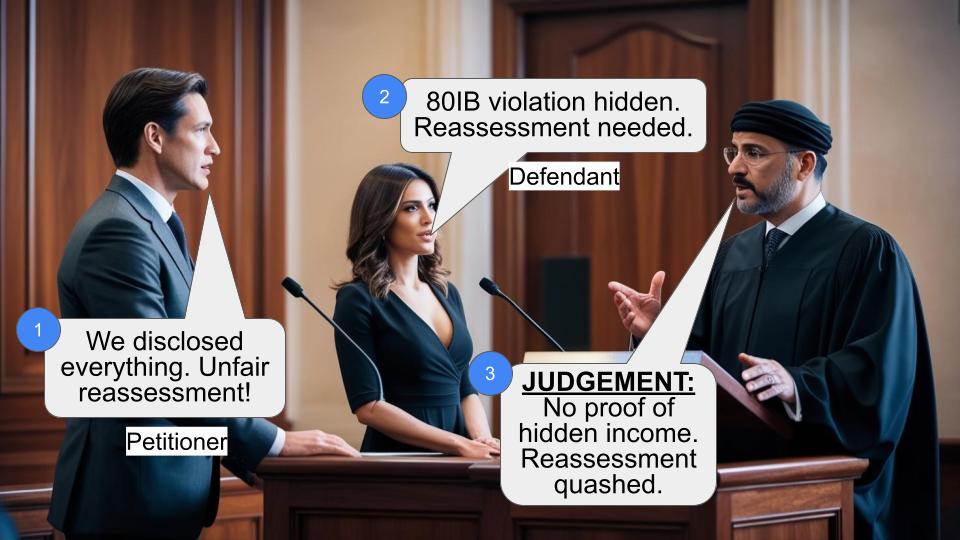
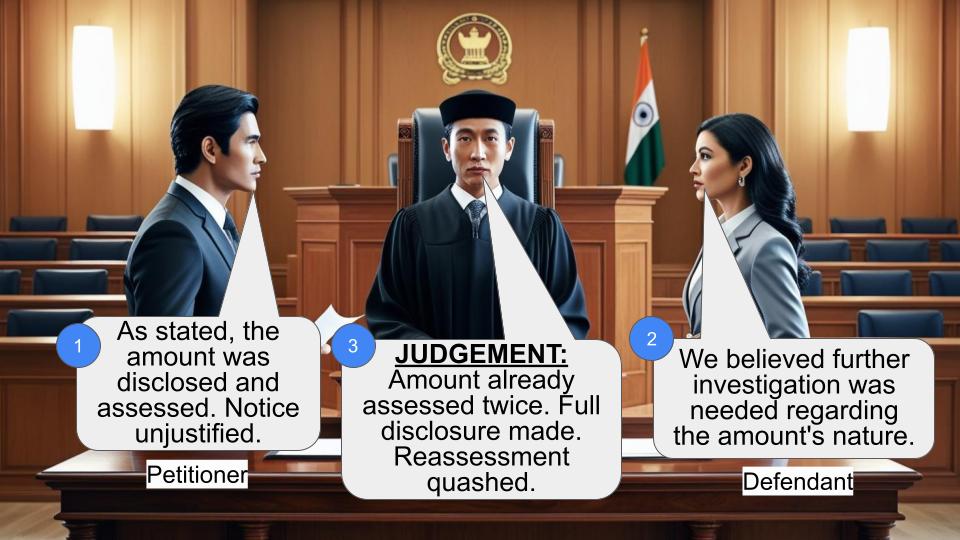
This case involves Anand Developers (the Petitioner) challenging a notice issued by the Assistant Commissioner of Income Tax (the Respondent) to reopen an assessment beyond the normal 4-year period. The High Court ruled in favor of the Petitioner, quashing the reassessment notice due to the Revenue's failure to establish that the assessee had not fully disclosed all material facts during the original assessment.
Get the full picture - access the original judgement of the court order here
Case Name:
Anand Developers vs Assistant Commissioner of Income Tax (High Court of Bombay)
Writ Petition No. 17 of 2020
Date: 18th February 2020
Key Takeaways:
1. For reassessment beyond 4 years, the Revenue must establish prima facie that the assessee failed to disclose all material facts fully and truly.
2. Mere bald assertions of non-disclosure are insufficient; specific details of undisclosed information are required.
3. Full disclosure by the assessee during the original assessment can prevent reassessment beyond the 4-year limit.
Issue:
Can the Income Tax Department issue a notice to reopen an assessment beyond the normal 4-year period when the assessee has fully disclosed all material facts during the original assessment?
Facts:
1. The case concerns the Assessment Year 2012-13.
2. Anand Developers submitted tax returns declaring a total income of Rs. 62,233/-.
3. The case was selected for scrutiny, and an assessment order was made on March 16, 2015, under Section 143(3) (of Income Tax Act, 1961).
4. On February 20, 2015, the Petitioner submitted a letter disclosing potential violations of Section 80IB (of Income Tax Act, 1961) for some flat sales.
5. On March 29, 2019, the Revenue issued a notice under Section 148 (of Income Tax Act, 1961) to reopen the assessment.
6. The Petitioner objected to the reopening, but their objections were rejected on December 17, 2019.
Arguments:
Petitioner:
- Full and true disclosures were made during the original assessment.
- The Revenue lacks jurisdiction to issue a notice beyond 4 years without proving failure to disclose.
- The reassessment is based on a mere change of opinion.
Respondent:
- The Petitioner admitted to violating Section 80IB (of Income Tax Act, 1961) provisions.
- The Petitioner failed to make true and full disclosures.
- The scope of interference with notices under Sections 147 (of Income Tax Act, 1961)/148 is limited.
Key Legal Precedents:
1. Mrs. Parveen P. Bharucha vs. The Deputy Commissioner of Income Tax Circle 2 and anr.
2. Bombay Stock Exchange Ltd. vs. Income Tax Officer
3. Hindustan Lever Ltd. vs. R.B. Wadkar, Assistant CIT, [2004] 268 ITR 232 (Bom)
4. Calcutta Discount Co. Ltd. vs. Income-tax Officer
Judgement:
The High Court ruled in favor of the Petitioner, quashing the reassessment notice and the order rejecting the Petitioner's objections. The court found that:
1. The Revenue failed to establish even prima facie that the Petitioner had not disclosed all material facts fully and truly.
2. The Petitioner had provided a list of flat owners and disclosed potential non-compliance in their letter dated February 20, 2015.
3. The Revenue's bald assertion of non-disclosure without specific details was insufficient to justify reopening the assessment beyond 4 years.
FAQs:
1. Q: What is the normal time limit for reopening an assessment under the Income Tax Act?
A: The normal time limit is 4 years from the end of the relevant assessment year.
2. Q: Under what circumstances can an assessment be reopened beyond 4 years?
A: An assessment can be reopened beyond 4 years if the Revenue can establish that the assessee failed to disclose fully and truly all material facts necessary for the assessment.
3. Q: What did the court mean by "bald assertion" in this case?
A: The court used "bald assertion" to describe the Revenue's claim of non-disclosure without providing specific details about what information was allegedly not disclosed.
4. Q: How does this judgment impact taxpayers?
A: This judgment reinforces the importance of full disclosure during original assessments and provides protection against arbitrary reopening of assessments beyond the 4-year limit.
5. Q: What sections of the Income Tax Act were central to this case?
A: The key sections were 147 and 148, which deal with income escaping assessment and issue of notice where income has escaped assessment, respectively.

Heard Mr. Shivan Desai for the Petitioner and Ms. S. Linhares, learned Standing Counsel for the Respondents.
2. Rule. Rule is made returnable forthwith with the consent of and at the request of the learned Counsel for the parties.
3. Challenge in this Petition is to the Notice dated 29th March, 2019, issued under Section 148 (of Income Tax Act, 1961) (IT Act) and the order dated 17th December, 2019, disposing of the Petitioner's objections to the reopening of the assessment in pursuance of the notice dated 29th March, 2019.
4. Mr. Shivan Desai, learned Counsel for the Petitioner submits that in the present case, true and complete disclosures were made by the Petitioner vide letter dated 20th February, 2015 in the course of the assessment proceedings itself. Upon consideration of such disclosures, the Assessing Officer (AO) made assessment order dated 16th March, 2015 under Section 143(3) (of Income Tax Act, 1961). Mr. Desai submits that in such circumstances, merely on the basis of a change of opinion, the AO lacked jurisdiction to issue notice under Section 148 (of Income Tax Act, 1961), seeking to reopen the assessment. In any case, Mr. Desai submits that since, there was absolutely no failure to make true and full disclosures, there was no jurisdiction to issue notice under Section 148 (of Income Tax Act, 1961), after expiry of period of 4 years from the date of assessment. On both these grounds, he submits that the Rule is liable to be made absolute in the present Petition. He relies on the cases of Mrs. Parveen P. Bharucha vs. The Deputy Commissioner of Income Tax Circle 2 and anr.
5. Ms. Linhares, learned Standing Counsel for the Respondents submits that since the Petitioner had admitted vide letter dated 20th February, 2015 that it had violated the provisions of Section 80IB (of Income Tax Act, 1961) and further, failed to make true and full disclosures, there was absolutely no jurisdictional error in issuing the impugned notice or making the impugned order. She submits that the scope of interference with notices under Section 147 (of Income Tax Act, 1961)/148 of the IT Act is quite limited. She submits that at this stage, it will not be appropriate to go into the merits of the matter, for which, the Petitioner will have ample opportunity during the reassessment proceedings. She, therefore, submits that the present Petition is liable to be dismissed. She relies on Calcutta Discount Co. Ltd. vs. Income-tax Officer 4 ; S. Narayanappa vs. Commissioner of Income-
tax 5 ; Assistant Commissioner of Income Tax vs. Rajesh Jhaveri Stock
Brokers (P) Ltd.6 and Raymond Woollen Mills Ltd. vs. Income Tax
Officer & Ors. in support of her defence.
6. The rival contentions now fall for our determination.
7. In the present case, we are concerned with the Assessment Year 2012-13, for which, the Petitioner had submitted returns within the prescribed period, declaring total income of Rs.62,233/-. The case was selected for scrutiny through CASS and notice was issued to the Petitioner under Section 143(2) (of Income Tax Act, 1961), which was served upon the Petitioner on 28-08-2013. Based upon the details furnished by the Petitioner to the AO, the assessment order dated 16th March 2015 was made by the AO in terms of Section 143(2) (of Income Tax Act, 1961).
8. Paragraphs 3 and 4 of the assessment order dated 16th March, 2015 are relevant to the issues raised in the present Petition and, therefore, the same are prescribed below for convenience of reference :
“3. In response to the notices issued, Shri Rajan Ramani, Chartered Accountant and the Authorized Representative of the assessee appeared from time to time and submitted the details. The details produced have been verified and the case was heard. The assessee is carrying on the Real Estate/Builders & Developers.
4. After perusing the details submitted by assessee, the assessment is concluded by accepting the return of income of the assessee.”
9. In fact, it is the case of the Petitioner that the Petitioner, vide letter dated 20th February, 2015, in the course of assessment proceedings before the AO had itself submitted that a few flats may have been allotted to persons in violation of Clause 10(f) of Section 80IB (of Income Tax Act, 1961). However, in the same letter, it was contended that this ought not to be regarded as any breach of the provisions of Section 80IB (of Income Tax Act, 1961) or in any case, this ought not to be regarded as any breach of the provisions of Section 80IB (of Income Tax Act, 1961) in its entirety and at the highest, benefit may be denied in respect of the transfers made in breach of Clause 10(f) of Section 80IB (of Income Tax Act, 1961).
10. The Petitioner has pleaded that for the present, the Petitioner does not have a copy of the letter dated 20th February, 2015 and, therefore, letters were addressed to the Respondents to furnish a copy of the same. However, the copy of the same has till date not been furnished by the Respondents.
11. The factum of address of the letter dated 20th February, 2015 is indisputable, because the Respondents have themselves not only referred to the letter dated 20th February, 2015, but also quoted from the letter dated 20th February, 2015 in the Show Cause Notice dated 17th December, 2019 issued to the Petitioner along with the impugned Order dated 17th December, 2019, by which the objections of the Petitioner to the reopening of the assessment came to be rejected. Even the impugned order dated 17th December, 2019, rejecting the Petitioner's objections, makes a specific reference to the Petitioner's own letter dated 20th February, 2015 submitted during the assessment proceedings under Section 143(3) (of Income Tax Act, 1961).
12. Both, the Show Cause Notice dated 17th December, 2019 and the impugned Order dated 17th December, 2019, specifically state that the Petitioner, in the course of the assessment proceedings before the AO, had furnished a list of flat owners to whom flats were sold in the project 'Bay Village'. The notice and the impugned order proceed to state that upon perusal of this list, coupled with the letter dated 20th February, 2015, it transpires that there was non- compliance on the part of the Petitioner with the provisions of Section 80IB (of Income Tax Act, 1961), at least in so far as some of the sales were concerned.
13. Since, it is virtually an admitted fact that the Petitioner had submitted a list of the flat owners and further, itself vide letter dated 20th February, 2015 pointed out that there may be breach in so far as sale of some of the flats are concerned, it can really not be said by the Respondents that there was no truthful or complete disclosures on the part of the Petitioners in the course of the assessment proceedings itself. Merely making of bald statement that the assessee had not disclosed fully and truly all the material facts, is really never sufficient in such matters.
14. In the case of Bombay Stock Exchange Ltd. (supra), Division Bench of this Court has held that though it is true that the reasons for initiating reassessment proceedings do, in fact, state that there was violation on the part of the Petitioner to disclose fully and truly all material facts necessary for its assessment, however, making of such bald assertion was not enough. Relying upon Hindustan Lever Ltd. vs. R.B. Wadkar, Assistant CIT, [2004] 268 ITR 232 (Bom), the Division Bench held that there is requirement of giving details as to which fact or the material was not disclosed by the Petitioner, leading to its income escaping assessment. In the said matter as well, there was only a bald assertion in the reasons that there was failure on the part of the Petitioner to disclose fully and truly all material facts, without giving any details thereof. The notice proposing to reopen the assessment was quashed in such circumstances.
15. In the present case as well, apart from bald assertion that the Petitioner had not disclosed fully and truly all material facts, no details have been disclosed as to the material which was allegedly not disclosed either truly, or fully. Rather, the record indicates that the entire list of flat owners was disclosed. Further, vide letter dated 20th February, 2015, disclosures were made in relation to the sale transactions and it was even suggested that some of the sale transactions may not be compliant with the provisions of Clause 10(f) of Section 80IB (of Income Tax Act, 1961). Clearly, therefore, the Respondents have failed to make out any case that there was no true and full disclosures by the Petitioner.
16. Section 147 (of Income Tax Act, 1961) empowers the AO who has reason to believe that any income chargeable to tax has escaped assessment for any assessment year, to reassess such income, no doubt, subject to the provisions of sections 148 to 153 of the IT Act. The proviso to Section 147 (of Income Tax Act, 1961), however, makes clear that where an assessment under sub- section (3) of section 143 (of Income Tax Act, 1961) has been made for the relevant assessment year, no action shall be taken under Section 147 (of Income Tax Act, 1961), after the expiry of four years from the end of relevant assessment year, unless any income chargeable to tax has escaped assessment for such assessment year by reason of the failure on the part of the assessee, inter alia, “to disclose fully and truly all material facts necessary for its assessment for that assessment year.”
17. This means that normally, the limitation period for reassessment under Section 147 (of Income Tax Act, 1961) is 4 years. However, in a case where the assessment has been made under Section 143(3) (of Income Tax Act, 1961) where, inter alia, the assessee fails to disclose fully and truly all material facts necessary for assessment for that assessment year, reassessment can be made even beyond the period of 4 years in terms of Section 148 (of Income Tax Act, 1961). Therefore, in order to sustain a notice seeking to reopen assessment beyond normal period of 4 years, it is necessary for the Respondents to establish, at least, prima facie that there was failure to disclose fully and truly all material facts necessary for the assessment for that assessment year.
18. In the facts of the present case, the Respondents have failed to establish this precondition even prima facie. Rather, the material on record establishes that there were full and true disclosures of all material facts necessary for the assessment of the Petitioner for the Assessment Year 2012-13. Despite this, the impugned notice seeking to reopen the assessment for the Assessment Year 2012-13 has been issued beyond the normal period of 4 years. According to us, on this short ground the impugned notice dated 29th March, 2019 and the impugned order dated 17th December, 2019 are required to be quashed and set aside.
19. The view which we have taken finds support in the decisions of the Division Bench of this Court in the case of Mrs. Parveen P. Bharucha (supra) and Zuari Foods and Farms Pvt. Ltd. (supra).
20. The decisions relied upon by Ms. Linhares are quite distinguishable and will not apply to the fact situation in the present matter.
21. S. Narayanappa (supra) provides that where it was clear from the material on record that there was nondisclosure on the part of the assessee which led to underassessment of income, the Revenue was entitled to issue notice, seeking reopening of the assessment. In the present case, the material on record is clear, on that there was no failure to disclose true and full material facts on the part of the Petitioner-assessee. Therefore, the decision in S. Narayanappa (supra) can be of no assistance to the Respondents-Revenue.
22. In Raymond Woollen Mills Ltd. (supra), the Hon'ble Apex Court has held sufficiency or correctness of the material on the basis of which the AO may have had 'reasons to believe' is not to be examined at the stage of determining the validity of the notices, seeking to reopen the assessment. In the present case, we have not at all adverted to the sufficiency or correctness of the material. In fact, that issue is not being addressed, since one of the essential parameters precedent to reopening of assessment, has not at all been complied with by the Revenue.
23. In Rajesh Jhaveri Stock Brokers (P) Ltd. (supra), there is discussion as to the circumstances in which it can be held that the notice seeking reassessment is based on a mere change of opinion by the AO. Again, we have not gone into this issue in the present matter and, therefore, the decision is really not attracted in the present case.
24. The decision in Calcutta Discount Co. Ltd. (supra) in fact, assists the case of the Petitioner rather than the Respondents. In this decision, the Hon'ble Supreme Court has held that it is the duty of the assessee to disclose fully and truly all primary relevant facts and once all primary facts are before the assessing authority, he requires no further assistance by way of disclosure and it is for him to decide what inference of facts can be reasonably drawn and what legal inferences have ultimately to be drawn. However, if there are some reasonable grounds for thinking that there had been under- assessment as regards any primary facts which could have a material bearing on question of under-assessment, that would be sufficient to give jurisdiction to the ITO to issue notice for reassessment.
25. In the present case, as noted earlier, there is absolutely no reference to any alleged material facts which the Petitioner failed to disclose in the course of the assessment proceedings. Rather, the impugned notice refers to the list, as well as the letter issued by the Petitioner itself, which is sought to be made basis for reopening of the assessment. In this case, it is apparent that all the primary facts were disclosed by the Petitioner. In fact, the Petitioner had disclosed truly and fully all the material facts and it was open to the AO to take the same into account in the course of the assessment proceedings or, in any case, it was open to the AO to issue notice for reassessment within normal period of 4 years from the date of assessment.
26. For all the aforesaid reasons, we allow the present Petition and quash and set aside the impugned notice dated 29th March, 2019 and the impugned order dated 17th December, 2019. Rule is accordingly made absolute in terms of prayer clauses (a), (b) and (c) of the Petition. There shall be no order as to costs.
Nutan D. Sardessai, J. M.S. Sonak, J.
×
Similar Ripples
Questions
Court Quashes Income Tax Reassessment Notice, Citing Full Disclosure by Assessee
Write your CommentSimilar Posts


Generic
- Reportdata/6080.pdf
