


Court Quashes Income Tax Reassessment Notices, Citing Lack of New Evidence and …


Full News
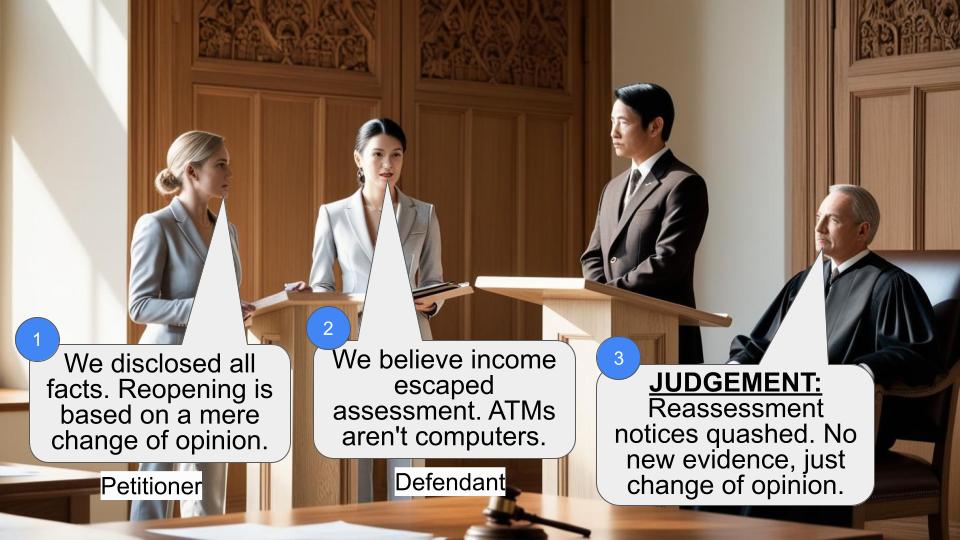
Court Quashes Income Tax Reassessment Notices, Citing Lack of New Evidence and Mere Change of Opinion
Court Quashes Income Tax Reassessment Notices, Citing Lack of New Evidence and Mere Change of Opinion
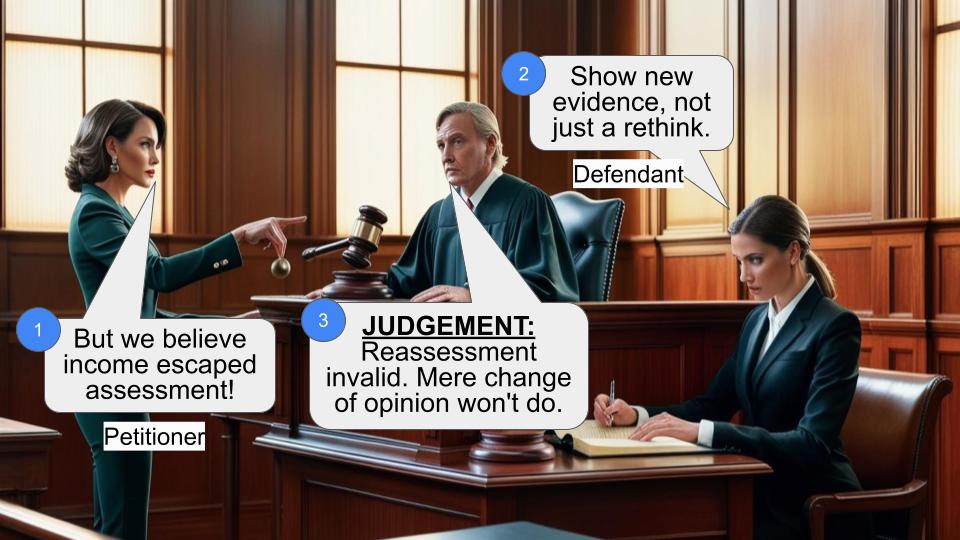
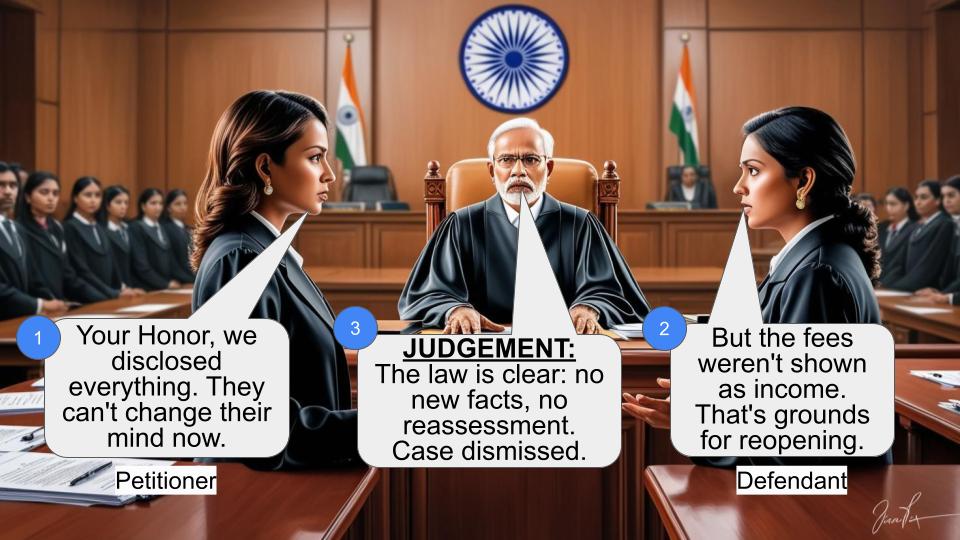
The High Court of Punjab and Haryana quashed notices issued by the Income Tax Department to reopen assessments for the State Bank of Patiala. The court ruled that the department failed to show any failure on the bank's part to disclose material facts fully and truly, and that reopening based on a mere change of opinion was not permissible.
Get the full picture - access the original judgement of the court order here
Case Name:
State Bank of Patiala vs. Commissioner of Income Tax & Another (High Court of Punjab & Haryana)
CWP No.6765 of 2013
Date: 22nd April 2015
Key Takeaways:
1. Reopening of assessments after 4 years requires proof of failure to disclose material facts.
2. Mere change of opinion is not a valid ground for reopening assessments.
3. Assessing Officers cannot review their own decisions but can reassess based on new evidence.
4. The court's jurisdiction can be invoked when the foundation for reopening is illegal.
Issue:
Can the Income Tax Department reopen completed assessments after 4 years without proving failure to disclose material facts or based solely on a change of opinion?
Facts:
- The State Bank of Patiala filed income tax returns for assessment years 2005-06, 2006-07, and 2007-08.
- The bank claimed 60% depreciation on ATMs, treating them as computers.
- Assessments were completed under Section 143(3) (of Income Tax Act, 1961) on 28.11.2007 and 30.11.2007.
- In 2012, the Income Tax Department issued notices under Sections 147 (of Income Tax Act, 1961) and 148 to reopen these assessments.
- The department's reason was that in a later assessment year (2008-09), they had disallowed the 60% depreciation claim on ATMs.
Arguments:
Petitioner (State Bank of Patiala):
- All material facts were fully disclosed in the original returns.
- Reopening was based on a mere change of opinion, which is not permissible.
- The notices didn't fulfill the mandatory requirement of recording that the assessee failed to disclose material facts.
Respondent (Income Tax Department):
- The Assessing Officer had reason to believe income had escaped assessment.
- ATMs are not computers and should be treated as plant and machinery with a lower depreciation rate.
- Complete disclosure of material facts was not made in the original returns.
Key Legal Precedents:
1. Duli Chand Singhania Vs. Assistant Commissioner of Income Tax (2004) 269 ITR 192
2. Mahavir Spinning Mills Ltd. Vs. Commissioner of Income Tax & another [2004] 270 ITR 290
3. Winsome Textiles Industries Ltd. Vs. Union of India & others [2005] 278 ITR 470
4. Commissioner of Income Tax, Delhi Vs. Kelvinator of India Ltd. [2010] 320 ITR 561
These cases established that reopening assessments after 4 years requires proof of failure to disclose material facts, and that mere change of opinion is not a valid ground for reopening.
Judgment:
The High Court allowed the writ petitions and quashed the notices issued by the Income Tax Department. The court held that:
1. For assessment years 2005-06 and 2006-07, the department failed to show any failure on the bank's part to disclose material facts fully and truly.
2. For assessment year 2007-08, reopening based on a mere change of opinion was not permissible.
3. The Assessing Officer has no power to review but only to reassess based on new evidence.
FAQs:
1. Q: What is the significance of the 4-year time limit in this case?
A: After 4 years, assessments can only be reopened if there's proof that the assessee failed to disclose material facts fully and truly.
2. Q: Can an Assessing Officer change their opinion on a previously assessed return?
A: No, a mere change of opinion is not a valid ground for reopening an assessment. There must be new evidence or information.
3. Q: What's the difference between reviewing and reassessing?
A: Reviewing means reconsidering a decision without new evidence, which is not allowed. Reassessing involves examining new evidence or information that wasn't available during the original assessment.
4. Q: Does this judgment apply to all income tax cases?
A: While it sets a precedent, each case is unique. However, it reinforces the principle that reopening assessments must be based on solid grounds, not just a change of opinion.
5. Q: What should taxpayers learn from this case?
A: It's crucial to disclose all material facts fully and truly in your original tax returns. If you've done so, it becomes harder for the tax department to reopen assessments after 4 years.

1. This judgment shall dispose of CWP Nos.6765, 17892 & 6767 of 2013, pertaining to assessment years 2005-06, 2006-07 & 2007-08, respectively, since common questions of law and facts are involved. However, to dictate orders, facts have been taken from CWP No.6765 of 2013.
2. The petitioner-Bank has challenged the order dated 25.03.2013 (Annexure P1), passed by respondent No.2, the Assistant Commissioner of Income Tax (its acronym, 'ACIT'), whereby its objections to the notice issued under Section 148 (of Income Tax Act, 1961) (for short, the 'Act'), for reopening of assessment, were rejected. Challenge has also been made to the notice issued under Section 147 (of Income Tax Act, 1961), on the basis of which, the reassessment notice was issued, whereby the reasons were recorded for reopening the assessment.
3. The main submission raised by the Learned Senior Counsel for the petitioner, in the cases pertaining to assessment years 2005-06 & 2006-07, is that once there was no finding recorded by the Assessing Officer (its acronym, 'AO') that the petitioner had not disclosed fully and truly all the material facts and a period of 4 years had expired from the end of the relevant assessment year, reopening could not be done on account of change of opinion, which had led to the notices being issued. In CWP No.6767 of 2013, the challenge was on the ground that since it was only a change of opinion, the same was not permissible on account of the foundation being illegal and the jurisdiction of this Court was, thus, being invoked.
4. As per the pleadings, the return of income under Section 139(1) (of Income Tax Act, 1961) was filed on 28.10.2005 and the assessment order was passed on 28.11.2007, under Section 143(3) (of Income Tax Act, 1961). The case of the Bank was that along with the return of income, it had filed its balance-sheet, profit and loss account, cash flow statements, notes on accounting policies, auditors reports, directors report etc. The Bank had installed various Automatic Teller Machines (its acronym, 'ATM'), for the benefit of its customers and claimed depreciation @ 60%, by treating it as computers instead of claiming 15% depreciation, which was in the case of a plant and machinery. The assessment was finalised upto the year 2007-08 and no disallowance was made on account of the depreciation claimed @ 60%.
5. After the expiry of 4 years from the date of the order passed under Section 143(3) (of Income Tax Act, 1961), notice dated 27.03.2012 (Annexure P2) was issued under Sections 147 (of Income Tax Act, 1961) & 148, which apparently did not satisfy the requirement provided under Section 147 (of Income Tax Act, 1961), regarding the failure of the assessee to disclose fully and truly all the material facts. The same was replied by filing detailed objections on 13.03.2013 (Annexure P5) by taking the plea that the returns, in response to the notice, had been filed and the Bank had disclosed all the relevant materials, showing that operationalisation of 251 ATMs had been done by March, 2005 and no fresh material had come to the notice of the AO to reopen the assessment and issue the notice under Section 148 (of Income Tax Act, 1961). The reopening, thus, was alleged to be a change of opinion by the successor, which was not permissible. Another detailed reply was submitted on 23.03.2013 (Annexure P4), placing reliance upon various judgments that since there were two views on the ATMs, the view in favour of the assessee should be adopted.
6. The said objections were, thereafter, rejected by taking the plea that no separate head of ATM machines was furnished for depreciation in the depreciation chart and it was only later, this aspect came to the light in another assessment year. It was, accordingly, held that reason to believe that the income had escaped assessment would entitle the AO to re-assess the income chargeable to tax, for the said assessment year.
7. In order to appreciate the controversy, the reasons which have been recorded by respondent No.2, for issuing the notice under Section 147 (of Income Tax Act, 1961) read with Section 148 (of Income Tax Act, 1961), would go on to show that when the assessment proceedings for the subsequent years 2008-09, were being processed, it came to the notice of the said AO that depreciation had been claimed @ 60%, which was disallowed and an addition of `3,71,00,000/- was made by disallowing the cost of depreciation claimed and only allowing depreciation @ 15% on the ATM by treating the same as plant and machinery. Accordingly, noticing that the position was similar for the concerned assessment years 2005-06 and since the 251 ATMs had been operationalised by March, 2005 and by holding that there was reason to believe that the income of the assessee, chargeable to tax, had escaped assessment, notice was issued for the years in question.
8. Counsel for the petitioner has, thus, submitted that the said notices were liable to be quashed along with the impugned order dated 25.03.2013, whereby the objections had been dismissed as it was only a change of opinion, being recorded by the AO by submitting that the Bombay High Court in Commissioner of Income Tax-1 Vs. M/s Saraswat Infotech Ltd. (in ITA(L) No.1243 of 2012) decided on 15.01.2013 (Annexue P10), has held against the Revenue on the said issue. Reliance has also been placed upon the judgment of the Income Tax Appellate Tribunal, New Delhi Bench, to contend that ATMs are computerized telecommunications and therefore, the depreciation was rightly claimed @ 60%. Similar reliance has also been placed upon the decision of the ITAT, Bangalore Bench in M/s NCR Corporation Pvt. Ltd. Vs. Assistant Commissioner of Income Tax (in ITA No.353 (Bang) 2010) decided on 28.02.2011, on the same issue.
9. Counsel for the Revenue, on the other hand, has justified the order, by taking the plea that necessary permission had been taken from the competent authority and notice was issued, thereafter, on 27.03.2012, since the AO had reason to believe that the income had escaped assessment as the ATM was not a computer and complete disclosure of material facts had not been made in the return filed and that depreciation @ 33.33% on straight-line method had been provided and there was no full disclosure to the annual report and accordingly, there was a valid reason to issue notice.
10. Without going into the merits of the issue as to whether the ATM is a computer or ought to be treated as normal plant and machinery, attracting different rates of depreciation, we are of the opinion that the present writ petitions are liable to be allowed on the ground that admittedly, the notice issued on 27.03.2012 did not fulfil the mandatory requirement of recording that the assessee did not disclose fully and truly all the material facts which was the necessary requirement in CWP Nos.6765 and 17892 of 2013. The reasons which have prevailed with the AO to issue notice reads as under:
“Reasons u/s 147 (of Income Tax Act, 1961) r.w.s. 148 (of Income Tax Rules, 1962) of the Income Tax Act, 1961 reopening the assessment. During the course of assessment proceedings for the assessment year 2008-09, it has been noticed that the assessee bank has claimed depreciation on ATM @ 60% by treating the ATM as Computer. At the time of finalizing the assessment, the assessee was allowed depreciation on ATM @ 15% as allowed under I.T. Laws on Plant & Machinery by treating the ATM as Plant & Machinery. Accordingly, an addition of Rs. 3,71,00,000/- was made by disallowing the excess depreciation claimed by the assessee. Similar is the position for the assessment year under consideration i.e. A.Y. 2005-06. Assessee had operationalised 251 ATMs by March, 2005. Therefore, I have reason to believe that income of the assessee chargeable to tax has escaped assessment for the financial year 2004-05 relevant to A.Y. 2005-06 within meaning of section 147 (of Income Tax Act, 1961).
Issue notice u/s 148 (of Income Tax Act, 1961) r.w.s. 151 (of Income Tax Rules, 1962) of the Income Tax Act, 1961.
Date: 27.03.2012 Sd/-
(Dr.Raman Garg)
Asstt. Commissioner of Income-tax, Circle, Patiala”
11. A perusal of the above would go on to show that when the returns for the subsequent years were processed, the AO had disallowed the claim made @ 60% and added a sum of `3,71,00,000/- to the income of the assessee-Bank, by allowing depreciation @ 15% only, by treating the ATMs as plant and machinery. Keeping in view the fact that the ATMs had been operationalised by March, 2005, reasons were recorded to believe that the income of the assessee, chargeable to tax, had escaped assessment. There is no disputing the fact that the assessment for the said years, i.e., 2005-06 and 2006-07, under Section 143(3) (of Income Tax Act, 1961) had concluded on 28.11.2007 and 30.11.2007 and determination of tax upon the assessee was made on the basis of the assessment. The proviso to Section 147 (of Income Tax Act, 1961) provides that no action shall be taken under the said section, after the expiry of 4 years from the end of the relevant assessment year unless any income chargeable to tax has escaped assessment, by reason of failure on the part of the assessee to make the return or respond to the notice issued under Section 142(1) (of Income Tax Act, 1961) or Section 148 (of Income Tax Act, 1961). The other condition is that there should be disclosure of fully and truly all material facts necessary for the said assessment year.
12. The issue of initiating proceedings under Section 147 (of Income Tax Act, 1961) was considered by this Court in Duli Chand Singhania Vs. Assistant Commissioner of Income Tax (2004) 269 ITR 192, wherein, it was held that in the absence of valid assumption of jurisdiction under Section 147 (of Income Tax Act, 1961), the notice after 4 years from the end of the assessment year in question, could not be initiated in the absence of any allegation that there was failure on the part of the assessee to disclose fully and truly all material facts. In the absence of any such reasons, the assumption of jurisdiction under Section 147 (of Income Tax Act, 1961) was not justified. Relevant portion of the reasoning given reads as under:
“13. The entire thrust of the findings recorded by the Assessing Officer in his order dated 13-3-2003 is to justify his satisfaction about escapement of income. According to him, it was a clear case of escapement of income as defined in Explanation-2 to Section 147 (of Income Tax Act, 1961) as the assessee had been allowed excessive relief under Section 80-O (of Income Tax Act, 1961). However, it is not necessary for us to go into the merits of this finding as the second requirement of the proviso has not been satisfied obviously. The reasons recorded by the Assessing Officer for initiation of proceedings under Section 147 (of Income Tax Act, 1961) have already been reproduced above. A bare perusal of the same shows that the satisfaction recorded therein is merely about escapement of income. There is not even a whisper of an allegation that such escapement had occurred by reason of failure on the part of the assessee to disclose fully and truly all material facts necessary for his assessment. Absence of this finding, which is a "sine quo non" for assuming jurisdiction under Section 147 (of Income Tax Act, 1961) in a case falling under the proviso thereto, makes the action taken by the Assessing Officer wholly without jurisdiction. As already observed, the learned counsel for the Revenue has conceded that neither in the reasons recorded nor in the order dated 13-3-2003, has the assessee been charged with failure to disclose, fully and truly all material facts necessary for his assessment.”
13. The said view was followed in Mahavir Spinning Mills Ltd. Vs. Commissioner of Income Tax & another [2004] 270 ITR 290, and the objections raised by the Revenue that the writ was not maintainable against the notice, was rejected. Relevant portion of the judgment reads as under:
“11. A bare perusal of the above shows that the entire thrust of the observations recorded by the Assessing Officer is to justify his satisfaction about escapement of income. There is not even a whisper of an allegation that such escapement had occurred by reason of failure on the part of the assessee to disclose fully and truly all material facts necessary for its assessment. As held in Duli Chand Singhania's case, absence of this finding makes the action of the Assessing Officer wholly without jurisdiction. Since the illegality of notice under Section 148 (of Income Tax Act, 1961) is apparent from the reasons recorded for initiation of proceedings under Section 147 (of Income Tax Act, 1961), it is a fit case for interference in the exercise of our writ jurisdiction. Sending the petitioner back to the Assessing Officer to raise these objections and requiring him to pass an order thereon would be prolonging the proceedings unnecessarily.”
14. Similarly, in Winsome Textiles Industries Ltd. Vs. Union of India & others [2005] 278 ITR 470, it was held that once the assessment had been made under Section 143(3) (of Income Tax Act, 1961), the genuineness of the claims made in the return had to be examined and the failure of the AO to do so would not permit him to reopen the assessment which had already been completed and had become barred by limitation. Accordingly, the notices issued under Section 148 (of Income Tax Act, 1961) were quashed. Relevant portion of the judgment reads as under:
“14. The limitation of four years provided in the proviso to Section 147 (of Income Tax Act, 1961) has been made applicable only to cases where assessments have already been completed under Sub-section (3) of Section 143 (of Income Tax Act, 1961) or under Section 147 (of Income Tax Act, 1961). There is a specific purpose behind it. Where the return is processed under Section 143(1)(a) (of Income Tax Act, 1961), the Assessing Officer has no jurisdiction to examine the genuineness of the claims made in the return of income. He has only limited power of making adjustments on the basis of information available in the return. However, when an assessment is made under Section 143(3) (of Income Tax Act, 1961), the Assessing Officer has very wide power to examine the genuineness of the claims made in the return and require the assessee to furnish whatever information the Assessing Officer deems necessary. In the present case, the assessment had been made under Section 143(3) (of Income Tax Act, 1961) and if the Assessing Officer was of the view that he required profit and loss account and depreciation charts of the assessment years 1995-96 and 1996-97 for examining the correctness of the claim under Section 80IA (of Income Tax Act, 1961), he could have required the assessee to produce the same. Failure of the Assessing Officer to do so, cannot be treated at par with the failure of the assessee to disclose fully and truly all material facts necessary for its assessment.”
15. The reasons for opening the assessment which had already been concluded on 28.11.2007 and 30.11.2007, thus, do not show that there was any failure on the part of the assessee to disclose fully and truly all the material facts and thus, it was merely a change of opinion and in view of the settled position of law, the petitioner would be entitled for setting aside the said notices issued. The said factor, namely, the additional factor regarding the change of opinion by the AO, would also be a valid ground for setting aside the notice issued for the assessment year 2007-08, which is discussed below.
16. In CWP No.6767 of 2013, pertaining to assessment year 2007-08, the writ petition is liable to be allowed, in view of the principle of law laid down by the Apex Court in Commissioner of Income Tax, Delhi Vs. Kelvinator of India Ltd. [2010] 320 ITR 561 wherein it has been held that jurisdiction could not be conferred on the basis of mere change of opinion and it could not be a reason per se to reopen assessments which had been finalised and change of opinion was not relevant ground for reason to believe for issuance of notice under Section 147 (of Income Tax Act, 1961). Relevant observations read as under:
“4. On going through the changes, quoted above, made to Section 147 (of Income Tax Act, 1961), we find that, prior to Direct Tax Laws (Amendment) Act, 1987, re-opening could be done under above two conditions and fulfillment of the said conditions alone conferred jurisdiction on the Assessing Officer to make a back assessment, but in section 147 (of Income Tax Act, 1961) [with effect from 1st April, 1989], they are given a go- by and only one condition has remained, viz., that where the Assessing Officer has reason to believe that income has escaped assessment, confers jurisdiction to re- open the assessment. Therefore, post-1st April, 1989, power to re-open is much wider. However, one needs to give a schematic interpretation to the words "reason to believe" failing which, we are afraid, Section 147 (of Income Tax Act, 1961) would give arbitrary powers to the Assessing Officer to re-open assessments on the basis of "mere change of opinion", which cannot be per se reason to re-open. We must also keep in mind the conceptual difference between power to review and power to re-assess. The Assessing Officer has no power to review; he has the power to re-assess. But re-assessment has to be based on fulfillment of certain pre-condition and if the concept of "change of opinion" is removed, as contended on behalf of the Department, then, in the garb of re-opening the assessment, review would take place. One must treat the concept of "change of opinion" as an in- built test to check abuse of power by the Assessing Officer. Hence, after 1st April, 1989, Assessing Officer has power to re-open, provided there is "tangible material" to come to the conclusion that there is escapement of income from assessment. Reasons must have a live link with the formation of the belief. Our view gets support from the changes made to Section 147 (of Income Tax Act, 1961), as quoted hereinabove. Under the Direct Tax Laws (Amendment) Act, 1987, Parliament not only deleted the words "reason to believe" but also inserted the word "opinion" in Section 147 (of Income Tax Act, 1961). However, on receipt of representations from the Companies against omission of the words "reason to believe", Parliament re-introduced the said expression and deleted the word "opinion" on the ground that it would vest arbitrary powers in the Assessing Officer. We quote hereinbelow the relevant portion of Circular No.549 dated 31st October, 1989, which reads as follows:
"7.2 Amendment made by the Amending Act, 1989, to reintroduce the expression `reason to believe' in Section 147 (of Income Tax Act, 1961).--A number of representations were received against the omission of the words `reason to believe' from Section 147 (of Income Tax Act, 1961) and their substitution by the `opinion' of the Assessing Officer. It was pointed out that the meaning of the expression, `reason to believe' had been explained in a number of court rulings in the past and was well settled and its omission from section 147 (of Income Tax Act, 1961) would give arbitrary powers to the Assessing Officer to reopen past assessments on mere change of opinion. To allay these fears, the Amending Act, 1989, has again amended section 147 (of Income Tax Act, 1961) to reintroduce the expression `has reason to believe' in place of the words `for reasons to be recorded by him in writing, is of the opinion'. Other provisions of the new section 147 (of Income Tax Act, 1961), however, remain the same."
5. For the aforestated reasons, we see no merit in these civil appeals filed by the Department, hence, dismissed with no order as to costs.”
17. The reason for reopening, thus, being merely a change of opinion on account of the assessment being made for the subsequent years would not give the AO the jurisdiction to reopen as he would, thus, be reviewing his earlier decision which has been held not to be permissible. Thus, keeping in view the above, writ petitions are allowed and the notice dated 27.03.2012 (Annexure P3) and the order dated 25.03.2013 (Annexure P1) are, accordingly, quashed.
(S.J.Vazifdar)
Acting Chief Justice
(G.S.Sandhawalia)
Judge
22.04.2015
×
Questions
Court Quashes Income Tax Reassessment Notices, Citing Lack of New Evidence and Mere Change of Opinion
Write your CommentSimilar Posts

Generic
- Reportdata/3831.pdf
