


Court Quashes Penalty for Alleged Income Concealment, Citing Lack of AO Satisfa…


Full News

Court Quashes Penalty for Alleged Income Concealment, Citing Lack of AO Satisfaction
Court Quashes Penalty for Alleged Income Concealment, Citing Lack of AO Satisfaction
The tax department (Revenue) tried to impose a penalty on a company for allegedly concealing income. But the Income Tax Appellate Tribunal (ITAT) said, "Nope, that's not right," and cancelled the penalty. The tax department wasn't happy about this and took it to the High Court. Spoiler alert: The High Court agreed with the ITAT and dismissed the Revenue's appeal.
Get the full picture - access the original judgement of the court order here
Case Name:
Commissioner of Income Tax Vs Mahabaleshwar Gas & Chemical (P) Ltd. (High Court of Delhi)
ITA 1041/2007
Date: 31st October 2007
Key Takeaways:
1. The Assessing Officer (AO) needs to clearly show they're satisfied that penalty proceedings should be initiated.
2. Just writing "Initiate penalty proceedings" in the assessment order isn't enough.
3. A difference of opinion on tax matters doesn't automatically mean income concealment.
4. The court's decision reinforces the importance of proper procedure in tax penalty cases.
Issue:
The main question here is: Was the levy of penalty under section 271(1)(c) (of Income Tax Act, 1961) valid when the Assessing Officer didn't clearly record their satisfaction for initiating penalty proceedings in the assessment order?
Facts:
1. The case is about the Assessment Year 2000-2001.
2. On March 31, 2003, the Assessing Officer made an assessment order.
3. At the end of this order, they wrote: "Initiated penalty proceedings Under Section 271(i)(c) (of Income Tax Act, 1961) separately."
4. Later, on December 30, 2004, the AO imposed a penalty of Rs. 9,20,100/-.
5. The company (assessee) appealed, and the Commissioner of Income Tax (Appeals) allowed it.
6. Both the company and the tax department then appealed to the ITAT.
7. The ITAT sided with the company, cancelling the penalty.
8. The tax department, not happy with this, appealed to the High Court.
Arguments:
The Revenue (tax department) argued:
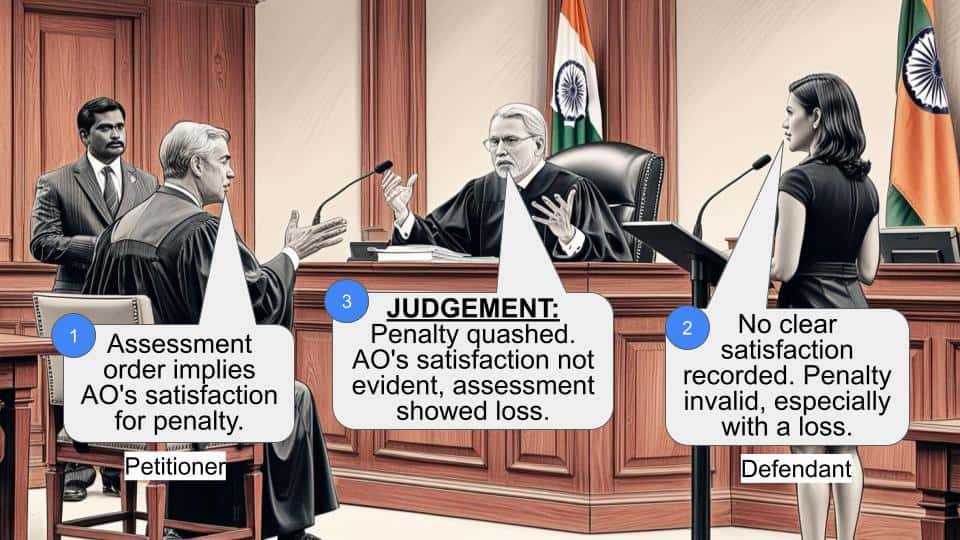
1. The AO's satisfaction for initiating penalty proceedings can be inferred from the assessment order.
2. They referred to a case (Indus Valley Promoters Limited) where this question was sent to a larger bench.
The Assessee (company) likely argued:
1. The AO didn't properly record their satisfaction for initiating penalty proceedings.
2. The disallowance was due to a difference of opinion, not concealment of income.
Key Legal Precedents:
1. CIT vs. Ram Commercial Enterprises Ltd. [2000] 246 ITR 568
2. Dilip N. Shroff vs. Joint Commissioner of Income Tax [2007] 291 ITR 519(SC)
3. T. Ashok Pai vs. Commissioner of Income Tax [2007] 292 ITR (SC)
4. CIT vs. O.K. Hosiery Mills P. Ltd. (ITA No. 12/2007)
5. Several other cases mentioned in
Judgement:
The High Court dismissed the Revenue's appeal, agreeing with the ITAT. Here's why:
1. They couldn't find any clear indication in the assessment order that the AO was satisfied penalty proceedings should be initiated.
2. The court also agreed with the ITAT's view on the merits of the case.
3. They found that the company's claim for depreciation was based on a genuine belief.
4. The court noted that a difference of opinion on tax matters doesn't equal concealment of income, especially when the company provided all the details in their tax return.
FAQs:
1. Q: What does this judgment mean for taxpayers?
A: It reinforces that tax authorities need to clearly justify why they're initiating penalty proceedings. They can't just do it without proper reasoning.
2. Q: Does this mean taxpayers can never be penalized for differences in tax interpretation?
A: Not exactly. It means that if there's a genuine difference of opinion and the taxpayer has provided all information, it shouldn't be treated as concealment of income.
3. Q: What's the significance of the AO's "satisfaction"?
A: It's crucial! The AO needs to be convinced and clearly state why they think penalty proceedings are necessary. It's a safeguard against arbitrary penalties.
4. Q: Could this case have wider implications?
A: Absolutely! It might influence how tax authorities approach penalty proceedings in the future, potentially leading to more careful consideration before initiating such actions.
5. Q: What should taxpayers learn from this case?
A: Always provide full information in your tax returns. If you have a genuine belief about a tax position, explain it clearly. And if faced with penalties, check if proper procedures were followed.

The Revenue is aggrieved by an order dated 14th December, 2006 passed by the Income Tax Appellate Tribunal ('Tribunal'), Delhi Bench `H', New Delhi in ITA No. 2072/Del/2006 relevant for the Assessment Year 2000-2001.
The Assessing Officer sought to initiate penalty proceedings under Section 271(1)(c) (of Income Tax Act, 1961), 1961 (`Act') by his assessment order dated 31st March, 2003 where at the end of the order, he observed as under :-
Assessed at Rs.23,86,713/-. Issued demand notice and challan. Charged interest under section 234 (of Income Tax Act, 1961) BandC upto date of assessment as per ITNS 150. Initiated penalty proceedings Under Section 271(i)(c) (of Income Tax Act, 1961) separately.
Following this, by a separate order dated 30th December, 2004, the Assessing Officer levied a penalty of Rs.9,20,100/-. The appeal against the said order filed by the Assessee was allowed by the Commissioner of Income Tax(Appeals) on the ground that even though the Assessing Officer has recorded satisfaction but on merits of the case the disallowance and addition made do not amount to concealment of income. Against the said order, both the Assessee and the Revenue filed appeals before the Income Tax Appellate Tribunal.
The Tribunal upheld the order of the CIT (A) on merits. Additionally, the Tribunal followed the decision of this Court in Commissioner of Income Tax Vs. Ram Commercial Enterprises Ltd., [2000] 246 ITR 568 and held that since there was no recording of satisfaction of the Assessing Officer in the order of assessment that penalty proceedings must be initiated, the appeal preferred by the Revenue should be dismissed.
At the outset it requires to be noted that the decision of this Court in Ram Commercial Enterprises Ltd. has been approved by the Supreme Court in Dilip N. Shroff Vs. Joint Commissioner of Income Tax, [2007] 291 ITR 519(SC)and T.Ashok Pai Vs. Commissioner of Income Tax, [2007] 292 ITR
(SC).Learned counsel for the Revenue states that another Bench of this Court has in Commissioner of Income Tax, Delhi IV v. Indus Valley Promoters Limited(2006) 155 Taxman 223 referred the following substantial question of law to a larger Bench which according to the referring Bench was not considered in Ram Commercial Enterprises Limited:
Whether satisfaction of the officer initiating the proceedings under section 271 of the Income Tax Act, 1961 can be said to have been recorded even in cases where satisfaction is not recorded in specific terms but is otherwise discernible from order passed by the authority She accordingly submits that this Court should await the decision of the larger Bench.
Assuming the Revenue were to succeed before the larger Bench, and the question referred to it is answered in the affirmative, it would mean that it is sufficient that the satisfaction of the Assessing Officer for initiating penalty proceedings against an Assessee under Section 271(1)(c) (of Income Tax Act, 1961) is discernible from the assessment order itself and that such satisfaction need not be separately or expressly indicated in the assessment order. In that event the assessment order in the present case would have to be examined to find out if the satisfaction of the Assessing Officer is discernible. Therefore, without expressing any view on the issue pending consideration by the larger Bench, and presuming that the question referred to it is answered in the affirmative, we proceed to examine the assessment order in the instant case in order to find out whether the satisfaction of the Assessing Officer that penalty proceedings should be initiated against the Assessee under Section 271(1)(c) (of Income Tax Act, 1961) is discernible therefrom.
Having gone through the assessment order, we find that it is not possible to discern any satisfaction of the Assessing Officer that penalty proceedings must be initiated against the Assessee under Section 271(1)(c) (of Income Tax Act, 1961). We may mention that we have adopted this procedure in large number of cases, some of which are Commissioner of Income Tax Del Vs. O.K. Hosiery Mills P. Ltd. (ITA No. 12/2007 decided on 14th September, 2007), Commissioner of Income Tax Vs. M/s Bharat Hotels Ltd. (ITA NO. 1074/2006 decided on 14th September, 2007), Commissioner of Income Tax Vs. M/s Bharat Hotels Ltd. (ITA No. 935/2006 decided on 14th September, 2007), Commissioner of Income Tax Del Vs. Fibro Tech Chemicals (ITA No. 954/2006 decided on 14th September, 2007),Commissioner of Income Tax Vs. M/s Preeti Aggarwala (ITA NO. 850/2006 decided on 15th September, 2007) and Commissioner of Income Tax Vs. Smt. Santosh Sharma (ITA No. 1088/2006 decided on 17th September, 2007). Apart from the above, we also find that the Revenue's appeal has been dismissed on merits by the Tribunal. It has been held that the claim of the Assessee for depreciation was based on a bonafide belief and that the disallowance of the said claim during assessment proceedings on a difference of opinion could not be treated as concealment of income by the Assessee, particularly when all the particulars in respect of the said claim were fully furnished by the Assessee in its return of income.
Having examined the matter on merits ourselves, we find no infirmity in
the view taken by the Tribunal in this regard. Therefore on merits as well no case for interference is made out. No substantial question of law arises. Dismissed.
MADAN B. LOKUR, J
OCTOBER 31, 2007 S.MURALIDHAR, J
×
Questions
Court Quashes Penalty for Alleged Income Concealment, Citing Lack of AO Satisfaction
Write your CommentSimilar Posts


Generic
- Reportdata/5207.pdf
