


Full News
Court Quashes Reassessment Notice for Lack of Commissioner's Approval
Court Quashes Reassessment Notice for Lack of Commissioner's Approval
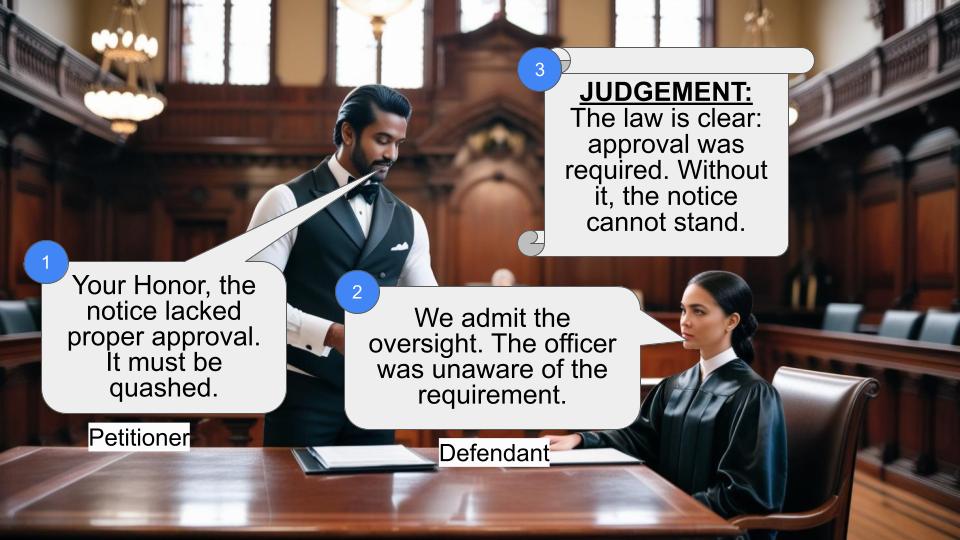
This case involves a dispute between Reliable Finhold Ltd. and the Union of India regarding a reassessment notice issued by the Income Tax Department. The High Court quashed the reassessment notice because it was issued without obtaining the necessary approval from the Commissioner or Chief Commissioner of Income Tax, as required by law.
Get the full picture - access the original judgement of the court order here
Case Name:
Reliable Finhold Ltd. vs Union of India and Another (High Court of Allahabad)
Writ Tax No.498 of 2014
Date: 15 September 2014
Key Takeaways:
1. Reassessment notices issued after four years from the end of the relevant assessment year require approval from the Commissioner or Chief Commissioner.
2. Failure to obtain this approval renders the reassessment notice invalid and subject to being quashed.
3. The court emphasized the importance of following proper procedural requirements in tax reassessment cases.
Issue:
Was the reassessment notice issued under Section 148 (of Income Tax Act, 1961) valid without the approval of the Commissioner or Chief Commissioner as required by the proviso to Section 151(1) (of Income Tax Act, 1961)?
Facts:
1. Reliable Finhold Ltd. filed its income tax return for the Assessment Year 1998-99 on November 30, 1998.
2. The original assessment was completed under Section 143(3) (of Income Tax Act, 1961) on March 22, 2000.
3. On March 29, 2005, the Assessing Officer issued a notice under Section 148 (of Income Tax Act, 1961) for reassessment.
4. The petitioner challenged this notice through a writ petition.
5. The court initially remanded the case back to the Assessing Officer to dispose of the petitioner's objections.
6. The Assessing Officer rejected the objections on June 10, 2014.
7. It was later revealed through an RTI query that no permission was obtained from the Commissioner/Chief Commissioner before issuing the reassessment notice.
Arguments:
Petitioner's Argument:
- The reassessment notice was issued more than four years after the end of the relevant assessment year.
- As the original assessment was under Section 143(3) (of Income Tax Act, 1961), no notice could be issued without the sanction of the Chief Commissioner or Commissioner.
Revenue's Argument:
- The Assessing Officer initially claimed that approval was an internal administrative process and not necessary for the validity of the notice.
- Later, in a counter-affidavit, the Revenue admitted that the Assessing Officer was unaware that the case had been completed under Section 143(3) (of Income Tax Act, 1961) and failed to seek the required approval.
Key Legal Precedents:
While no specific case laws were cited in this judgment, the court heavily relied on the interpretation of Section 151(1) (of Income Tax Act, 1961).
Judgement:
1. The court held that the reassessment notice dated March 29, 2005, was invalid.
2. The notice was quashed and set aside because it was issued without the satisfaction of the Chief Commissioner or Commissioner as required by the proviso to Section 151(1) (of Income Tax Act, 1961).
3. The writ petition was allowed in favor of the petitioner.
FAQs:
Q1: Why was the reassessment notice quashed?
A1: The notice was quashed because it was issued without obtaining the required approval from the Commissioner or Chief Commissioner, which is mandatory for notices issued after four years from the end of the relevant assessment year.
Q2: What is the significance of Section 151(1) (of Income Tax Act, 1961) in this case?
A2: Section 151(1) (of Income Tax Act, 1961) and its proviso set out the requirements for issuing reassessment notices, including the need for approval from higher authorities in certain circumstances.
Q3: Could the Income Tax Department have avoided this outcome?
A3: Yes, if they had followed the proper procedure and obtained the necessary approval from the Commissioner or Chief Commissioner before issuing the reassessment notice.
Q4: What lesson can tax authorities learn from this case?
A4: Tax authorities should be diligent in following procedural requirements, especially when dealing with reassessments beyond the four-year period, to ensure the validity of their actions.
Q5: Does this judgment set a precedent for similar cases?
A5: While I can't provide legal advice, this judgment does emphasize the importance of following proper procedures in tax reassessment cases and could be relevant in similar situations.

The petitioner has called into question a notice for re-assessment issued for Assessment Year 1998-99 by the Assessing Officer, the second respondent, on 29 March 2005. The petitioner has also called into question an order passed by the Assessing Officer on 10 June 2014 disposing of the objections to re-opening of the assessment.
The petitioner filed its return of income for A.Y. 1998-99 on 30 November 1998. The petitioner was assessed on 22 March 2000 under Section 143(3) (of Income Tax Act, 1961)1 by the Assessing Officer. The petitioner received a notice dated 29 March 2005 under Section 148 (of Income Tax Act, 1961). The petitioner filed writ proceedings2 before this Court challenging the re-assessment notice which petition was finally disposed of on 23 April 2014 by remanding the proceedings back to the Assessing Officer to dispose of the objections of the petitioner to re-opening of the assessment. The Assessing Officer disposed of the objections, rejecting them, by an order dated 10 June 2014.
The submission which has been urged on behalf of the petitioner is that in the present case, the assessment was sought to be re-opened beyond the period of four years of the end of the relevant assessment year and since the original order of assessment was made under Section 143(3) (of Income Tax Act, 1961), no notice could have been issued without the sanction of the Chief Commissioner or the Commissioner. It has been urged that as a matter of fact, no sanction had been issued.
While disposing of the objections of the petitioner, the Assessing Officer dealt with the objection to the effect that no sanction was obtained of the Commissioner under Section 151 (of Income Tax Act, 1961) in the following observations :
In certain cases the AO has to be of a particular rank and satisfaction or approval of the higher authority is required. It needs to be emphasized that as per the Act satisfaction required before issuance of notice for reassessment/assessment of the AO and not of any higher authority whose approval may be required. Such approval is an internal administrative process for better regulation of the Machinery of the tax collection. The manner in which the assessee has set out the objection. This means that an assessee can conceal income give inaccurate particulars but not proceeded against if some approval or time limit is not obtained or has gone by. In any case their objection will be again examined during the assessment proceedings if required by the Hon'ble appellate authority. This objection is accordingly not acceptable.”
Subsequently, the petitioner filed a supplementary affidavit disclosing the information received on 12 June 2014 from the Assessing Officer, Income Tax Officer-6(2), Kanpur. In response to a query under the Right to Information Act, 2005 as to whether permission was obtained from the Commissioner/Chief Commissioner in compliance with the provisions of Section 151 (of Income Tax Act, 1961) before the notice under Section 148 (of Income Tax Act, 1961) dated 29 March 2005 had been issued for A.Y. 1998-99, the answer was in the negative.
In order to enable the Revenue to clarify the matter, by an order dated 8 September 2014, the learned Standing Counsel was directed to take instructions and file a counter affidavit. In the counter affidavit which has been filed on behalf of the Revenue, the following statement has been made :-
The assessee filed its return of income on 30.11.1998 in the office of ITO, Ward 2(1), Kanpur, who was under administrative control of CIT-I, Kanpur. Thereafter, the ITO-2(1) completed the assessment under Section 143(3) (of Income Tax Act, 1961), After restructuring of the Department, the jurisdiction over the corporate cases was transferred to CIT-II, Kanpur Charge. A perusal of the proforma submitted by the then A.O. for obtaining approval for issue of notice shows that the then A.O. was not aware about the fact that the said case had already been completed under Section 143(3) (of Income Tax Act, 1961) otherwise he would have sought approval of the CIT, as required for the purpose well within the stipulated limitation of six years.”
Section 151(1) (of Income Tax Act, 1961) provides as follows:
“151(1) In a case where an assessment under sub-section (3) of section 143 (of Income Tax Act, 1961) or section 147 (of Income Tax Act, 1961) has been made for the relevant assessment year, no notice shall be issued under section 148 (of Income Tax Act, 1961) by an Assessing Officer, who is below the rank of Assistant Commissioner or Deputy Commissioner
unless the Joint Joint Commissioner is satisfied on the reasons recorded by such Assessing Officer that it is a fit case for the issue of such notice :
Provided that, after the expiry of four years from the end of the relevant assessment year, no such notice shall be issued unless the Chief Commissioner or Commissioner is satisfied, on the reasons recorded by the Assessing Officer aforesaid, that it is a fit case for the issue of such notice.”
Sub-section (1) of Section 151 (of Income Tax Act, 1961) provides inter alia that where an assessment has been made under section 143(3) (of Income Tax Act, 1961), a notice under section 148 (of Income Tax Act, 1961) cannot be issued by an Assessing Officer, who is below the rank of Assistant Commissioner or Deputy Commissioner unless the Joint Commissioner is satisfied on the reasons recorded by the Assessing Officer that there is a fit case for the issuance of a notice. The proviso to sub-section (1), however, requires the satisfaction of the Chief Commissioner/ Commissioner after the expiry of a period of four years from the end of the relevant assessment year, failing which, no notice can be issued.
In the present case, admittedly the original assessment was under Section 143(3) (of Income Tax Act, 1961). The notice under Section 148 (of Income Tax Act, 1961) was sought to be issued more than four years after the end of the relevant assessment year. The assessment year is A.Y. 1998-99. Notice under Section 148 (of Income Tax Act, 1961) was issued on 29 March 2005.
In the circumstance, clearly the proviso to sub-section (1) of Section 151 (of Income Tax Act, 1961) was attracted. Admittedly, as the counter affidavit which has been filed by the Revenue indicates, no sanction or permission of the Commissioner was obtained.
In this view of the matter, the entire exercise of re-opening of the assessment under Section 148 (of Income Tax Act, 1961) fails to meet the basic jurisdictional requirement under the proviso to sub-section (1) of Section 151 (of Income Tax Act, 1961) since under the proviso no notice can be issued except on the satisfaction of the Commissioner or, as the case may be, the Chief Commissioner and admittedly there was no such satisfaction in the present case. The re- assessment notice dated 29 March 2005 would have to be quashed and set aside.
The re-assessment notice dated 29 March 2005 is, accordingly, quashed and set aside having been issued without the satisfaction of the Chief Commissioner or the Commissioner as required by the proviso to sub- section (1) of Section 151 (of Income Tax Act, 1961).
The writ petition is, accordingly, allowed. There shall be no order as to costs.
Date: 15.09.2014
SK
(Dr. D.Y. Chandrachud, C.J.) (Dilip Gupta, J.)
×
Similar Ripples
Questions
Court Quashes Reassessment Notice for Lack of Commissioner's Approval
Write your CommentSimilar Posts


Generic
- Reportdata/4598.pdf
