


Court Quashes Revived Tax Proceedings, Citing Finality and Limitation


Full News
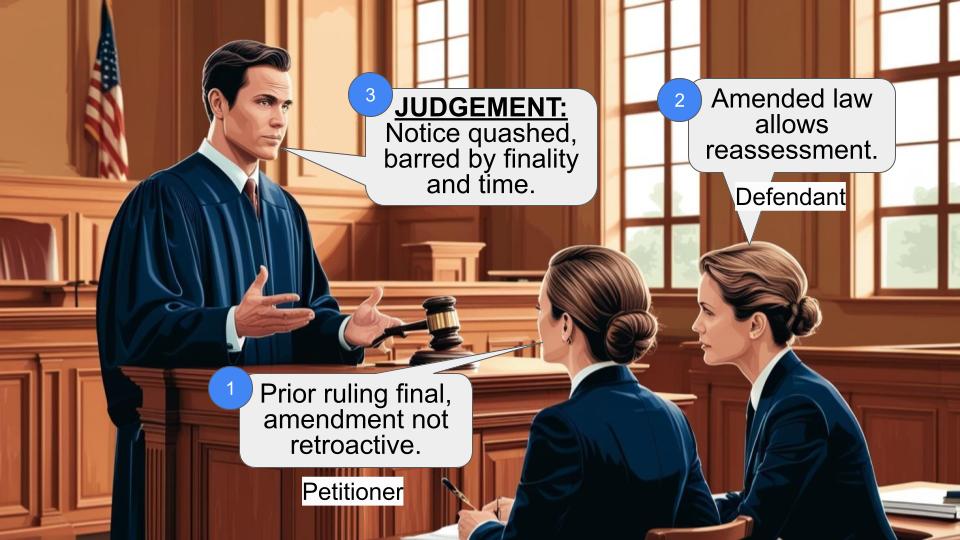
Court Quashes Revived Tax Proceedings, Citing Finality and Limitation
Court Quashes Revived Tax Proceedings, Citing Finality and Limitation
This case involves Oracle India P. Ltd. challenging a notice issued by the Deputy Commissioner of Income Tax under Section 201(1) (of Income Tax Act, 1961)/201(1A) of the Income Tax Act, 1961. The notice, issued on 20.01.2015, pertained to the Financial Year 2007-08 (Assessment Year 2008-09). The Delhi High Court ruled in favor of Oracle India, setting aside the notice and subsequent order, citing issues of finality and limitation.
Get the full picture - access the original judgement of the court order here
Case Name:
Oracle India P. Ltd. Vs Deputy Commissioner of Income Tax (High Court of Delhi)
W.P.(C) 3075/2015 & CM No.5493/2015
Date: 9th July 2015
Key Takeaways:
1. Proceedings that have ended and attained finality cannot be revived through administrative methods.
2. Amendments to tax laws are not automatically retrospective unless explicitly stated.
3. The limitation period for tax assessments is not merely procedural but imposes a fetter on the Assessing Officer's power.
Issue:
Can the Income Tax Department issue a fresh notice under Section 201(1) (of Income Tax Act, 1961)/201(1A) for a financial year that had already been subject to proceedings that were concluded by a court order, based on a subsequent amendment to the limitation period?
Facts:
1. A notice was initially issued to Oracle India on 17.02.2014 under Section 201(1) (of Income Tax Act, 1961)/201(1A) for the Financial Year 2007-08.
2. Oracle India challenged this notice in the Delhi High Court (WP(C) No. 2061/2014).
3. On 05.12.2014, the court disposed of the case, ruling that the notice was time-barred.
4. The Finance (No.2) Act, 2014 amended Section 201(3) (of Income Tax Act, 1961), extending the limitation period to seven years, effective from 01.10.2014.
5. Based on this amendment, a fresh notice was issued on 20.01.2015 for the same financial year.
Arguments:
Oracle India (Petitioner):
1. The limitation prescribed by the Income Tax Act is not merely a period of limitation but imposes a fetter on the Assessing Officer's power.
2. The amendment to Section 201(3) (of Income Tax Act, 1961) was not retrospective, so it couldn't revive expired proceedings.
Income Tax Department (Respondent):
1. The amended limitation period of seven years should apply if new information came to light after the 2014 amendment.
Key Legal Precedents:
1. S.S. Gadgil v. Lal & Co.: 53 ITR 231 (SC)
2. K.M. Sharma v. ITO: 254 ITR 772 (SC)
3. National Agricultural Cooperative Marketing Federation of India v. Union of India: 260 ITR 548 (SC)
These cases establish that the limitation in tax laws imposes a fetter on the Assessing Officer's power, not just a procedural time limit.
Judgement:
1. The court ruled in favor of Oracle India, setting aside the notice dated 20.01.2015 and the subsequent order dated 17.03.2015.
2. The court held that proceedings that had ended and attained finality with the 05.12.2014 order couldn't be revived through this new methodology.
3. The court noted that no new information had come to light; the new notice was based on the same information as the previous one.
4. Even if the seven-year limitation applied, the period for completing the assessment for FY 2007-08 had expired on 31.03.2015.
FAQs:
1. Q: Why couldn't the tax department issue a new notice based on the amended law?
A: The amendment wasn't retrospective, and the previous proceedings had already attained finality through a court order.
2. Q: What's the significance of the "fetter on power" argument?
A: It means that once the limitation period expires, the tax authority loses the power to act, not just the right to proceed.
3. Q: Did the court rule on whether new information could extend the limitation period?
A: The court explicitly stated it didn't express a view on this point, as it wasn't relevant to this case.
4. Q: How does this judgment impact other taxpayers?
A: It reinforces the principle that concluded proceedings can't be easily reopened, even if laws change, unless the changes are explicitly retrospective.
5. Q: What's the key lesson for tax authorities from this case?
A: They should be cautious about trying to revive concluded cases based on subsequent amendments, especially without new information.

This writ petition is directed against the notice dated 20.01.2015 issued under Section 201(1) (of Income Tax Act, 1961)/201(1A) of the Income Tax Act, 1961 pertaining to the Financial Year 2007-08 relating to the Assessment Year 2008-09. Earlier, for the same very Financial year, a notice had been issued under the same provisions on 17.02.2014. The objections were taken by the petitioner/ assessee and an order disposing of the objections was passed. Ultimately, the matter was brought to this Court by way of WP(C) No.2061/2014 which was disposed of by an order dated 05.12.2014 to the following effect:-
“In this writ petition, the petitioner challenges the notice dated 17.02.2014 issued by DCIT - Circle 51 (1) under Section 201 (of Income Tax Act, 1961) in respect of the Financial Year 2007-2008. The order dated 14.03.2014, pursuant to the said notice, is also under challenge. One of the points raised by the petitioner was of limitation. The learned counsel for the petitioner drew our attention to Section 201(3) (of Income Tax Act, 1961) which has been introduced in the said Act with effect from 01.04.2010. The proviso to sub-Section (3) stipulates that an order can be passed at any time on or before 31.03.2011. This makes it clear that insofar as the Financial Year 2007-2008 is concerned, in the circumstances of this case, no order can be made under sub-Section (1) of Section 201 (of Income Tax Act, 1961) after 31.03.2011. Since the notice itself had been issued on 17.02.2014, it is clearly time barred. Consequently, the impugned notice dated 17.02.2014, as also the order dated 14.03.2014, cannot survive. They are set aside.
The writ petition is allowed to the aforesaid extent. We make it clear that we have not examined the merits of the matter from any other stand-point. There shall be no order as to costs.
All pending applications also stand disposed of.”
From the above order, it is clear that this Court held that the said notice dated 17.02.2014 was time barred in view of the provisions of Section 201(3) (of Income Tax Act, 1961) as it then existed.
The present impugned notice has been issued on 20.01.2015 in an attempt to take advantage of the amendment to Section 201(3) (of Income Tax Act, 1961) which was brought into effect from 01.10.2014. Here, the period of limitation has been extended to seven years by the Finance (No.2) Act, 2014.
Mr Syali, the learned senior counsel appearing on behalf of the petitioner relied upon the Supreme Court’s decision in the case of S.S. Gadgil v. Lal & Co.: 53 ITR 231 (SC) which has been subsequently followed in several other decisions of the Supreme Court including K.M. Sharma v. ITO: 254 ITR 772 (SC) and National Agricultural Cooperative Marketing Federation of India v. Union of India: 260 ITR 548 (SC) to submit that the limitation prescribed by the Income Tax Act was not mere a period of limitation but that it imposes a fetter upon the power of the Assessing Officer to take action under the said provisions. In this context, it was submitted that since power in respect of Financial Year 2007-08 expired on 31.03.2011, it could not be revived unless the legislature specifically made a retrospective amendment to the same. The substitution of Section 201(3) (of Income Tax Act, 1961) by the Finance (No.2) Act, 2014 was with effect from 01.10.2014 and not with retrospective effect. Mr Sahni appearing on behalf of Revenue submitted that if new information came to the knowledge of the Assessing Officer after the amendment of 2014 then the period of limitation would be seven years for completion of the assessment.
However, we need not go into that aspect of the matter inasmuch as, in the present case, no new information has come and the impugned notice that was issued on 20.01.2015 was on the basis of the same information in respect of which the notice dated 17.02.2014 had been issued. Thus, those proceedings which had ended and attained finality with the passing of the order dated 05.12.2014 of this Court in WP(C) 2061/2014 cannot now be sought to be revived through this methodology adopted by the Assessing Officer. Even otherwise, insofar as the Financial Year 2007-08 is concerned, the period for completing the assessment under Section 201(1) (of Income Tax Act, 1961)/201(1A) has expired on 31.03.2015.
Therefore, looked at from any point of view, insofar as the facts of the present case are concerned, the impugned notice dated 20.01.2015 and subsequent order dated 17.03.2015 cannot be sustained. The same are set aside. The writ petition is allowed.
We make it clear that we have not expressed any view on the point raised by Mr Sahni that in case fresh or new information is discovered then the limitation would get extended upto seven years.
BADAR DURREZ AHMED, J
JULY 09, 2015 SANJEEV SACHDEVA, J
×
Questions
Court Quashes Revived Tax Proceedings, Citing Finality and Limitation
Write your CommentSimilar Posts


Generic
- Reportdata/3637.pdf
