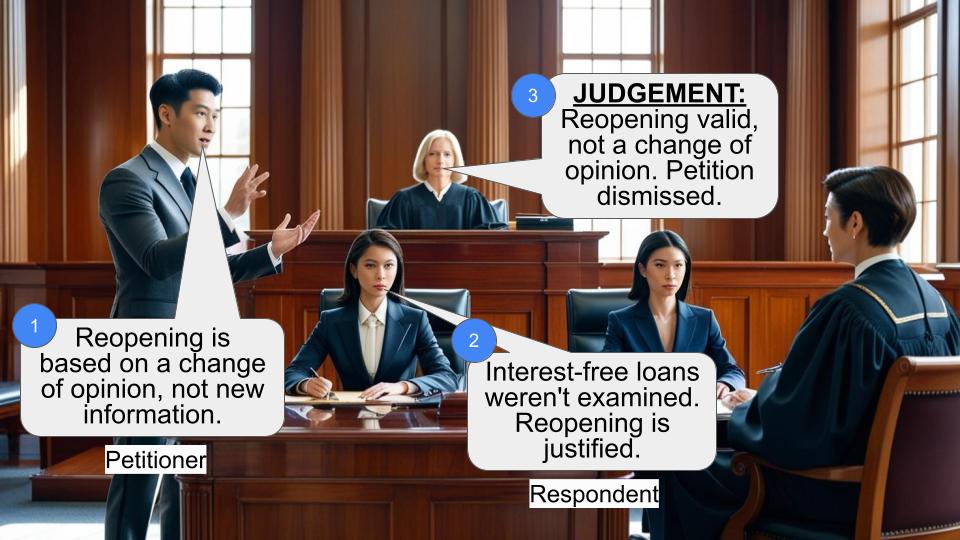
Court Quashes Tax Assessment Transfer, Citing Lack of Proper Notice


Full News

Court Quashes Tax Assessment Transfer, Citing Lack of Proper Notice
Court Quashes Tax Assessment Transfer, Citing Lack of Proper Notice
A company called Genus Electrotech Ltd. challenged an order that transferred their tax assessment from Ahmedabad to Moradabad. The High Court sided with the company, saying the tax authorities didn't give them a fair chance to object to the transfer. It's a win for the principle of natural justice in administrative decisions.
Get the full picture - access the original judgement of the court order here
Case Name:
Genus Electrotech Ltd. vs Union of India (High Court of Gujarat)
Special Civil Application No. 9010 of 2016
Date: 18th July 2016
Key Takeaways:
1. Tax authorities must provide clear reasons when proposing to transfer an assessment case.
2. A mere notice to attend a hearing isn't enough to satisfy the requirement of natural justice.
3. The court emphasized the importance of giving assessees a real opportunity to object to proposed transfers.
4. Even if an assessee might be aware of potential reasons, the authority still needs to formally communicate them.
Issue:
Did the Principal Commissioner of Income Tax violate principles of natural justice by not providing adequate reasons in the notice for the proposed transfer of the tax assessment case?
Facts:
1. Genus Electrotech Ltd. had its tax assessments in Ahmedabad since 2011.
2. In July 2015, there were search and seizure operations at the company director's home and a survey at their office.
3. On November 3, 2015, the Principal Commissioner issued a notice about transferring the case to Moradabad.
4. The company asked for more info and raised objections, but the transfer order was passed on December 30, 2015.
5. Moradabad is about 700-800 km away from Ahmedabad, which was a big concern for the company.
Arguments:
The company said:
1. The notice didn't give any reasons for the proposed transfer.
2. They weren't given necessary info to make a proper objection.
3. The transfer would cause great inconvenience due to the distance.
The tax department argued:
1. A notice was issued, and that's enough.
2. The transfer order had proper reasons.
3. The company knew about the search operations, so they should have understood the reason.
Key Legal Precedents:
1. Shikshana Prasaraka Mandali vs. Commissioner of Income Tax (352 ITR 53): This case emphasized that a show cause notice must be adequate for effective response.
2. Shree Ram Vessel Scrap P. Ltd. v. Commissioner of Income Tax (355 ITR 255): While upholding that coordinated investigation is a valid reason for transfer, it noted that the notice had indicated prima facie reasons.
Judgement:
The court ruled in favor of Genus Electrotech Ltd. They said:
1. Just issuing a notice isn't enough; it needs to have reasons for the proposed transfer.
2. The company was left to guess why the transfer was happening, which isn't fair.
3. Even if the company knew about the search operations, that doesn't excuse the authority from properly communicating the reasons.
4. The court set aside the transfer order dated December 30, 2015.
FAQs:
1. Q: Does this mean tax authorities can never transfer cases?
A: No, they can, but they need to provide clear reasons and give the assessee a fair chance to object.
2. Q: What if the assessee already knows the potential reasons for transfer?
A: Even then, the authority needs to formally communicate the reasons in the notice.
3. Q: How specific does the notice need to be?
A: It should give enough information for the assessee to understand why the transfer is being considered and to make an effective objection.
4. Q: Can the tax department try to transfer the case again?
A: Potentially, yes, but they'd need to follow proper procedure and provide clear reasons this time.
5. Q: Does this judgment apply to all administrative decisions?
A: While it's specifically about tax assessment transfers, the principles of natural justice it upholds could be relevant in other administrative contexts too.

1. The petitioner has challenged an order dated 30.12.2015 passed by the Principal Commissioner of Income tax, Ahmedabad, under which the petitioner's assessment came to be transferred from DCIT (Circle2)(1)(1), Ahmedabad to ACIT (Central Circle) Moradabad (U.P.).
2. Brief facts are as under.
3. The petitioner is a company registered under the Companies Act. Till the year 2011, the petitioner's assessments were being processed by ACIT, Circle- 12(1), New Delhi, as the registered office of the petitioner company was situated within his jurisdiction. In the year 2011, the petitioner shifted its corporate office to Ahmedabad and due to which the jurisdiction of the petitioner for assessment was transferred to Ahmedabad. At the request of the petitioner, its pending appeals for the earlier assessment years 200607 to 200809 were also transferred to Ahmedabad.
4. On 3031/07/2015, search and seizure operations were carried out by the investigation wing of the Incometax department at the residential premises of the director of the petitioner company at Gandhidham. Survey operation was also carried out at the factory premises and the corporate office of the company.
5. On 03.11.2015, the Principal Commissioner of Incometax, Ahmedabad, issued a notice to the petitioner, in which it was conveyed as under:
“Sir
Sub: For hearing Fixed in the Case of M/s. Genus Electrotech Limited regarding Please refer to the above.
In the matter sited above, I am directed to intimate you that the hearing is fixed in your case, in respect to transfer your case at Moradabad (UP).
In view of the above, you are requested to attend the hearing fixed on 23.11.2015 at 1230 p.m. at Room No.101, 1st Floor, Navjivanm Trust Building, Ahmedabad.”
6. In response to such notice, the petitioner replied under letter dated 23.11.2015 and sought adjournment. On 21.12.2015, the petitioner wrote yet another letter and demanded certain information and documents to enable the petitioner to make a proper representation. On 04.01.2016, though no such documents or information was supplied, the petitioner made following representation:
“1) That Company { Genus Electrotech Ltd.} a public limited company incorporated under the provisions of Companies Act and was assessed in New Delhi upto A.Y.200809 and on request its jurisdiction was changed to Ahmedabad since Company has shifted its corporate office from New Delhi to Ahmedabad. Company maintains its records at Ahmedabad since 200809.
2) That on 30th and 31st July search and seizure operations was conducted at the residential premises of directors of the company at their residence at Gandhidham under the provisions of section 132 (of Income Tax Act, 1961) by DDIT (Investigation) Moradabad (U.P.) and simultaneously survey was also conducted at the factory premise of the company situated at Gandhidham.
3) That on the same days search and seizure was conducted in the premises of cousin brothers assessed at Moradabad by DDIT (Investigation) Moradabad.
4) That company OBJECT in transferring its jurisdiction to Moradabad (Uttar Pradesh) because:
a) Moradabad is nearly 800 KM away from Ahmedabad and it would cause great hardship to company to attend and produce records at Moradabad in day to day hearings by Income Tax Authorities.
b) No Seizure is made from the premise of the Company.
c) No prima facie link established by DDIT (Investigation) Moradabad of the company [Genus Electrotech Ltd.] with the search and seizure operations with cousin brothers assessed at Moradabad. Even copy of letter of DDIT Moradabad requesting for transfer of case is not made available to company.
d) Primafacie there is nothing which require transfer of case of the Company at Moradabad even for shortwhile if it is assumed that there are some information relating to company and others assessed at Moradabad the same be communicated to Ahmedabad Income Tax Authorities for necessary action.
In view of above it is prayed that Jurisdiction of the assessee company need not to be transferred and be remain in Ahmedabad.”
7. The Principal Commissioner eventually passed the impugned order dated 30.12.2015 transferring the assessment from Ahmedabad to Moradabad, which order reads as under:
“ORDER UNDER SECTION 127(2) OF THE INCOME TAX ACT, 1961
Transfers of jurisdiction in the case mentioned in schedule below was considered in the context of search u/s 132 (of Income Tax Act, 1961) in the case of M/s. Genus Electrotech Ltd. Before passing an order u/s 127(2) (of Income Tax Act, 1961), sufficient opportunity of being heard was given vide this office letter dated 03.11.2015 in view of change of cities. The assessee asked for an adjournment vide letter dated 14.12.2015. This was granted. The assessee on the reporting date asked for the copy of letter from I.T. Authorities at Moradabad, but has not intimated any difficulties as such. The assessee was well aware of search in connected cases at Moradabad. Hence, it can be taken that there is no serious reason against the change of jurisdiction. In view of the facts & circumstances and in exercise of the powers conferred under subsection 2(a) (of Income Tax Act, 1961) of Section 127 (of Income Tax Act, 1961) of the Incometax Act, 1961 and all other powers enabling me in this behalf, I, the Pr.Commissioner of Incometax – 2, Ahmedabad hereby transfer the case mentioned in column No.2 of the Schedule hereunder from the Assessing Officer mentioned in column No.4 to the Assessing Officer mentioned in column No.5 thereof.
SCHEDULE
Sr.No.
Name of the Assessee
PAN Assessing Officer
1 2 3 From (4) To (5)
1 M/s. Genus Electrotech Ltd
AABCG9645H Dcit, Cir-2(1)
(1), Ahmedabad ACIT, Central Circle, Moradabad
2. This change of jurisdiction is ordered for the sake of coordinated enquiries in search and seizure cases. This order shall take effect from 30.12.2015.”
8. This order, the petitioner has challenged in the present proceedings primarily on the ground of breach of principles of natural justice. First contention of the counsel for the petitioner is that the notice issued by the Principal Commissioner did not contain any reasons why the assessment was proposed to be transferred. Second contention of the counsel was that without supplying necessary information and documents though asked for and without conveying the date of further hearing, the Principal Commissioner passed the exparte order of transfer. Counsel submitted that Moradabad is situated nearly at the distance of 700 kms from Ahmedabad and transfer of assessment would therefore, cause great prejudice and inconvenience to the petitioner.
9. On the other hand, learned counsel Mrs.Bhatt for the department opposed the petition contending that the notice for transfer was issued. The competent authority while exercising powers under section 127(2) (of Income Tax Act, 1961) ('the Act' for short) has recorded proper reasons in the order of transfer. All the requirements of exercise of powers under section 172(2) (of Income Tax Act, 1961) were thus, satisfied. The powers have been exercised bonafide and on proper materials. She submitted that there is no breach of natural justice as contended by the petitioner. There is no requirement that reasons must be cited in the show cause notice. In any case, the petitioner was aware about the requirement of coordinated investigation in view of search and seizure operations. Requirement of natural justice cannot be applied when the same would be an empty formality. In this context, she relied on the decision of the Supreme Court in case of Dharampal Satyapal Limited v. Deputy Commissioner of Central Excise, Gauhati and others, reported in 2015 (8) SCC 519.
10. Section 127 (of Income Tax Act, 1961) pertains to power of the prescribed Revenue authorities to transfer cases. Under subsection (1) thereof, such authority after giving the assessee a reasonable opportunity of being heard wherever it is possible to do so and after recording reasons for doing so, is authorized to transfer any case from one or more of the Assessing Officers subordinate to him to any other Assessing Officer. Under subsection (2) of section 127 (of Income Tax Act, 1961), such case can be transferred where both the Assessing Officers are not subordinate to the same prescribed authority.
11. Even before subsection (1) of section 127 (of Income Tax Act, 1961) made a reference to giving reasonable opportunity of being heard to the assessee, such requirement was recognized and read into the provision before which such powers could be exercised. The requirement of hearing is now part of the statute. It is not even the case of the department that no such hearing was necessary. In the present case, requirement of issuing a notice and allowing the petitioner to raise objections why the case should not be transferred, were therefore, the fundamental and essential requirements before the power of transfer could have been exercised. In this context the question would be, whether mere issuance of notice without any indication whatsoever of the grounds on which the assessment is proposed to be transfered would satisfy this requirement ? We would answer this question in context of the notice issued by the Principal Commissioner, the contents of which we have reproduced in the earlier portion of the order. This notice merely informed the petitioner that hearing of the petitioner's case is fixed on a particular date in respect to transfer the case to Moradabad and that the petitioner should therefore, attend the office at the appointed time.
12. For multiple reasons, this notice would fail the test of granting reasonable opportunity of hearing. Mere issuance of notice inviting attendance of an assessee for hearing of a case for transfer of the assessment can hardly be stated to be fulfillment of requirement of hearing. On what primafacie grounds or reasons the case is to be transferred, was nowhere indicated in this notice. The petitioner was left to imagine such grounds and meet with them by making a representation in writing or orally if he so desired. By not indicating any reasons, why the authority proposed to transfer the case, the Principal Commissioner merely called upon the petitioner to attend his office for hearing. This notice gives not the slightest idea to the petitioner why the assessment which is otherwise competent at Ahmedabad is proposed to be transferred some 700 kms away at Moradabad in U.P. In other words, the authority asked the assessee to imagine the possible grounds why the case would be considered for transfer and then to meet such grounds by making representation. He thus made the procedure of giving hearing a mere formality.
13. After attempting on couple of occasions to elicit further response from the Commissioner, the petitioner raised written objections under letter dated 04.01.2016 and specifically raised four grounds why the case should not be transferred. The petitioner did refer to the search and seizure operations at the residential premises of the director of the company and survey action at the factory of the petitioner company. However, this would not in any manner reduce the requirement of the prescribed authority to at least convey to the petitioner the primafacie reason why the assessment was being considered for transfer. Though unaware of the order of transfer of assessment, the petitioner had raised such detailed objections shortly thereafter. However, the fundamental action of the authority was flawed since at no point of time, the petitioner was given any idea why the assessment was under transfer.
14. The fact that in the present case, the petitioner was aware about the parallel search and survey proceedings would not change the contours of law. The administrative law which has over a long period of time been well refined recognizes certain elements of principles of natural justice inbuilt in any administrative order having adverse civil consequences which cannot be jettisoned by bringing the theory of empty formality or no prejudice.
15. A similar question came up for consideration before the Bombay High Court in case of Shikshana Prasaraka Mandali vs. Commissioner of Incometax and others, reported in 352 ITR 53. Final order of transfer was based on various grounds, one of which were mentioned in the show cause notice. In this respect, the Court observed as under:
“15. The giving of notice containing the reasons for the proposed action is a basic postulate for compliance of the Audi Alteram Partem Rule. It is axiomatic that unless a party is informed of the reasons for the proposed action, it would be impossible for the noticee to put forth its point of view with regard to the reasons for the proposed action. The views of the noticee are to be considered by the authority before taking any decision to confirm or drop the notice. A show cause notice to be effective must be adequate so to enable a party to effectively object/respond to the same. The authority concerned is obliged to consider the objections, if any, and thereafter reach a finding one way or the other. This alone ensures absence of arbitrary exercise of powers by the authorities. Thus, there has been failure of Audi Alteram Partem Rule and the case of the Petitioner has been transferred in breach of natural justice de hors the nongiving of personal hearing to the Petitioner. In that view of the matter also the order dated 2/8/2012 passed by the respondent cannot be sustained.”
16. In case of Shree Ram Vessel Scrap P. Ltd. v. Commissioner of Incometax, reported in 355 ITR 255, Division Bench of this Court while upholding that effective and coordinated investigation is a valid reason for transfer of an assessment, upheld the action of transfer passed by the competent authority in the said case. In said case also, it was noticed that the notice for transfer had indicated primafacie reasons for transfer of assessment. We may reproduce relevant portion of the judgment:
“21. Exercise of power under subsection(1) and subsection(2) of the Act comes with certain procedural requirements namely, of granting a reasonable opportunity of being heard in the matter wherever it is possible to do so, of recording of reasons for passing such order and as provided by the Supreme Court in Ajanta Industries(supra) communicating such reasons also to the assessee. Subject to fulfillment of such procedural requirements, the authority under section 127 (of Income Tax Act, 1961) enjoys considerable discretion while exercising the power contained in sub- section(1) or subsection(2) thereof. Such discretion ofcourse has to be exercised for achieving the public purpose and not for any arbitrary or irrelevant consideration. On the other hand, it can also be seen that transfer of a pending case from one Assessing Officer to another outside of a city, locality or place is likely to cause considerable inconvenience to an assessee. Therefore, even though an assessee may not have a vested right to insist that his assessment be completed only at one place or by a particular Assessing Officer, nevertheless, the reasons for transfer must be weighty enough to offset against such personal inconvenience of an assessee. In exercise of power under section 127 (of Income Tax Act, 1961) thus we are concerned with larger public interest on one hand and personal inconvenience on the other. However, as long as such powers are exercised bona fide, for public purpose and in the interest of Revenue, the role of the Court to dissect such reasons and to come to a different conclusion would be extremely limited. It is by now well settled that judicial review against the administrative order in exercise of writ jurisdiction, the Court is concerned with the decision making process and not the final decision itself. Unless the reasons which prompted the competent authority to transfer the case can be stated to be wholly irrelevant or arbitrary, the Court would not interfere with such reasons. Ofcourse an order of such nature can and need to be quashed if it is demonstrated that same is passed either without jurisdiction or is actuated by mala fide either in fact or in law.
24. In the present case, we notice that that petitioners belonged to the same family or group. They were subjected to common search operation. Their assessments were therefore, under proposal for transfer. A show cause notice was issued to all of them in which the Commissioner called upon them to explain why the cases should not be centralised at Ahmedabad for effective and coordinated investigation. After considering their objections and permitting the oral submissions by the authorised representative, the Commissioner passed the order transferring the cases on the ground that cases were required to be centralised. Since Bhavnagar did not have Central Range Office, they could be transferred at Ahmedabad. Their request that cases be consolidated at Bhavnagar or Mumbai was considered but not accepted. They were instead offered alternative places for transfer of cases within the jurisdiction of Surat, Baroda or Rajkot Office. They did not accept the offer. It was thereupon that the Commissioner proceeded to finalise his proposed transfer of cases from Bhavnagar to Ahmedabad.
25. We do not find that the Commissioner committed any error either in law or in facts. Reason for transfer was clearly indicated in the show cause notice namely, for centralisation of cases and for effective and coordinated investigation. Such reasons were further elaborated while dealing with and disposing of the objections of the petitioners in the final order of the transfer. Before doing so, the authorised representative of the petitioners was offered three other alternatives Rajkot, Baroda and Surat where the department had centralized wing. We do not find that the reasons either lacked clarity or sufficiency. When it is pointed out that several places of the company were subjected to common search operation, it is but natural that it would be in the interest of Revenue and perhaps also in the interest of the assessees that cases be consolidated and be placed before one single Assessing Officer. This would avoid duplication of collection of evidence and assessment of evidence. This would also avoid conflict of opinions. The reason that being search cases they had to be placed before a centralised circle office also cannot be stated to be irrelevant. The department for internal convenience and efficient functioning, if has created a special branch for dealing with search cases and has decided to conduct assessments of such cases under such wing, surely assessee cannot have any objection to the same. Assessee has no right in law to insist that his case be kept out of consideration of such branch. Assessees were offered alternative of placing their cases either at Rajkot, Baroda or Surat. It is not even suggested before us that such offer was not made. Under the circumstances we do not find any infirmity in the orders under challenge.
26. We therefore side with the school of thought that the reason for effective and coordinate investigation for transfer of assessment cases is neither vague or ground not insufficient. Particularly in the present case when through show cause notice and during hearing of such notices, it was clearly brought to the notice of the assessees the need for transfer of cases, no case for interference is made out. Learned counsel Shri Soparkar submitted that all the judgements taking contrary view pertain to cases which are transferred from one place to another where atleast one assessee is being assessed. This to our mind is not the relevant factor. It may be a factual aspect common to all cases. None of the decisions is based on such fact. Neither Section 127 (of Income Tax Act, 1961), nor any of the decision brought to our notice provides that assessment cases can be transferred from one place to another only as long as atleast one of the case of the group is pending at such place. Section 127 (of Income Tax Act, 1961) does not recognise or provide any such limitation on exercise of the powers. Discretion is wide and may be required to be exercised in varieties of situations. We neither can, nor propose to foresee all of them.”
17. For the reasons stated above, impugned order dated 30.12.2015 is set aside. Petition is allowed and disposed of.
(AKIL KURESHI, J.)
(A.J. SHASTRI, J.)
×