


Court Quashes Tax Commissioner’s Revision Notice, Upholds Assessing Officer’s D…


Full News
Court Quashes Tax Commissioner’s Revision Notice, Upholds Assessing Officer’s Decision
Court Quashes Tax Commissioner’s Revision Notice, Upholds Assessing Officer’s Decision
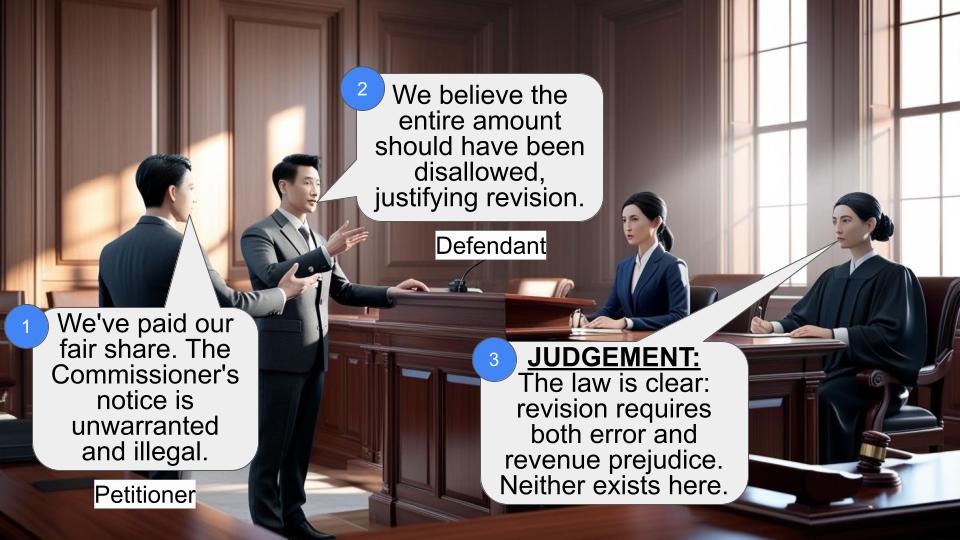
This case involves JMC Projects (India) Ltd. challenging a notice issued by the Commissioner of Income Tax for revision of tax assessments. The High Court ruled in favor of JMC Projects, quashing the Commissioner’s notice and upholding the original assessment orders.
Get the full picture - access the original judgement of the court order here
Case Name:
JMC Projects (India) Ltd. Vs Principal Commissioner of Income Tax (High Court of Gujarat)
Special Civil Application No. 3434 of 2015
Date: 21st December 2015
Key Takeaways:
- The Commissioner cannot revise an assessment order merely because it’s erroneous if it’s not prejudicial to the revenue’s interests.
- If legitimate tax has been realized, even through an erroneous order, the Commissioner cannot exercise revisional powers.
- Appellate authorities have wide powers to examine and modify assessments, making revision unnecessary in many cases.
Issue:
Can the Commissioner of Income Tax revise assessment orders under section 263 (of Income Tax Act, 1961) when additions have already been made by the Assessing Officer, albeit using a different methodology?
Facts:
- JMC Projects (India) Ltd. claimed expenses for payments to 176 sub-contractors from 2008-09 to 2012-13.
- A search and seizure operation was conducted on the company premises on 17.11.2011.
- The Assessing Officer found these transactions non-verifiable and made additions totaling Rs.123 crore.
- The Commissioner issued a notice under section 263 (of Income Tax Act, 1961) to revise these assessments, suggesting the entire amount of Rs.105.36 crore should have been disallowed.
- JMC Projects challenged this notice in the High Court.
Arguments:
Petitioner (JMC Projects):
- The assessment orders were not prejudicial to revenue interests as additions were already made.
- The Commissioner lacks jurisdiction to revise orders when appeals are pending before the CIT (Appeals).
Revenue:
- The Assessing Officer should have disallowed the entire expenditure instead of estimating GP rates.
- The Commissioner can exercise revisional powers to ensure proper additions are made.
Key Legal Precedents:
- Commissioner of Income-tax v. Smt. Minalben S.Parikh (1995) 79 Taxman 184
- Commissioner of Income-tax v. Gabriel India Ltd. (1993) 71 Taxman 585
- Malabar Industrial Co. Ltd. v. Commissioner of Income-tax 243 ITR 83
- Commissioner of Income-tax v. Jawahar Bhattacharjee (2012) 341 ITR 434
- Income-Tax Officer vs. DG Housing Projects Ltd. 343 ITR 329
Judgement:
The High Court ruled in favor of JMC Projects, quashing the Commissioner’s notice. Key points:
- The Assessing Officer had already made additions exceeding the amount proposed by the Commissioner.
- The assessment orders cannot be considered prejudicial to revenue interests.
- Section 263 (of Income Tax Act, 1961) powers are not meant for improving assessment orders but for addressing prejudice to revenue.
- The Commissioner lacked jurisdiction to issue the revision notice.
FAQs:
Q: Why did the court quash the Commissioner’s notice?
A: The court found that the Assessing Officer had already made sufficient additions, making the orders not prejudicial to revenue interests.
Q: Can the Commissioner revise an order just because it’s erroneous?
A: No, the order must be both erroneous and prejudicial to revenue interests for the Commissioner to revise it.
Q: What powers does the Appellate Commissioner have in such cases?
A: The Appellate Commissioner has wide powers to confirm, reduce, enhance, or annul the assessment while disposing of an appeal.
Q: Does this judgment limit the Commissioner’s revisional powers?
A: Yes, it clarifies that these powers cannot be used merely to improve the reasoning of assessment orders when proper tax has been levied.
Q: What’s the significance of this judgment for taxpayers?
A: It provides protection against unnecessary revisions when assessments have already been made, even if through different methodologies.

1. This petition is filed by the assessee challenging a notice dated 11.02.2015, as at Annexure-I to the petition, issued by the Commissioner of Income Tax initiating revisional proceedings under section 263 (of Income Tax Act, 1961) (“the Act” for short) for assessment years 2008-09 to 2012-13. Brief facts are as under:
2. Petitioner is a Company registered under the Companies Act and is regularly assessed to tax. For the assessment years 2006- 07 to 2012-13, petitioner had filed returns of income which were processed by the revenue authorities. Later on, however, search and seizure operations took place at the premises of the petitioner company on 17.11.2011. Assessing Officer passed fresh scrutiny assessments under section 144 (of Income Tax Act, 1961) read with section 153-A (of Income Tax Act, 1961) for the relevant assessment years falling in the block period. During the course of such assessments, payments made by the petitioner Company to 176 entities showing them as sub-contractors along with various other income and expenditure entries of the petitioner company came up for discussion by the assessing officer. The assessing officer noted that the company had claimed that it had got certain construction works executed by sub-contractors during the period under consideration. However, upon scrutiny, it was found that these vendors were not available at the given addresses. The assessee was, therefore, called upon to produce the vendors before the assessing officer along with books of accounts, bills, vouchers, inspection reports etc. The assessee was also called upon to show cause why the transactions with the said vendors should not be treated as bogus. The assessing officer noted that these vendors were not presented before him and the revenue was, therefore, unable to verify the transactions between the assessee and the said vendors.
3. Despite resistance from the assessee, the assessing officer held that the expenses claimed by the assessee under profit & loss account to the tune of Rs.105.36 crore (rounded off), which represented the payments made to such vendors for sub-contracts, were not verifiable. The assessee had claimed such expenditure in the profit & loss account. The assessing officer, therefore, was not satisfied with the correctness of the accounts of the assessee and rejected the books of accounts of the assessee in terms of section 145(3) (of Income Tax Act, 1961). He thereafter proceeded to compare the gross profit ratio of various other agencies in the similar business and made additions on this score spread over all the assessment years, namely, assessment years 2008-09 to 2012-13.
4. These assessments are subject-matter of appeals at the hands of the assessee. Such appeals are pending before the Appellate Commissioner. The thrust of challenge of the assessee is the additions made by the assessing officer on the basis of the gross profit rate for all the years. At that stage, the Commissioner issued the impugned notice dated 11.2.2015. Since the contents of the notice are crucial, we may record the entire notice which reads as under: “ Date: 11.02.2015 To, J.M.C.Projects (India) Ltd. A-104, Shapath-IV, Opp.Karnavati Club, S.G.Highway, Ahmedabad.
Sub: Notice for proceedings u/s.263 (of Income Tax Act, 1961) in your case for Assessment Years 2008-09 to 2012-13. Please refer to above.
2. In your case, Search u/s.132 (of Income Tax Act, 1961) was conducted on 17.11.2011. Thereafter, assessments were completed u/s.143(3) (of Income Tax Act, 1961) read with section 153A (of Income Tax Act, 1961) by the Deputy Commissioner, Central Circle-1(1), Ahmedabad on 29.03.2014.
3. From the perusal of records, it is found that you have claimed that some sub-contracts were executed for you by various persons from the Assessment Years 2008-09 to 2012-13. Detailed inquiries were made in respect of various parties by the AO and it was found that the transactions claimed in the name of total 176 sub- contractors were non-verifiable. The AO further observed in the assessment order that the total value of work claimed to be done by the above mentioned 176 parties was of Rs.1,05,36,55,448/- for the period for Assessment Years 2008-09 to 2012-13. Since the genuineness of these expenses could not be established by you, it was clear that you had inflated the expenses to the extent of Rs.1,05,36,55,448/- and hence, the entire amount was liable to be disallowed and added back to your total income for various years. However, rather than making this specific addition, the AO rejected your books of accounts by invoking the provisions of section 145(3) (of Income Tax Act, 1961) and estimated the G.P. for various years.
4. In view of above mentioned fact, the assessment orders passed by the AO for above mentioned years are erroneous and prejudicial to the interest of Revenue. You are, therefore, required to show cause as to why the above mentioned orders should not be cancelled u/s.263 (of Income Tax Act, 1961) and fresh assessments should not be made in your case. Your reply, in this regard, should reach me on or before 27.02.2015 positively. In case of non-compliance, the issue will be decided ex-parte on the basis of material on record. Sd/- SANDEEP KAPOOR
Pr.Commissioner of Income- tax (Central), Ahmedabad”
5. The petitioner has challenged this notice on various grounds. Counsel for the petitioner vehemently contended that the Commissioner had no authority to take the orders of assessment under revision in exercise of powers under section 263 (of Income Tax Act, 1961). He pointed out that the assessing officer had made additions on account of non-verifiability of the payments made to 176 vendors which additions totally came to Rs.123 crore (rounded off). Thus, as against the proposed addition of Rs.105.36 crore suggested by the Commissioner in his impugned notice, the assessing officer had already made much greater additions concerning the same expenditure. The order of the assessing officer, therefore, cannot be stated to be prejudicial to the interest of the revenue. On such premises, counsel for the petitioner raised the following contentions:
(i) That the orders of assessments were not prejudicial to the interest of revenue. The Commissioner, therefore, had no jurisdiction to issue the notice under section 263 (of Income Tax Act, 1961);
(ii) Original assessments were made in consultation with higher authorities as required under the law. It was, therefore, not open for the Commissioner to revise such orders.
(iii) Assessee's appeals were pending before the CIT (Appeals) and were being heard, where the main issue is the additions made by the assessing officer, which is also
subject-matter of the notice for revision issued by the Commissioner. At that stage, therefore, it was not open for the Commissioner to exercise such revisional powers.
6. Counsel for the petitioner relied on various decisions of this Court and other Courts. It is, however, not necessary to refer to all, except the following: (i) In case of Commissioner of Income-tax v. Smt. Minalben S.Parikh reported in (1995) 79 Taxman 184, in which it was observed as under:
“12. From the aforesaid, it can well be said that the well- settled principle in considering the question whether an order is prejudicial to the interests of the Revenue or not is to address oneself whether the legitimate to revenue due to the exchequer has been realised or not or can be realised or not if the order, under consideration are allowed to stand. For arriving at this conclusion, it becomes necessary and relevant to consider whether the income in respect of which tax is to be realised, has been subjected to tax or not or if it is subjected to tax, whether it has been subjected to tax at the rate at which it could yield the maximum revenue in accordance with law or not. If the income in question has been taxed and legitimate revenue due in respect of that income has been realised, though as a result of erroneous order having been made in that respect, in our opinion, the Commissioner cannot exercise the powers for revising the order under section 263 (of Income Tax Act, 1961) merely on the basis that the order under consideration is erroneous. If the material in that regard is available on the record of the assessee concerned; the Commissioner cannot exercise his powers by ignoring that material which links the income concerned with the tax realisation made thereon. The two questions are interlinked and the authority exercising the powers under section 263 (of Income Tax Act, 1961) is under an obligation to consider the entire material about the existence of income and the tax which is realisable in accordance with law and further what tax has in fact been realised under the alleged
(ii) In case of Commissioner of Income-tax v. Gabriel India Ltd. Reported in (1993) 71 Taxman 585, Division Bench of Bombay High Court observed that:
“12. As observed in Dawjee Dadabhoy & Co. v. S.P.Jain (1957) 31 ITR 872 (Cal.) at page 881, “the words 'prejudicial to the interests of the revenue' have not been defined, but it must mean that the orders of assessment challenged are such as are not in accordance with law, in consequence whereof the lawful revenue due to the State has not been realized or cannot be realised. It can mean nothing else”. The aforesaid observations were also applied by the Gujarat High Court in Addl. CIT v. Mukur Corpn. (1978) 111 ITR 312. We are of the opinion that the aforesaid interpretation given by the Calcutta High Court to the expression 'prejudicial to the interests of the revenue' is the correct interpretation.”
(iii) In case of Malabar Industrial Co. Ltd. v. Commissioner of Income-tax reported in 243 ITR 83, the Supreme Court observed as under: The phrase 'prejudicial to the interests of the revenue' has to be read in conjunction with an erroneous order passed by the Assessing Officer. Every loss of revenue as a consequence of an order of Assessing Officer cannot be treated as prejudicial to the interests of the revenue, for example, when an Income- tax Officer adopted one of the courses permissible in law and it has resulted in loss of revenue, or where two views are possible and the Income-tax Officer has taken one view with which the Commissioner does not agree, it cannot be treated as an erroneous order prejudicial to the interests of the revenue unless the view taken by the Income-tax Officer is unsustainable in law. It has been held by this Court that where a sum not earned by a person is assessed as income in his hands on his so offering, the order passed by the Assessing Officer accepting the same as such will be erroneous and prejudicial to the interests of the revenue. Rampyari Devi Saraogi v. Commissioner of Income-tax, (1968) 67 ITR 84 (SC) and in Smt. Tara Devi Aggarwal v. CIT,(1973) 88 ITR 323 (SC)“
7. On the other hand, learned counsel Mr.M.R.Bhatt for the Revenue resisted the petition contending that, at this stage where the Commissioner has merely issued a notice, scrutiny by the Court would be extremely limited to finding out whether the exercise of jurisdictional power is justified or not. The Commissioner has in the notice itself pointed out that the additions made by the assessing officer were based on the rejection of books of accounts and on re- calculation of the G.P. Rate. In fact, the assessing officer should have disallowed the entire expenditure of Rs.105.36 crore which he failed to do. He, therefore, submitted that such addition should have been correctly made by the assessing officer so that the same can be sustained. Merely because the assessing officer has made certain additions by itself would not preclude the Commissioner from exercising the powers under section 263 (of Income Tax Act, 1961), particularly when it is found that the assessing officer has not made additions on proper premises. Counsel for the revenue also submitted that in view of the statutory mechanism provided under the Act, the order of the Commissioner that may be passed on the basis of the impugned notice is appealable. This Court, therefore, in exercise of its extraordinary jurisdiction would not interfere at this stage. In this context, reliance was placed on the decision of the Supreme Court in case of Commissioner of Income-tax v. Chhabi Dass Agarwal reported in (2013) 357 ITR 357.
8. Facts are not seriously in dispute. Assessments made by the assessing officer for the entire block period contained an import element of expenditure of Rs.105.36 crore for the payments made to 176 different vendors by the petitioner as having sub-contracted certain works. Assessing Officer disputed and doubted genuineness of such expenditure and during the course of assessment, after putting the assessee to notice, came to the conclusion that such payments were not verifiable. As noted, the assessing officer thereupon proceeded to reject the book results of the petitioner company and re-assessed the profit disclosed by the petitioner for the relevant assessment years and, in the process, made total addition of Rs.123 crore. The unescapable conclusion, therefore, would be that, as against the expenditure of Rs.105.36 crore claimed by the assessee to have been paid to these vendors, the assessing officer made addition of Rs.123 crore by way of the income of the assessee. Whatever be the method adopted by the assessing officer, it remains a matter of fact that total income of Rs.123 crore got added in case of the assessee in assessments for the assessment years 2008-09 to 2012-13. 9. The Commissioner does not dispute this aspect of the matter. Though in the impugned notice there is no such clear-cut admission to detailed assertion made by the petitioner in the petition backed by materials on record, there is no denial in the reply filed by the Commissioner. We would, therefore, proceed on the basis that against the proposed addition of Rs.105.36 crore suggested by the Commissioner in the imugned notice, the assessing officer under the same heads for the assessment years in question had made addition of Rs.123 crore to the income of the assessee. The crucial question, therefore, arises whether revisional powers under section 263 (of Income Tax Act, 1961) can be exercised. As held by the Supreme Court in the case of Malabar Industrial Co. Ltd. (supra), powers under section 263 (of Income Tax Act, 1961) would be available when an order of assessment is shown to be erroneous and prejudicial to the interests of the revenue. In other words, both the conditions, namely, that the order of assessment is erroneous and that is also prejudicial to the interests of the revenue must exist to give jurisdiction to the Commissioner to take an order of assessment in revision.
10. In the case of Commissioner of Income-tax v. Jawahar Bhattacharjee reported in (2012) 341 ITR 434, Full Bench of Gauhati High Court held that not holding such inquiry as is normal and not applying the mind to relevant material in making an assessment would be an erroneous assessment.
11. In the case of Income-Tax Officer vs. DG Housing Projects Ltd. reported in 343 ITR 329, Division Bench of Delhi High Court held that, a finding that the order is erroneous is a condition or requirement which must be satisfied for exercise of jurisdiction under section 263 (of Income Tax Act, 1961). The matter cannot be remanded for a fresh decision to the the assessing officer to conduct further inquiries without a finding that the order is erroneous.
12. As noted, Division Bench of this Court in case of Smt.Minalben S. Parikh (supra) held and observed that, if income in question has been taxed and legitimate revenue due in respect of that income had been realized, though as a result of order having been made in that respect, the Commissioner cannot exercise powers for revising the order under section 263 (of Income Tax Act, 1961) merely on the basis that the order under consideration is erroneous.
13. In view of such legal position, we are afraid, the Commissioner could not have issued the impugned notice seeking to revise the order of assessment on the premise that the assessing officer did not apply the correct parameters and though taxed the same income, by applying wrong methodology. We may recall, in the impugned order the Commissioner expressed prima facie opinion that the entire expenditure of Rs.105.36 crore was liable to be disallowed and added to the total income of the assessee. The assesssing officer, instead of making specific addition, rejected the books of accounts by invoking section 145(3) (of Income Tax Act, 1961) and estimated the G.P. for different years.
14. As noted, when tax additions were made which resulted into orders of assessment being framed levying tax on the same income, the orders of assessment cannot be stated to be prejudicial to the interests of the revenue. To the factual aspect, even the Revenue is unable to raise any contest. The apprehension of the revenue appears to be that if the logic adopted by the assessing officer is not accepted in appeal, the entire additions would be deleted. Under the circumstances, if the correct methodology, as suggested by the Commissioner in the impugned notice, is adopted, the additions would stand the test of law. In other words, the Commissioner desires that the order of assessment should be better written and flaws, if any, be ironed out. In our opinion, powers under section 263 (of Income Tax Act, 1961) are not meant for improving an order of assessment. As long as the income is assessed and tax as per the law levied, the order cannot be stated to be prejudicial to the interests of the revenue and, therefore, not revisable.
15. There is one more reason why we cannot share the apprehension of the revenue. When an order of assessment is framed and certain additions made resulting to levying of tax, two situations may arise. The assessee may accept such assessment and so far as the tax levied is concerned it would achieve finality. If the assessee is aggrieved by the order of assessment, he has a right to appeal to the appellate Commissioner under section 246 (of Income Tax Act, 1961). Section 251 (of Income Tax Act, 1961) lays down the powers of appellate Commissioner. Sub-section (1) thereof provides, inter alia, that the Commissioner, while disposing of an appeal against the order of assessment, shall have the power to confirm, reduce and enhance or annul the assessment. Thus, once an appeal is filed by the assessee against an order of assessment, the appellate Commissioner while disposing of such appeal would have wide powers not only to annul the assessment or to reduce the assessment made by the assessing officer, but also to confirm or even enhance the assessment. In that view of the matter, we do not see any limitation on the power of the appellate Commissioner in the appeals filed by the present assessee in examining the real essence of the expenditure claimed by the assessee towards the payments made to the said controversial vendors. Merely because the assessing officer has made additions in a particular manner would not mean that the Commissioner (Appeals) would be confined to scrutiny of the methodology adopted by the assessing officer and to proceed either to confirm or to delete the additions, if such methodology is not found entirely satisfactory. Even without the aid of these wide powers, the appellate authority would have inherent power to uphold the additions on correct application of law and facts if sustainable even if on the reasoning of the assessing officer is not found correct. In other words, the appellate authority is not bound by the reasoning of the assessing officer and can through different route reach the same conclusion.
16. Under the circumstances, we do not think that the powers under section 263 (of Income Tax Act, 1961) can be exercised when, though addition has been made, on the footing of the premises which are not to the satisfaction of the Commissioner and, therefore, to make additions on better premises with better reasoning or on different application of legal principles.
17. In the result, in our opinion, the Commissioner lacked jurisdiction to issue the impugned notice. When the question is the very foundation of the notice and jurisdiction of the Commissioner to exercise such powers, the question of relegating the petitioner to alternative remedy or to permit the Commissioner to complete the proceedings and thereafter to direct the petitioner to take appeal route does not arise.
18. In the order dated 13.07.2015, Division Bench had permitted the Commissioner to proceed further with the hearing of the notice, but not to pass final order without leave of the Court. We are in the process of striking down the notice. Therefore, there is no question of passing any order of revision.
19. In the result, the impugned notice is quashed. Petition is allowed and disposed of accordingly.
(AKIL KURESHI, J.)
(MOHINDER PAL, J.)
×
Questions
Court Quashes Tax Commissioner’s Revision Notice, Upholds Assessing Officer’s Decision
Write your CommentSimilar Posts

Generic
- Reportdata/3220.pdf
