Court Rejects Revenue's Appeal: Bogus Purchase Claims Dismissed Due to Lack of …


Full News
Court Rejects Revenue's Appeal: Bogus Purchase Claims Dismissed Due to Lack of Evidence
Court Rejects Revenue's Appeal: Bogus Purchase Claims Dismissed Due to Lack of Evidence
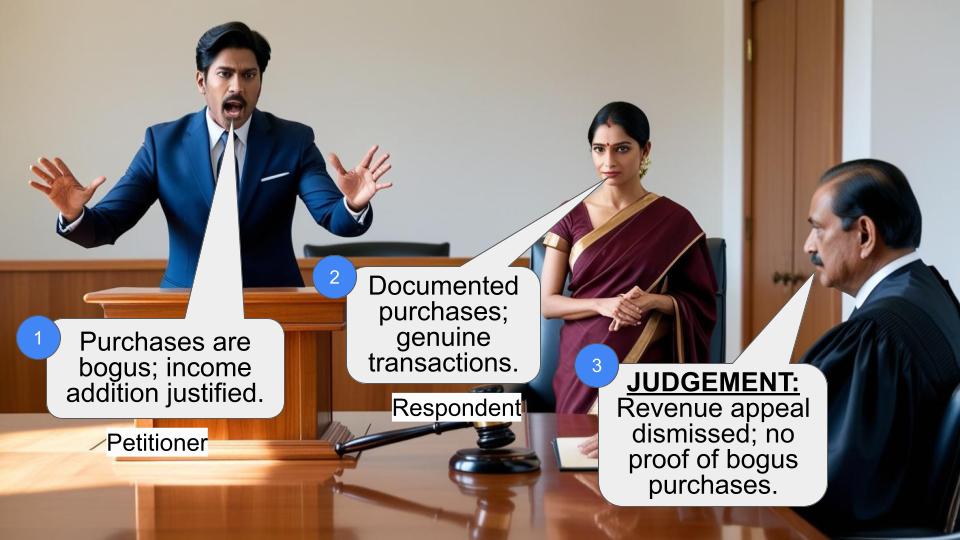
The tax authorities (Revenue) tried to claim that a company called Padmini VNA Mechatronics Pvt. Ltd. made some fake purchases. The company appealed, and both the Commissioner of Income Tax (Appeals) and the Income Tax Appellate Tribunal (ITAT) sided with the company. The Revenue then took it to the High Court, but they lost there too. The court basically said, "Nope, you don't have enough proof to show these purchases were bogus."
Get the full picture - access the original judgement of the court order here
Case Name:
Principal Commissioner of Income Tax Vs Padmini VNA Mechatronics Pvt. Ltd (High Court of Delhi)
ITA No.140/2019 & CM No.6355/2019
Date: 11th February 2019
Key Takeaways:
1. The tax department can't just claim purchases are fake without solid evidence.
2. Proper documentation like VAT forms, stock registers, and excise records can be crucial in proving the legitimacy of purchases.
3. The court values detailed analysis of evidence over broad allegations.
4. Previous similar judgments can significantly influence current cases.
Issue:
The main question here is: Can the Revenue department add to the assessee's income by claiming bogus purchases when they haven't pointed out any discrepancies in the documentary evidence provided by the assessee?
Facts:
1. This case is about the Assessment Year 2008-09.
2. The tax department issued reassessment notices to Padmini VNA Mechatronics, saying they made bogus purchases.
3. The company makes automobile and electronic parts.
4. The tax folks claimed that purchases from two companies, M/s Om Industrial Corporation (OIC) and M/s Techno Enterprises, were fake.
5. They based this on some survey proceedings under Section 133 (of Income Tax Act, 1961) and statements under Section 133A (of Income Tax Act, 1961).
6. The Assessing Officer (AO) disallowed expenditure of ₹60,61,4801.
Arguments:
Revenue's side:
- They said the purchases from OIC and Techno Enterprises were bogus.
- They relied on statements from alleged "bogus entry providers."
- They argued that just depositing money doesn't prove actual purchase or use of goods.
Company's side:
- They provided tons of documents: VAT deposit forms, D-3 Transit/Transport challans, stock registers, central excise gate passes, etc.
- They showed how goods moved from seller to buyer, including VAT department checks at the border.
- They demonstrated the entire process from purchase to production to sales, backed by various records.
Key Legal Precedents:
The court referred to its own previous orders in ITA Nos.111/2019 and 112/2019, dated 04.02.2019, which dealt with similar issues for the same company but for different assessment years (2006-07 and 2007-08). In those cases, the court had also dismissed the Revenue's appeals.
Judgement:
The High Court dismissed the Revenue's appeal. Here's why:
1. The company didn't just show money transfers; they proved the actual movement of goods.
2. The VAT authorities' stamp on transit challans at the border was seen as strong evidence.
3. Other documents like stock registers, factory receipts, and excise registers were considered sufficient proof that the purchases were genuine.
4. The court felt that the Commissioner of Income Tax (Appeals) had done a more thorough analysis of the evidence compared to the Assessing Officer.
5. The court found no substantial question of law arising from the case.
FAQs:
1. Q: What does this judgment mean for businesses?
A: It shows that maintaining proper documentation of purchases and following all tax procedures can help defend against allegations of bogus transactions.
2. Q: Why did the court favor the company's evidence over the tax department's claims?
A: The company provided comprehensive documentation showing the entire chain of transactions, while the tax department relied more on general statements without pointing out specific discrepancies.
3. Q: What role did previous judgments play in this case?
A: The court's previous decisions in similar cases involving the same company significantly influenced this judgment, showing the importance of legal precedents.
4. Q: Can the tax department still make claims of bogus purchases in the future?
A: Yes, but this judgment suggests they'll need to provide more concrete evidence and point out specific discrepancies in the assessee's documentation.
5. Q: What types of evidence were most crucial in this case?
A: VAT forms, transit challans, stock registers, and excise records were particularly important in proving the legitimacy of the purchases.

1. The Revenue in this appeal under Section 260A (of Income Tax Act, 1961) is aggrieved by the ITAT’s order, which had affirmed the Appellate Commissioner’s decision, setting aside a reassessment order.
2. The substantial question of law raised is that the lower appellate authorities have returned unreasonable and perverse findings on merits. For Assessments Year 2008-09, reassessment notices were issued to the assessee, on the ground that the latter had made bogus purchases. The assessee manufactured various kinds of automobile parts and electronic parts. The precise complaint was that the two concerns, M/s Om Industrial Corporation (OIC) and M/s Techno Enterprises were shown as sellers of raw material in respect of the substantial quantities. The Revenue alleged that the purchases reflected from these sources were bogus. The Revenue relied upon the survey proceedings under Section 133 (of Income Tax Act, 1961) as well as the statements made under Section 133A (of Income Tax Act, 1961). It further relied upon the statement made allegedly by bogus entry providers, who stated that the amounts claimed by the asessee as expenditure were of fictitious and bogus nature. The AO acted upon these and disallowed the expenditure to the tune of ₹60,61,4801.
3. Upon appeal the CIT(A) considered the explanation and also various documentary evidence on record. These included the forms evidencing deposit of VAT dues; the D-3 Transit/Transport challan, stock register maintained at the asseessee’s factory premises, the relevant central excise gate passes/records of purchases in the statutory register RG-1 etc. After recording these submissions, the CIT(A) held that the issues in the relevant assessment year were squarely covered by his orders for A.Y. 2006-07 and 2007-08. In those orders, the CIT(A) was of the opinion that even though initiation of re-assessment was justified, the addition made in the reassessment proceedings, was not justified. The CIT(A)’s reasoning in those orders was as follows:
“The AO has also made a reference to the bank Accounts of these concerns showing cash withdrawal for returning the money to the beneficiaries. In view of these broad findings, the AO reached to the conclusion that the purchases made from these parties are not genuine. The AO however, could not point out any discrepancy in the documents and records, including stock register produced before him. In this case, I find that all the, purchases are evidences by purchase invoices. All the 3 parties are registered with VAT and having TIN nos. as mentioned in the invoices. All the 3 parties are at Faridabad / Haryana. The purchases are made by the appellant at it's Gurgaon factory. For every sale from Faridabad / Haryana to Gurgaon, the seller party has to obtain advance D - 3 Vat Form from Faridabad VAT Deptt. This form is to be accompanied with the purchase invoice during transportation of goods from the seller to the buyer. The purchase invoice, D - 3 VAT form and the physical goods transported are inter - sea matched by the Vat Deptt. at the border. The VAT Deptt. after verification, put it's seal on the D - 3 form In this case, for all the 3 parties all such documents have been produced by the appellant. It un- doubtedly shows the movement of goods from Haryana to Gurgaon. On receipt of goods, it receipt is entered in the gate entry register by the Security guard on the gate who after physical verification of the goods put a seal on the back of the invoice. This seal mentions the particulars of gate entry no., date and initial of security guard. Then, the goods are received in store where it's receipts are entered in the stock register. Then the movement of goods from the stores to production Deptt. is also recorded in the Stock Register. The copies of relevant stock records showing this movement has also been produced before AO wherein no discrepancy has been noticed. The unit is cover under the Excise Act. The production, and it's sale is recorded in the Excise records. All these records were produced and filed before the AO wherein, again no discrepancy has been noticed. All these documents shows the movement of goods from Haryana to Gurgaon factory of the appellant and thereafter issuance for production and ultimately culminating into sales. The Excise records are audited periodically by the Excise Deptt. Purchase also needs to be reported to the VAT Deptt. through VAT returns. The purchases from these parties also stood declared to the VAT Deptt. which after verification, accepted the same. The appellant also filed a certificate from the Production manager alongwith details of production wise clearance which clearly shows that these items were used and consumed by the Production Deptt.
As explained by the appellant, these purchases constitutes the raw material for manufacturing "valves" which is the end product of the appellant which valves are sold to Original Equipment Manufacturing companies like Maruti, Mahindra, Tata etc., etc., wherein this item is being used as a motor part. In this case, complete documentary evidences have been filed before the AO wherein no discrepancy has been pointed out. The payment for purchases had been made through cheques.
4. The Revenue’s appeals for those assessment years having been dismissed, it approached this Court in ITA Nos.111/2019 and 112/2019, which have been dismissed by our order dated 04.02.2019 with the following observations :
“3. On the basis of the above reasoning, the CIT set aside the final reassessment order which had disallowed the expenditure. The Revenue’s appeal before ITAT was unsuccessful. On behalf of the Revenue, it is urged that the findings of the Appellate Commissioner and ITAT cannot be sustained because they did not give any credence to the statements recorded under Section 133A (of Income Tax Act, 1961). It is further stated that mere deposit of amounts to D-3 challan, did not signify that the goods were actually purchased or had been consumed as alleged by the assessee.
4. This Court is of the opinion that the assessee did not rely merely upon the deposit of the amount but rather movement of the goods, which is borne out by the VAT authorities’ stamp on transit challan i.e. chungi, at the border.
5. Furthermore, other evidence such as the stock register, factory certifying the receipt of the goods as and when they were moved into the premises; clearly recorded in the statutory central excise registers RG-1 etc., were sufficient proof to show that the purchases were not bogus. Moreover, the CIT(A) re-apprised all the evidence, unlike the AO, who was largely influenced by the so-called credit entry providers.
6. This Court is of the opinion that having regard to the detailed analysis of the CIT(A), with which the ITAT’s finding concurred, no question of law arises.”
5. The present appeal raises similar grounds and is covered by our order dated 04.02.2019. No substantial question of law arises. The appeal is, therefore, dismissed.
S. RAVINDRA BHAT, J
PRATEEK JALAN, J
FEBRUARY 11, 2019
×