


Court Rejects Tax Addition Based on Retracted Statement, Upholds Tribunal's Fac…


Full News

Court Rejects Tax Addition Based on Retracted Statement, Upholds Tribunal's Factual Finding
Court Rejects Tax Addition Based on Retracted Statement, Upholds Tribunal's Factual Finding
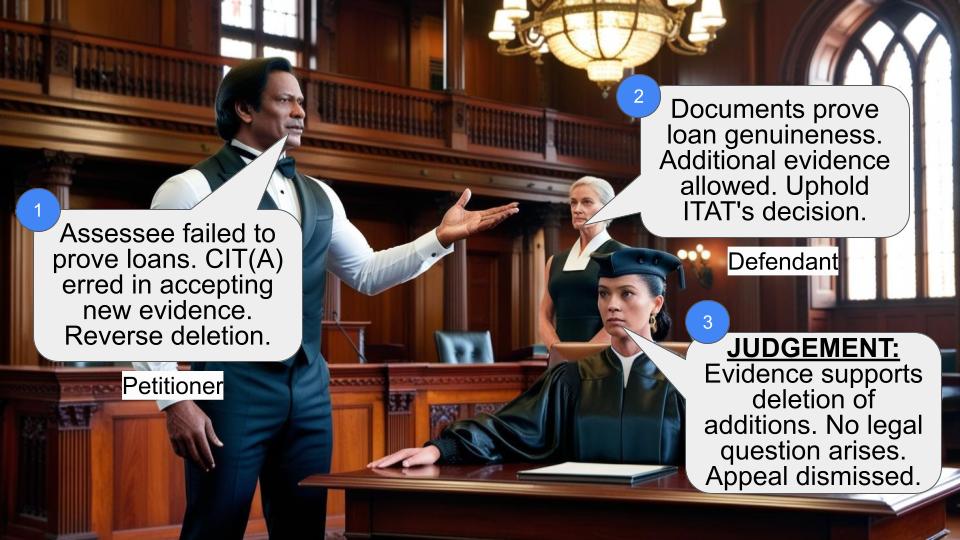
This case involves the Commissioner of Income Tax appealing against an order by the Income Tax Appellate Tribunal (ITAT) in favor of the assessee, Harpal Singh. The dispute centered around an addition made by the Assessing Officer under section 69B (of Income Tax Act, 1961), based on a retracted statement from a seller. The High Court dismissed the appeal, affirming the ITAT's decision that no substantial question of law arose from the case.
Get the full picture - access the original judgement of the court order here
Case Name:
Commissioner of Income Tax vs. Harpal Singh (High Court of Punjab & Haryana)
Income Tax Appeal Nos.474 & 475 of 2007
Date: 31st January 2008
Key Takeaways:
1. Additions under section 69B (of Income Tax Act, 1961) cannot be made solely based on retracted statements without corroborating evidence.
2. The right to cross-examine is crucial when relying on third-party statements for tax assessments.
3. Tribunal's findings of fact, if based on evidence, are generally not interfered with by higher courts.
4. Consistency in tax treatment across related cases (seller and buyer) is important.
Issue:
Was the Income Tax Appellate Tribunal (ITAT) correct in confirming the order of the CIT(A) in favor of the assessee, considering the retracted statement of the seller and the lack of opportunity for cross-examination?
Facts:
1. Harpal Singh (the assessee) purchased agricultural land on behalf of NRIs (Avtar Singh and Smt. Satinder Kaur) in two transactions on 14.12.2000 and 9.4.2001.
2. The land was bought from Satinder Pal Singh for Rs.38,35,000/- and Rs.46,32,500/- respectively, at Rs.2,30,000/- per acre.
3. The Assessing Officer received information from the Assistant Director of Income Tax (Investigation) that the seller had admitted to selling the land at Rs.4 lacs per acre.
4. Based on this, the Assessing Officer added Rs.38.65 lacs and Rs. 46,32,500/- for the assessment years 2001-02 and 2002-03 under Section 69B (of Income Tax Act, 1961).
5. The seller later retracted his statement about receiving additional money.
6. The CIT(A) and ITAT ruled in favor of the assessee, deleting the additions.
Arguments:
Department's Arguments:
1. The seller's initial statement admitting to receiving additional money should be considered valid.
2. The right to cross-examine is not necessarily a part of reasonable opportunity.
Assessee's Arguments:
1. The seller retracted his statement, and no corroborating evidence was provided.
2. The assessee was not given an opportunity to cross-examine the seller.
3. The funds for the purchase came from NRI accounts, and there was no evidence of undisclosed sources.
Key Legal Precedents:
1. The case of K.P. Varghese was cited (though not elaborated upon in the judgment) regarding the need for concrete evidence beyond mere statements .
2. The principle that Tribunal's findings of fact, if based on evidence, should not be interfered with by higher courts was applied .
Judgement:
The High Court dismissed the appeals filed by the Department, affirming the ITAT's decision. The court held that:
1. The ITAT had recorded a pure finding of fact based on the evidence available.
2. There was no material or evidence before the Assessing Officer to conclude that the assessee had paid consideration above the amount mentioned in the registered sale deed.
3. The seller's retracted statement, without corroboration, was insufficient to justify the addition.
4. The assessee was not given an opportunity to cross-examine the seller, which was crucial given that the statement was the only evidence.
5. In the seller's own assessment, the sale consideration as shown in the sale deed was accepted by the Department.
FAQs:
Q1: Why was the seller's initial statement not considered valid?
A1: The seller retracted his statement, and there was no corroborating evidence to support the claim of additional payment.
Q2: Why is cross-examination important in such cases?
A2: Cross-examination allows the assessee to challenge the credibility and accuracy of statements made against them, ensuring fairness in the proceedings.
Q3: What is the significance of section 69B (of Income Tax Act, 1961) in this case?
A3: Section 69B (of Income Tax Act, 1961) deals with investments that are not fully disclosed in the books of account. The Assessing Officer tried to use this to add the alleged undisclosed amount to the assessee's income.
Q4: How does this judgment impact similar cases?
A4: It emphasizes the need for concrete evidence beyond mere statements, especially retracted ones, when making additions to assessed income. It also highlights the importance of providing opportunities for cross-examination in such cases.
Q5: What role did the NRI angle play in this case?
A5: The fact that the funds came from NRI accounts and were properly documented helped support the assessee's claim that there were no undisclosed sources of income used for the land purchase.

1. This order shall dispose of two appeals i.e. ITA Nos.474 and 475 of 2007 filed under Section 260A (of Income Tax Act, 1961) by the Department against the order dated 9.3.2007 passed by the Income Tax Appellate Tribunal, Chandigarh (hereinafter referred to as `ITAT') in ITA Nos.363 & 364/Chd/2005 preferred against the respondent/assessee for the years 2001-02 and 2002-03, raising the following substantial questions of law for consideration of this Court:-
(i) Whether the ITAT was right in confirming the order of CIT(A) in favour of the assessee by stating that the seller has retracted his statement based on which the A.O. had made the addition in view of the fact that the assessee cannot be allowed to retract from an earlier admission by mere statement?
(ii) Whether the ITAT was right in confirming the order of CIT(A) in favour of the assessee by stating that the assessee was not provided opportunity to cross examine the seller in view of the fact that the right to cross examine is not necessarily a part of reasonable opportunity?
In the present case, the assessee purchased 17.5 and 21 acres of agricultural land on 14.12.2000 and 9.4.2001, on behalf of Avtar Singh and Smt.Satinder Kaur (NRIs.), situated at village Kalalmajra from one Satinder Pal Singh for a consideration of Rs.38,35,000/- and Rs.46,32,500/-, respectively, @ Rs.2,30,000/- per acre. The payment of the sale consideration was made from NRI account No.01190057727 belonging to aforesaid Avtar Singh and Smt.Satinder Kaur.
The Assessing Officer on receiving the information from the Assistant Director of Income Tax (Investigation), Ludhiana along with a copy of statement of the seller Satinder Pal Singh, recorded by the Investigating Wing of the Department in which the seller had admitted that he had sold the land in question @ Rs.4.00 lacs per acre, but the sale deed was got registered @ Rs.2.30 lacs per acre, issued notices under Section 148 (of Income Tax Act, 1961) (hereinafter referred to as `the Act') for the assessment years 2001-02 and 2002-03. After hearing the assessee, the Assessing Officer while relying upon the statement of Satinder Pal Singh recorded by the Investigating Wing of the Department, which he subsequently retracted, assessed the value of the land purchased by the assessee @ Rs.4.00 lacs per acre and framed the assessment while adding Rs.38.65 lacs for the assessment year 2001-02 and Rs.46,32,500/- for the assessment year 2002-03 under Section 69B (of Income Tax Act, 1961) by treating the same as investment from undisclosed sources.
Aggrieved against the aforesaid order of assessment, the assessee filed two separate appeals before the Commissioner of Income Tax (Appeals), Patiala which were allowed by the Appellate Authority on 3.2.2005 while making the following observations:-
“....The Ld. AO has heavily relied upon the statement recorded by the ADI (Inv), Ludhiana on 18.9.2001 in which the seller has deposed that apart from the registration deed he had received Rs.72,00,000/- from the appellant in five installments. This statement has been perused by me and it is found that the contents of this statement regarding declaration of extra money received from the purchasers had not been substantiated by him either in the same statement or through his subsequent conduct. Neither the ADIT (Inv) nor the Ld. AO has brought any adverse material to substantiate the contents of the said statement relied upon by them despite the retraction of the same. Unless, some money or consideration is proved to have been actually passed on to the seller, mere controversial one time confession of the seller that had been retracted by him later on, cannot help the department in view of the ratio of Hon'ble Supreme Court in the famous case of KP Vergese. Moreover, the Ld. AO had also not given any opportunity to the appellant in the interest of natural justice to cross examine the seller. Since, it is a case of an agent working for NRI masters and no concrete evidence has been brought on record to strengthen his case, it is difficult to concur with the views of the Ld. Assessing Officer that the appellant had indeed paid any amount over and above the registered sale deed. There is no dispute that the seller was not able to tell the appropriation of money as to where he invested the alleged money and also that no asset had been found by the ADI (Inv), Ludhiana in consonance with so called confession to corroborate his view and support the passing of any money. Clearly in the instant case, the Departmental stand has not been substantiated with proper evidence. Rather, in the case of the seller Sh. Satinder Pal Singh who is being assessed with ITO, Ward-III, Khanna, the Ld. AO while completing his assessment after detailed scrutiny has categorically accepted that he had sold the land to the appellant in the capacity of agent of NRIs for a sum of Rs.38,35,000/- only in this year.
6.1 In view of the above discussion, I am of the considered opinion that the Ld. AO was not justified in adding the sum of Rs.38.\,65,000/- in the hands of the appellant treating the same as investment from undisclosed sources. Hence the same is deleted.”
The Department being not satisfied with the orders of the Commissioner of Income Tax (Appeals), filed two separate appeals before the ITAT. The said appeals were dismissed by the ITAT on 9.3.2007 by the impugned order while observing as under:-
“....After considering the entire conspectus of facts and the legal position, we are inclined to hold that in so far as factual position is concerned, there is no clinching evidence or material with the revenue to justify the inference that the assessee has made investment in the purchase of lands over and above the amount stated in purchase deed. The entire case of the revenue is built on the statement made by the seller before the ADI (Inv.), Ludhiana on 18.9.2001 in which it is deposed that he has received money over and above the amount stated in the registered Purchase/Sale Deed. We are unable to accept the veracity of the said statement for more than one reason. Firstly, the said statement has subsequently been retracted that such retraction was very much before the ADI (Inv.), Ludhiana. The said statement as well as the subsequent retraction was also before the assessing authority who had assessed the return of income filed by the seller Sh. Satinder Pal Singh. We have perused the said assessment order placed at pages 13 to 29 of the paper book and find that the stated consideration has been accepted. The Assessing Officer in the case of the seller has referred to the information received from the Investigating Wing in para 1 itself, therefore, it is not a case where the said assessing authority was unaware of the information gathered by the Investigating Wing of the department. In spite of the same, the assessing authority has independently verified the position and has not inferred that no consideration over and above the stated consideration has changed hands. thirdly, we also notice that the present assessee, in the course of assessment proceedings, specifically contested the alleged admission by Sh. Satinder Pal Singh and requested that the assessee be allowed to cross examine the said person. There is nothing on record to indicate the reasons as to why the assessing authority failed to allow cross examination, specially when the only evidence with the assessing authority was the alleged statement of the seller. Therefore, the said statement has been put to use by the revenue without it being tested. For all the above reasons, we are inclined to affirm the conclusion of the CIT (A) that the aforesaid piece of evidence cannot be used to justify the impugned addition.
8. Apart from the aforesaid, the issue can also be seen from a different angle. In this case, it is an accepted position that the GPA holder has purchased the property for and on behalf of two NRIs. In this connection, the NRI namely, Sh. Avtar Singh explained before the assessing authority the details of the sources of funds. It is evident from the submissions made before the income tax authorities that the funds of investment in land purchase came out of the bank accounts maintained by the said NRI with State Bank of India, Sector 17, Chandigarh. The entire credit and debit entries credit in the said accounts were also sought to be explained. The said Sh. Avtar Singh also placed an affidavit to state that the entire amount used for purchasing the land was remitted from abroad. Therefore, the entire factual position in this regard was before the assessing authority. In the face of such evidence, there is no material with the revenue as to the source from where the assessee in question could have utilized money from undeclared sources. In fact, in the entire exercise, the Assessing Officer has not even made any attempt to inquire the sources from where the assessee could have met the requirements of payment of on-money.
Therefore, the presumption that whatever is stated on the registered deed is correct unless the contrary is proved by credible evidence, clearly applies in the instant case.”
Against the said order, the aforesaid two appeals have been filed.
After hearing the counsel for the appellant and going through the impugned orders passed by the ITAT, we are of the opinion that the ITAT has recorded a pure finding of fact after taking into consideration the evidence/material available on the record to the effect that before the Assessing Officer there was no material or evidence to conclude that the assessee had paid a consideration over and above the amount mentioned in the registered sale deed, i.e.@ Rs.2.30 lacs per acre and the addition made by him was without any basis. The only evidence/material available before the Assessing Officer was the so called statement of Satinder Pal Singh, which was recorded by the Assistant Director of Income Tax (Investigation), Ludhiana on 18.9.2001 in which he had deposed that he had sold the land in question @ Rs.4.00 lacs per acre, and apart from the amount mentioned in the registered sale deed, he had received Rs.72.00 lacs cash from the assessee in five installments. Undisputedly, said Satinder Pal Singh subsequently retracted from his statement before the Assistant Director of Income Tax (Investigation), Ludhiana itself whereby he had confirmed that he had not received any amount over and above the consideration stated in the sale deed. Further, it is also undisputed position that before the Assessing Officer said Satinder Pal Singh did not appear and made any statement nor an opportunity was granted to the assessee to confront the sale deed and cross-examine Satinder Pal Singh on the statement which he had made before the Assistant Director of Income Tax (Investigation), Ludhiana. In spite of all this evidence, the Assessing Officer made the addition under Section 69B (of Income Tax Act, 1961) only on the basis of conjectures while observing that it is a well known practice that the sale deeds of immovable properties are being registered at the much lower rates than the rates prevailing in the markets. It is also undisputed fact that after selling of the land, Satinder Pal Singh was assessed under the Act and at that time the sale value of the said land was taken as indicated in the registered sale deed and that assessment had become final. In our opinion, the ITAT has duly appreciated the evidence/material available on the record and various contentions raised by the parties, and then came to the aforesaid conclusion, which in our view, is a pure finding of fact which does not require any interference by this court. Therefore, in our opinion, in these appeals no substantial question of law is arising from the impugned order for consideration of this Court.
Hence, both the appeals are dismissed.
(SATISH KUMAR MITTAL)
JUDGE
(RAKESH KUMAR GARG)
JUDGE
January 31, 2008
×
Questions
Court Rejects Tax Addition Based on Retracted Statement, Upholds Tribunal's Factual Finding
Write your CommentSimilar Posts


Generic
- Reportdata/4917.pdf
