


Court Rejects Tax Authority's Suspicion-Based Addition, Upholds Taxpayer's Capi…


Full News

Court Rejects Tax Authority's Suspicion-Based Addition, Upholds Taxpayer's Capital Gains Claim
Court Rejects Tax Authority's Suspicion-Based Addition, Upholds Taxpayer's Capital Gains Claim
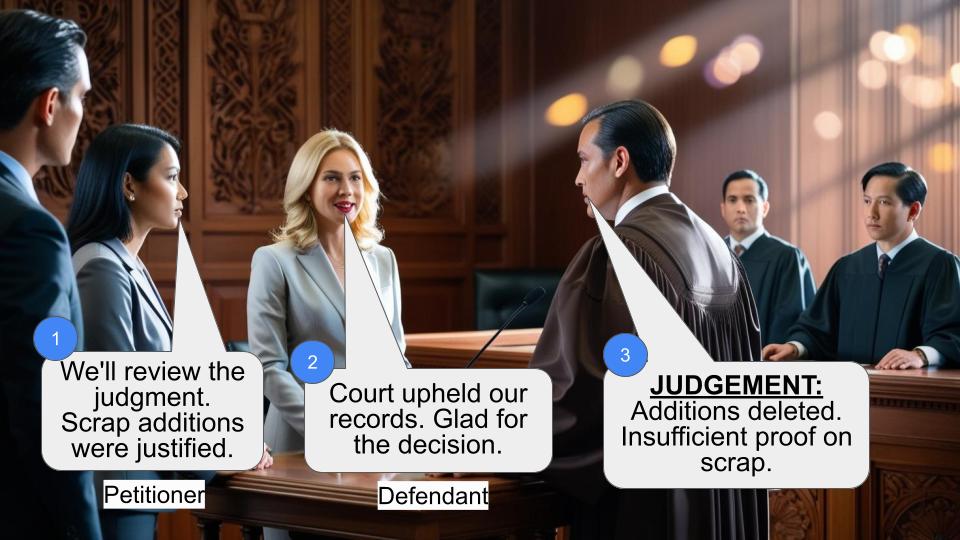
This case involves a dispute between the Income Tax Department (appellant) and a taxpayer (respondent) over the treatment of short-term capital gains. The tax authority had treated the taxpayer's declared capital gains as unexplained cash credit, but the Income Tax Appellate Tribunal (ITAT) ruled in favor of the taxpayer. The High Court dismissed the tax department's appeal, upholding the ITAT's decision.
Get the full picture - access the original judgement of the court order here
Case Name:
Commissioner of Income Tax Vs Mahesh chandra G Vakil (High Court of Gujarat)
Tax Appeal No.1503 of 2011
Date: 25th September 2012
Key Takeaways:
1. Additions under section 68 (of Income Tax Act, 1961) (unexplained cash credit) cannot be made solely based on suspicion.
2. Taxpayers' explanations, when supported by evidence, should be given due consideration.
3. Courts are reluctant to interfere with factual findings of lower appellate authorities unless they are perverse or unreasonable.
Issue:
Was the Income Tax Appellate Tribunal (ITAT) correct in deleting the addition of Rs.36,71,881/- made under section 68 (of Income Tax Act, 1961) by the Assessing Officer by treating the Short Term Capital Gain as unexplained cash credit?
Facts:
1. The case pertains to the assessment year 2006-07 (accounting period: 01.04.2005 to 31.3.2006).
2. The assessee (taxpayer) filed a return declaring total income of Rs.12,02,147/-, including short-term capital gain of Rs.4,92,580/-.
3. The Assessing Officer treated Rs.36,71,882/- as unexplained cash credit under section 68 (of Income Tax Act, 1961), instead of accepting it as capital gain on sale of shares as declared by the assessee.
4. The assessee appealed to the Commissioner (Appeals), who ruled in favor of the assessee.
5. The revenue department then appealed to the Income Tax Appellate Tribunal (ITAT), which upheld the Commissioner's decision.
6. The revenue department further appealed to the High Court.
Arguments:
Assessee's arguments:
1. The purchase transactions were made on the "Online Trading System" and were genuine.
2. Prior to 1.4.2005, it wasn't compulsory for clients to have their own transaction records under SEBI guidelines, explaining the use of broker's code for earlier purchases.
3. The contract note clearly mentioned that brokerage was inclusive of service tax.
4. Complete details were furnished, including contract notes, bank statements, and Demat Account records.
Revenue's arguments:
1. The Assessing Officer's decision was based on suspicions about the genuineness of the transactions.
2. There was an absence of a broker-client agreement.
3. The use of "self code" by the broker was questionable.
Key Legal Precedents:
The judgment doesn't explicitly mention any specific legal precedents. However, it emphasizes the principle that additions under section 68 (of Income Tax Act, 1961) cannot be made solely based on suspicion.
Judgement:
1. The High Court dismissed the appeal of the revenue department.
2. It upheld the ITAT's decision, finding no reason to interfere with the factual findings.
3. The court noted that the ITAT had appreciated the evidence on record and found the assessee's explanations satisfactory.
4. The court emphasized that the Assessing Officer's treatment of capital gain as unexplained cash credit was based only on suspicion, which is not sufficient grounds for such an addition.
FAQs:
Q1: What is section 68 (of Income Tax Act, 1961)?
A1: Section 68 (of Income Tax Act, 1961) deals with unexplained cash credits. It allows the tax authority to tax certain unexplained credits found in the books of an assessee.
Q2: Why did the court dismiss the revenue's appeal?
A2: The court found that the ITAT's decision was based on a reasonable appreciation of evidence and that the revenue couldn't show that the ITAT's findings were perverse or unreasonable.
Q3: What evidence did the assessee provide to support their claim?
A3: The assessee provided contract notes for sale and purchase, bank statements of the broker, Demat Account records showing transfer of shares, and transaction abstracts from the stock exchange.
Q4: Can the tax department make additions based solely on suspicion?
A4: No, this judgment clearly states that additions under section 68 (of Income Tax Act, 1961) cannot be made by the Assessing Officer only on the basis of suspicion.
Q5: What's the significance of this judgment for taxpayers?
A5: This judgment emphasizes the importance of maintaining proper documentation for financial transactions. It also reassures taxpayers that if they can provide satisfactory explanations and evidence, tax authorities cannot make arbitrary additions to their income.

1. The appellant – revenue has challenged the order dated 31.05.2011 made by the Income Tax Appellate Tribunal (the Tribunal) by proposing the following question :
“Whether on facts and circumstances of the case and in law, the Hon'ble ITAT is right in deleting the addition of Rs.36,71,881/- made u/s. 68 (of Income Tax Act, 1961) by the Assessing Officer by treating the Short Term Capital Gain as unexplained cash credit?”
2. The assessment year is 2006-07 and the corresponding accounting period is 01.04.2005 to 31.3.2006. The respondent – assessee filed return of income declaring total income of Rs.12,02,147/- including short term capital gain of Rs.4,92,580/-. The Assessing Officer framed assessment under section 143(3) (of Income Tax Act, 1961) treating Rs.36,71,882/- as unexplained cash credit under section 68 (of Income Tax Act, 1961) as against capital gain on sale of share declared by the assessee. The assessee carried the matter in appeal before the Commissioner (Appeals) who allowed the said ground of appeal and directed the Assessing Officer to accept the claim of the assessee of Rs.36,71,882/- as capital gains. The revenue carried the matter in appeal before the Tribunal, but did not succeed.
3. Mr. Manav Mehta, learned counsel for the appellant has assailed the impugned order by placing reliance upon the reasoning adopted by the Assessing Officer.
4. As can be seen from the impugned order, the Tribunal, after appreciating the evidence on record, has found that before the Assessing Officer the assessee had explained that the purchase transactions were made on the “Online Trading System” and these transactions were genuine. Earlier, that is prior to 1.4.2005, it was not compulsory for the client to have his own transaction record under SEBI guidelines. Therefore, the purchases earlier were made using the broker's code, and it was for this reason that the broker had used the “self code”. Since the shares were sold after 1.4.2005, the transactions were not under the broker’s code. As regards service-tax and stamp charges the contract note of the broker clearly mentioned that the brokerage was inclusive of service tax etc. In the case of the selling broker the Service tax Securities Transaction tax and Education Cess were separately mentioned. As regards the point raised by the Assessing Officer that there was absence of broker-client agreement, the Tribunal accepted the submission of the assessee that the genuineness of the transactions was already proved by the contract notes for sale and purchase, the bank statement of the broker, the Demat Account showing transfer in and out of shares, as also abstract of transactions furnished by the CSE. The Tribunal, after appreciating the evidence on record, concurred with the findings recorded by the Commissioner (Appeals) that the assessee had furnished complete details which were not found false or bogus by the Assessing Officer and that it was only on suspicion that the Assessing Officer had treated the capital gain declared by the assessee as unexplained cash credit under section 68 (of Income Tax Act, 1961). In the light of the aforesaid findings of fact recorded by it, the Tribunal dismissed the appeal of the revenue.
5. In the light of the above findings of fact recorded by the Tribunal, it is not possible to state that the view adopted by the Tribunal is, in any manner, unreasonable or perverse. Besides, the learned counsel for the appellant is not in a position to show that the Tribunal has placed reliance upon any irrelevant material or that any relevant material has been ignored, nor is he able to point out any material to the contrary so as to dislodge the concurrent findings of fact recorded by the Tribunal. Under the circumstances, the impugned order being based upon concurrent findings of fact recorded by the Tribunal upon
appreciation of the evidence of record, does not give rise to any question of law, much less, a substantial question of law so as to warrant interference. The appeal is, accordingly, dismissed.
[AKIL KURESHI, J.]
[HARSHA DEVANI, J.]
×
Similar Ripples
Questions
Court Rejects Tax Authority's Suspicion-Based Addition, Upholds Taxpayer's Capital Gains Claim
Write your CommentSimilar Posts


Generic
- Reportdata/5412.pdf
