


Court Remands Case on Validity of Income Tax Proceedings Under Section 158BD (o…


Full News
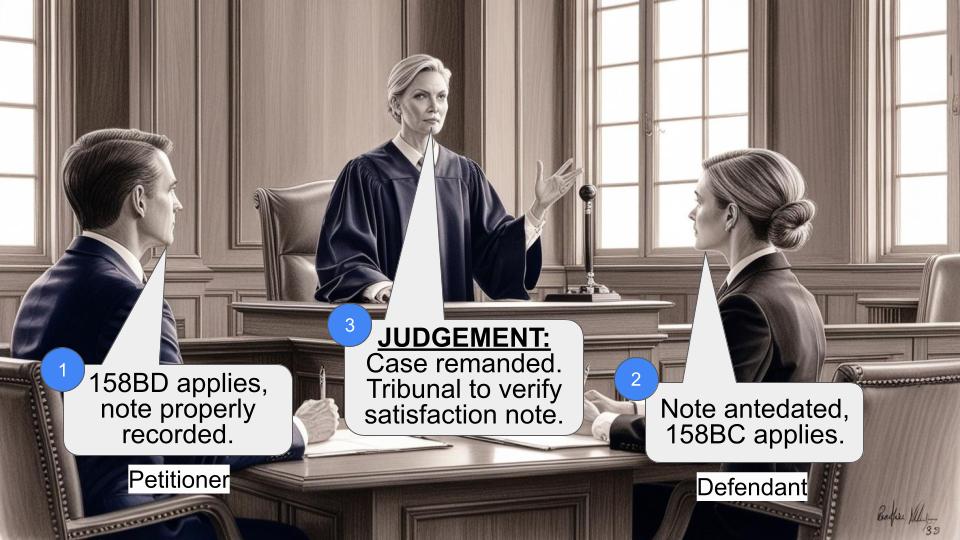
Court Remands Case on Validity of Income Tax Proceedings Under Section 158BD (of Income Tax Act, 1961)
Court Remands Case on Validity of Income Tax Proceedings Under Section 158BD (of Income Tax Act, 1961)
This case involves an appeal by the Income Tax Department against Anupam Nagalia regarding the validity of proceedings initiated under Section 158BD (of Income Tax Act, 1961). The main dispute centers around whether the proper procedures were followed in initiating these proceedings, particularly concerning the recording of a "satisfaction note". The High Court ultimately decided to remand the case back to the Income Tax Appellate Tribunal for fresh examination.
Get the full picture - access the original judgement of the court order here
Case Name:
Commissioner of Income Tax Vs Anupam Nagalia (High Court of Punjab & Haryana)
ITA No.55 of 2015
Date: 6th January 2016
Key Takeaways:
1. The importance of a properly recorded "satisfaction note" in initiating proceedings under Section 158BD (of Income Tax Act, 1961).
2. The timing and flexibility allowed in recording the satisfaction note.
3. The need for a case-by-case examination of whether procedures were followed correctly.
Issue:
Was the Income Tax Department's initiation of proceedings under Section 158BD (of Income Tax Act, 1961) against Anupam Nagalia valid and proper?
Facts:
1. A search and seizure operation was conducted at Anupam Nagalia's residence on May 8, 2003, along with Vatika group of companies.
2. The Assessing Officer issued a notice under Section 158BD (of Income Tax Act, 1961) to Nagalia on May 31, 2005.
3. Nagalia filed a return declaring nil income.
4. The Assessing Officer assessed undisclosed income of ₹1,89,53,900 under Section 158BD (of Income Tax Act, 1961) read with Section 158BC (of Income Tax Act, 1961) on May 21, 2007.
5. Nagalia appealed, arguing that his case should have been assessed under Section 158BC (of Income Tax Act, 1961), not 158BD.
6. The Commissioner of Income Tax (Appeals) ruled in Nagalia's favor.
7. The Income Tax Department appealed to the Income Tax Appellate Tribunal, which dismissed their appeal.
8. The Department then appealed to the High Court.
Arguments:
Income Tax Department:
- Nagalia's name wasn't on the search warrant, so he wasn't covered under Section 132(1) (of Income Tax Act, 1961).
- Proceedings under Section 158BD (of Income Tax Act, 1961) were initiated based on materials found during the search of Vatika Group entities.
Anupam Nagalia:
- Once the search team entered his premises, he was covered under Section 132(1) (of Income Tax Act, 1961) and should have been assessed under Section 158BC (of Income Tax Act, 1961).
- The satisfaction note was not recorded until January 27, 2006, and any earlier note was likely antedated.
Key Legal Precedents:
1. CIT vs. Calcutta Knitwears Limited, (2014) 362 ITR 673: The Supreme Court held that a satisfaction note is essential for Section 158BD (of Income Tax Act, 1961) proceedings and can be prepared at various stages of the assessment process.
2. State of Andhra Pradesh vs. M.Ramakishtaiah & Co., (1994) 93 STC 406: Cited by Nagalia's counsel regarding presumptions when documents are not produced.
3. CIT I, Ludhiana vs. Mridula Prop. M/s Dhruv Fabrics, Ludhiana: The High Court interpreted "immediately after" in the context of recording satisfaction notes.
Judgement:
The High Court decided to remand the case back to the Income Tax Appellate Tribunal. The court noted that the Tribunal, being the final fact-finding authority, had not recorded any finding regarding the recording of the satisfaction note on May 31, 2005, or whether it was antedated. The High Court directed the Tribunal to examine these issues afresh and record a reason-based finding.
FAQs:
1. Q: What is a "satisfaction note" in this context?
A: A satisfaction note is a document recorded by the Assessing Officer indicating their belief that undisclosed income belongs to a person other than the one searched.
2. Q: Why is the timing of the satisfaction note important?
A: The timing helps determine whether proper procedures were followed in initiating proceedings under Section 158BD (of Income Tax Act, 1961).
3. Q: What's the difference between Section 158BC (of Income Tax Act, 1961) and 158BD (of Income Tax Act, 1961)?
A: Section 158BC (of Income Tax Act, 1961) deals with assessment of searched persons, while 158BD deals with undisclosed income of any other person.
4. Q: What does "remanding the case" mean?
A: It means the High Court is sending the case back to the Tribunal for further examination and a new decision.
5. Q: Does this judgment set a new precedent?
A: While it doesn't set a new precedent, it emphasizes the importance of proper procedure and thorough examination in such tax cases.

1. This appeal has been filed by the appellant-revenue under Section 260A (of Income Tax Act, 1961) (in short, “the Act”) against the order dated 11.7.2014, Annexure A.3 passed by the Income Tax Appellate Tribunal, Bench 'A', New Delhi (in short, “the Tribunal”) in IT(SS) No.36/Del/2010 for the block period 1.4.1997 to 8.5.2003, claiming following substantial questions of law:-
“1. Whether in the facts and circumstances of the case, the learned ITAT has erred in law in dismissing the appeal of the revenue on the ground that proceedings under section 158BD (of Income Tax Act, 1961) in the case of assessee have been initiated on the basis of satisfaction made from the seized materials found as a result of search conducted on the assessee and thus the proceedings under section 158BD (of Income Tax Act, 1961) were not valid?
2. Whether in the facts and circumstances of the case, the learned ITAT has erred in law by not appreciating that the name of the assessee was not appearing in the search warrant executed on 8.5.2003 at his residence (which was containing name of Vatika Group of entities namely M/s Vatika Landbase Pvt. Limited, S/Shri Anil Bhalla, Gaurav Bhalla and Gautam Bhalla) and thus the assessee has not been covered under section 132(1) (of Income Tax Act, 1961)?
3. Whether in the facts and circumstances of the case, the learned ITAT has erred in law by not appreciating that proceedings under section 158BD (of Income Tax Act, 1961) have been initiated in the case of assessee on the basis of satisfaction made from seized material found as a result of search conducted in the cases of the entities of Vatika Group?”
2. A few facts relevant for the decision of the controversy involved as narrated in the appeal may be noticed. A search and seizure operation was conducted at the residence of the respondent-assessee - Anupam Nagalia, EG-3118, Garden Estate, Gurgaon on 8.5.2003 alongwith Vatika group of companies. The Assessing Officer having jurisdiction over Vatika group of companies recorded satisfaction in the case of the assessee and notice under section 158BD (of Income Tax Act, 1961) was issued to the assessee on 31.5.2005. The assessee filed his return under section 158BD (of Income Tax Act, 1961) declaring nil income. The copy of the satisfaction note was provided to the assessee. Undisclosed income of ` 1,89,53,900/- was assessed under section 158BD (of Income Tax Act, 1961) read with section 158BC (of Income Tax Act, 1961) on the basis of documents seized from the assessee's residence by the Assessing Officer vide order dated 21.5.2007, Annexure A.1. The assessee filed appeal before the Commissioner of Income Tax (Appeals) [CIT(A)]. It was pleaded by the assessee that his case should have been assessed under Section 158BC (of Income Tax Act, 1961) and not under Section 158BD (of Income Tax Act, 1961) as he had been covered under Section 132(1) (of Income Tax Act, 1961) and proceedings under section 158BC (of Income Tax Act, 1961) had become barred by limitation on 31.5.2005. Even the undisclosed income assessed by the Assessing Officer was based on the documents seized from his own residence during the search and seizure operation. Thus, the Assessing Officer was not having jurisdiction to assess his case under section 158BD (of Income Tax Act, 1961). In the remand report before the CIT(A), it was submitted by the Assessing Officer that the assessee had complied with the notice under section 158BD (of Income Tax Act, 1961). The assessee did not raise any objection on the issue of block assessment under sections 158BD (of Income Tax Act, 1961) or 158BC (of Income Tax Act, 1961) and had only objected to the initiation of proceedings under section 158BD (of Income Tax Act, 1961) on the issue of merit of satisfaction note. The CIT(A) vide order dated 14.6.2010, Annexure A.2 held that proceedings initiated under section 158BD (of Income Tax Act, 1961) were not legal as the assessee was covered under section 132(1) (of Income Tax Act, 1961) and should have been assessed under section 158BC (of Income Tax Act, 1961) and not under Section 158BD (of Income Tax Act, 1961). Aggrieved by the order, the department filed appeal before the Tribunal. It was pleaded by the department that the name of the assessee was not appearing in the search warrant under section 132(1) (of Income Tax Act, 1961). The search warrant was issued in the name of M/s Vatika Landbase Pvt. Limited, S/Shri Anil Bhalla, Gaurav Bhalla and Gautam Bhalla. The assessee submitted that once the search team entered his premises, he was covered under section 132(1) (of Income Tax Act, 1961) and thus proceedings should have been initiated under section 158BC (of Income Tax Act, 1961). The assessee also questioned the merit of the satisfaction note. The Tribunal vide order dated 11.7.2014, Annexure A.3 dismissed the appeal filed by the department holding that the assessee had objected to the validity of the proceedings before the Assessing Officer. The Tribunal relied upon the observation of the learned CIT(A) that the satisfaction note had been framed on the basis of documents found and seized from the assessee whereas according to the appellant-revenue, to record satisfaction under section 158BD (of Income Tax Act, 1961), these documents could not form the basis. Hence the instant appeal by the revenue.
3. We have heard learned counsel for the parties.
4. Learned counsel for the appellant-revenue submitted that the Apex Court in CIT vs. Calcutta Knitwears Limited, (2014) 362 ITR 673 dealing with the issue regarding recording of satisfaction note for purposes of Section 158BD (of Income Tax Act, 1961) had remanded the case to the Tribunal. Further, this Court while examining identical issue in ITA No.591 of 2009 decided on 10.4.2015 (CIT I, Ludhiana vs. Mridula Prop. M/s Dhruv Fabrics, Ludhiana), remanded the matter to the Tribunal.
5. On the other hand, learned counsel for the assessee- respondent submitted that the satisfaction note was not recorded till 27.1.2006 as it was not produced when it was asked for. The satisfaction note dated 31.5.2005, if any, was antedated. No explanation had been tendered by the revenue for not producing the alleged satisfaction note earlier. Reliance was placed upon judgment of the Apex Court in State of Andhra Pradesh vs. M.Ramakishtaiah & Co., (1994) 93 STC 406. It was urged that presumption was that no satisfaction had ever been recorded by the revenue. It was further urged that infact the alleged satisfaction note was recorded on 27.1.2006 by the Assessing Officer of the person having jurisdiction over the assessee and not of the searched person which is sine qua non for assumption of jurisdiction under Section 158BD (of Income Tax Act, 1961).
6. In Calcutta Knitwears Limited's case (supra), the Apex Court while delving into identical issue recorded that for purposes of Section 158BD (of Income Tax Act, 1961), a satisfaction note is sine qua non and must be prepared by the Assessing Officer of the searched person before he transmits the records to the other Assessing Officer who has jurisdiction over such other person. The satisfaction note could be prepared at either of the following stages :(a) at the time of or alongwith the initiation of proceedings against the person against whom search was conducted under Section 158BC (of Income Tax Act, 1961); (b) alongwith the assessment proceedings under section 158BC (of Income Tax Act, 1961); and (c) immediately after the assessment proceedings are completed under Section 158BC (of Income Tax Act, 1961) of the person against whom search was conducted. It was observed thus:-
“41. We would certainly say that before initiating proceedings under Section 158BD (of Income Tax Act, 1961), the assessing officer who has initiated proceedings for completion of the assessments under Section 158BC (of Income Tax Act, 1961) should be satisfied that there is an undisclosed income which has been traced out when a person was searched under Section 132 (of Income Tax Act, 1961) or the books of accounts were requisitioned under Section 132A (of Income Tax Act, 1961). This is in contrast to the provisions of Section 148 (of Income Tax Act, 1961) where recording of reasons in writing are a sine qua non. Under Section 158BD (of Income Tax Act, 1961) the existence of cogent and demonstrative material is germane to the assessing officers’ satisfaction in concluding that the seized documents belong to a person other than the searched person is necessary for initiation of action under Section 158BD (of Income Tax Act, 1961). The bare reading of the provision indicates that the satisfaction note could be prepared by the assessing officer either at the time of initiating proceedings for completion of assessment of a searched person under Section 158BC (of Income Tax Act, 1961) or during the stage of the assessment proceedings. It does not mean that after completion of the assessment, the assessing officer cannot prepare the satisfaction note to the effect that there exists income tax belonging to any person other than the searched person in respect of whom a search was made under Section 132 (of Income Tax Act, 1961) or requisition of books of accounts were made under Section 132A (of Income Tax Act, 1961). The language of the provision is clear and unambiguous. The legislature has not imposed any embargo on the assessing officer in respect of the stage of proceedings during which the satisfaction is to be reached and recorded in respect of the person other than the searched person.
42. Further, Section 158BE(2)(b) (of Income Tax Act, 1961) only provides for the period of limitation for completion of block assessment under section 158BD (of Income Tax Act, 1961) in case of the person other than the searched person as two years from the end of the month in which the notice under this Chapter was served on such other person in respect of search carried on after 01.01.1997. The said section does neither provides for nor imposes any restrictions or conditions on the period of limitation for preparation the satisfaction note under Section 158BD (of Income Tax Act, 1961) and consequent issuance of notice to the other person.
43. In the lead case, the assessing officer had prepared a satisfaction note on 15.07.2005 though the assessment proceedings in the case of a searched person, namely, S.K. Bhatia were completed on 30.03.2005. As we have already noticed, the Tribunal and the High Court are of the opinion that since the satisfaction note was prepared after the proceedings were completed by the assessing officer under Section 158BC (of Income Tax Act, 1961) which is contrary to the provisions of Section 158BD (of Income Tax Act, 1961) read with Section 158BE(2)(b) (of Income Tax Act, 1961) and therefore, have dismissed the case of the Revenue. In our considered opinion, the reasoning of the learned Judges of the High Court is contrary to the plain and simple language employed by the legislature under Section 158BD (of Income Tax Act, 1961) which clearly provides adequate flexibility to the assessing officer for recording the satisfaction note after the completion of proceedings in respect of the searched person under Section 158BC (of Income Tax Act, 1961). Further, the interpretation placed by the Courts below by reading into the plain language of Section 158BE(2)(b) (of Income Tax Act, 1961) such as to extend the period of limitation to recording of satisfaction note would run counter to the avowed object of introduction of Chapter to provide for cost- effective, efficient and expeditious completion of search assessments and avoiding or reducing long drawn proceedings.
44. In the result, we hold that for the purpose of Section 158BD (of Income Tax Act, 1961) a satisfaction note is sine qua non and must be prepared by the assessing officer before he transmits the records to the other assessing officer who has jurisdiction over such other person. The satisfaction note could be prepared at either of the following stages:
(a) at the time of or along with the initiation of proceedings against the searched person under Section 158BC (of Income Tax Act, 1961);
(b) along with the assessment proceedings under Section 158BC (of Income Tax Act, 1961); and (c) immediately after the assessment proceedings are completed under Section 158BC (of Income Tax Act, 1961) of the searched person.
45. We are informed by Shri Santosh Krishan, who is appearing in seven of the appeals that the assessing officer had not recorded the satisfaction note as required under Section 158BD (of Income Tax Act, 1961), therefore, the Tribunal and the High Court were justified in setting aside the orders of assessment and the orders passed by the first appellate authority. We do not intend to examine the aforesaid contention canvassed by the learned counsel since we are remanding the matters to the High Court for consideration of the individual cases herein in light of the observations made by us on the scope and possible interpretation of Section 158BD (of Income Tax Act, 1961).
46. With these observations, the appeals are disposed of. The matters are remanded to the respective High Courts for deciding the matters afresh after affording an opportunity of hearing to the parties.
Ordered accordingly.”
7. This Court in Mridula Prop. M/s Dhgruv Fabrics, Ludhiana's case (supra) following the judgment of the Apex Court in Calcutta Knitwears Limited's case (supra) recorded thus:-
“10. Mr. Mittal and Mr. Jain, learned counsel appearing on behalf of the respondents in these appeals rightly agreed that in view of the judgment of the Supreme Court the Assessing Officer was entitled to record his satisfaction even after the assessment proceedings were completed under Section 158BC (of Income Tax Act, 1961) of the searched person. They, however, contended that the satisfaction must be recorded not at any time after the assessment proceedings are completed under section 158BC (of Income Tax Act, 1961) of the searched person but immediately thereafter.
11. The question that falls for our consideration, therefore, is the meaning of the words "immediately after" in the judgment. The Supreme Court did not specify any outer limit. In our view, the words indicate that the satisfaction note must be prepared as soon as practicably possible and without undue delay after the assessment proceedings are completed under section 158BC (of Income Tax Act, 1961) of the searched person. This must necessarily depend upon the facts of each case. We do not read the words "immediately after" to mean something as drastic or rigid as the very next moment or even the very next day or even week after the completion of the assessment proceedings under section 158 (of Income Tax Act, 1961) BC of the searched person. The error in the respondent's submission is in reading the words "immediately after" so rigidly arisen on account of considering them in isolation instead of reading the judgment as a whole. For instance, in paragraph 43, the Supreme Court observed:-
"Section 158BD (of Income Tax Act, 1961) which clearly provides adequate flexibility to the assessing officer for recording the satisfaction note after the completion of proceedings in respect of the searched person under Section 158BC (of Income Tax Act, 1961)." (emphasis supplied).
12. It is neither possible nor necessary to have any strict formula in this regard. For instance, there may be cases where after the assessment proceedings are completed under section 158-BC (of Income Tax Act, 1961) of the searched person, the Assessing Officer is indisposed for some reason such as on the ground of health. It would not be unreasonable if the satisfaction is recorded soon after he recovers. The Assessing Officer may have enormous burden of work upon completing the assessment proceedings under Section 158-BC (of Income Tax Act, 1961). It would be permissible if he took some time after completing such pending work to prepare the satisfaction note. Each case must be judged upon its own facts.
13. Our view is supported by the judgment of a Division Bench of this Court dated 14.02.2011 in Income Tax Appeal No. 147 of 2010 Commissioner of Income Tax, Faridabad v. M/s Om Parkash and sons. The Division Bench held as under::-
"17. .....As regards delay in issuing notice to the assessee, we find merit in the contention that it was a case which involved a huge fraud of tax evasion where business of searched person was to give accommodation entries resulting in tax evasion to the extent of Rs.132 Crores in total, spread over the cases of various assesses in all over India. The coordination by the assessing officer of the searched person was time consuming affair. In these circumstances, delay cannot be held to be unreasonable and cannot be held to vitiate the assessment. No doubt once satisfaction is formed during block assessment of searched person, action must be promptly taken as submitted on behalf of the assessee and as held by the Gujarat High Court in Khandubhai Vasanji Desai and others Vs. DCIT and another (1999) 236 ITR 73. Whether or not action was prompt depends upon circumstances of each case."
14. In the present case, the notices were issued to about 70 persons on the documents seized from the Bhatia Group. The Assessing Officer, therefore, had to take action against the 70 persons on account of the same search operation under Section 132 (of Income Tax Act, 1961). He could not possibly do so the same day or even by the next day. The paperwork in such cases is itself enormous. Moreover, this presumably was not the only work that the Assessing Officer had. A period of three and a half months in the facts of this case was entirely reasonable. The respondent is in any event not prejudiced on account of the satisfaction having been prepared thereafter.
In these circumstances, the appellant having taken three and a half months to record his satisfaction cannot be held to be unreasonable.
15. The appellant contended that the satisfaction was recorded on 15.07.2005. If that is established, as held earlier, it is sufficient compliance with the provisions of Section 158-BD (of Income Tax Act, 1961). The respondents, however, contended that there was never any satisfaction recorded at all. The orders of the Assessment Officer and of C.I.T. (Appeals) refer to the satisfaction note of 15.07.2005. The issue as to whether the same is genuine as contended by the appellant or fabricated and false as contended by the respondents may be considered by the Tribunal.
16. All the appeals are accordingly allowed. The question of law is answered in favour of the appellant. The appeals are restored to the file of the ITAT and shall be decided on-merits by the Tribunal. There shall be no order as to costs.”
8. In the present case, the Tribunal being a final fact finding authority had not recorded any finding with regard to the recording of satisfaction note on 31.5.2005. Further, nothing was observed whether the satisfaction note dated 31.5.2005, if any, produced by the revenue was antedated or not. In such circumstances, the matter requires to be remanded to the Tribunal to examine it afresh and record a reason- based finding. It shall be open to the parties to raise all the points before the Tribunal who shall adjudicate the matter expeditiously. The substantial questions of law are answered accordingly. The appeal stands disposed of.
(Ajay Kumar Mittal)
Judge
January 06, 2016 (Raj Rahul Garg)
'gs' Judge
×
Similar Ripples
Questions
Court Remands Case on Validity of Income Tax Proceedings Under Section 158BD (of Income Tax Act, 1961)
Write your CommentSimilar Posts

Generic
- Reportdata/3203.pdf
