


Full News
Court Rules: Rental Income Taxable as House Property, Not Business Income
Court Rules: Rental Income Taxable as House Property, Not Business Income
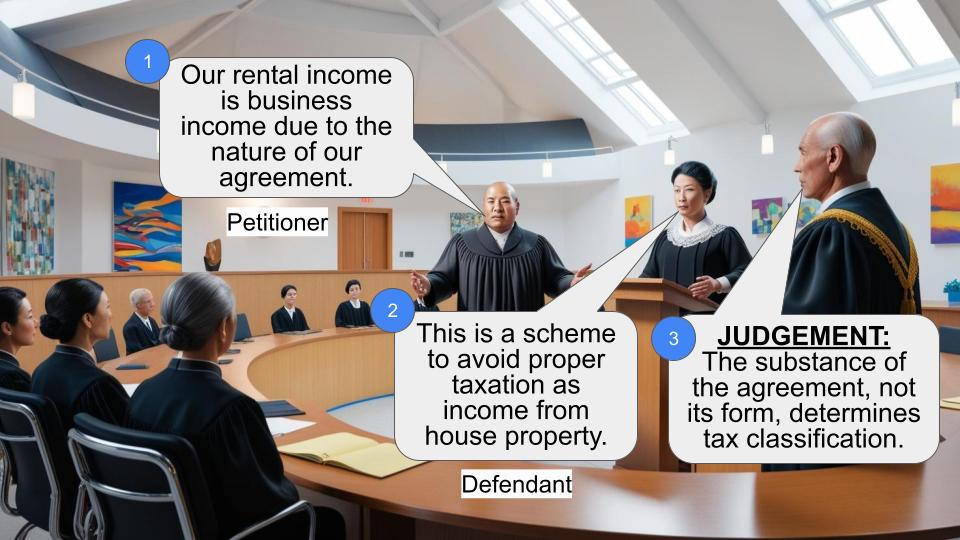
This case involves Ocean Structures (P) Ltd. (the Assessee) and the Assistant Commissioner of Income Tax. The dispute centered around whether the income earned by the Assessee from renting out a property should be taxed as income from house property or as business income. The court ruled in favor of the tax authorities, deciding that the income should be taxed as income from house property.
Get the full picture - access the original judgement of the court order here
Case Name:
Ocean Structures (P) Ltd. Vs Assistant Commissioner of Income Tax (High Court of Delhi)
ITA No. 392 of 2007
Date:25th October 2007
Key Takeaways:
1. The nature of income, not its calculation method, determines its tax classification.
2. Closely connected parties may not be considered independent entities for tax purposes.
3. Courts will look beyond the form of an agreement to its substance when determining tax liability.
Issue:
Should the income earned by the Assessee from renting out its property be taxed as income from house property (under Section 22 (of Income Tax Act, 1961)) or as business income (under Section 28 (of Income Tax Act, 1961))?
Facts:
1. Ocean Structures (P) Ltd. constructed a building called 'CTC Plaza' on a plot in New Delhi.
2. The company entered into a license agreement with M/s Chhabra Silk & Sarees on September 30, 1998.
3. The licensee was allowed to use the premises for its business of dealing in sarees, garments, fabrics, etc.
4. The consideration was calculated as a percentage of the licensee's sales proceeds.
5. During the assessment year in question, the shareholding pattern of the Assessee company changed significantly, with the partners of the licensee firm becoming majority shareholders.
Arguments:
Assessee's Argument:
- The income should be treated as business income due to the nature of the agreement and the calculation method.
Tax Authorities' Argument:
- The Assessee and licensee were closely connected entities.
- The license agreement was a colourable device to make income from house property appear as business income.
- The income should be taxed as income from house property.
Key Legal Precedents:
1. United Commercial Bank v. Commissioner of Income Tax, 32 ITR 688
2. East India Housing and Land Development Trust Ltd. v. CIT, 42 ITR 49(SC)
3. Universal Plast v. CIT, 237 ITR 454(SC)
These cases established that the nomenclature given by parties to the consideration for use of premises is immaterial, and that parting with possession of premises for earning income classifies it as income from house property.
Judgement:
The High Court dismissed the appeal and ruled in favor of the tax authorities. Key points:
1. The court found no infirmity in the Assessing Officer's conclusion that the Assessee and licensee were closely connected.
2. The license agreement was deemed a colourable device to make income from house property appear as business income.
3. The court agreed that the Assessee had merely parted with possession of the premises to earn income.
4. The quantum of consideration was not determinative of whether the income was business income or income from house property.
5. The income was to be taxed under Section 22 (of Income Tax Act, 1961) as "income from house property".
FAQs:
Q1: Why did the court rule against the Assessee?
A1: The court found that the Assessee had merely parted with possession of the property to earn income, which classifies it as income from house property.
Q2: Does the method of calculating rent affect its tax classification?
A2: No, the court clarified that the quantum or calculation method of the consideration doesn't determine whether it's business income or income from house property.
Q3: What impact does the relationship between the Assessee and licensee have?
A3: The close connection between the parties led the court to view the arrangement as a potential attempt to reclassify the nature of income for tax purposes.
Q4: What sections of the Income Tax Act were central to this case?
A4: Section 22 (of Income Tax Act, 1961) (income from house property) and Section 28 (of Income Tax Act, 1961) (profits and gains of business) were the key sections discussed.
Q5: How important are previous legal precedents in such cases?
A5: Very important. The court relied on established precedents to support its decision, showing the significance of past rulings in interpreting current cases.

1. This appeal under Section 260A (of Income Tax Act, 1961) (the Act') is directed against the Order dated 29.9.2006 passed by the Income Tax Appellate Tribunal (the `Tribunal') in ITA No. 2847/Del/2002 for the Assessment Year 1999-2000. The Tribunal reversed the Order dated 15.4.2002 passed by the Commissioner of Income Tax [the `CIT(A)'] and held that the income earned by the Assessee should be charged to tax under Section 22 (of Income Tax Act, 1961), i.e., under the head “income from house property” and not under Section 28 (of Income Tax Act, 1961), i.e., under the head “profits and gains of business”
2. The Assessee constructed a building named 'CTC Plaza' on a plot of land measuring 1200 sq. yds. at F-43, Kilokri Ring Road, Ashram Chowk, New Delhi ('the premises'). The Assessee entered into a licence agreement dated 30.9.1998 with M/s Chhabra Silk & Sarees, Chandni Chowk, New Delhi under which the licensee was permitted to use the premises for its business of dealing in sarees, garments, fabrics, etc. for a consideration which was to be a percentage of the sale proceeds.
3. The Assessing Officer (AO), after discussing the terms of the licence, came to the conclusion that the Assesssee and the licensee were not independent entities but were closely connected to each other. The AO concluded that the licence agreement had been drafted in a manner to make the receipt of the income from the house property appear to be business income calculated as a percentage of the sales of the licensee. The AO, as a matter of fact, further found that during the Assessment Year in question, the shareholding pattern of the Assessee company had undergone a sea change. The partners of the licensee firm M/s Chabbra Silk and Sarees were the majority shareholders with a controlling interest over the Assessee company. The AO concluded that “the receipt of income in the hands of assessee company is based on sale made by the licensee over which the assessee company would have no control had both the entities been independent commercial entities.” Based on these findings, the AO concluded that the income had to be charged as income from house property and not as business income.
4. In the appeal filed by the Assessee, the CIT(A) after discussing some of the clauses of the licence agreement came to the conclusion that the commission earned by the Assessee was business income and not income from house property and that this was “duly evidenced by the size of commission received by the company which only a commercial complex carrying commercial activities can fetch.”
5. The Tribunal reversed the decision of the CIT(A) relying on the principles settled by the Supreme Court in the decisions in United Commercial Bank v. Commissioner of Income Tax, 32 ITR 688 and East India Housing and Land Development Trust Ltd. v. CIT, 42 ITR 49(SC) which had been reaffirmed in Universal Plast v. CIT, 237 ITR 454(SC). The Tribunal concluded that the nomenclature given by the parties to the consideration for use of premises was immaterial, and that clause of the licence agreement made it clear that the Assessee had parted with the possession of the premises to M/s Chabbra Silks for earning income from such premises. Accordingly the Tribunal upheld the order of the AO that the proper head for charging income tax would be under Section 22 (of Income Tax Act, 1961), i.e., “income from house property”.
6. We have heard the submission of Mr. Krishan Mahajan, learned counsel for the assessee and Ms. Sonia Mathur, learned Standing Counsel for the Revenue. On examining the clauses of the licence agreement we detect no infirmity in the finding of fact arrived at by the AO that the entire arrangement of a licence agreement with M/s Chabbra Silk was a colourable device to make the income from house property appear as income from business. We are not a little surprised that the CIT(A) has, without adverting to the finding of the AO that the licensor and the licensee are not independent entities but are closely connected to each other, come to a conclusion that the commission paid to the Assessee was not 'income from house property'. It is apparent from the reading of the clauses of the licence agreement that the Assessee has merely parted with the possession of the premises for the purposes of earning income therefrom. We are also unable to appreciate the conclusion arrived at by the CIT(A) that the quantum of the consideration was determinative of whether the income was business income or income from house property. We accordingly find no infirmity in the conclusions on facts arrived at by the AO which have been affirmed by the Tribunal.
7. No substantial question of law arises for consideration. The appeal is dismissed.
S. Muralidhar, J.
Madan B. Lokur, J.
×
Similar Ripples
Questions
Court Rules: Rental Income Taxable as House Property, Not Business Income
Write your CommentSimilar Posts


Generic
- Reportdata/5236.pdf
