


Court Rules Transfer of Shares, Not Property, Determines Capital Gains Tax


Full News
Court Rules Transfer of Shares, Not Property, Determines Capital Gains Tax
Court Rules Transfer of Shares, Not Property, Determines Capital Gains Tax
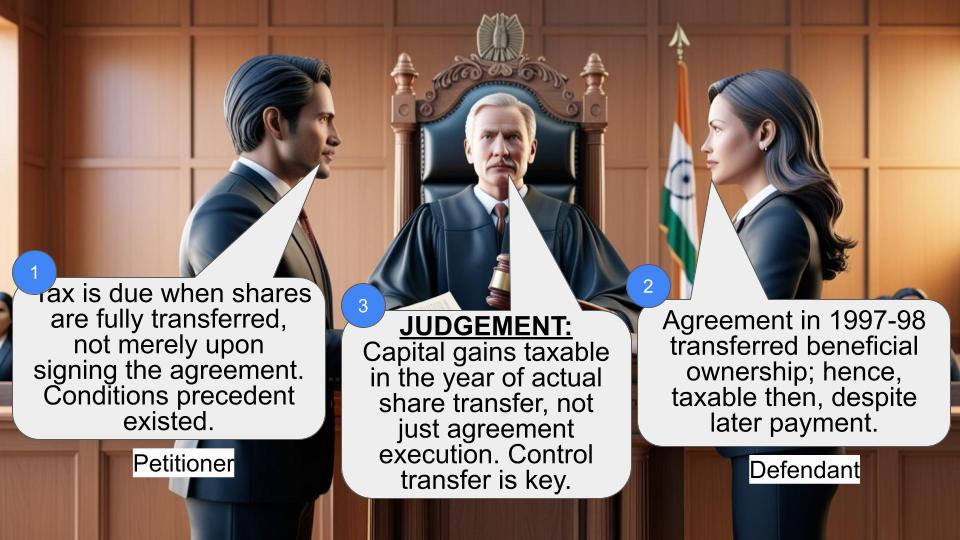
This case involves a dispute over the chargeability of capital gains tax on the transfer of shares in a company that owned two flats in Mumbai. The key issue was whether the transfer of the shares should be taxed in the assessment year 1997-98, as determined by the tax authorities, or in a later year when the actual transfer of shares took place. The High Court ultimately ruled in favor of the taxpayer, finding that the transfer of shares was not completed in 1997-98 and therefore the capital gains tax should not be charged in that year.
Get the full picture - access the original judgement of the court order here
Case Name:
Rajat Lal Vs Commissioner of Income Tax & Anr. (High Court of Allahabad)
Income Tax Appeal No.6 of 2005
Date: 4th October 2012
Key Takeaways:
1. The passing or transferring of complete control over a property, not just the execution of an agreement, determines the chargeability of capital gains tax.
2. The intention of the parties, as evidenced by the terms of the agreement, is crucial in determining when the transfer occurred for tax purposes.
3. Mere possession of a property by a buyer does not necessarily mean the property has been transferred, especially if the seller retains certain rights over the property.
Issue:
Whether the capital gains tax on the transfer of shares in a company that owned two flats in Mumbai should be charged in the assessment year 1997-98, as determined by the tax authorities, or in a later year when the actual transfer of shares took place.
Facts:
- The taxpayer, Rajat Lal, owned 7,784 shares (out of 8,000) in a company called M/s Rajendra Lal Shadi Lal & Company (P) Ltd. (the "Company"), which owned two flats in Mumbai.
- On August 19, 1996, Rajat Lal and his wife entered into an agreement to sell the entire share capital of the Company to SRF Ltd. for a total consideration of Rs.5 crores.
- The agreement stipulated that upon payment of the first installment of Rs. 1.25 crores on October 31, 1996, the sellers would execute a transfer deed and take steps to transfer the 8,000 shares to the buyer. However, the actual share certificates were to be kept with a solicitor until the final installment was paid.
- The buyer, SRF Ltd., was already in possession of the two flats owned by the Company as a tenant under a separate rent agreement.
- The final installment of the sale consideration was paid between February 1999 and March 2000, well after the original due date of April 30, 1997.
Arguments:
- The tax authorities argued that the capital gains tax should be charged in the assessment year 1997-98 because the agreement to transfer the shares was executed in that year, even though the actual transfer of shares did not occur until later.
- The taxpayer argued that the capital gains tax should not be charged in 1997-98 because the actual transfer of shares did not take place until the final installment was paid in 2000, and the agreement itself had conditions that prevented the buyer from becoming the full owner of the shares until then.
Key Legal Precedents:
- CIT, Delhi (Central) v. Bharat Nidhi Ltd. (1982) 133 ITR 447: Shares are movable property, and the transfer of ownership occurs when the parties intend it to, as evidenced by the conduct of the parties.
- CIT, Madurai v. M. Ramaswamy (1985) 151 ITR 122: Even without registration of the transfer in the company's books, the shares can be considered transferred if the formalities between the transferor and transferee have been completed.
- Rajagiri Rubber and Produce Co. Ltd. v. CIT (1993) 203 ITR 663: For capital gains tax purposes, the transfer of shares is complete when the share certificates are handed over, regardless of registration in the company's books.
Judgment:
The High Court ruled in favor of the taxpayer, finding that the capital gains tax should not be charged in the assessment year 1997-98. The court held that the transfer of the shares was not completed in 1997-98 because the actual share certificates were not delivered to the buyer, and the agreement had conditions that prevented the buyer from becoming the full owner of the shares until the final installment was paid. The court also found that the buyer's possession of the flats was as a tenant, not as an owner, and therefore the transfer of the property was not completed either. The court directed the tax authorities to tax the capital gains in the year when the actual transfer of shares took place.
FAQs:
1. Q: Why did the court rule in favor of the taxpayer?
A: The court found that the transfer of shares was not completed in the assessment year 1997-98 because the actual share certificates were not delivered to the buyer, and the agreement had conditions that prevented the buyer from becoming the full owner of the shares until the final installment was paid. The court also determined that the buyer's possession of the flats was as a tenant, not as an owner, so the transfer of the property was not completed either.
2. Q: What are the key legal principles established in this case?
A: The key principles are:
- The passing or transferring of complete control over a property, not just the execution of an agreement, determines the chargeability of capital gains tax.
- The intention of the parties, as evidenced by the terms of the agreement, is crucial in determining when the transfer occurred for tax purposes.
- Mere possession of a property by a buyer does not necessarily mean the property has been transferred, especially if the seller retains certain rights over the property.
3. Q: What are the implications of this case for future cases involving the transfer of shares and capital gains tax?
A: This case reinforces the importance of looking at the substance of a transaction, rather than just the form, when determining the timing of a transfer for capital gains tax purposes. It also highlights the need to carefully examine the terms of the agreement between the parties to understand their true intentions and the conditions that may have prevented a full transfer of ownership.

1. This income tax appeal under Section 260A (of Income Tax Act, 1961) (for short, the Act) filed by the assessee appellant arise out of the order dated 30.11.2004 passed by the Income Tax Appellate Tribunal (in short, the Tribunal) relating to assessment year 1997-98 by which the appeal filed by the Joint Commissioner of Income Tax, Special Range, Muzaffarnagar was partly allowed and while setting aside the order of the CIT (A), Muzaffarnagar dated 20.5.2000 deleting the capital gain of Rs.4,77,14,279/- from the total income of the assessee-appellant, as computed by the A.O. The A.O. was made free to tax it, in the order in which the transfer of shares took place in accordance with law.
2. This appeal was admitted by the Court on 17.1.2005 on the questions of law as follows:-
"A. Whether on the facts and in the circumstances of the case, the Tribunal erred in law in holding that capital gains on transfer of shares were liable to tax during the previous year relevant to assessment year 1997-98?
C. Whether the Tribunal was legally correct in holding that the capital gains was assessable in the assessment year 1997-98 even when there was no transfer of shares as provided for and contemplated under the Companies Act?
F. Whether on the facts and in the circumstances of the case, the Tribunal erred in law in holding that the agreement was one for transfer of immovable property?
I. Whether the Tribunal misinterpreted the deed of agreement dated 19.8.1996 and erroneously took the view that the proprietary right in the shares vested in the buyer on the payment of the first installment. The Tribunal failed to take into consideration that no transfer deed transferring the certificate was ever issued by the appellant in the relevant assessment year 1997-98 nor was he recorded as a shareholder in the records of the company?
K. Whether on the facts and in the circumstances of the case, the Tribunal erred in law in taking into account irrelevant material and ignoring essential material and evidences on record?
L. Whether on the facts and in the circumstances of the case, the conclusion arrived at by the Tribunal is perverse in as much as no reasonable person correctly informed of the position in law would come to?"
3. We have heard Shri V.B. Upadhya, Sr. Advocate assisted by Shri Ritvik Upadhya for the assessee appellant. Shri Shambhu Chopra appears for the income tax department.
4. Briefly stated the facts giving rise to this appeal are that the assessee-appellant were assessed to income tax in the capacity of an individual. He owned 7784 shares of M/s Rajendra Lal Shadhi Lal & Company (P) Ltd., New Delhi (out of 8000 equity shares of Rs.100/- each). The balance 216 shares were held by his wife Smt. Poonam Lal. The company owned two flats Nos.407 and 412 in Olympus Apartment, Altamount Road, Cumballa Hill, Mumbai. The company also held 10 shares of Rs.50 each in Olympus Cooperative Housing Society ltd., Mumbai of which it is a member. These flats were let out by the company to SRF Ltd. of Delhi at Rs.20,000/- per month for a period of 32 months from 1.8.1994 to 31.3.1997 under an agreement executed on 28.10.1994.
5. On 19.8.1996, the assessee and his wife jointly entered into an agreement to sell the entire share capital of M/s Rajendra Lal Shadi Lal & Co. Pvt. Ltd. for a sale consideration of Rs.5,00,00,000/- @ Rs.6,250/- per share. As per this agreement the total purchase price of 8,000 fully paid up equity shares of the company was agreed to be Rs.5,00,00,000/-, including the earnest money of Rs.1,25,00,000/-. The balance amount of Rs.3,75,00,000/- was paid in three subsequent installments, as under:-
"Installment Value Payable on First Rs.1,25,00,000/- 31/10/1996 Second Rs.1,25,00,000/- 01/01/1997 Third Rs.1,25,00,000/- 30/04/1997"
6. As per the agreement, on payment of the first installment, the seller was to execute transfer deed and to take all the necessary steps to get the said 8,000 shares transferred in the name of the buyer in the records of the company. After the transfer of shares in the name of SRF Ltd. the said shares were kept in the custody of solicitor till the remaining installments is paid by the buyer. The shares were to be released by the solicitors only after being furnished the evidence of payment by the buyer to the seller to the complete satisfaction of the solicitors. Since the transfer of the shares in the company also involved transfer of immovable properties situated in Mumbai in the from of two flats, the concerned parties also agreed to seek permission under Section 269 (of Income Tax Act, 1961) UL (3) of the I.T. Act from the Appropriate Authority at Mumbai, which was duly granted on 8/11/1996.
7. The assessee filed return for the accounting period 1.4.1996 to 31.3.1997 (A.Y. 1997-98) on 27.6.1997 declaring income of Rs.39,18,664/-, including agricultural income of Rs.1,85,806/-. The return was processed under Section 143(1)(a) (of Income Tax Act, 1961) on 24.12.1997, on an income of Rs.39,18,664/-. The case was subsequently fixed for hearing by issuing notice under Section 143(2) (of Income Tax Act, 1961). On the chargeability of capital gains, the A.O. found that as per Clause-7 of the agreement dated 19.8.1996, upon receipt of first installment the assessee would have no right, title and interest in the said shares of the company and the buyer will become owner of the same. The assessee had received first installment on 31.10.1996, after which he was left with no right, title or interest in the shares. Clause-10 of the agreement provided that consequent to purchase of 100% transfer voting interest and controlling power in the company was given to the buyer i.e. SRF Ltd. The possession and ownership of the society shares and premise attached thereto were to vest with the buyer through the said company. It was also provided that if need be both the parties shall obtain no objection certificate from the appropriate authority under Section 269(UC) (of Income Tax Act, 1961).
8. The A.O. after examining the contentions of both the parties, the agreement and the other documents held that the transaction entered into by the assessee with SRF Ltd. through agreement dated 19.8.1996 amounts to transfer within the meaning of Section 2(47)(i)(ii) (of Income Tax Act, 1961) and (vi) of the Act and the same is chargeable to capital gains tax under Section 45 (of Income Tax Act, 1961). So far as year of chargeability is concerned, the A.O. held that the capital gains shall be charged to tax in the previous year relevant to the year under consideration on the basis of accrual. He relied upon Addl. CIT v. G.M. Omarkhan, (1979) 116 ITR 950 (AP) as confirmed by the Supreme Court in G.M. Omarkhan v. Addl. CIT, 1996 ITR 269 in which it was held that it matters little that the consideration for the transfer is received or realised in a later year. The A.O. also relied upon CIT v. Rohtak Textile Mills Ltd., 138 ITR 195 (Del) in which it was held that capital gain arising from transfer of a capital asset is chargeable to tax during the previous year in which the transfer took place even though the consideration was not ascertained and was in dispute. He also relied upon Fort Properties (P) Ltd. v. CIT, (1994) 208 ITR 232 (Bom) in which it was held that year of agreement is the year of changeability of capital gains. For section 145 (of Income Tax Act, 1961) it is sufficient, if in the relevant accounting year profits have arisen out of sale of capital asset i.e. to say if the assessee had a right to receive the profit. It is not necessary that the assessee should have received the same, when once profits have arisen in the accounting year out of sale of capital assets, what the parties did subsequent to that year will not have any bearing on their liability to tax in respect of past year. The assessee was thus assessed on the total income of Rs.5,27,72,840/-. The A.O. directed penal interest to be charged under Section 234B (of Income Tax Act, 1961) and 234C and to draw penalty proceedings under Section 271(i)(c) (of Income Tax Act, 1961) for concealment and furnishing inaccurate particulars and directed issuance of demand notice and challan.
9. In Appeal the CIT (A) held that in the facts of the case it cannot be said that there is any transfer either of the shares or of the immovable property during the assessment year under appeal. It was not necessary to find out whether the buyer had made the payment of sale consideration within the period stipulated in the sale agreement dated 19.8.1996. What is necessary is to see whether in law there is any transfer of the shares of M/s Rajendra Lal Shadi Lal & Company (P) Ltd. to M/s SRF Ltd. Unless the shares are so transferred, there is no question of transferring any immovable property held by that company in spite of grant of no objection certificate by the appropriate authority. M/s SRF Ltd. already enjoyed property as tenant, and unless something more was done, it could not be said that the agreement by itself enable it to enjoyment of the property. There was nothing to indicate any such effect of transferring of the property. The buyer had possession of the property as tenant and there was nothing more to show that any fresh lease of any enjoyment was granted. On the interpretation of the clauses of the agreement, the CIT (A) held that by virtue of Clause 7 of the agreement, the buyer became owner either of the shares or of the immovable property owned by the company. The second part of the said clause was not appreciated, which states that on receipt of first installment the buyer will become owner of the shares, but the buyer will have no right to deal with or transfer by way of sale, gift, mortgage, pledge or otherwise these shares or any assets or properties of the company till final installment is fully paid and the shares are released from the solicitors in accordance with Annexure-1. Nothing of the sort was done in the relevant assessment year. Shares were not released in favour of the buyer by 31.3.1997 or even later. So far as legal position is concerned, relying upon CIT v. M. Ramaswamy, (1985) 151 ITR 122 (Mad); K.N. Narayanan & Anr. v. ITO, (1984) 145 ITR 373 (Ker) and CWT v. Babulal Jatia, (1982) 137 ITR 540 (Cal.), the appellate authority held:- "All the above authorities are unanimous in their view that the shares of a Company can be transferred only when they are delivered to the buyer along with instrument of transfer (transfer deed). Of course for this purpose, it is not necessary that they should actually be registered in the name of the buyer in the records of the Company whose shares are the subject matter of transfer. Admittedly, the shares continued to remain with the appellant till the end of the previous year i.e. 31.3.97. The shares in question were thus not transferred to M/s SRF Ltd. during the asstt. year under appeal. Thus looked at from any angle, there was no transfer of the shares of M/s Rajendra Lal Shadi Lal & Co. Pvt. Ltd. by the appellant to SRF Ltd. during the relevant period. Consequently, there was also no transfer of any flat situated in Bombay from the appellant or from Rajendra Lal Shadi Lal & Co. Pvt. Ltd. to the buyer. Once this fact is accepted, there is no question of any capital gain having arisen to the appellant during the year under appeal. I, therefore, delete the capital gain of Rs.4,77,14,279/- from the total income of the appellant as computed by the A.O. The A.O. is of course free to tax it in the year in which such transfer takes place, in accordance with law."
10. The Joint Commissioner of Income Tax, Special Range, Muzaffarnagar filed I.T. Appeal No.3548 (Del) of 2000 in the Income Tax Appellate Tribunal. The appeal was partly allowed with the findings that from all the facts and circumstances one would find that the intention of the parties to the agreement was to transfer the shares on receipt of the first installment, as it was found that the physical delivery of the share certificates and the payments of the sale consideration are not the prime factors to decide time of transfer or sale of movable goods/ shares. The Tribunal, thereafter, held in paragraphs 26, 27 and 28 as follows:- "26. If we examine this agreement on the other point of view whether it was an agreement to sale of shares or it was an agreement to sale of two flats, owned by M/s. Rajendra Lal Shadi Lal & Co. Pvt. Ltd., through transfers, its entire share holding in favour of the buyer. We would find that it was not only a transfer of shares, but in fact it was a transfer of two flats situated at Cumballa Hill, Mumbai, through 100% of transfer of share holding in M/s. Rajendra Lal Shadi Lal & Co. Pvt. Ltd., in favour of the buyer i.e. M/s. SRF Limited. During the course of hearing, it has been candidly accepted by the learned counsel for the assessee that M/s. Rajendra Lal Shadi Lal & Co. Pvt. Ltd. did not have any other asset except these two flats in Olympus Apartments, Altamount Road, Cumballa Hill, Mumbai and was not involved in any other business activity except realization of rent, meaning thereby the flats of this company were intended to be sold by the assessee and his wife, who owned and control the entire issue and paid up capital of this company by way of transfer of shares of Rajendra Lal Shadi Lal & Co. Pvt. Ltd. In the light of these facts it is not a case where the assessee was simply intended to transfer the shares of a particular company, but through this agreement the assessee intended to transfer the immovable property in favour of the buyer, who was in possession of both the flats as a tenant at a nominal rent of Rs.20,000/- per month. Since these two flats were owned by Rajendra Lal Shadi Lal & Co. Pvt. Ltd., these flats can be sold either by Rajendra Lal Shadi Lal & Co. Pvt. Ltd. directly by executing the sale deeds or by transfer of the entire share holdings of Rajendra Lal Shadi Lal & Co. Pvt. Ltd. by the assessee and his wife in favour of the buyer. Though being the controlling authority of M/s. Rajendra Lal Shadi Lal & Co. Pvt. Ltd., the assessee and his wife can sold these two flats in favour of the buyer i.e. M/s. SRF Limited, but if they do so, the company would be left with no assets. To keep the company alive, the assessee might have adopted this mode of transfer of entire share holding in Rajendra Lal Shadi Lal & Co. Pvt. Ltd. in favour of M/s. SRF Limited so that M/s. SRF Limited would have full control of Rajendra Lal Shadi Lal & Co. Pvt. Ltd. and can comfortably enjoy the possession of these two flats. If this agreement is viewed in the light of these facts, one would certainly find that it is not a simple agreement of sale of shares, but is also an agreement of sale of immovable property. If that be the case, provisions of section 2(47) (of Income Tax Act, 1961) would certainly come into play and according to section 2(47) (of Income Tax Act, 1961) the transfer in relation to a capital asset includes any transaction involving the allowing of the possession of any immovable property to be taken or retained in part performance of a contract of the nature referred to in section 53-A (of Income Tax Act, 1961) of the Transfer of Property Act. Section 53-A (of Income Tax Act, 1961) of the Transfer of Property Act providesfor a shield of protection to the proposed transferee to remain in possession against the original owner, who has agreed to sale to the transferee if the proposed transferee satisfied other conditions of section 53-A (of Income Tax Act, 1961). This protection is available as a shield only against the transferor, the proposed vendor from disturbing the possession the proposed transferees, who are putting in possession pursuant to such an agreement. In the instant case, the buyer got the initial possession of the property through the lease deed against a rent and the buyer remained in possession even after the agreement to sale and the buyer have also made the compliance of the terms of the agreement though there may be a delay in making the payments of the instalments, but that does not disentitle the buyer to claim an ownership right in the property. The parties to this agreement have also treated this agreement to sale of immovable property and after this agreement they approached the Appropriate Authority for no objection under section 269 (of Income Tax Act, 1961) UL (3) of the Act. The specific clause with respect to this ownership of these two flats by the company was also inserted in this agreement. If this agreement is to be examined in the light of the further acts of the assessee, which are evident from the certificate under section 269 (of Income Tax Act, 1961) UL (3) of the Act and a letter dated 31st October, 1996, one would find that this agreement was executed to sell these two flats through transfer of entire share holdings of M/s. Rajendra Lal Shadi Lal & Co. Pvt. Ltd. So while deciding the time of transfer/sale of this immovable property or shares provisions of section 2(47) (of Income Tax Act, 1961) should also be taken into account.
27. We have also carefully examined the judgments referred to by the assessee and we find that all these judgments are rendered under different set of facts and none of them is applicable to the facts of the assessee's case. Keeping in view the totality of the facts and circumstances of the case, we are of the considered opinion that this agreement is not only an agreement to sale of shares, but through this agreement, two flats i.e. the immovable properties are being transferred and provisions of section 2(47) (of Income Tax Act, 1961) are attracted. So far as the time of transfer is concerned, we are of the considered view that the transfer of shares took place in the financial year relevant to the impugned assessment year on receipt of the first instalment. We, therefore, do not find in agreement with the order of the Commissioner of Income-tax (Appeals). Accordingly, we set aside the order of the CIT (Appeals) and restore that of the assessing officer. 28. In the result, the appeal filed by the Revenue, is partly allowed."
11. Shri V.B. Upadhyay, learned counsel for the appellant assessee submits that the Tribunal erred in law in holding that in terms of agreement dated 19.8.1996 between the parties capital gain on transfer of shares accrued on the receipt of the first installment of sale consideration. The shares were not transferred in the assessment year in question as provided for and contemplated under the Companies Act. In the absence of delivery of share certificates and transfer deed for effecting transfer of shares still was not complete and the right of the appellant did not extinguish in the shares. The Tribunal misinterpreted the deed of agreement and erroneously took the view that the proprietary right in the shares vested in the buyer on the payment of the first installment. The Tribunal failed to take into consideration that no transfer deed transferring the share certificates was ever issued by the appellant in the relevant assessment year 1997-98, nor was he recorded as a shareholder in the records of the company.
12. Shri V.B. Upadhyay further submits that the reliance placed by the Tribunal in Section 2(47)(vi) (of Income Tax Act, 1961) for the purposes of holding that the shares were actually transferred to the buyer in the assessment year 1997-98 was totally misplaced and illegal. The Tribunal was not justified in law in holding that the capital gains were assessable in the assessment year 1997-98, when there was no transfer of shares either as per proceedings of Sale of Goods Act or the Transfer of Property Act or as it was provisions of the company law and the provisions of the Income Tax Act in the previous year ending 31.3.1997. The Tribunal also erred in holding that the agreement was one for transfer of immovable property. The immovable property did not belong to the assessee appellant nor the said property was sold. It was only the shares, which were agreed to be sold and thus alleged capital gains in respect of the said property could not be assessed in the hands of the appellant. It is submitted that M/s SRF Ltd., the buyer was already the tenant in possession of the property and continued to be so even after execution of the agreement to sale in as much as it continued to pay rent to M/s Rajendra Lal Shadi Lal & Co. Pvt. Ltd., till the shares and the share transfer forms were actually handed over to them in the year 2000.
13. Shri V.B. Upadhyay submits that the agreement was not finalised till the previous year relevant to assessment year 1997- 98, resulting in transfer of shares, as was evident from the certificate from the buyer confirming in December, 1999 that the agreement was not finalised upto 31.3.1997. The appellant and his wife computed capital gains for the previous year relevant to assessment year 2000-01, in which year transfer deeds were physically handed over to the buyer. The appellant deposited the sale consideration on 27.3.2000 in notified securities and claimed the capital gains as exempt from tax in terms of Section 54 (of Income Tax Act, 1961) EC of the Act.
14. Shri V.B. Upadhyay has relied upon CIT, Delhi (Central) v. Bharat Nidhi Ltd. (Delhi High Court), 1982 (133) ITR 447; CIT, Madurai v. M.Ramaswamy (Madras High Court), 1985 (151) ITR 122; Rajagiri Rubber and Produce Co. Ltd. v. Commissioner of Income Tax (Kerala High Court), 1993 (203) ITR 663 and Smt. Raj Rani Devi Ramna v. Commissioner of Income Tax, (Patna High Court), 1992 (201) ITR 1032 in support of his submissions.
15. In CIT, Delhi (Central) v. Bharat Nidhi Ltd. (Supra) the Delhi High Court held that shares are movable property in terms of Sale of Goods Act. When and at what time a property can pass on to the buyer is laid down in Chapter-III. Section 19 (of Income Tax Act, 1961) provides that where there is contract for the sale or specific or ascertained goods the property in them is transferred to the buyer at such time as the parties to the contract intend it to be transferred; and for the purpose of ascertaining the intention oft he parties to the contract, regard shall be had to the conduct of the parties. Sub-section (2) of Section 19 (of Income Tax Act, 1961) elaborates that the rules in ss.20 to 24 are to be looked at for ascertaining the intention of the parties as to the time at which the property in the goods is to pass to the buyer. Section 21 (of Income Tax Act, 1961) provides that where there is a contract for the sale of specific goods and the seller is bound to do something to the goods for the purpose of putting them into a deliverable state the property does not pass unless such thing is done and the buyer has notice thereof. The Delhi High Court relied upon Maneckji Pestonji Bharucha v. Wadilal Sarabhai & Co., AIR 1926 PC 38, 40 and Alfred William Domingo v. L. C. De'Souza, (1928) ILR 50 All 695=AIR 1928 All 481 in which it was held that only a person, who is on the register is in the full sense of the word the owner of the share. But the title to get on the register consists in the possession of a certificate together with a transfer signed by the registered holder. It further relied upon in holding that under Section 21 (of Income Tax Act, 1961) unless shares were specified by serial numbers, which can be identified it cannot be said to be a contract for sale of specified goods as contemplated by Section 21 (of Income Tax Act, 1961), as they would remain unascertained. In Kuppiah Chetty v. Saraswathi Ammal, AIR 1941 Mad 769 it was held that an agreement to transfer shares in a company accompanied with the actual instrument of transfer which has not been completed so far as the transferor could complete it does not amount to a transfer deed sufficient to cause the title to pass. By itself it would be nothing more than an enforceable agreement to convey and until the transfer endorsement is signed the shares would be unascertained goods and would not be in a deliverable state. The Delhi High Court also cited Bank of India Ltd. v. Jamsetji A. H. Chinoy, AIR 1950 PC 90, 07 in which it is observed that in India a purchaser of shares (which under the Indian Sale of Goods Act come within the definition of ‘Goods’) does not acquire an equitable interest by virtue of the contract of sale. The Delhi High Court held that the ownership of the shares continues to be shown in the stock-in- trade of the assessee and the value of the shares included in its closing stock. They were never credited to the assessee’s account in the relevant assessment year. The annual entries were made in the accounts and thus the Tribunal committed an illegality in holding that there was completed transaction of shares by the agreement amounting to a credit sale.
16. In CIT, Madurai v. M. Ramaswamy (Supra) it was held by the Madras High Court relying upon Shelat (V.R.) v. P.J. Thakar, (1975) 45 Comp Cas 43 (SC) that where as between the transferor and the transferee, all formalities have been gone through, such as the execution of a document of transfer and the physical handing over of the shares by the transferor to the transferee, the shares should be taken to have been transferred to the transferee, though until the transfer of shares is registered in the company’s books in accordance with the company law, the transfer could not enable the transferee to exercise rights of a shareholder vis-à-vis the company, the shares should be taken to have been transferred to the transferee, where after completing all the formalities the doner dies, it was held that requirement of both Section 122 (of Income Tax Act, 1961) and 123 of the Transfer of Property Act were completely satisfied in a case of gift so as to vest the right in the donee to obtain share certificate in accordance with the provisions of the company law as the right to get the share certificate made out in the name of the donee became irrevocable and complete by registration of the deed as well as by delivery. The actual transfers in the register of the company concerned, which were necessary to enable the donee to exercise the rights of a shareholder, were mere enforcement of that right, and the mere fact that such transfers had to be recorded in accordance with the company law did not detract from the completeness of what was donated. The Madras High Court thus held that it is not necessary for actual registration of shares by the company in the name of the transferee to deny the rights to the transferee to have equitable rights in relation to his shares.
17. In Rajagiri Rubber and Produce Co. Ltd. v. Commissioner of Income Tax (Kerala High Court) (Supra) it was held that in the case of transfer of shares, for purposes of section 45 (of Income Tax Act, 1961), as between the transferor and the transferee, the transaction is complete when the share certificates are handed over. The mere fact that the company has not registered the transfers in its books would not justify the claim that the transfer took place only later.
18. In Smt. Raj Rani Devi Ramna v. Commissioner of Income Tax (Patna High Court) (Supra) it was held that properties do not necessarily pass as soon as the instrument is registered, for the true test is the intention of the parties. Registration is prima facie proof of an intention to transfer, but it is no proof of an operative transfer if there is a condition precedent as to the payment of consideration or delivery of the deed. Thus the seller may retain the deed pending payment of price and, in that case, there is no transfer until the price is paid and the deed is delivered. If the intention is that title should pass immediately, even though the consideration has not been paid, title passes, that is, failure to pay the consideration for a conveyance does not defeat the conveyance except where there is an agreement that it should take effect only if the consideration is first paid. Considering the provisions of Section 45 (of Income Tax Act, 1961) and Section 2(47) (of Income Tax Act, 1961) it was held by the Patna High court that the word ‘transfer’ has been defined under Section 2(47) (of Income Tax Act, 1961) which provides that in relation to a capital asset, transfer includes the sale, exchange or relinquishment of the asset or the extinguishment of any rights therein or the compulsory acquisition thereof under any law. The concept of sale of an immovable property which is included in the expression ‘capital asset’ as defined under Section 2(14) (of Income Tax Act, 1961), has to be gathered from Section 54 of the Transfer of Property Act, 1882. Where the transfer is to take effect only on payment of entire consideration amount, it has to be held that there was no transfer of land covered by the three sale deeds in question during the period under consideration making the assessee liable for capital gains tax under Section 45 (of Income Tax Act, 1961).
19. Shri V.B. Upadhyay submits that in the present case a close reading of agreement more particularly paragraphs 6 and 7 would demonstrate that what was agreed was to execute transfer deeds and take all necessary steps to get all the 8000 shares transferred in the name of the buyer in the records of the company representing 100% of the voting interest and controlling power on the receipt of the first installment. The seller was not left with any right, title or interest in the shares and the buyer would become owner of the same on the receipt of the first installment, however, there was condition to such transfer namely that the buyer would have no right to deal with, or transfer by way of sale, gift, mortgage, pledge or otherwise these shares or any assets or properties of the company till the final installment was fully paid and the shares are released from the solicitors in accordance with the agreement. The earnest money was paid in the relevant year on 20.8.1996 by cheque, which are returned back encashed. It was re-presented on 23.8.1996. The first installment agreed to be paid on 31.10.1996 was actually paid on 15.11.1996. The second installment agreed to be paid on 1.1.1997 was paid on 6.3.1997 and the third installment to be paid on 30.4.1997 was paid from 15.3.1999 to 10.3.2000. Since the buyer defaulted in payment of installments and finally paid upto 10.3.2000 the assessee appellant and his wife did not sign the transfer deeds, so as to transfer the shares in favour of the buyer nor the shares were delivered to the buyer or their solicitors. The flats at Bombay were already under tenancy and no fresh document were executed, in pursuance to the transfer of shares in respect of property. The sale as such could not be said to have been affected as according to the intention of the parties the transfer was to be complete and all consequences were to ensue after payment of the last installment, which was paid on 10.3.2000, after which the appellant deposited the sale consideration on 27.3.2000, in notified securities claiming capital gains as exemption from tax in terms of Section 54EC (of Income Tax Act, 1961).
20. Shri Shambhu Chopra has relied upon the reasoning given by the Tribunal in support of his submissions and has further relied upon Jasbir Singh Sarkaria, In re, (2007) 294 ITR 196 (Authority for Advance Rulings); Smt. Raj Rani Devi Ramna v. Commissioner of Income Tax (Supra); CIT v. Ghaziabad Engineering Co. (P) Ltd., 2001 (249) ITR 244; Chaturbhuj Dwarkadas Kapadia v. Commissioner of Income Tax, 2003 (260) ITR 491 (Bombay High Court); CIT v. Mormasji Mancharji Vaid, 2001 (250) ITR 542; CIT v. Podar Cement Pvt. Ltd. & Ors., 1997 (226) ITR 625 in support of his submissions.
21. In Jasbir Singh Sarkaria, In re (Supra) it was held that the purpose of introducing clause (v) in conjunction with clause (vi) in section 2(47) (of Income Tax Act, 1961), defining ‘transfer’ was to widen the net of taxation of capital gains so as to include transactions that closely resembled transfers but were not treated as such under the general law. The avoidance or postponement of tax on capital gains by adopting devices such as the enjoyment of property in pursuance of revocable power of attorney or part performance of a contract of sale was sought to be arrested. ‘Possession’ contemplated by clause (v) of Section 2(47) (of Income Tax Act, 1961) need not necessarily be sole and exclusive possession. So long as the transferee is, by virtue of the possession given, enable to exercise general control over the property so as to make use of it for the intended purpose, the mere fact that the owner has also the right to enter the property to oversee the development work or to ensure performance of the terms of the agreement does not introduce incompatibility. The concurrent purpose of the owner who can exercise possessory rights to a limited extent can very well be reconciled. Clause (v) will have its full play even in such a situation. Possession given to the developer need not ripen into exclusive possession on payment of the installments in entirety for the purpose of determining the date of transfer. In this judgment reliance was placed upon Chaturbhuj Dwarkadas Kapadia (Supra) in which building not occupied by tenants was agreed to be sold by the assessee (individual) in August 1994 to developer to develop the property in accordance with the Rules and Regulations, framed under the Maharashtra Housing and Area Development Act. A limited power of attorney was executed and permissions were obtained and irrevocable license was given to enter upon the assessee’s share of property and to demolish the building. The developer obtained the permissions in the financial year ending 31 st march, 1996 and paid almost the entire sale price except very small amount to the assessee. The permission to construct upto plinth level was obtained in November, 1996. The power of attorney was executed in March, 1999. The Bombay High Court examining the provisions of the amended Act w.e.f. April 1 st , 1988 enunciated the principles for the applicability of Section 2(47)(v) (of Income Tax Act, 1961) and held that the Court should not go into by the date of actual possession. The Court should actually go by the date, when irrevocable license was given indicating passing of or transferring the complete control over the property in favour of the developer. The possession then that the date of contact would be relevant to decide the year of changeability.
22. In CIT v. Ghaziabad Engineering Co. (P) Ltd. (Supra) the Delhi High Court held that since the registered document took effect from the date of its execution, the transfer became operative, when the lease deed was executed and not when it was registered and accordingly the assessee was entitled to exemption under Section 247(vi) (of Income Tax Act, 1961).
23. In CIT v. Mormasji Mancharji Vaid (Supra) the Full Bench of Gujarat High Court held that for the purposes of tax on capital gains under Section 45 (of Income Tax Act, 1961) the transfer of immovable property of value exceeding Rs.100/- is affected on the date of execution of the document of transfer and not either on the date of presentation of the document for registration or on the date on which registration of the deed is completed. The capital gains on the transfer has to be assessed to tax in the assessment year relevant to the previous year within which the date of execution of the deed of transfer falls, and not subsequent assessment year relevant to the previous year in which the deed is registered.
24. Coming to the facts of the present case we find that the entire share capital of M/s Rajendra Lal Shadi Lal & Company (P) Ltd. was held by the appellant assessee (7784 shares) and his wife Smt. Poonam Lal (216 shares). The company was the owner of two flats nos.407 and 412, Olympus Apartment, Altamount Road, Cumballa Hill, Mumbai and held ten shares of Olympus Cooperative Housing Society Ltd., Mumbai covered by Certificate No.47 and 48 of Rs.50/- each. Both the flats were given to M/s SRF Ltd. on rent. The flats were in occupation of the tenant i.e. M/s SRF Ltd. The appellant and his wife entered into agreement dated 19.8.1996 with M/s SRF Ltd. to sell the entire 8000 shares for sale consideration of Rs.5 crores. It was agreed that on the receipt of the first installment of Rs.1,25,00,000/- payable on 31.10.1996, the seller will execute transfer deed and will take all necessary steps to get all the 8000 shares transferred in the name of buyer in the records of the company represented 100% voting interest and controlling power in the company. This stipulation in Clause-6 was controlled and continued by Clause 7 of the agreement, which provided that upon receipt of first installment the sellers will not have left with any right, tittle or interest in the shares and the buyer will become owner of the same; however, the buyer will have no right to deal with or transfer by way of sale, gift, mortgage, pledge or otherwise these shares or any assets or properties of the company till the final installment is fully paid and the shares are released from the solicitors in accordance with Annexure 1. The terms in Annexure-1 to the agreement provided that after transfer of shares in the name of M/s SRF Ltd. (on payment of first installment), the said share scripts will be kept in the custody of the solicitor till the final installment is paid by the buyer. The solicitors were to be appointed as per mutual consent of the buyer and the seller. The shares were to be released by the solicitors only after being furnished evidence of payment by the buyer to the sellers to the complete satisfaction of the solicitors. In case of delay in payment of the installments the buyer was liable to pay interest at the rate of 18% per annum for the period of default. The agreement thus clearly stipulated that though the transfer deeds will be executed and the shares will be transferred in the name of the buyer in the records of the company, the actual delivery of scripts had to await the full payment. The physical custody of the share certificate was to remain with the solicitors until full payment namely the payment of third installment was made by 30.4.1997.
25. It is admitted that the third instalment was paid with delay between 15.2.1999 to 10.3.2000, much after the agreed date i.e. 30.4.1997. The stipulation in para 6 that on the execution of the transfer deed on the payment of first installment necessary steps will be taken to get all the 8000 shares transferred in the name of the buyer in the records of the company representing 100% of the voting interest and controlling powers in the company, was hedged with the conditions that the scripts will be kept with the solicitors mutually agreed upon between the parties to be released on the final payment. The buyer company was not to become the owner of the shares and did not have any right to deal with or transfer the shares or any assets or properties of the company till the final payment. The buyer company thus neither became the owner of the shares, nor could deal with the shares or any assets or properties of the company, as its owner. The intention of the parties was thus to transfer the voting interest and controlling power in the company to the buyer on the execution of the agreement. The rights of ownership of the shares was withheld in such a manner that the transferee was not entitled to transfer the shares, or any assets or properties of the company till the final installment was fully paid and scripts were released from the solicitors.
26. The SRF Ltd. i.e. the buyer was already in possession of the properties, namely the two flats, which were the only assets of M/s Rajendra Lal Shadi Lal & Company (P) Ltd., the seller, in pursuance to a rent agreement. No further document was executed with regard to rent agreement or for transferring the ownership of the property. The ownership in the property was sought to be transferred with the ownership of the shares, which would give the controlling power to the buyer company. Since these shares were to be physically transferred to the buyer company only after payment of the full price, it cannot be said that there was any transfer in the property as contemplated under Section 2(47)(vi) (of Income Tax Act, 1961). The enjoyment of the immovable property even after the date of payment of first installment was not in pursuance to the transfer of the shares and controlling interest in the company but as a tenant, under the agreement of tenancy. It is not denied that the tenant continued to pay the rent till the entire amount of sale consideration was paid, and did not claim any ownership rights in the properties. The permission obtained under Section 269 (of Income Tax Act, 1961) UC also did not amount to any transfer as no transfer deed was executed transferring the property to the buyer company. No objection certificate under Section 269UC (of Income Tax Act, 1961), may be one of the circumstances to prove the transfers, it could not be relied on to be a document in evidence of the transfer.
27. We do not find that the decisions cited by the revenue, support the contention that in the facts and circumstances as in the present case, the shares or the properties held by the company would be treated to be transferred or deemed to be transferred in the financial year ending on 31.3.1997.
28. In Chaturbhuj Dwarkadas Kapadia v. Commissioner of Income Tax (Bombay High Court) (Supra) the test laid down was the passing of or transferring the complete control over the property and not any execution of agreement or power of attorney. The Bombay High Court also found that almost the entire sale consideration of Rs.1,85,63,220/- in that case except for small amount of Rs.9,98,000/- was paid on 31st March, 1996. In the present case the first installment of Rs.1.25 crores out of total sale consideration of Rs.5 crores was paid on 20.8.1996, which was credited to the account of the assessee on 23.8.1996. The remaining sale consideration was paid later upto 10.3.2000. The balance of the installments of Rs.1.85 crores was paid between 15.2.1999 to 10.3.2000.
29. In the circumstances as above, we find that the Tribunal committed error in law in holding that Section 2(47)(vi) (of Income Tax Act, 1961) will be attracted, and that immovable properties were transferred with the agreement of sale of shares, which were actually an agreement of sale of immovable properties.
30. The income tax appeal is allowed. The questions of law framed as above are decided in favour of the assessee and against the revenue. The department will proceed accordingly.
Dt.04.10.2012
×
Questions
Court Rules Transfer of Shares, Not Property, Determines Capital Gains Tax
Write your CommentSimilar Posts


Generic
- Reportdata/5373.pdf
