


Court Slams Revenue for Casual Appeals, Upholds Penalty Deletion in Tax Case


Full News

Court Slams Revenue for Casual Appeals, Upholds Penalty Deletion in Tax Case
Court Slams Revenue for Casual Appeals, Upholds Penalty Deletion in Tax Case
This case involves an appeal by the Revenue (tax authorities) against an order by the Income Tax Appellate Tribunal (ITAT) that deleted penalties imposed on Virgo Marketing (P) Ltd. The High Court dismissed the Revenue's appeal, criticizing the casual filing of appeals in settled matters and imposing costs on the Revenue.
Get the full picture - access the original judgement of the court order here
Case Name:
Commissioner of Income Tax vs. Virgo Marketing (P) Ltd. (High Court of Delhi)
ITA No. 1345 of 2007
Date: 25th January 2008
Key Takeaways:
1. The Assessing Officer (AO) must record specific satisfaction for initiating penalty proceedings under Section 271(1)(c) (of Income Tax Act, 1961).
2. The court strongly discouraged the Revenue from filing casual appeals in settled matters.
3. The judgment reinforces the importance of proper procedure in penalty proceedings.
4. The court imposed costs on the Revenue for filing an appeal without merit.
Issue:
Did the Assessing Officer record a valid satisfaction for initiating penalty proceedings under Section 271(1)(c) (of Income Tax Act, 1961)?
Facts:
1. The case pertains to Assessment Years 2000-2001, 2001-2002, and 2002-2003.
2. The Assessing Officer initiated penalty proceedings under Section 271(1)(c) (of Income Tax Act, 1961).
3. The Commissioner of Income Tax (Appeals) and the Income Tax Appellate Tribunal both deleted the penalty.
4. The Revenue filed an appeal to the High Court under Section 260A (of Income Tax Act, 1961).
Arguments:
Revenue's Argument:
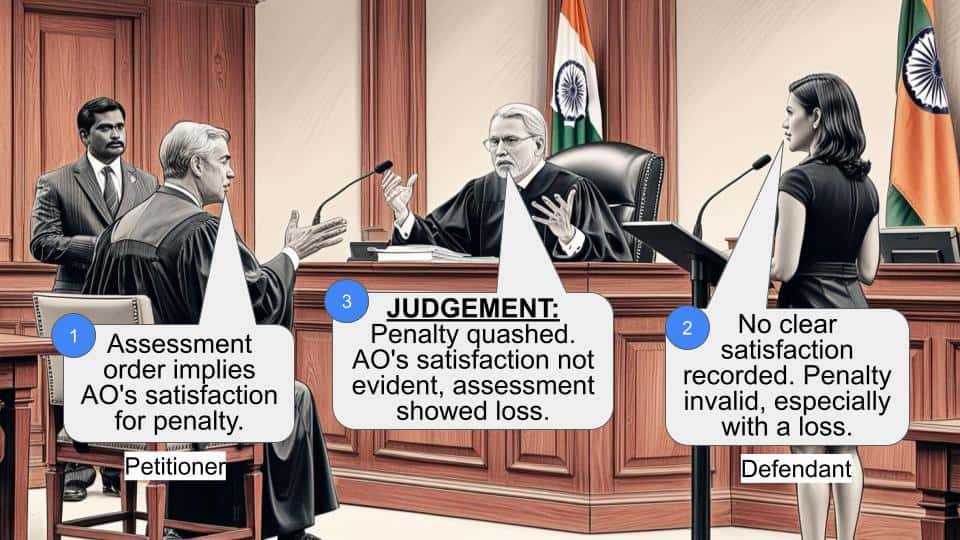
- The satisfaction of the officer initiating penalty proceedings can be discerned from the order, even if not recorded in specific terms.
- The matter should be referred to a larger bench due to a similar issue being considered in another case.
Assessee's Argument (implied):
- The Assessing Officer did not record proper satisfaction for initiating penalty proceedings.
- All material facts were disclosed in the returns, and nothing was concealed.
Key Legal Precedents:
1. Commissioner of Income Tax v. Ram Commercial Enterprises Ltd. [2000] 246 ITR 571 (Delhi)
2. Dalip N. Shroff v. Joint Commissioner of Income Tax [2007] 291 ITR 519 (SC)
3. T. Ashok Pai v. Commissioner of Income Tax [2007] 292 ITR 11 (SC)
4. Diwan Enterprises v. Commissioner of Income Tax [2000] 246 ITR 571 (Delhi)
5. Commissioner of Income Tax v. B.R. Sharma [2005] 275 ITR 303 (Delhi)
These precedents establish that the Assessing Officer must record specific satisfaction for initiating penalty proceedings under Section 271(1)(c) (of Income Tax Act, 1961).
Judgement:
1. The court dismissed the Revenue's appeal and imposed costs of Rs. 5,000.
2. The court found that it was not discernible from the assessment order why the AO initiated penalty proceedings and under which part of Section 271(1)(c) (of Income Tax Act, 1961).
3. The court criticized the Revenue for filing appeals in a casual manner despite settled law on the subject.
4. The concurrent decisions of the CIT(A) and Tribunal deleting the penalty were upheld.
FAQs:
1. Q: What was the main issue in this case?
A: The main issue was whether the Assessing Officer had recorded a valid satisfaction for initiating penalty proceedings under Section 271(1)(c) (of Income Tax Act, 1961).
2. Q: Why did the court dismiss the Revenue's appeal?
A: The court dismissed the appeal because it couldn't discern from the assessment order why the AO initiated penalty proceedings and under which part of Section 271(1)(c) (of Income Tax Act, 1961).
3. Q: What criticism did the court make against the Revenue?
A: The court criticized the Revenue for filing appeals casually in matters where the law has been settled, causing unnecessary pressure on the court system.
4. Q: What costs did the court impose on the Revenue?
A: The court imposed costs of Rs. 5,000 on the Revenue, to be deposited with the Registrar General for use in juvenile justice.
5. Q: What is the significance of this judgment for future tax cases?
A: This judgment reinforces the importance of proper procedure in initiating penalty proceedings and discourages the casual filing of appeals by the Revenue in settled matters.

1. The Revenue is aggrieved by an order dated 26th April, 2007 passed by the Income Tax Appellate Tribunal, Delhi Bench C?, New Delhi (`the Tribunal?)in ITA Nos. 1547, 1548 and 1549/Del/2006 relevant for the Assessment Years 2000-2001, 2001-2002 and 2002-2003.
2. The sole question that has arisen for consideration in this appeal under Section 260A (of Income Tax Act, 1961) (`the Act?) is whether the Assessing Officer had recorded a valid satisfaction for initiating penalty proceedings under Section 271(1)(c) (of Income Tax Act, 1961).
3. Learned counsel for the Revenue accepted the fact that this Court has taken the view in Commissioner of Income Tax v. Ram Commercial Enterprises Ltd.,[2000] 246 ITR 571 (Delhi) that the Assessing Officer must record his satisfaction in specific terms for initiating penalty proceedings under Section 271(1)(c) (of Income Tax Act, 1961). She also accepted the fact that the view taken by this Court in Ram Commercial Enterprises Ltd. has been approved by the Supreme Court in Dalip N. Shroff v. Joint Commissioner of Income Tax, [2007] 291 ITR 519 (SC) and T. Ashok Pai v. Commissioner of Income Tax, [2007] 292 ITR 11 (SC).
4. Nevertheless, it was contended that the matter should be referred to a larger Bench because the following issue has been referred to a larger Bench in Commissioner of Income Tax, Delhi v. Indus Valley Promoters Limited, (2006) 155 Taxman 223 on the ground that one aspect of the contention of the Revenue was not considered in Ram Commercial Enterprises:
Whether satisfaction of the officer initiating the proceedings under section 271 of the Income Tax Act, 1961 can be said to have been recorded even in cases where satisfaction is not recorded in specific terms but is otherwise discernible from order passed by the authority??
5. In view of above submission of learned counsel for the Revenue, we have proceeded on the basis that the question will be answered in the affirmative in favour of the Revenue by the larger Bench of this Court and have considered and decided the matter in that light.
6. From a perusal of the assessment order, it is found that for the purpose of initiating penalty proceedings, the Assessing Officer has stated as follows:
Assessed at Rs.25,25,680/-. Issue demand notice and challans. Charge interest as per rules. Penalty proceedings u/s 271(1)(c) (of Income Tax Act, 1961) have been initiated separately.?
7. It is now settled that penalty proceedings are penal in nature. Section 271(1)(c) (of Income Tax Act, 1961) postulates penalty being imposed either for furnishing inaccurate particulars of income or for concealing the income.
8. There is nothing to suggest that the Assessing Officer had applied his mind to the question about which facet of Section 271(1)(c) (of Income Tax Act, 1961) is applicable to the case and for what act of omission or commission by the Assessee. The Assessee had filed its returns and had disclosed all material facts of the case and had concealed nothing in its returns. If the Assessing Officer takes a view contrary to that expressed by the Assessee, it does not perse mean that the Assessee has adopted an illegal device for reducing its tax liability.
9. Against the order imposing penalty, the Assessee preferred an appeal before the Commissioner of Income Tax (Appeals) [`CIT(A)?] and in his order dated 27th January, 2006, the CIT(A) was of the view that the Assessing Officer had not properly recorded his satisfaction before initiation of penalty proceedings. This view was upheld by the Tribunal.
10. We are unable to discern from a reading of the assessment order why the Assessing Officer chose to initiate penalty proceedings against the Assessee and under which part of Section 271(1)(c) (of Income Tax Act, 1961). In other words, we are unable to discern from the assessment order the reason for initiating penalty proceedings. Therefore, the concurrent view held by both the authorities below must be accepted.
11. The procedure that we have adopted has been consistently followed by us in a large number of cases, some of which are Commissioner of Income Tax Del v. O.K. Hosiery Mills P. Ltd. (ITA No.12/2007 decided on 14th September, 2007), Commissioner of Income Tax v. M/s Bharat Hotels Ltd. (ITA No.1074/2006 decided on 14th September, 2007), Commissioner of Income Tax v. M/s Bharat Hotels Ltd.(ITA No.935/2006 decided on 14th September, 2007), Commissioner of Income Tax v. Fibro Tech Chemicals (ITA No.954/2006 decided on 14th September, 2007),Commissioner of Income Tax v. M/s Preeti Aggarwala (ITA No.850/2006 decided on 15th September, 2007), Commissioner of Income Tax v. Smt. Santosh Sharma (ITA No.1088/2006 decided on 17th September, 2007) and Commissioner of Income Tax v. O.P. Lohia (ITA No.1052/2007 decided on 1st November, 2007).
12. Even though the law has been settled by this Court in a very large number of cases, apart from Ram Commercial Enterprises such as Diwan Enterprises v. Commercial of Income, [2000] 246 ITR 571 (Delhi) and Commissioner of Income Tax v. B.R. Sharma, [2005] 275 ITR 303, the Revenue is still filing these sort of appeals for no apparent reason. By this casual attitude of the Revenue, the Registry (apart from this Court) has been put under severe pressure in dealing with a large influx of appeals, which prima facie do not have any merit. By this flood of litigation, the Revenue is ensuring that more important cases,where stakes are much higher and where perhaps the Revenue has a better case, get receded into the background and their turn cannot come up in the near future. We have been repeatedly observing this but to no effect.
13. Under the circumstances, we are constrained to dismiss this appeal with costs of Rs.5,000/- , which will be deposited by the Revenue by way of a cheque in favour of the Registrar General of this Court within four weeks from today to be utilized for juvenile justice.
14. List on 14th March, 2008 for compliance.
MADAN B. LOKUR, J JANUARY 25, 2008 V.B. GUPTA, J ITA No.1345/2007 Page 1 of 7
×
Questions
Court Slams Revenue for Casual Appeals, Upholds Penalty Deletion in Tax Case
Write your CommentSimilar Posts


Generic
- Reportdata/4952_.pdf
