


Court Stays Tax Demand for Co-op Society, Citing Precedent in Assessee's Favor


Full News

Court Stays Tax Demand for Co-op Society, Citing Precedent in Assessee's Favor
Court Stays Tax Demand for Co-op Society, Citing Precedent in Assessee's Favor
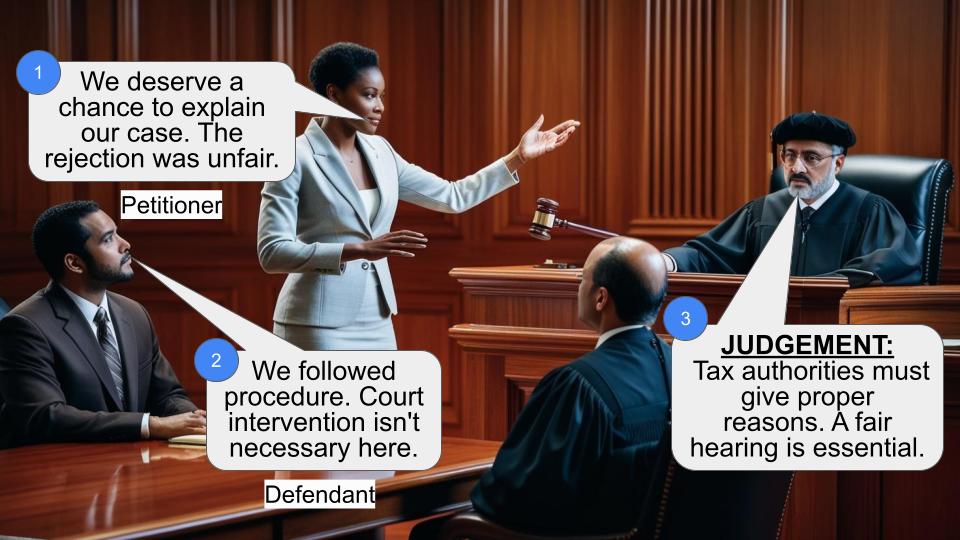
This case involves KEM Hospital and Seth G. S. Medical College Employees Co-operative Credit Society Ltd. challenging a tax demand by the Income Tax Department. The court ruled in favor of the society, staying the tax demand until their appeal is heard, based on previous favorable decisions in the society's own case.
Get the full picture - access the original judgement of the court order here
Case Name:
Kem Hospital and Seth G.S. Medical College Employees Co-operative Credit Society Ltd. Vs Income Tax Officer (High Court of Bombay)
Writ Petition No.766 of 2020
Date: 13th March 2020
Key Takeaways:
1. When a dispute relates to an issue previously decided in the assessee's favor, the assessee shouldn't be treated as in default for the disputed amount.
2. Tax authorities should respect decisions made by higher appellate authorities in previous years for the same assessee.
3. The court emphasized the importance of judicial discipline in tax matters.
Issue:
Should the tax demand be stayed when previous appellate decisions in the assessee's own case have ruled in their favor on the same issue?
Facts:
1. The petitioner is a co-operative credit society providing credit to its members.
2. For the assessment year 2017-18, the Income Tax Officer denied the petitioner's claim for deduction under Section 80P(2)(a)(i) (of Income Tax Act, 1961).
3. The assessing officer treated the petitioner as a co-operative bank and added Rs.2,96,10,186.00 to their total income.
4. The petitioner appealed this decision and requested a stay on the tax demand.
5. Both the Income Tax Officer and the Principal Commissioner of Income Tax rejected the stay application, asking for 20% payment of the demand.
Arguments:
Petitioner's arguments:
1. In earlier years, higher authorities had ruled in their favor, recognizing them as a co-operative society eligible for deduction under Section 80P (of Income Tax Act, 1961).
2. The assessing officer should not have taken a different view, ignoring binding decisions of higher authorities.
Tax authorities' arguments:
1. Mere filing of an appeal is not sufficient grounds for staying the entire demand.
2. As per CBDT Circular, the petitioner should pay 20% of the demand for the rest to be stayed.
Key Legal Precedents:
1. CBDT Circular No.530 dated 06.03.1989:
Clarifies that when a dispute relates to an issue decided in the assessee's favor in an earlier year, the assessee shouldn't be treated as in default for the disputed amount.
2. ICICI Prudential Life Insurance Co. Ltd. Vs. Commissioner of Income Tax, 226 Taxman 74:
Examined the CBDT Circular mentioned above.
3. Union of India Vs. Kamlakshi Finance Corporation Limited, 55 Excise Law Times 483:
Supreme Court emphasized that revenue officers are bound by decisions of appellate authorities in quasi-judicial issues.
Judgement:
1. The court allowed the writ petition and stayed the tax demand until the first appellate authority disposes of the appeal.
2. The court found the approach of the tax authorities unjustified in not accepting the stay prayer and insisting on 20% payment.
3. The court directed the first appellate authority to expedite the hearing of the petitioner's appeal.
FAQs:
Q1: Why did the court rule in favor of the petitioner?
A1: The court recognized that previous appellate decisions in the petitioner's own case had ruled in their favor on the same issue, and tax authorities should respect these decisions.
Q2: What is the significance of CBDT Circular No.530?
A2: This circular states that when a dispute relates to an issue previously decided in the assessee's favor, they shouldn't be treated as in default for the disputed amount.
Q3: Does this judgment mean the petitioner won't have to pay any tax?
A3: No, it means the tax demand is stayed until their appeal is heard by the first appellate authority. The final tax liability will depend on the outcome of that appeal.
Q4: What does this case say about judicial discipline in tax matters?
A4: The case emphasizes that lower authorities should follow decisions made by higher appellate authorities to avoid undue harassment to assessees and chaos in tax administration.
Q5: Can tax authorities ignore previous favorable decisions for an assessee?
A5: No, the judgment clearly states that tax authorities should respect and follow decisions made by higher appellate authorities in previous years for the same assessee.

Heard Mr. Kale, learned counsel for the petitioner and Mr. Walve, learned standing counsel Revenue for the respondents.
2. This petition has been filed under Article 226 of the Constitution of India assailing the legality and correctness of order dated 03.02.2020 passed by respondent No.1 rejecting the application of the petitioner for stay of demand as well as order dated 18.02.2020 passed by respondent No.2 similarly rejecting the prayer for stay of demand made by the petitioner. Further prayer made is to stay the demand till disposal of the appeal preferred by the petitioner before the Commissioner of Income Tax (Appeals) against the order of assessment.
3. Be it stated that petitioner i.e., KEM Hospital and Seth GSM College Employees Co-operative Credit Society Limited is an association of persons running a co-operative credit society and providing credit to its members. For the assessment year 2017-18, the assessing officer i.e., Income Tax Officer-20 (3)(4), Mumbai (respondent No.1) passed the assessment order dated 20.11.2019 holding that petitioner is a co-operative bank other than a primary agricultural credit society or a primary co-operative agricultural and rural development bank. Treating the petitioner as a co-operative bank, deduction claimed by the petitioner under Section 80P(2)(a)(i) (of Income Tax Act, 1961), 1961 (briefly ‘the Act’ hereinafter) was declined by the assessing officer and the amount covered by the said claim i.e., Rs.2,96,10,186.00 was added to the total income of the assessee.
4. Following passing of the assessment order, respondent No.1 issued notice of demand to the petitioner under Section 156 (of Income Tax Act, 1961) on the same day.
5. Aggrieved by the order of assessment, petitioner preferred appeal before the Commissioner of Income Tax (Appeals)-32, Mumbai, also referred to as the ‘first appellate authority’, on 14.12.2019 for which 272033491141219 was provided as the acknowledgment number.
6. While the appeal of the petitioner is pending, petitioner submitted an application before respondent No.1 on 24.01.2020 with the prayer that the entire demand be stayed / kept in abeyance till disposal of the appeal by the first appellate authority. Contention of the petitioner was that in earlier years, similar orders passed by the assessing officer were interfered with by the first appellate authority holding the petitioner to be a co-operative society and allowing deduction under Section 80-P (of Income Tax Act, 1961) as claimed by the petitioner. Such orders of the first appellate authority were affirmed by the Income Tax Appellate Tribunal. Therefore, it was contended that there was no reason for the assessing officer to take a different view in the assessment order under consideration ignoring the binding decision of the higher authorities for the earlier years. Accordingly, prayer for stay of the entire disputed demand was made.
7. Respondent No.1 by his order dated 03.02.2020 rejected the prayer of the petitioner by holding that mere filing of an appeal is not a sufficient ground for stay of the entire demand. Referring to Circular of the Central Board of Direct Taxes (CBDT) dated 29.02.2016, petitioner was asked to pay 20% of the demand and on such payment, it was mentioned that the demand would be stayed.
8. Aggrieved by such rejection of the prayer for stay, petitioner submitted another application for stay of demand dated 07.02.2010 before the Principal Commissioner of Income Tax-20, Mumbai i.e., respondent No.2, highlighting the fact that in the case of the petitioner itself the higher authorities had held the petitioner to be a co-operative society for the purpose of Section 80P (of Income Tax Act, 1961). Therefore, there was no reason for the assessing officer to take a different view in the present assessment year.
9. By a cryptic order dated 18.02.2020, respondent No.2 rejected the stay application of the petitioner while directing the petitioner to deposit 20% of the demand in which event the balance demand would be stayed till decision of appeal by the first appellate authority.
10. In the course of the hearing, learned counsel for the petitioner has placed before us a copy of CBDT Circular No.530 dated 06.03.1989 whereby it was clarified that when the demand in dispute relates to an issue that has been decided in favour of the assessee in an earlier year by the appellate authority or Court in assessee’s own case, the assessee would not be treated as an assessee in default in respect of the amount attributable to such disputed point. This CBDT Circular was examined by this Court in ICICI Prudential Life Insurance Co. Ltd. Vs. Commissioner of Income Tax, 226 Taxman 74 wherein this Court referred to the decision of the Supreme Court in Union of India Vs. Kamlakshi Finance Corporation Limited, 55 Excise Law Times 483 wherein Supreme Court emphasized that in disposing of the quasi- judicial issues, revenue officers are bound by the decisions of the appellate authorities. Judicial discipline requires that the order of the higher appellate authorities should be followed unreservedly by the subordinate authorities. The mere fact that the order of the appellate authority is not ‘acceptable’, which itself is an objectionable phrase, can be no ground for not allowing the claim unless the decision of the appellate authority has been suspended by a competent Court. Supreme Court emphasized that if such healthy rule of judicial discipline is not followed, it would result in undue harassment to the asssessees and chaos in the administration of tax laws.
11. On the other hand Mr. Walve, learned standing counsel submits that respondent Nos.1 and 2 were justified in insisting upon payment of 20% of the tax demand which is the bare minimum for staying the entire demand. Since the appeal of the petitioner is pending before the first appellate authority, hearing of the same may be expedited.
12. Submissions made have been considered.
13. After hearing learned counsel for the parties and on due consideration, we feel that the approach taken by both respondent Nos.1 and 2 in not accepting the stay prayer of the petitioner and instead directing the petitioner to pay 20% of the demand is not justified. The two authorities did not address the issues raised by the petitioner, namely, that in his own case for earlier assessment years against orders passed by the assessing officer on the same issue, the first appellate authority had held it to be a co-operative society and entitled to deduction under Section 80P(2) (of Income Tax Act, 1961) which was confirmed by the Tribunal. It was not the case of the petitioner that only because it has filed an appeal before the first appellate authority, the entire demand should be stayed.
14. We have also perused the CBDT Circular No.530 dated 06.03.1989 and considered the decision of this Court in ICICI Prudential Life Insurance Co. Ltd. (supra).
15. On due consideration, we are of the view that the impugned demand notice dated 20.11.2019 issued by respondent No.1 for the assessment year 2017-18 is liable to be stayed till disposal of the appeal by the first appellate authority. We also direct that the first appellate authority may expedite hearing of the appeal filed by the petitioner on 14.12.2019.
16. Writ petition is accordingly allowed but there shall be no order as to costs.
(MILIND N. JADHAV, J.) (UJJAL BHUYAN, J.)
×
Similar Ripples
Questions
Court Stays Tax Demand for Co-op Society, Citing Precedent in Assessee's Favor
Write your CommentSimilar Posts


Generic
- Reportdata/5985.pdf
