Court Upholds Allowance of Commission Expenditure in Export Business


Full News

Court Upholds Allowance of Commission Expenditure in Export Business
Court Upholds Allowance of Commission Expenditure in Export Business
This case involves the Principal Commissioner of Income Tax challenging the Income Tax Appellate Tribunal (ITAT)'s decision to allow commission expenditure claimed by Mohan Export India Pvt. Ltd. The court dismissed the revenue's appeal, affirming that the commission expenditure was reasonably linked to the assessee's business and therefore allowable.
Case Name:
Principal Commissioner of Income Tax Vs Mohan Export India Pvt. Ltd. (High Court of Delhi)
ITA 640/2017
Date: 4th January 2018
Key Takeaways:
1. Commission expenditure can be allowed if it's reasonably linked to the assessee's business.
2. Courts should not position themselves in the "armchair of the assessee" regarding business decisions.
3. Disallowance of expenses based solely on suspicion is not tenable under Section 37 (of Income Tax Act, 1961).
Issue:
Can the revenue authority disallow commission expenditure when it can be reasonably linked to the assessee's export business?
Facts:
1. Mohan Export India Pvt. Ltd. (the assessee) filed a return for the assessment year 2006-07, declaring an income of ₹28,56,87,073/-.
2. The Assessing Officer (AO) disallowed commission expenditure of ₹7,33,09,398.93/- and added ₹2,10,00,000/- as unexplained bank deposits.
3. The assessee appealed to the Commissioner of Income Tax (Appeals) [CIT(A)], who deleted these additions.
4. The Income Tax Appellate Tribunal (ITAT) affirmed the CIT(A)'s decision.
5. The revenue authority then appealed to the High Court.
Arguments:
Revenue's Arguments:
1. The assessee failed to discharge its onus under Section 37(1) (of Income Tax Act, 1961).
2. There was insufficient evidence to support the commission expenditure claim.
3. The Volcker Committee Report raised suspicions about the assessee's transactions.
Assessee's Arguments:
1. The commission expenditure was necessary for their export business.
2. The payments were made in accordance with RBI regulations.
3. The commission agents' roles were clearly defined in the agreements.
Key Legal Precedents:
While no specific case laws were cited in the judgment, the court relied on the principle that business expenditure should be allowed if it's reasonably linked to the assessee's business, as per Section 37 (of Income Tax Act, 1961).
Judgement:
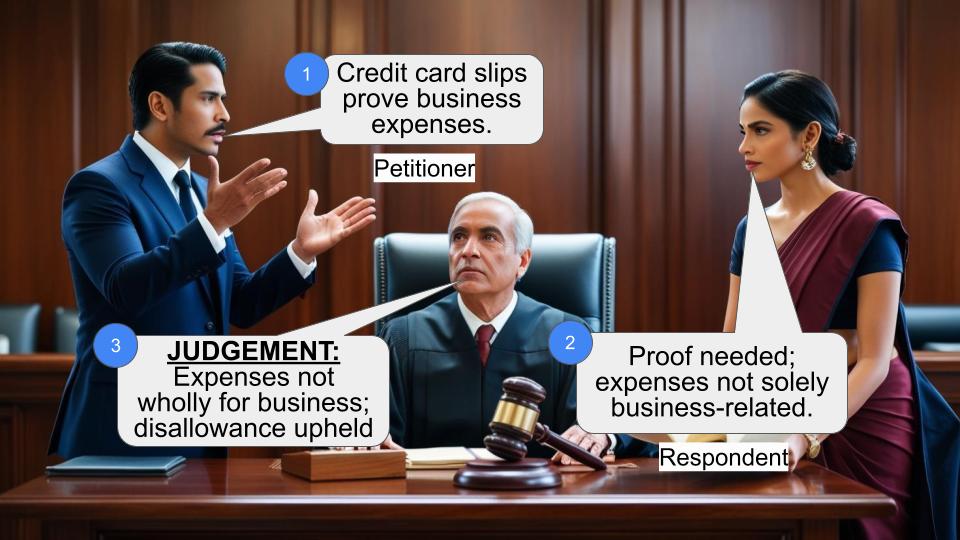
1. The court dismissed the revenue's appeal, upholding the ITAT's decision.
2. It found that the commission expenditure was reasonably linked to the assessee's export business.
3. The court criticized the AO's approach of disallowing expenses based on suspicion.
4. It emphasized that courts should not position themselves in the "armchair of the assessee" regarding business decisions.
FAQs:
1. Q: Why did the court allow the commission expenditure?
A: The court found that the expenditure was reasonably linked to the assessee's export business and was not disproportionate to the total contract values.
2. Q: What was the significance of the Volcker Committee Report in this case?
A: The court found the reference to the Volcker Committee Report irrelevant for the assessment year in question, as it pertained to a different time period and circumstances.
3. Q: How did the court view the AO's decision to disallow the expenses?
A: The court criticized the AO's approach, stating that disallowance based solely on suspicion is not tenable under Section 37 (of Income Tax Act, 1961).
4. Q: What principle did the court emphasize regarding business decisions?
A: The court stressed that tax authorities should not position themselves in the "armchair of the assessee" when evaluating business decisions.
5. Q: What was the outcome regarding the unexplained bank deposits?
A: The court upheld the lower authorities' decision to delete the addition of ₹2,10,00,000/- as unexplained bank deposits, finding that the assessee had sufficiently explained these deposits.

1. In this appeal, the revenue challenges findings rendered by the Income tax appellate tribunal (ITAT) as unreasonable and contrary to fact. The ITAT affirmed the decision of the CIT (Appeals), who had directed deletion of the amounts that were brought to tax by the AO, by disallowance of expenditure claimed, by the assessee.
2. The assessee had filed its return for assessment year (AY) 2006-07, declaring an income of'28,56,87,073/- on 05.12.2006. On 19.12.2008, in answer to queries made by the AO, the assessee furnished the statement showing the FOB Value of exports to the parties where Agency Commission was payable, along with an up to date statement of commission showing commission paid/payable during the AY 06-07 in respect of exports made. The outstanding commission payable continued to be shown as a liability in its books of account. The details of the statement clearly shows that out of seven commission agents, payments were made for Rs.7,52,783.52/- and the assessee had claimed the commission due as being Rs. 1577070.55/-. The AO felt that no prudent person would show that such commission was unpaid even after a lapse of 3 years and commission agents were entitled to pursue their payments only after the year 2010. The AO held that the assessee had failed to prove genuineness of the business transaction and payment made to the service agents, and also considering the background of the assessee as reported in the Volcker Committee Report, the entire amount of Rs.7,33,09,398.93/- was added back to the total income of the assessee. The AO also asked the assessee to explain the source of deposits shown by it; in response, the assessee furnished the source of cash deposit as withdrawals on different dates from different banks. The entries were scrutinized and it was found that no direct link except the deposit of Rs.9,00,000/- dated 05.11.08 could be linked to the assessee as this was the only sum which could be linked with the withdrawal which was made on 03.11.08. Holding there was proper evidence and explanation, the cash deposits of Rs.2,10,00,000/- made on different dates was treated as unexplained deposits in the bank and added in the assessee's total income.
3. The findings of the AO were carried in appeal to the CIT(A), who firstly permitted the assessee to adduce additional evidence. The CIT(A) found that all the details relating to commission payments had been filed by the assessee company in the course of assessment proceedings and the details of commission payments below Rs.5 lakhs were not filed under a bona fide belief that the AO had only asked for details of major expenses exceeding Rs.5 lakhs. Though, there is a clear requirement of commissions paid and received vide Para 20 of the questionnaire dated 12.02.2008, the AO did not give any specific reminder to the appellant to the effect that details relating to commission payment below Rs.5 lakhs were not filed. Therefore, there was some communication gap between the AO and the assessee company in so far as filling details of Rs.10,28,957/- was concerned. The CIT(A) noted that the assessee company had made an aggregate payment of Rs.7,08,59,575/- and all requisite details were duly made available to the AO but for the details of commission of Rs.10,28,957/-,which is only 1.45% of the total expenditure and part of which was paid to the parties which are already included in the details filed before the AO. Therefore, the CIT (A) was of the view that the assessee company did not file the details of Rs.10,28,9571- as it was under bona fide impression that there was sufficient compliance by filing details of commissions exceeding Rs.5 lakhs. Accordingly, the CIT (A) found that the assessee company was prevented by sufficient cause. He also noted that the AO has been allowed sufficient opportunity to examine the additional evidence in the course of the remand proceedings. In view of the aforesaid facts and circumstances, the Ld. CIT(A) allowed the assessee's request and took the additional evidence on record.
4. On the merits with regard to addition of Rs.7,33,09,398/- the CIT(A)'s opinion was that, the AO failed to appreciate the situation in which the assessee was making payment of commission to the commission agents. An important condition in the contracts was that the payment had to be made only after receipt of payment by the assessee against the exports made through the concerned agents.b Therefore, the CIT(A) held that no prudent businessman will pay commission till the payments from the importers/buyers are realized. In fact, there is a clear stipulation by the RBI that in no circumstances agency commission would be remitted before shipment of the goods subject matter of export.
5. The CIT(A) also noted that the assessee's representative had furnished copies of letters written by the assessee to its bankers for release of remittance of commission amount to the agents. Those letters clearly suggested that the assessee had to declare not only the appointment of agents, export of goods with his assistance, but it also has to declare the fact that it has received and realized the sales proceeds.It was only thereafter that banks released the payment(s) of commission. Thus, the payment of commission was not left to the sweet will or discretion of the assessee; it was to be paid after satisfaction/fulfillment of stringent conditions laid down by the Reserve Bank of India; commission payments were to made only after realization of export sales proceeds. The CIT(A) also agreed with the assessee that the expenditure was allowable on the basis of the mercantile system of accounting obliging it to book the commission expenses in the year of accounting of export sales.
6. The AO's observation that no details of specific services rendered by the commission agents have been furnished in the course of assessment roceedings was held to be devoid of any merits. A detailed discussion made in the order - said the CIT (A) suggested that the assessee had listed specific responsibilities of the commission agents in the agreement executed with the respective commission agents. Therefore, it could not be said that no details of actual services rendered by the commission agents were filed before her, as copies of the agreements were duly placed before her in the course of assessment proceedings. Some agreements were old and the assessee on the basis of such agreements made commission payments even in earlier years. Therefore, keeping in view the detailed responsibilities assigned to the commission agents, the CIT(A) disagreed with the AO's finding that no specific details of services rendered by the commission agents were made available. With regard to naming the assessee in the independent inquiry committee, namely, Volcker Committee Report, the CIT(A) held that this ground was also not relevant so far as the present AY was concerned. As stated by the assessee, no export, directly or indirectly, had been made to Iraq nor had the assessee claimed any commission payment in connection with any transactions pertaining to Iraq during the year under consideration. Further, the AO had conveniently ignored the fact that Saddam Hussain was removed as president of Iraq and was jailed in April, 2003 and therefore there was no basis for using the findings of Volcker Committee for disallowing the assessee's claim for the assessment year under consideration.
7. As regards addition of Rs.2,10,00,000/- the CIT(A) was of the view that the AIR information showing cash deposits of Rs.2,10,00,000/- on 28 occasions by the assessee in the Lord Krishna Bank,New Delhi did not appear to be correct. The assessee had made cash deposits of only Rs.1,05,00,000/- (Rs.52,50,000/- on 7 occasions in CP and Rs.52,50,000/- on 7 occasions in the Lajpat Nagar branch of Lord Krishna Bank, New Delhi) which were verifiable from the cash books produced during the remand proceedings and the bank NC(s) of the assessee and also certified by the bank. In view of the above facts and considering the report of the AO, the CIT(A) held that all the cash deposits made by the assessee were duly explained and no addition was called for. Accordingly, the addition of Rs.2,10,00,000/- was deleted.
8. The ITAT affirmed the CIT (A)'s findings; it also noticed that the entire quantum of commission paid was meager, in percentage terms, compared to the aggregate value of the contracts entered into by the assessee, with various foreign buyers, for supplies; those buyers were located in 10 different countries and there were different contracts, for various periods. Furthermore, with respect to the deposits made, the ITAT concluded, on an appreciation of the material on record, that the additions made by the AO were not justified.
9. The revenue argues, in support of its appeal, that the findings in the impugned order are unsustainable, because the claim of commission expenditure was dubious as the assessee failed to discharge its onus under Section 37(1) (of Income Tax Act, 1961) (the Act) which mandates that the expenditure had to be actually incurred and impugned expenditure was laid out and expanded wholly and exclusively for the purpose of the business of the assessee. It was argued that apart from producing agreements entered into with the agents, who were paid commission, there was no other material to support the expenditure claimed. Counsel submitted that without a correlation to the nature of service provided, by the commission, the needle of suspicion that the amounts were slush money, as was suggested in the Volker Committee Report, could not be ruled out. Similarly, with respect to the cash deposits, counsel highlighted that the ITAT fell into error, because there was no sufficient co-relation between the amounts withdrawn.
10. It is seen from the above discussion that the additions made by the AO were on two counts:commission expenditure and deposits. The first was disallowed, because, in the AO's opinion, apart from producing copies of agreements, the assessee did not furnish any other proof of payment. Moreover, the sums payable were not shown to be due; the AO correctly concluded that prudent men of commerce would not have allowed matters regarding payment to languish as was apparent in the books of account, and other material, furnished. The CIT (A) and the ITAT concluded that the nature of the assessee's activities, i.e as a trader and supplier, could lead one to conclude that the assistance of commission agents, was to aid it to introduce buyers and transact business. The ITAT, from the given materials and circumstances, produced in a tabular statement, the payments above 10 lakh; it also drew another chart indicating the amounts made to different parties in different African countries. The impugned order shows that 9 parties in 11 different countries were shown to have been paid Rs.7,33,093,398/- out of a total of Rs.167,68,66,065/25 ( over Rupees one hundred and sixty seven crores) worth of contracts entered into. This translates to commission payouts of less than 4.50%.
11. In this court's opinion, the AO's additions, made on account of the disallowance of commission payments claimed, are based entirely on Zuspicion. The assessee is a private party; it sources goods and commodities and trades in them in various countries in Africa. To secure contracts and also to ensure that payments are received in a timely manner and repatriated expeditiously, it utilizes the services of local agents in each country. From the angle of the Indian economy, the assessee's efforts lead to export transactions, which in turn augment the foreign exchange resources; the assessee reports income, which is subjected to taxation. The commission expenditure laid out, therefore, can reasonably be linked with its business; its claim that it is laid out wholly for commercial terms is not fantastic; neither are the parties paid the amounts, bogus or dubious. In fact, they even confirmed receiving payments. By disallowing this expenditure, based on the AO's personal understanding of how business ought to be conducted, the purpose of Section 37 (of Income Tax Act, 1961) was set at naught; besides, the AO virtually positioned himself in the armchair of the assessee, as regards the business conducted by it- an entirely untenable situation, that the law frowns upon. For these reasons, the court is of opinion that the concurrent findings of fact rendered by the lower appellate authorities do not call for disturbance.
12. As in the case of commission expenditure, the AO's conclusion that the sources of income towards deposits made were not disclosed or sufficiently proved, were correctly set aside by the lower authorities, who carried out their fact appreciation exercise, reasonably.
13. For the above reasons, it is held that no question of law arises; the appeal is therefore, dismissed as unmerited. No costs.
×