Court Upholds Assessee's Compliance in Share Applicant Identity Case


Full News
Court Upholds Assessee's Compliance in Share Applicant Identity Case
Court Upholds Assessee's Compliance in Share Applicant Identity Case
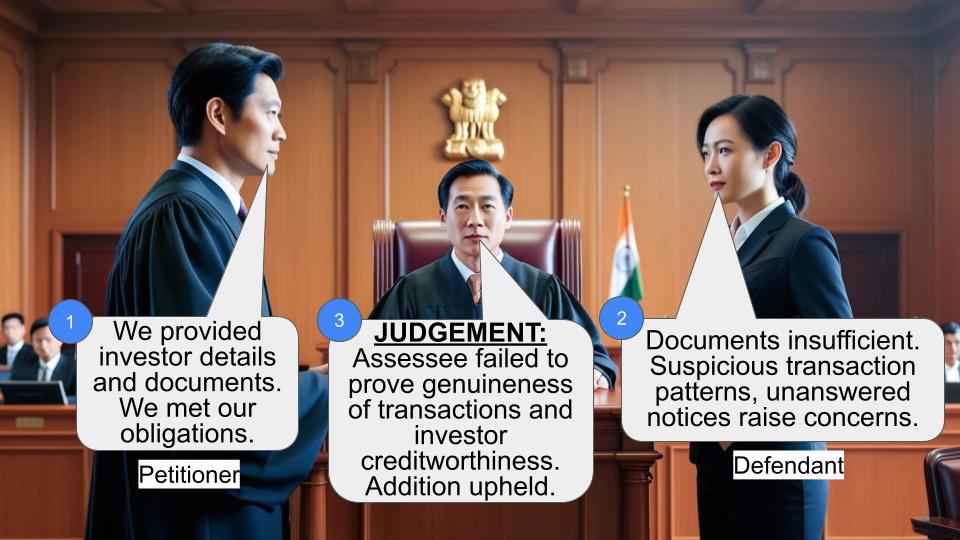
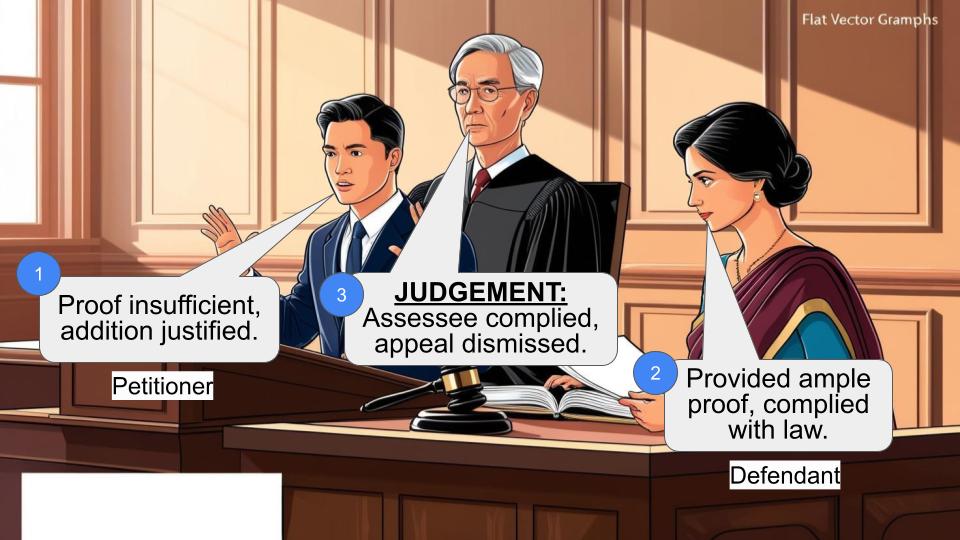
This case involves the Principal Commissioner of Income Tax (revenue) appealing against an order by the Income Tax Appellate Tribunal (ITAT) that favored Softline Creation P. Ltd. (assessee). The ITAT had confirmed the Commissioner of Income Tax (Appeals)'s decision that additions under Section 68 (of Income Tax Act, 1961) were unwarranted. The High Court dismissed the revenue's appeal, affirming that the assessee had sufficiently established the identity, genuineness, and creditworthiness of share applicants.
Get the full picture - access the original judgement of the court order here
Case Name:
Principal Commissioner of Income Tax Vs Softline Creation (P) Ltd. (High Court of Delhi)
ITA 504/2016
Date: 31st August 2016
Key Takeaways:
1. The court emphasized the importance of providing sufficient evidence to establish the identity, genuineness, and creditworthiness of share applicants.
2. Physical presence of directors is not always necessary if other credible documentation is provided.
3. The judgment reinforces the principles laid out by the Supreme Court in the Lovely Exports case.
Issue:
Did the assessee sufficiently establish the identity of share applicants, genuineness of transactions, and creditworthiness as required under Section 68 (of Income Tax Act, 1961)?
Facts:
1. The case pertains to the Assessment Year 2003-04.
2. The assessee was subjected to re-assessment based on a statement by one Mahesh Garg.
3. The Assessing Officer (AO) questioned the application money for share issues and premium.
4. The AO added ₹78 lakhs to the assessee's income, claiming the share applicants were bogus entities.
5. The CIT(A) reversed this addition, which was later confirmed by the ITAT.
Arguments:
Revenue's Argument:
- The AO's addition under Section 68 (of Income Tax Act, 1961) was justified.
- The assessee should have produced the Directors and source of funds of share applicants to prove genuineness.
Assessee's Argument (implied):
- Sufficient documentation was provided, including PAN numbers, affidavits of Directors, and bank details of share applicants.
Key Legal Precedents:
1. CIT v. Fair Finvest Ltd. 2013 357 ITR 146 (Del): The court relied on this case, which had similar circumstances.
2. CIT v. Lovely Exports Pvt. Ltd. 216 CTR (SC) 195: The Supreme Court's decision in this case set the standard for compliance in such matters.
Judgement:
The High Court dismissed the revenue's appeal, stating:
1. The assessee had provided sufficient evidence to establish the identity, genuineness, and creditworthiness of share applicants.
2. The AO's decision to add amounts merely due to the physical absence of Directors was not justified.
3. The assessee complied with the law as outlined by the Supreme Court in the Lovely Exports case.
4. No question of law arises given the concurrent findings of fact by the CIT(A) and ITAT.
FAQs:
1. Q: What documentation did the assessee provide to prove the genuineness of transactions?
A: The assessee provided PAN numbers, affidavits of Directors, and bank details of share applicants.
2. Q: Why did the court dismiss the revenue's appeal?
A: The court found that the assessee had sufficiently established the identity, genuineness, and creditworthiness of share applicants, in line with legal requirements.
3. Q: Is it necessary for company directors to be physically present during assessment proceedings?
A: Not always. In this case, the court deemed that physical presence was not necessary when other credible documentation was provided.
4. Q: What is the significance of the Lovely Exports case in this judgment?
A: The Lovely Exports case set the standard for compliance in such matters, which the assessee in this case was found to have met.
5. Q: What section of the Income Tax Act was central to this case?
A: Section 68 (of Income Tax Act, 1961), which deals with unexplained cash credits, was the key section in this case.

1. The revenue is aggrieved by the order dated 10.02.2016 of the Income Tax Appellate Tribunal (ITAT) which confirmed the Commissioner of Income Tax (Appeals)’s order [hereafter “CIT(A)”]. The CIT(A) had ruled in favour of the assessee, i.e. the additions under Section 68 (of Income Tax Act, 1961) [hereafter “the Act”] were unwarranted.
2. The short facts are that the assessee was subjected to re-assessment for Assessment Year (AY) 2003-04. The re-assessment was based upon a statement made by one Mahesh Garg, who is said to have alleged that some of the companies which he dealt with were bogus. Taking aid of that statement, the Assessing Officer (AO) proceeded to question the assessee with regard to the application money in respect of issue of shares and premium thereon for the relevant AY. In the course of re-assessment proceedings, the AO, based upon the materials furnished, concluded that the assessee had not discharged the initial burden placed upon it under Section 68 (of Income Tax Act, 1961) and had not established the genuineness of identity, of the transaction or the credibilities of parties who had invested. He, therefore, directed addition of `78 lakhs. The AO’s conclusions were based upon his deduction that the share applicants were bogus entities, which he arrived at because of assessee’s omission to produce the Directors of such share applicants/companies despite being called upon to do so. The CIT(A) reversed this addition; that order was confirmed by the ITAT.
3. It is urged on behalf of the revenue that the AO’s order, additing the amounts under Section 68 (of Income Tax Act, 1961) was justified in the circumstances. Learned counsel emphasized that to prove the identity, genuineness of the transaction and the creditworthiness of share applicants, it was essential for the assessee to produce the Directors as well as the source of funds of the share applicants since in the absence of these materials, the assessee could not claim to be aggrieved by the addition.
4. This Court has considered the concurrent order of the CIT(A) as well as the ITAT. Both these authorities primarily went by the fact that the assessee had provided sufficient indication by way of PAN numbers, to highlight the identity of the share applicants, as well as produced the affidavits of Directors. Furthermore, the bank details of the share applicants too had been provided. In the circumstances, it was held that the assessee had established the identity of the share applicants, the genuineness of transactions and their creditworthiness. The AO chose to proceed no further but merely added the amounts because of the absence of the Directors to physically present themselves before him.
5. The ITAT has relied upon a decision of this Court in CIT v. Fair Finvest Ltd. 2013 357 ITR 146 (Del) where in somewhat similar circumstances, it was stated as follows:
“6. This Court has considered the submissions of the parties. In this case the discussion by the CIT(Appeals) would reveal that the assessee has filed documents including certified copies issued by the Registrar of Companies in relation to the share application, affidavits of the Directors, Form 2 filed with the ROC by such applicants confirmations by the applicant for company’s shares, certificates by auditors etc. Unfortunately, the assessing officer chose to base himself merely on the general inference to be drawn from the reading of the investigation report and the statement of Mr. Mahesh Garg. To elevate the inference which can be drawn on the basis of reading of such material into judicial conclusions would be improper, more so when the assessee produced material. The least that the assessing officer ought to have done was to enquire into the matter by, if necessary, invoking his powers under Section 131 (of Income Tax Act, 1961) summoning the share applicants or directors. No effort was made in that regard. In the absence of any such finding that the material disclosed was untrustworthy or lacked credibility the assessing officer merely concluded on the basis of enquiry report, which collected certain facts and the statements of Mr. Mahesh Garg that the income sought to be added fell within the description of Section 68 (of Income Tax Act, 1961).
7. Having regard to the entirety of facts and circumstances, the Court is satisfied that the finding of the Tribunal in this case accords with the ratio of the decision of the Supreme Court in Lovely Exports (supra).”
6. We are of the opinion that no question of law arises, having regard to the concurrent findings of fact. The assessee has, in our opinion, complied with the law spelt out by the Supreme Court in CIT v. Lovely Exports Pvt. Ltd. 216 CTR (SC) 195. The appeal is meritless and is consequently dismissed.
S. RAVINDRA BHAT, J
DEEPA SHARMA, J
AUGUST 31, 2016
×