


Court Upholds Business Income Classification for Hire Charges in Export Profits…


Full News
Court Upholds Business Income Classification for Hire Charges in Export Profits Case
Court Upholds Business Income Classification for Hire Charges in Export Profits Case
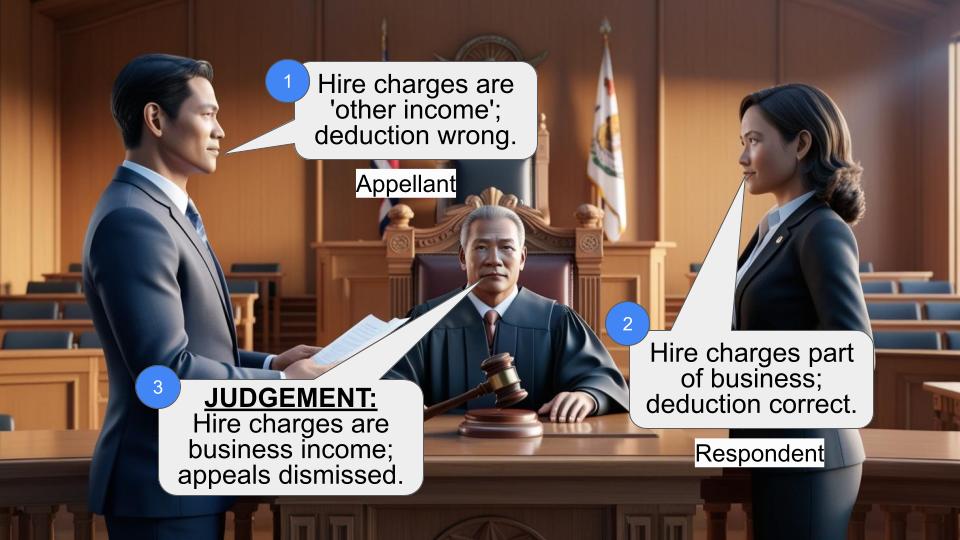
This case involves the Commissioner of Income Tax (CIT) appealing against V.S. Dempo & Company Ltd. regarding the classification of income from hire charges and duty refunds. The Income Tax Appellate Tribunal (ITAT) ruled in favor of the assessee, upholding that such income should be considered business income for the purpose of calculating export profits under Section 80HHC (of Income Tax Act, 1961).
Get the full picture - access the original judgement of the court order here
Case Name:
Commissioner of Income Tax Vs V.S. Dempo & Company Ltd. (High Court of Bombay)
Tax Appeal No.60 & 65 of 2006
Date: 29th April 2015
Key Takeaways:
1. Income from hire/lease of vessels and duty refunds can be classified as business income in a composite business.
2. The Commissioner's power of revision under Section 263 (of Income Tax Act, 1961) is limited when the Assessing Officer's view is not erroneous.
3. The formula in Section 80HHC(3) (of Income Tax Act, 1961) is designed to calculate export profits in composite businesses.
4. Reclassifying all non-export related income as "income from other sources" would render parts of Section 80HHC (of Income Tax Act, 1961) redundant.
Issue:
Was the ITAT justified in setting aside the CIT's order without specifically determining whether lease hire charges and duty refunds were operational income attributable to the assessee's business?
Facts:
1. V.S. Dempo & Company Ltd. filed its income tax return for the assessment year 1996-1997, declaring an income of Rs. 7.71 crores.
2. The Assessing Officer (AO) completed the assessment under Section 143(3) (of Income Tax Act, 1961), determining the total income at Rs. 8.44 crores after allowing a deduction of Rs. 23.22 crores under Section 80HHC (of Income Tax Act, 1961).
3. On February 1, 2001, the CIT exercised revision powers under Section 263 (of Income Tax Act, 1961), claiming the AO's order was erroneous.
4. The CIT argued that income from hire charges and duty refunds should be classified as "Income from other sources" rather than business income for Section 80HHC (of Income Tax Act, 1961) calculations.
5. The assessee appealed to the ITAT, which ruled in their favor.
Arguments:
Assessee's arguments:
1. The CIT's exercise of jurisdiction under Section 263 (of Income Tax Act, 1961) was improper.
2. In a composite business, income from vessel hire/lease is part of business profits.
3. Such income cannot be classified as "Income from other sources."
Revenue's arguments:
1. The ITAT should have considered whether the income was business income or from other sources.
2. The ITAT failed to deal with the merits of the matter.
Key Legal Precedents:
1. Malabar Industrial Co. Ltd. v. Commissioner of Income Tax (2000) 243 ITR 83 (SC): When two views are possible and the AO takes one, it can't be treated as erroneous merely because the Commissioner has a different view.
2. Commissioner of Income Tax vs. Max India Ltd. [2007] 295 ITR 282 (SC): The AO's view can't be treated as erroneous unless it's unsustainable in law, based on the law prevailing when the view was taken.
Judgement:
The High Court dismissed the CIT's appeals, ruling that:
1. The income from hire charges and duty refunds is attributable to business profits.
2. The CIT's exercise of revision powers under Section 263 (of Income Tax Act, 1961) was not justified.
3. The ITAT's order was upheld for both assessment years (1995-1996 and 1996-1997).
FAQs:
1. Q: Why did the court rule in favor of the assessee?
A: The court found that the income in question was part of the assessee's composite business income and that the AO's original classification was not erroneous.
2. Q: What is the significance of Section 80HHC (of Income Tax Act, 1961) in this case?
A: Section 80HHC (of Income Tax Act, 1961) provides a formula for calculating export profits in composite businesses, which supports treating the disputed income as business income.
3. Q: Why couldn't the CIT reclassify the income as "Income from other sources"?
A: Doing so would render parts of Section 80HHC (of Income Tax Act, 1961) redundant and ignore the formula provided for composite businesses.
4. Q: What are the limitations on the CIT's power of revision under Section 263 (of Income Tax Act, 1961)?
A: The CIT can only revise an order if it's both erroneous in law and prejudicial to the revenue's interests. If the AO's view is a possible interpretation of the law, it can't be considered erroneous.
5. Q: How does this judgment impact similar cases?
A: It reinforces the principle that in composite businesses, income from related activities (like vessel hire) can be classified as business income for export profit calculations under Section 80HHC (of Income Tax Act, 1961).

1. These two appeals filed under Section 260-A (of Income Tax Act, 1961), 1961 (hereinafter referred to as 'the Act') have been filed against two orders of the Income Tax Appellate Tribunal (hereinafter referred to as 'I.T.A.T.') both dated 30 December 2005 passed for assessment year 1995-1996 and 1996-1997.
2. Both these appeals were admitted on 27 November 2006 on the following common substantial question of law :
Whether on the facts and in the circumstances of the case the ITAT was justified in law in setting aside the order passed by the CIT without giving any finding, whether the lease hire charges and refund of duty on export proceeds on other services, received by the assessee was operational income attributable to the business of the Assessee or not ?
While admitting the petition this Court had directed that besides these two appeals one more appeal being Income Tax Appeal No.63 of 2006 should also be heard together. However, counsel for the parties state that the issue arising in Income Tax Appeal No.63 of 2006 is different from the issues arising herein. Consequently, at their request Income Tax Appeal No.63 of 2006 is detagged.
3. The counsel for the parties state that the facts in both these appeals are more or less identical and therefore the result in any one of the appeals would govern the other. Accordingly, for the sake of convenience, we shall refer to facts in Tax Appeal No.60 of 2006 dealing with the assessment year 1996-1997 while considering the rival contentions.
4. The appellant filed its return of income for the annual year 1996- 1997 on 29 November 2006 declaring its income at Rs.7.71 crores. The Assessing Officer by an order dated 4 February 1999 completed the assessment under Section 143(3) (of Income Tax Act, 1961) determining the appellant's total income at Rs.8.44 crores. This was after having extended the benefit of deduction under Section 80 (of Income Tax Act, 1961) HHC of the Act to the extent of Rs.23.22 crores.
5. On 1 February 2001, the Commissioner of Income Tax in exercise of his powers under Section 263 (of Income Tax Act, 1961) sought to revise the order dated 4 February 1999 passed under Section 143(3) (of Income Tax Act, 1961). The Commissioner of Income Tax by his order dated 1 February 2001 held that the order dated 4 February 1999 is erroneous for the reason that while computing deduction under Section 80 (of Income Tax Act, 1961) HHC of the Act income comprising of hire charges for vessels and refund of duty on export proceeds cannot be classified as Business Income but has to categorized as Income from other sources. This on the ground that the above income is not connected with the respondent's – assessee's export business. Consequently, the order dated 4 February 1999 passed under Section 143(3) (of Income Tax Act, 1961) by the Assessing Officer was set aside and the issue of deduction under Section 80 (of Income Tax Act, 1961) HHC of the Act was restored to the Assessing Officer for passing a fresh assessment order.
6. Being aggrieved, the appellant has filed appeal to the I.T.A.T. The appellant's contention was that exercise of jurisdiction under Section 263 (of Income Tax Act, 1961) by the Commissioner was improper. It was submitted that merely because the Assessing Officer has taken one of the two possible views it cannot be held that the order of the Assessing Officer is erroneous. Besides, the appellant also contended that in case of a composite business such as that carried on by the respondent – assessee the income earned on account of lease / hire charges of vessels / barges etc. is a part of the profit of its business as computed under the head of profits and gains of business or profession. Thus, the same cannot be classified under the head Income from other sources. The revenue before the I.T.A.T. relied upon the orders of the CIT passed under Section 263 (of Income Tax Act, 1961).
7. The I.T.A.T. by the impugned order dated 30 December 2005 allowed the respondent – assessee's appeal. It held that in case of composite business, there is no reason to treat income earned on account of lease / hire of vessels / barges etc. as Income from other sources for the purpose of Section 80 (of Income Tax Act, 1961) HHC of the Act. This is particularly so as the parliament has given a formula to arrive at profits of exports in case of composite business in Sub-section 3 of the Section 80 (of Income Tax Act, 1961) HHC of the Act. Further I.T.A.T. relied upon the decision of the Apex Court in Malabar Industrial Co. Ltd. V. Commissioner of Income Tax reported in (2000) 243 ITR 83 (SC). in support of the view that where two views are possible and an Assessing Officer has taken one view it cannot be treated as an erroneous or prejudicial to the interest of the revenue merely because the Commissioner has a different view on the subject.
8. Ms. Desai, learned counsel appearing for the revenue in support of the appeals submits that the impugned order dated 30 December 2005 of the I.T.A.T. could not have dismissed the appeal without having considered the issue whether or not the income on account of lease / hire of vessels / barges etc. is income from business or income from other sources. It is submitted that the I.T.A.T. failed to deal with the merits of the matter and for that reason the impugned order of the tribunal is not sustainable.
9. As against the above, Mr. Naniwadekar, learned counsel appearing for the respondent – assessee submitted that the impugned order calls for no interference. In support he relied upon the Apex Court's decision in Commissioner of Income Tax vs. Max India Ltd. reported in [2007] 295 ITR 282 (SC), which while dealing with the powers of revision of the Commissioner of Income Tax in the context of Section 80 (of Income Tax Act, 1961) HHC of the Act held where two views are possible and the Assessing Officer has taken one view, the same cannot be treated as erroneous and prejudicial in the interest of revenue unless the view taken by the Assessing Officer is not sustainable in law. Further, the Apex Court held that the view taken by the Assessing Officer or by the Commissioner has to be on the basis of the law prevailing on the day the view was taken. It is submitted that at the time when the Assessing Officer took a view that the same has to be considered as a part of business income, it could not have been said to be a view which is erroneous in law. Thus on the above account it is submitted that the exercise of the jurisdiction under Section 263 (of Income Tax Act, 1961) by the Commissioner of Income Tax in the present case is bad in law.
10. It is well settled that the power under Section 263 (of Income Tax Act, 1961) is exercised by the Commissioner of Income Tax when the orders of the Assessing Officer satisfy the twin test of being erroneous in law and prejudicial to the interest of the revenue. Both these tests have to be cumulatively satisfied. The Assessing Officer while passing the assessment order under Section 143(3) (of Income Tax Act, 1961) had considered the income on account of hire/lease of vessels / barges etc. as part of the respondent - assessee business income as it formed a part of its composite business income under the head of profits and gain of business. The Commissioner of Income Tax in exercising his powers in revision has sought to revise the same on the ground that the aforesaid income has for the purposes of Section 80 (of Income Tax Act, 1961) HHC of the Act has to be excluded from business income and considered as income from other sources. This for the purposes of arriving at export profits under Section 80 (of Income Tax Act, 1961) HHC of the Act. It is not disputed that the respondent - assessee's income from hire / lease from vessels / barges etc. were a part of its business income under the head of profit and gain of business as a part of its composite business. The order in revision of the Commissioner of Income Tax, seeks to reclassify income from profit and gain of business as income from other sources merely on the ground that such income is not connected with export business and does not qualify for export business. This view of the Commissioner of Income Tax is not correct in law and the view taken by the Assessing Officer cannot be said to be erroneous. This is for the reason that undisputedly to take care of such contingencies that the parliament has prescribed a formula in Section 80 (of Income Tax Act, 1961) HHC (3) of the Act to arrive at the profits derived from the export business. The above formula which enables arriving at the profits attributable to export business after taking into account the profit of the business as a whole subject to clause (baa) of the explanation to Section 80 (of Income Tax Act, 1961) HCC of the Act. Thus the Assessing Officer's view was not erroneous for the exercise of powers of revision under Section 263 (of Income Tax Act, 1961). In fact, on the contrary, if the Commissioner's reasoning is to be adopted that all income which is not connected with export business even if it is a part of profits and gain of business has to be reclassified as income from other sources, then clause (baa) of the explanation to Section 80 (of Income Tax Act, 1961) HHC of the Act would be rendered redundant. This is for the reason that then there would be no occasion to reduce the profits and gains of business by 90% of any income which falls therein. It is well settled principle of law that a statute should not be so interpreted that any part of statute is rendered redundant. Besides, in any view of the matter, the view taken by the Assessing Officer on the basis of the law as it then stood is a possible view. Thus, the exercise of jurisdiction under Section 263 (of Income Tax Act, 1961) by the Commissioner of Income Tax is not justified. In view of the above, we find no fault with the impugned order of the I.T.A.T. as the income on account of hire charges and refund of duty of export proceeds is attributable to profits and gain of business of the respondent - assessee and therefore it is not a income from other sources entitling the Commissioner of Income Tax to exercise his powers of revision in respect of the assessment order passed under Section 143(3) (of Income Tax Act, 1961).
11. Accordingly, the substantial question of law is answered in the affirmative i.e. in favour of the respondent – assessee and against the revenue for both the assessment years involved namely assessment years 1995-1996 and 1996-1998.
12. Appeals dismissed. No order as to costs.
M. S. SANKLECHA, J. F. M. REIS, J.
×
Similar Ripples
Questions
Court Upholds Business Income Classification for Hire Charges in Export Profits Case
Write your CommentSimilar Posts


Generic
- Reportdata/3790.pdf
